

Accountants Web Design That Attracts New Clients
Let's get one thing straight: your accounting firm's website is no longer a simple online brochure. It should be your hardest-working employee, the primary engine driving new clients to your door. It’s the very first impression you make, and in the digital world, it can be the difference between being found by your ideal client and getting completely lost in the noise.
Your Website Is Your Most Valuable Business Asset
You need to stop thinking of your website as a line item on your expense sheet. It’s a dynamic, lead-generating machine that works for your firm 24/7, and it’s time to treat it that way.
Think about how modern clients—whether they're a growing tech startup, an established family business, or an individual sorting out their tax—actually look for an accountant. They aren't flipping through the Yellow Pages. Their journey starts on Google, moves to evaluating your website, and ends with them deciding if you’re the right fit, all before they've even picked up the phone.
Your website is where that first critical contact happens. An outdated, slow, or confusing site can scare off a fantastic potential client in seconds, sending them right into the arms of your competitor. On the other hand, a professional, clean, and client-focused website builds immediate trust and screams competence. It's the digital equivalent of a firm handshake and a well-organised office.
The Shift from Overhead to Investment
The entire conversation around web design for accountants has changed. The question isn't "Do I need a website?" anymore. Now, it's "How can my website become my number one source of new business?"
The numbers back this up. A stagnant, poorly designed site is actively costing you money in lost opportunities. We've seen it time and time again. Industry data shows that 68% of accountants say their online presence directly brings in new business leads. Better yet, firms with modern, SEO-optimised websites see a 35% increase in enquiries compared to those stuck with an old site.
Need more proof? A Brisbane firm we know of brought in $150,000 in new fees in a single year, purely from traffic generated by their redesigned website. You can discover more insights from website conversion tactics for accountants, but the takeaway is clear.
A modern accounting website doesn't just sit there displaying information. It actively works to attract, engage, and convert prospects into billable hours. It’s a core business asset that directly fuels your firm’s growth.
Stand Out with Digital Excellence
In a crowded market, a standout online presence is one of your most powerful differentiators. It allows you to:
- Showcase Your Expertise: A solid blog and resource hub filled with practical guides immediately positions you as a go-to authority.
- Build Instant Credibility: Professional team photos, clear credentials, and genuine client testimonials are non-negotiable for fostering trust.
- Streamline Your Operations: Why wouldn't you want to make life easier? Integrating features like appointment schedulers and secure file portals improves efficiency for both you and your clients.
Ultimately, investing in professional web design is a direct investment in your firm's future. It ensures that when your ideal clients are searching for the exact services you offer, they don’t just find you—they’re convinced you’re the only choice.
Laying the Groundwork: Your Website Blueprint
Jumping straight into colours and logos is a classic mistake. Before you even think about design, you need a solid plan. A haphazard approach almost guarantees you’ll miss the mark, and you’ll find yourself back at the drawing board spending more money a year later.
This planning phase—the blueprint—is where we translate your firm's real-world goals into a clear structure. It's what guides every single decision from here on out.
It all kicks off by getting crystal clear on your ideal client. Seriously, who are you trying to attract? Is it Melbourne-based tech startups needing a Xero whiz, or are you helping retirees in Perth navigate the maze of Self-Managed Super Funds (SMSFs)?
You absolutely must get this specific. Knowing your audience inside and out determines the language you use, which services you put front and centre, and the entire vibe of your site. A website designed to attract young entrepreneurs will have a totally different look and feel to one that needs to reassure established families.
Shaping Your Site’s Structure
Once you’ve nailed who you're talking to, you can figure out what you need to tell them. This is what we call site architecture—organising all your content and services in a way that just makes sense. The goal is to create a path for visitors so intuitive they can find what they need without a second thought.
A great starting point is to list out all your core services. Then, group them into logical categories. For most accounting firms, it looks something like this:
- About Us: This is where you introduce your team, highlight your credentials, and share your firm's philosophy.
- Services: Have dedicated pages for your main service lines, like Business Advisory, Tax Compliance, or SMSF Administration.
- Industries: If you specialise in certain sectors (e.g., construction, healthcare, retail), give them their own pages.
- Resources/Blog: Your home for articles, guides, and calculators that prove you know your stuff.
- Contact Us: Make it ridiculously easy for potential clients to reach out.
This skeleton becomes your sitemap, which is essentially the floor plan for your website. The diagram below shows how a good structure turns a casual search into a genuine enquiry.
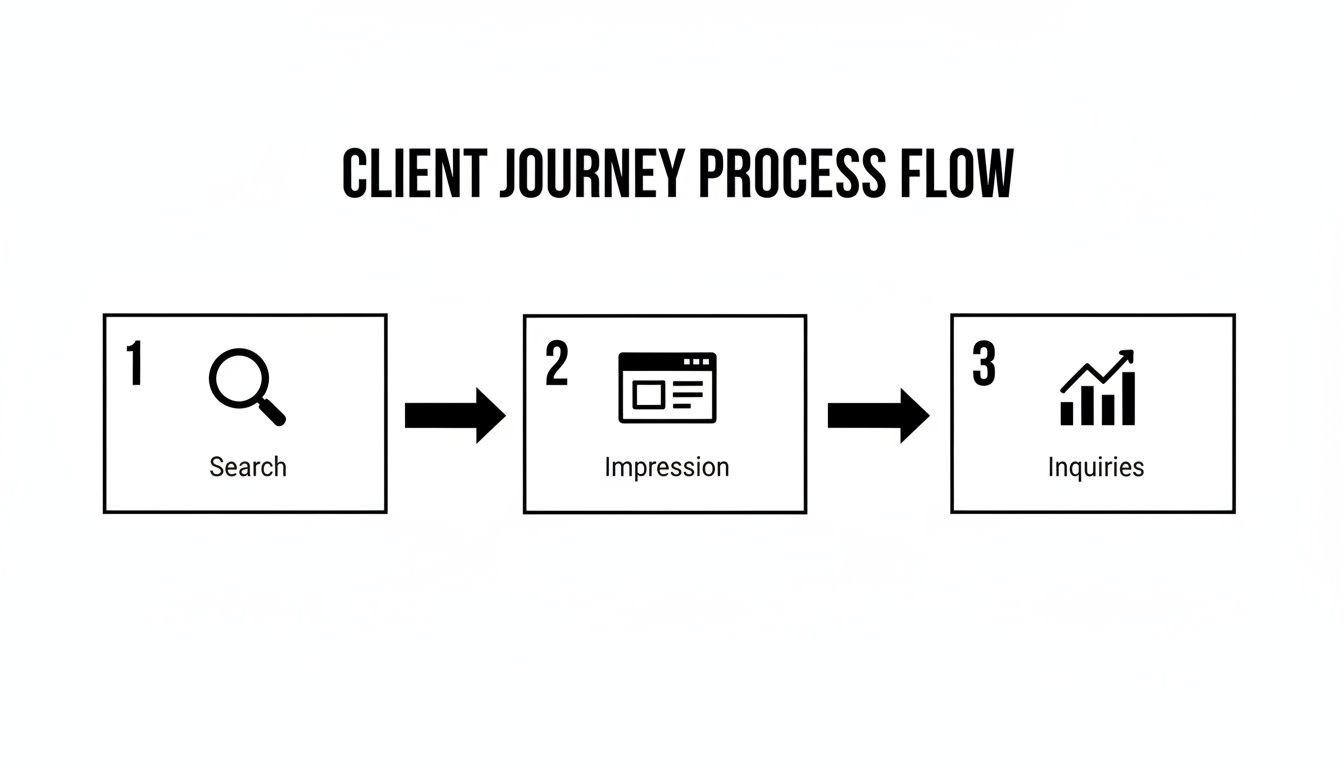
As you can see, a seamless journey from discovery to action doesn't happen by accident. It's the direct result of a well-planned site architecture.
Mapping the Client Journey
With your sitemap ready, it's time to walk in your potential client's shoes. Think about the path they'll most likely take.
Perhaps they find a blog post you wrote about Fringe Benefits Tax, click through to your main "Business Tax Services" page, and then head over to your contact page to book a meeting. Every step should feel like a natural progression, guiding them closer to getting in touch.
Your website's structure should be so intuitive that a visitor never has to think about where to click next. The path to becoming a client should be frictionless, clear, and compelling.
As you're putting this blueprint together, don't forget about search engine optimisation (SEO). It’s something you need to bake in from day one, not tack on at the end. Grab this ultimate new site SEO checklist to make sure your site is built for discoverability right from launch. This foundational work is what ensures all the effort you put into planning actually gets seen by the clients you want.
Designing for Unshakable Trust and Authority

When you're an accountant, trust isn't just a nice-to-have. It's the bedrock of every single client relationship. Your website is often the very first interaction a potential client has with your firm, so it has to scream professionalism, security, and deep-seated expertise from the get-go.
This all starts with the visual fundamentals. A clean, professional design is non-negotiable. I'm talking about a refined colour palette that conveys financial stability—think deep blues, classic greys, and crisp whites. Avoid loud, distracting colours that can make you look amateurish. The aim is to make a visitor feel calm and assured the second they land on your homepage.
Showcasing Your Expertise and Credentials
Authority isn't something you can just claim; you have to prove it. The best way to do this is to make your qualifications and successes impossible to ignore. Your website needs to display the key trust signals that truly matter to Australian clients.
Here are the trust elements that I’ve seen make the biggest impact:
- Professional Memberships: Your affiliation with bodies like Chartered Accountants Australia and New Zealand (CA ANZ) or CPA Australia must be clearly visible, ideally on your homepage and footer.
- Team Photos: Use high-quality, professional photos of your actual team. Please, avoid generic stock photos. People want to see the real experts they'll be trusting with their finances.
- Client Testimonials: Genuine quotes and reviews from happy clients are powerful social proof. For many prospects, seeing positive feedback from a business like theirs is the final nudge they need to get in touch.
These aren't just cosmetic touches. A recent survey showed that 55% of Australian accountants prioritise web design specifically for building trust. And the data backs this up, showing that modern sites with this kind of cohesive branding see 30% higher client sign-ups. You can discover more statistics about what makes a great website to see just how much these details matter.
Your website is your digital storefront. Displaying your credentials and client successes is like hanging your diplomas and awards in the lobby—it immediately tells visitors they're in the right place.
From Services to Success Stories
Beyond logos and headshots, your content is what solidifies your position as an authority. Vague, one-line service descriptions are a major red flag for savvy clients. You need to create detailed pages for each of your core services, explaining not just what you do, but how you help and, crucially, who you help.
For instance, don’t just have a generic "Business Advisory" page. Break it down. Create dedicated content around "Cash Flow Forecasting for Trades" or "Succession Planning for Family Businesses." This targeted approach shows you understand your clients' specific challenges and speak their language.
But the most compelling tool you have is the case study. A well-written success story walks a potential client through a real-world problem you solved, outlining your process and the tangible results you delivered. This narrative approach is far more persuasive than a simple list of skills. By weaving these content strategies into a thoughtful design, you create an online presence that doesn't just look authoritative—it is authoritative. You can learn more about user experience design principles to see how great design helps your content shine.
Essential Features That Convert Visitors Into Clients

A slick design and solid, trustworthy content will get people to your website. But what makes them pick up the phone or fill out a form? It's the practical, interactive features that turn a casual browser into a paying client.
A truly effective website for an accounting firm goes beyond just being a digital brochure. It should be a workhorse, providing genuine utility for both your prospects and your existing clients. These features aren’t just bells and whistles; they’re the engines that drive conversions and boost your firm's efficiency.
Think about the daily friction points in your practice. You’re constantly chasing clients for documents, playing phone tag to book a simple meeting, or answering the same basic questions day in, day out. A strategic website can solve these headaches, freeing up your team’s time for the high-value work that actually matters.
Make Client Interactions Seamless
One of the most valuable additions you can make to your firm’s website is a secure client portal. This is a private, login-protected space where your clients can safely upload financial documents, download reports, and communicate with your team. It immediately elevates your professionalism and demonstrates that you take data security as seriously as they do.
Likewise, an integrated appointment scheduler is an absolute game-changer. By plugging a tool like Calendly or Acuity Scheduling directly into your site and syncing it with your firm’s calendars, you kill the back-and-forth emails. A potential client can see your real-time availability and book a consultation in just a few clicks. It’s that simple.
These tools offer some pretty clear benefits:
- Improved Efficiency: You’ll slash the administrative workload by automating document collection and scheduling.
- Enhanced Security: It provides a far safer alternative to emailing sensitive financial information back and forth.
- Better Client Experience: You’re offering modern, on-demand convenience that clients don’t just appreciate—they now expect it.
Ultimately, the right website features have a direct impact on your bottom line. We’ve seen that for Australian accountants, a staggering 61.5% of website redesigns are triggered by a poor user experience. The good news? Those projects go on to deliver a 40% higher conversion rate after launch, simply because functional, client-focused features make it easier for people to do business with you.
Guide Visitors With Clear Calls to Action
Every single page on your website needs a purpose. Most of the time, that purpose is to guide the visitor to take a specific next step. You do this with clear, compelling calls-to-action (CTAs). A CTA is simply a button or link that tells the user exactly what to do next.
Vague, lazy CTAs like "Learn More" or "Click Here" are dead weight. Your CTAs need to be specific, action-oriented, and answer the user’s "what's in it for me?" question.
A visitor should never land on a page and be left wondering what to do. Your website needs to confidently lead them from one logical step to the next, whether that’s downloading a guide, booking a call, or reading a case study.
Here are a few examples of CTAs that actually work:
- "Book Your Free 15-Minute Consultation"
- "Download Our EOFY Business Checklist"
- "Get a Custom Quote"
These CTAs aren’t just buttons; they’re a critical part of your sales process. They direct traffic, capture leads, and move prospects one step closer to becoming a client. When you pair these with a strong, responsive layout, their effectiveness multiplies. Our guide on mobile-friendly web page design dives into how crucial this is for capturing leads from any device. Integrating these features isn’t just good practice—it's essential for a modern, client-winning website.
Getting Found With Local SEO and Performance
So you’ve got a polished, professional website. That's a great start, but it's only half the battle. If potential clients can't find it, it might as well not exist.
This is where local Search Engine Optimisation (SEO) and site performance come in. For accountants, this isn't about being famous online. It’s about showing up the moment a local business owner searches for “tax accountant Brisbane” or a retiree needs “SMSF advice in Sydney.” Local SEO is what connects their urgent problem to your solution.
Dominate Your Local Search Results
The absolute heart of your local SEO strategy is your Google Business Profile (GBP). This is your firm’s digital shopfront on Google Maps and in search results. A well-maintained profile is a massive trust signal, giving clients your address, phone number, and hours at a glance. Most importantly, it showcases your client reviews.
But just filling in the basics isn't enough. You have to actively manage it.
- Go All-In on Client Reviews: Good reviews are your most powerful marketing tool. In fact, 76% of firms say word-of-mouth and client reviews are their most important technique. Don't be shy—ask your happy clients to leave a review.
- Create Location-Specific Pages: If your firm has offices in multiple suburbs or cities, build dedicated pages on your site for each one. Think "Bookkeeping Services Gold Coast" or "Tax Returns Parramatta." This tells Google you're a serious player in those specific areas.
- Lock Down Your NAP: Your firm's Name, Address, and Phone number (NAP) needs to be identical everywhere online. Check your website, your GBP, and any other directory. Even a small inconsistency like "St" vs "Street" can confuse search engines and hurt your ranking.
A website isn't a 'set and forget' project. You need to be proactive about making sure you’re the first, most credible option a potential client sees when they search for services in your area.
To really pull ahead of the competition and bring in new clients, a modern playbook for effective SEO for accounting firms is essential.
Why Site Speed and Performance Matter
A slow website doesn't just annoy people; it actively costs you business. These days, site speed and mobile-friendliness are crucial ranking factors for Google. A clunky, slow-loading site sends a clear signal to Google that you offer a poor user experience, which will tank your search rankings.
Think about it—a huge chunk of your potential clients are looking you up on their phones, often while on the go. If your site isn't fast and easy to use on a small screen, they're gone. They’ll just hit the back button and click on your competitor.
A fast, responsive design is a non-negotiable part of any modern accountants web design project. If you want to dig deeper into these strategies, check out our guide on how to improve your local SEO for businesses. A high-performing site makes sure that when clients do find you, they stick around long enough to be impressed.
Launching and Maintaining Your Digital Hub
Taking your new website live is a huge milestone, but it’s certainly not the finish line. Think of it more as the starting pistol firing. A successful launch demands a meticulous pre-flight check to make sure your investment starts delivering results from the moment it’s live.
This is where you need to be absolutely thorough. Before you even think about flipping the switch, work through a comprehensive pre-launch checklist. Click on every single link. Submit every form. Test every page on your phone and your computer to make sure they load quickly. A broken link or a contact form that goes nowhere is a dead end for a potential new client.
And, crucially, double-check that your analytics tools, like Google Analytics, are properly installed and tracking data. Without that insight, you’re flying blind and have no real way of knowing what’s working and what’s falling flat.
From Launch Day to Long-Term Growth
Once your site is live and breathing, the job shifts from building to nurturing. An accountants web design project isn't a "set and forget" task; it's a living, breathing asset that needs ongoing attention to protect its value. You wouldn't build a new office and then just walk away, would you? The same principle applies here.
Your long-term strategy should really boil down to a few key activities:
- Security and Backups: Keep your website’s software and any plugins updated religiously. This patches security holes before they become a problem. Also, make sure you have a regular backup schedule so you can restore your site in a flash if anything goes wrong.
- Fresh Content: To stay relevant with both clients and search engines, you need to keep feeding the machine. Publishing new blog articles, industry updates, and helpful resources shows you're on the ball and gives your SEO a continuous boost.
- Active Promotion: Your new site should be the central hub for all your marketing. Funnel traffic towards it from your email newsletters, your social media profiles, and any online ads you're running. Make it the destination.
Your website is your firm's digital heartbeat. Consistent maintenance and smart marketing are what keep it pumping a steady flow of high-quality leads into your practice, cementing its place as your most valuable business asset.
Common Questions About Accountants Web Design
Whenever we talk to accounting firms about a new website, the same few questions always pop up. It makes sense – you want to know what you’re getting into before you commit.
Let's walk through the big ones we hear all the time to give you a clear picture of the process, the investment, and what it really takes to get it right.
How Much Should a Firm Budget for a Website?
This is always the first question, and for good reason. For a small to mid-sized Australian firm, you should be looking at a budget between $5,000 and $20,000 for a website that actually generates leads.
That range covers a custom design that reflects your firm's professionalism, the technical SEO groundwork to get you found, and all the essential features that turn a visitor into a client. Trying to skate by on less usually means cutting corners on things that directly impact your credibility and your ability to attract new business. Think of it as investing in your number one marketing asset, not just a line item expense.
Is a DIY Website Builder Good Enough?
It’s tempting to look at platforms like Squarespace or Wix and think you can save a few thousand dollars by building it yourself. While these tools are great for some, they often create more problems than they solve for a professional services firm.
The templates can look generic, making it hard for your firm to stand out. More importantly, they just don't have the specialised SEO power or the high-level security features that are absolutely non-negotiable when you’re handling sensitive client information.
A professional build ensures your website projects unshakable trust, ranks for valuable local search terms, and provides a secure, scalable platform that can adapt as your firm grows.
How Long Does It Take to Build?
Once you decide to go ahead, you'll naturally want to know how long it will be until you're live.
A professionally built accounting website typically takes 8-12 weeks from our initial strategy session right through to launch day. This isn't an arbitrary timeline; it allows for the proper attention to be given to each critical stage—from custom design and content creation to rigorous testing and final optimisation. The result is a high-performance asset that’s ready to start working for you from the moment it goes live.
Ready to build a website that becomes your firm's most valuable asset? The team at Website Builder Australia creates custom, SEO-optimised websites that build trust and generate leads for accountants across the country. Start your project with us today.


