

Google Ads for Tradies A Simple Guide to Fast Results
Let's be honest: Google Ads is probably the hardest-working salesperson you'll ever hire. It's on the job 24/7, ready to put your business in front of homeowners who need your help right now.
When a pipe bursts or the air con dies on a scorching summer day, people don't scroll through their social feeds. They grab their phone and Google for a solution. Being at the top of that search list at that exact moment is what turns a panicked homeowner into your next paying customer.
Why Google Ads Are a Tradie's Best Mate
In a world filled with marketing noise, Google Ads cuts straight to the chase. It’s not about finding people who might need a plumber one day; it’s about making sure you’re found by the person whose bathroom is currently flooding. This kind of "high-intent" traffic is the lifeblood for any trade business looking to grow.
Think about it. A homeowner in Brisbane with a blocked drain isn't interested in a flyer they got last week. They're frantically typing "emergency plumber Brisbane" into their phone. Being the first name they see isn't just a slight edge—it's often the deciding factor between you getting the call or your competitor.
Capture High-Intent Local Customers
The true magic of Google Ads for tradies is its power to connect you with people who have an urgent, expensive problem that needs fixing immediately. These aren't tyre-kickers; they are highly motivated customers ready to book someone on the spot. Your ads pop up precisely when and where they're needed most.
This approach is incredibly effective here in Australia. We've seen local campaigns for terms like 'emergency electrician Sydney' hit a click-through rate (CTR) of 4.8%, which is miles ahead of the general search average. It makes sense when you consider that over 83% of Aussies use Google as their first port of call for finding local services.
Dominate Your Service Area
Forget about casting a wide net and hoping for the best. Google Ads lets you target specific postcodes and suburbs with pinpoint accuracy. This means every dollar you spend is going towards attracting clicks from potential customers who are actually in your service area. No more wasted ad spend on calls from the other side of town.
The cost of being invisible online is huge. Every time a potential customer searches for your trade in your area and you're not there, you haven't just lost a lead—you've gift-wrapped it for your competitor.
By showing up consistently at the top of the search results, you build more than just a list of leads. You build a reputation as the go-to expert in your community. This kind of digital presence is a massive part of modern local SEO for tradies and creates a powerful, self-sustaining stream of new jobs.
To see just how transformative this can be for businesses like yours, check out these real-world Google Ads case studies that break down the results.
Building Your Campaign Foundation for Success
Think of your Google Ads campaign like the foundation of a house. If you get it wrong from the get-go, every dollar you build on top of it is just propping up a shaky, money-draining structure. I've seen far too many tradies get this wrong, so let's walk through how to build a campaign that actually brings in the jobs.
Your first big decision is the campaign type. Google throws a few options at you, but for most tradies in Australia, it really just comes down to two: Search campaigns or Performance Max (PMax).
- Search Campaigns: This is the bread and butter, the classic. Your ads pop up right when a potential customer is frantically typing something like "emergency plumber Brisbane" into Google. You’re in the driver's seat, controlling the keywords, the ads, and the bids. It’s perfect for capturing those urgent, high-intent leads.
- Performance Max (PMax): This is Google’s newer, AI-powered beast. You feed it a bunch of assets – headlines, descriptions, images, maybe a video – and it blasts ads across Google's entire network (think YouTube, Gmail, Display ads, the lot). It’s got a lot of reach, but you lose a massive amount of control.
My advice? For any tradie starting out or wanting to get a grip on their ad spend, stick with a Search campaign. It gives you the control you need to make sure your budget is only being spent on the exact searches that lead to paying jobs. You can’t afford to waste money on anything else.
This is exactly how a solid Search campaign works: it connects a customer's problem directly to your phone.
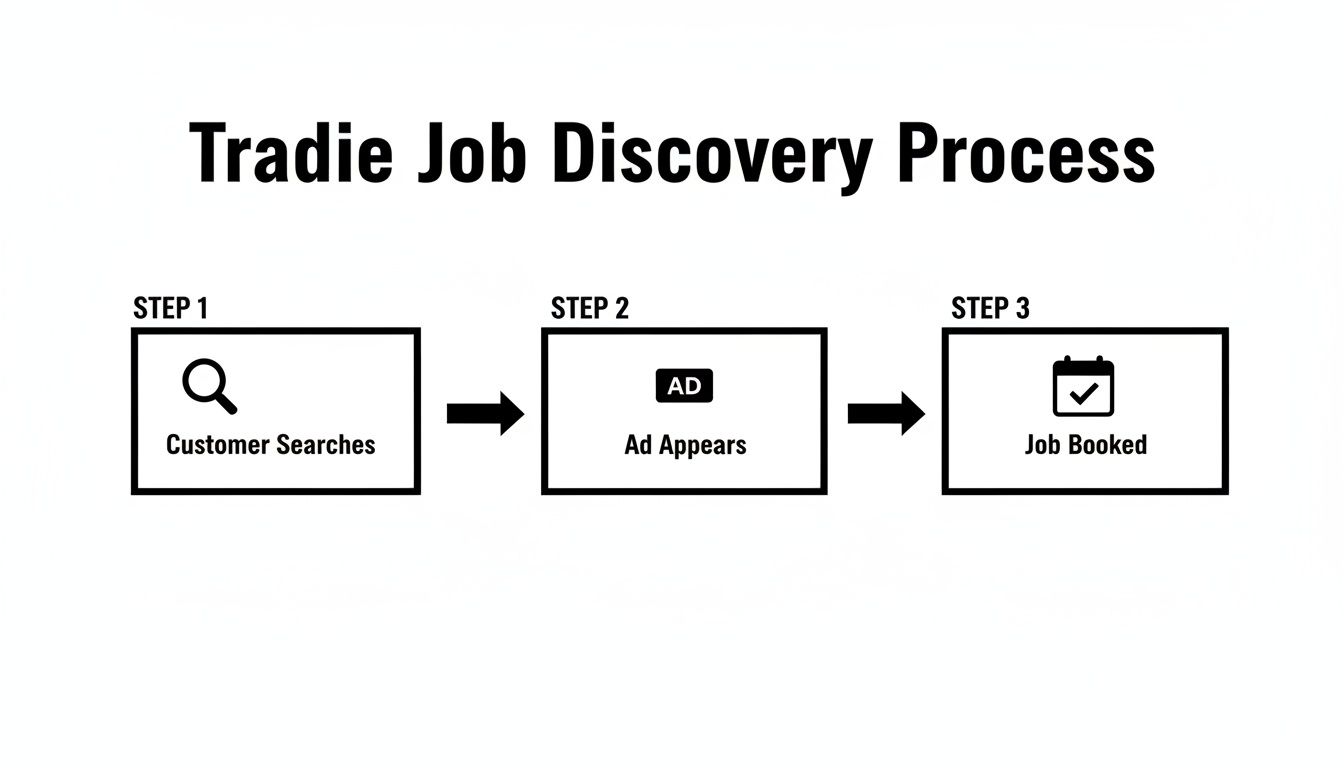
It’s a straightforward path from their problem to you providing the solution. That’s the beauty of it.
Structuring Your Ad Groups for Clarity
Okay, so you've picked a Search campaign. The next rookie error I see all the time is chucking every single service you offer into one big "ad group". Don't do it. It's like having one van with all your tools thrown in the back—a total mess and completely inefficient.
What you want to do is create separate ad groups for each of your main services.
Let's say you're an electrician. Your ad groups should look something like this:
- Ad Group 1: Emergency Electrician
- Ad Group 2: Switchboard Upgrades
- Ad Group 3: LED Lighting Installation
Why? Because now, when someone searches for "switchboard upgrade cost," they see an ad that talks specifically about switchboards. Not some generic "Brisbane Electrician" ad. This relevance is everything. It gets you more clicks and, more importantly, better quality leads who are actually looking for what you do.
Targeting and Budgeting
Two final pieces of the foundation puzzle: nailing your location targeting and setting a realistic budget.
Location Targeting is Non-Negotiable. You have to tell Google exactly where you work. Don't just type in "Sydney". Go into your campaign's location settings and get specific with the suburbs or postcodes you service. If you're a builder in the Northern Beaches and you don't cross the bridge, then exclude the rest of Sydney. It’s a simple click that stops you from paying for calls from customers you can't even get to.
When it comes to your bidding strategy, my go-to for new campaigns is 'Maximise Conversions'. This tells Google's algorithm to use your budget to hunt for the most phone calls and contact form submissions it can find. It’s a smart way to start without having to fiddle with manual bids.
As for what to spend, a decent starting point for a local tradie is around $25 to $50 a day. This gives the system enough data to start learning and optimising, without you having to mortgage the house. Once the leads are rolling in and you're seeing a good return, you can confidently start dialling it up.
Right, you've sorted out your campaign structure. Now for the bit that really makes the phone ring: your keywords and ad copy.
This is the engine room of your entire Google Ads setup. Nail this, and you’ll get genuine job requests from people who need you now. Get it wrong, and you'll just be throwing money away on tyre-kickers and job-seekers. The whole game is about zeroing in on customer intent.
It's time to move past the theory and pick the exact search terms that signal a customer is ready to hire someone, not just browse.
Choosing Keywords That Attract Paying Customers
The gap between a campaign that prints money and one that burns it often comes down to the keywords you choose. You’ve got to get inside the head of a customer with a problem that needs fixing today.
They aren't just typing "plumbing" into Google. They’re far more specific. They’re searching for things like "emergency plumber near me" or "fix leaking tap cost".
The first term, "plumbing," is way too broad. It'll get you clicks from people looking for DIY videos, TAFE courses, or even plumbing supplies. The other two are what we call high-intent keywords. They scream urgency and show a clear need for a professional service.
This is where your budget should be focused. We're talking about keywords that include:
- Service + Location: like "electrician Chatswood" or "builder northern beaches"
- Problem-based searches: things like "blocked drain repair Sydney" or "hot water system not working"
- Urgency words: "emergency," "24/7," and "same day"
Sure, these highly specific keywords get fewer searches overall, but the quality of the leads is night and day. You're basically fishing in a small pond packed with hungry fish, not a massive ocean full of everything else.
A great way to find more of these gold-nugget keywords is to see what your successful competitors are doing. It can really pay off to learn how to conduct competitor analysis and see what's already working for others in your area.
Understanding Keyword Match Types
Google gives you different "match types" to control how closely a user's search needs to match your keyword. Getting this right is crucial for not wasting money. Here’s a quick rundown for a tradie context.
| Tradie Keyword Match Type Examples | |||
|---|---|---|---|
| Keyword Type | Example Keyword | What It Matches | Best For |
| Broad Match | plumber sydney |
Could match “plumbing jobs in Perth” or “how to become a plumber”. Very loose. | Almost never recommended for tradies. It’s a budget-killer. |
| Phrase Match | "emergency electrician" |
Will match searches like “emergency electrician near me” or “24 hour emergency electrician”. The phrase must be included. | Capturing a good range of relevant, high-intent searches without being too restrictive. A great starting point. |
| Exact Match | [blocked drain plumber] |
Only matches “blocked drain plumber” or very close variations like “plumber for blocked drain”. | Targeting your most valuable, highest-converting keywords with pinpoint accuracy. |
As you can see, sticking to Phrase Match and Exact Match is your safest bet. It gives you control and ensures you’re only showing up for searches that actually matter to your business.
The Power of a Negative Keyword List
Just as critical as choosing the right keywords is telling Google which searches you don't want to show up for. Your negative keyword list is like a bouncer for your campaign, turning away all the irrelevant clicks at the door. Honestly, this is one of the quickest ways to stop wasting your ad spend.
Every single tradie should have a negative keyword list from day one. Start with the obvious ones:
- jobs
- career
- course
- DIY
- how to
- free
- cheap
- apprentice
If you’re a sparky in Perth, the last thing you want is to pay for a click from someone in Melbourne searching for "electrician jobs". Adding these terms as negatives instantly stops that from happening, saving you cash right out of the gate.
Think of your ad budget like fuel in your ute. High-intent keywords are the direct freeway to your destination (a paying customer). Irrelevant searches are the long, scenic detours that burn fuel without getting you any closer. Your negative keyword list is the GPS that keeps you locked on that freeway.
Crafting Ad Copy That Gets the Click
Okay, so you've got your keywords sorted. Now you need an ad that grabs the searcher by the collar and says, "I'm the one you need to call." Your ad is your three-second pitch. It has to be clear, compelling, and build trust instantly.
Ever wondered why some tradies seem to be swimming in online leads while others are stuck making cold calls? A big part of it is that their ads actually connect with the customer's problem. The data proves it, too. In Australia, industrial and commercial services (which includes most trades) can see really strong conversion rates, with some benchmarks hitting as high as 6.84%.
A winning ad formula for a tradie is pretty simple:
- A Headline That Matches the Search: If they typed in "emergency plumber," your headline better say "Emergency Plumber Sydney." It’s an instant confirmation they’re in the right place.
- Show Off Your Unique Selling Points (USPs): Use the description to list what makes you the best choice. Think "24/7 Service," "Fixed Price Quotes," or a "100% Satisfaction Guarantee."
- Include a Strong Call to Action (CTA): Don't be shy—tell them exactly what to do next. "Call Now for a Free Quote" or "Book Your Job Online" are direct and effective.
When you bring together razor-sharp keywords and ad copy that speaks directly to the customer, you create a powerful, lead-generating machine for your trade business.
Right, you’ve nailed the ad and someone’s clicked. Great start. But let’s be honest, that’s only half the battle. Where you send that potential customer next is what separates a campaign that actually gets you jobs from one that just chews through your budget.
So many tradies make the classic, and very expensive, mistake of just dumping all that hard-won traffic onto their homepage. This is a huge own-goal.
What you absolutely need is a dedicated landing page. Think of it as a specialist tool built for one specific purpose: to turn that click into a phone call or a quote request. It’s a clean, focused page that cuts out all the noise and steers the visitor straight to the action you want them to take.
This isn’t just some marketing fluff; it’s a critical part of running Google Ads that actually make the phone ring.
Key Elements of a High-Converting Tradie Landing Page
A top-notch landing page doesn’t have to be complicated. In fact, simpler is almost always better. It just needs the right ingredients, arranged for someone who’s likely stressed, in a rush, and looking at it on their phone.
Here’s what your landing page must have:
- A Clear Headline That Matches Your Ad: If your ad promises “24/7 Emergency Plumber in Brisbane,” the very first thing they see on the page should be that exact phrase. It’s instant reassurance that they’ve come to the right place.
- A Big, Obvious Click-to-Call Number: Your phone number should be impossible to miss, right at the top. On a mobile, it absolutely must be a tappable link that opens the phone’s dialler. No excuses.
- A Super-Simple Quote Form: Only ask for what you truly need. That’s usually just a name, phone number, suburb, and a short message about the job. Every extra field you add is another reason for them to give up and leave.
- Powerful Trust Signals: Show off your trade licences, logos from associations like Master Electricians or Master Plumbers, and a few of your best Google reviews or testimonials. This stuff builds credibility in a split second.
We saw this in action with a Brisbane plumber we worked with. By creating a fast, clean landing page that matched their ads, their bounce rate plummeted from 50% down to 22%. The direct result of that one change? 74% more qualified leads. It just goes to show how vital that seamless journey is.
Design for Mobile First, Always
You have to remember that a huge number of your clicks will come from people searching on their phones. Your landing page has to work flawlessly on a small screen.
Think about it. Someone with a blocked drain isn't sitting at their desk casually comparing options. They're standing in their laundry with water on the floor, phone in hand, looking for the fastest fix. If your page is slow or a pain to use on mobile, they'll hit the back button and call your competitor before you can blink.
This means big, chunky buttons that are easy to tap, text you can read without pinching and zooming, and a page that loads lightning-fast. Nailing these details is a cornerstone of good user experience design principles and has a direct impact on your campaign's bottom line.
Your landing page is your digital handshake – make sure it’s a firm and confident one.
Tracking What Matters to Measure Your ROI
Spending your hard-earned cash on Google Ads without tracking the results is like driving your ute with a blindfold on. You’re burning fuel, sure, but you have no clue if you’re actually getting any closer to a paying job.
This is exactly where so many tradies go wrong. But getting it right is the secret to turning that ad spend into real, tangible profit.
The whole point of running ads is to make the phone ring and get quote requests flooding your inbox. These are your conversions – the specific actions that put money in your pocket. You simply have to track them. If you don't, you can't tell which keywords, ads, or campaigns are making you money and which are just a black hole for your budget.
Setting Up Essential Conversion Tracking
For any trade business, there are two main conversions you absolutely need to have your eye on:
- Phone Calls from Ads: This is a big one. It tracks when someone on their mobile sees your ad and clicks the call button directly. That’s a hot lead calling you, ready to go.
- Website Form Submissions: This tracks when someone clicks your ad, lands on your website, and properly fills out your "Request a Quote" or contact form.
Getting these set up inside your Google Ads account isn't optional; it's mandatory. It’s the only way to get a clear, data-driven picture of what’s actually working.
Understanding the Metrics That Matter
Once your tracking is up and running, your Google Ads dashboard will start lighting up with useful data. It’s easy to get lost in all the numbers, so just focus on the ones that tell you if you're making money.
The two most important numbers for any tradie are your Cost Per Lead (CPL) and your Return On Ad Spend (ROAS). CPL shows what you paid for each phone call or form submission. ROAS shows how much revenue you’re making for every dollar you spend on ads.
Let's break it down with some simple maths. Say you spend $500 on ads and get 10 leads. Your CPL is a straightforward $50. If just two of those leads turn into booked jobs worth a total of $5,000, your ROAS is 10x ($5,000 revenue divided by $500 ad spend). That’s the proof that your ads are a profitable investment, not just an expense.
Looking at Australian benchmarks for the home services industry, the average conversion rate can be as high as 12.96% for urgent repair-related searches. This just shows how powerful this can be when done right. With smart management, it’s completely realistic for every dollar you put in to bring back a significant return. You can dig deeper into the data by reading more about Google Ads statistics.
Optimising Your Campaigns for Long-Term Growth
Right, so you've launched your Google Ads campaign. Good on you. But getting your ads live is just the first step – the real work, and the real money, comes from what you do next.
Think of your campaign less like a ‘set and forget’ vending machine and more like the engine in your ute. It needs regular tuning to keep it running smoothly and efficiently. This ongoing optimisation is how you’ll steadily drop your costs, get better quality leads, and make sure your ads are a profitable source of work for years to come.
Don't worry, this isn't about getting lost in complicated charts for hours on end. It’s all about making small, consistent tweaks based on what the data is telling you. A few simple checks each week can make a massive difference to your bottom line.
Dive Into Your Search Term Report
Inside your Google Ads account, there’s a tool called the Search Term Report. Honestly, this thing is pure gold. It shows you the exact phrases people are typing into Google just before they click your ad.
You’ll want to get in the habit of checking this report at least once a week. It lets you do two incredibly important things:
- Spot New Keyword Opportunities: You'll often find killer search terms you hadn't even thought of. Say you're a painter in Melbourne and see a few good leads came from "exterior house painting cost Northcote." You can immediately add that as a new, targeted keyword to capture more of that specific work.
- Find Negative Keywords (and Save a Fortune): This is where you plug the leaks in your budget. If you see clicks from searches like “how to fix a leaking tap yourself” or “plumbing course TAFE,” you’re paying for clicks that will never turn into a job. Add words like “how to,” “yourself,” and “course” to your negative keyword list to stop your ads from showing for those searches ever again.
A/B Test Your Ad Copy
Never assume the first ad you write is the best it can be. You need to test it. A simple A/B test just means you run two slightly different ads in the same ad group to see which one gets a better response.
The goal here is to find the message that actually gets your ideal customer to pick up the phone. You might be shocked to find that an ad promoting a “$0 Call-Out Fee” gets twice as many calls as one that talks about your “10 Years Experience.” The only way to know for sure is to test it.
The trick is to only change one thing at a time – either the headline, the description, or your call to action. Let the ads run for a couple of weeks, then check the results. Pause the ad with the lower click-through rate (CTR) or conversion rate, and write a new one to challenge the winner.
This cycle of constant improvement is what separates the campaigns that just tick along from the ones that become serious money-makers. For anyone wanting to really get under the hood and refine their paid advertising, learning more about effective campaign strategies for PPC is a great next step for driving sustainable growth.
Your Google Ads Questions, Answered
Jumping into Google Ads can feel like a bit of a punt, especially when you're using your own hard-earned cash. It's smart to have questions. In fact, we get asked the same ones by tradies all over Australia, so let's cut through the noise and give you some straight answers.
How Much Should a Tradie Actually Budget for Google Ads?
This is the big one, isn't it? The honest answer is that it really depends on your trade and where you're based. But for most local tradies, a great starting point is somewhere between $25 to $50 a day.
Think of it as your testing budget. This gives the system enough data to start learning what works without you having to mortgage the house. Once the phone starts ringing and you can see a clear return on your investment, you can start to confidently dial that budget up. The goal isn't just to spend money—it's to make it.
How Long Before I Actually See Results?
One of the best things about Google Ads is the speed. Unlike SEO, which is a long game, you can see traffic and potential leads hitting your site the very day your campaign goes live. Once Google gives your ads the green light, they’re out there, ready to be seen.
But "results" isn't just about clicks. You'll want to give your campaign a good two to four weeks to really bed in. This gives Google's algorithm time to learn and, more importantly, gives you enough data to see which keywords are driving real jobs, not just tyre-kickers.
What’s a Good Cost Per Lead for a Tradie?
This can vary wildly. An emergency plumber in metro Sydney will naturally pay more for a lead than a painter in a regional town, simply because the job values and competition are worlds apart.
As a solid benchmark here in Australia, you should be aiming for a Cost Per Lead (CPL) somewhere between $40 and $80. If your leads are consistently costing you more than that, it’s a red flag that something in your campaign needs a good tune-up.
This isn't just a guess, either. Recent data for the Australian market shows the average cost per lead for home services is around $66.69. But here's the kicker: that can drop to as low as $50 for campaigns that are tightly targeted to specific local suburbs. It just proves how crucial that local focus is. You can dive into more stats by reading the full 2026 report on Google Ads statistics.
Can I Just Send Ad Traffic to My Homepage?
Look, you can, but you really, really shouldn't. It's one of the most common and expensive mistakes we see tradies make. Your homepage is built for a general audience—it talks about all your services, your history, everything. That's just distracting for a customer who has a single, urgent problem they need solved right now.
Instead, always, always send your ad traffic to a dedicated landing page. This is a page built with one goal in mind: getting that person to call you or fill out a form. It should match your ad, have your phone number front and centre, and feature a dead-simple contact form. It’s a simple switch that can make a massive difference to your conversion rate.
At Website Builder Australia, we build high-performance websites and Google Ads campaigns that are designed to do one thing: make the phone ring for tradies. If you're ready to get serious about growing your business, we can build a strategy that delivers real, measurable results. Explore our digital marketing services today.


