

Hire a Google Ads Specialist: The AU SMB Guide for 2026
You're probably here because Google Ads looked simpler from the outside.
You set up a campaign, picked a few keywords, wrote some ads, and watched clicks come in. Then the budget started disappearing faster than expected. The phone didn't ring enough. Form leads felt weak. The reports inside Google Ads told one story, while your sales calendar told another.
That's the point where many Australian small business owners start asking the right question. Not “How do I tweak this one setting?” but “Do I need a google ads specialist?”
For a Brisbane tradie, a suburban clinic, an ecommerce shop, or a service business targeting a few core metros, the answer usually comes down to one thing. Can you reliably turn ad spend into profitable enquiries or sales without losing half your week inside the platform? If not, it's time to get help.
There's another layer in Australia that generic advice often misses. Public AU-specific benchmark data is thin, so hiring decisions can't rely on neat comparison charts or broad salary reports. You need a sharper framework. You need to know what to brief, what to ask, what skills matter, and how to tell real capability from polished sales talk.
When to Hire a Google Ads Specialist
If you're spending money every month and still guessing which campaign produces customers, you're already close to the hiring point.
The DIY phase makes sense at the start. It helps you understand the basics, your offer, and the language customers use. But DIY stops being efficient once campaign management starts stealing hours from quoting, sales follow-up, staff management, or stock planning. That's when ad management becomes an operational drag instead of a growth lever.

The tipping point most owners recognise
A small business usually doesn't hire a specialist because the interface feels confusing. It hires one because the cost of getting it wrong starts exceeding the cost of expert help.
That often shows up in familiar ways:
- Spend rises but results don't. You increase budget, yet lead quality stays patchy or sales stay flat.
- You can't prove return. You see clicks and impressions, but you can't connect them cleanly to calls, booked jobs, or revenue.
- Campaign work spills into everything else. You're checking search terms at night, adjusting bids between jobs, and still not feeling in control.
- The account has become reactive. You're constantly fixing problems rather than building a stable acquisition system.
- Local targeting keeps slipping. You want Brisbane or South East Queensland demand, but traffic doesn't always match the service area.
Practical rule: Hire when Google Ads starts consuming management time without producing management-level clarity.
That's not a soft argument. It's a commercial one.
A useful data point comes from Australia, not the US. A 2025 Sensis report cited here found that businesses using local PPC specialists achieved 37% higher conversion rates and 28% lower CPCs than those using offshore management. The logic is straightforward. Local operators tend to understand Australian search behaviour, local intent, and the way suburb, city, and service-area language affects campaign quality.
What a specialist changes in practice
A good google ads specialist doesn't just “run ads”. They tighten the whole decision loop.
They'll usually improve three things first:
Targeting discipline
They cut wasted traffic by sharpening keywords, locations, exclusions, and match type choices.Tracking quality
They make sure phone calls, forms, purchases, or booked consultations are measured properly enough to guide decisions.Budget control
They stop broad campaign drift, pace spend more carefully, and direct budget toward what converts.
The best time to hire isn't after a complete blow-up. It's when you can already see signs of drift and know you don't have the time or depth to fix it properly.
If your ads are profitable and tightly managed, keep going. If you're running on instinct, half-trust in platform automation, and a weekly sense that money is leaking somewhere, bring in a specialist before that leakage becomes normal.
Preparing Your Google Ads Brief and Budget
Before you speak to any candidate, write a one-page brief. It doesn't need agency language. It needs business clarity.
Most poor engagements start with vague instructions like “we want more leads” or “we need help with Google”. That forces the specialist to guess. Better candidates will push back and ask for detail. You'll save time if you prepare it up front.
Build a brief that helps someone do good work
Keep it short and practical. Include:
- Your core objective. More phone calls, more online sales, more quote requests, more bookings, or more store visits.
- Your highest-value service or product lines. Not everything you sell. The items that matter most commercially.
- Your service area. Brisbane only, specific suburbs, multiple cities, or national ecommerce.
- Your ideal customer. Homeowners, commercial buyers, parents, first-home buyers, repeat online shoppers, or another defined audience.
- Your sales process. Do leads call, fill out a form, book online, or buy immediately?
- Your current assets. Existing Google Ads account, GA4, Google Tag Manager, landing pages, product feed, call tracking, or CRM.
- Your known issues. Low-quality leads, weak tracking, poor enquiry-to-sale rate, or traffic landing on the wrong page.
If you need help thinking through search intent before the brief is written, a practical primer on keyword research for blog posts 2025 is useful because it trains you to separate broad topics from commercial intent. That same thinking helps with paid search.
Set a budget you can defend
Budgeting has two parts. Media spend and management cost.
Many owners only think about the ad spend itself. But the management model matters because it shapes behaviour. You'll usually run into three pricing structures.
| Pricing model | How it works | Best fit | Main risk |
|---|---|---|---|
| Monthly retainer | Fixed monthly fee for strategy, optimisation, reporting, and meetings | Businesses wanting stable support | Scope can get blurry if responsibilities aren't written down |
| Percentage of ad spend | Fee rises as media spend rises | Accounts with significant ongoing budget and active optimisation needs | The incentive can lean toward spending more, not always spending better |
| Hourly or project-based | Paid for setup, audits, or specific tasks | Smaller businesses, short-term fixes, or account rebuilds | Can become fragmented if no one owns ongoing performance |
There isn't one “correct” model. The right one depends on account complexity, your internal capacity, and whether you need strategy, hands-on execution, or both.
If you can't explain your sales goal, margins, and service area in plain English, no specialist can price the work properly.
Know what you're buying
A proposal should tell you whether the specialist is handling:
- Campaign setup and structure
- Keyword and search term management
- Ad copy testing
- Conversion tracking
- Landing page input
- Merchant Centre or feed work
- Monthly reporting
- Meetings and strategic recommendations
If you're trying to understand how ad budgets and management costs fit together, this guide on how much Google PPC costs in Australia gives a useful starting point for framing the conversation.
A clean brief doesn't just help the specialist. It helps you compare proposals on substance instead of style.
The Skills Checklist for a High-Performing Specialist
Plenty of people can launch a campaign. Far fewer can run one with commercial discipline.
That's the gap you need to judge. A real google ads specialist combines platform skill, measurement skill, and business judgement. If one of those is missing, results usually look unstable. The account may show activity, but not reliable progress.

Technical foundations that should be non-negotiable
Start with the basics. If a candidate struggles here, don't move forward.
A capable specialist should be comfortable with:
- Campaign structure across Search, Performance Max, remarketing, and brand versus non-brand segmentation where relevant
- Keyword strategy including match types, query review, negative keywords, and intent mapping
- Ad copy testing with clear message-to-intent alignment
- Conversion tracking through GA4, Google Tag Manager, and platform-side conversion definitions
- Location controls that reflect how Australian businesses service suburbs, cities, or states
- Budget pacing so campaigns don't burn early or starve high-intent traffic later in the month
These aren't advanced extras. They're table stakes.
Strategic capability is where the real value sits
Here, weak operators often get exposed.
A stronger specialist can explain why a campaign is underperforming in commercial terms, not just platform terms. They can tell you whether the issue sits in search intent, offer-market fit, landing page mismatch, tracking quality, or budget allocation.
They also know that ads don't work alone. Click quality and conversion quality depend heavily on page experience. If you want a grounded reference point, this guide on optimizing landing pages for conversions is worth reviewing because it helps you understand why a strong ad can still fail on a weak page.
A specialist who only talks about clicks usually manages activity. A specialist who talks about enquiry quality, close rates, and tracking confidence manages growth.
What advanced Performance Max knowledge looks like
Performance Max is where credentials and real skill often diverge.
Many operators can switch it on. Fewer know how to shape it properly. According to WordStream's 2025 Google Ads benchmarks discussion, expert specialists achieve 25-40% higher ROAS on Performance Max campaigns by using a structured 5-step methodology, including buyer-journey asset group segmentation and feed optimisation with AU-specific geo-targeting and attributes.
That matters because Performance Max can otherwise become a black box. A real specialist should be able to discuss:
Asset group segmentation
They shouldn't dump every product or service into one mixed bundle and hope the machine sorts it out.Feed quality
If you run ecommerce or structured services, they should care about feed completeness, naming logic, and local relevance.Signals and exclusions
They need a point of view on audience signals, negative themes, and where low-intent traffic tends to creep in.Readiness for automation
They should know when conversion volume and data quality are too weak for aggressive automation.Evaluation beyond the platform dashboard
They should look at lead quality and sales reality, not just in-platform conversion counts.
Here's a useful explainer before you interview anyone:
Signs you're speaking with a growth partner
The strongest candidates usually sound calm, specific, and slightly sceptical of easy wins.
Look for someone who can:
- Explain trade-offs clearly. For example, broader reach can help discovery, but it often lowers lead quality.
- Read data carefully. They don't overreact to a short-term dip if the signal quality is weak.
- Communicate plainly. They can brief a director and still work at account level.
- Connect paid traffic to sales operations. They care about what happens after the click.
- Challenge bad assumptions. If your offer, page, or targeting is the problem, they'll say it.
That's the difference between someone who manages a channel and someone who improves a customer acquisition system.
Agency vs Freelancer Which Model Suits Your Business
The right hiring model depends less on ideology and more on the shape of your business.
A freelancer can be excellent. An agency can be excellent. Both can also disappoint if the fit is wrong. The better question is this: Do you need one sharp operator or a broader operating system?
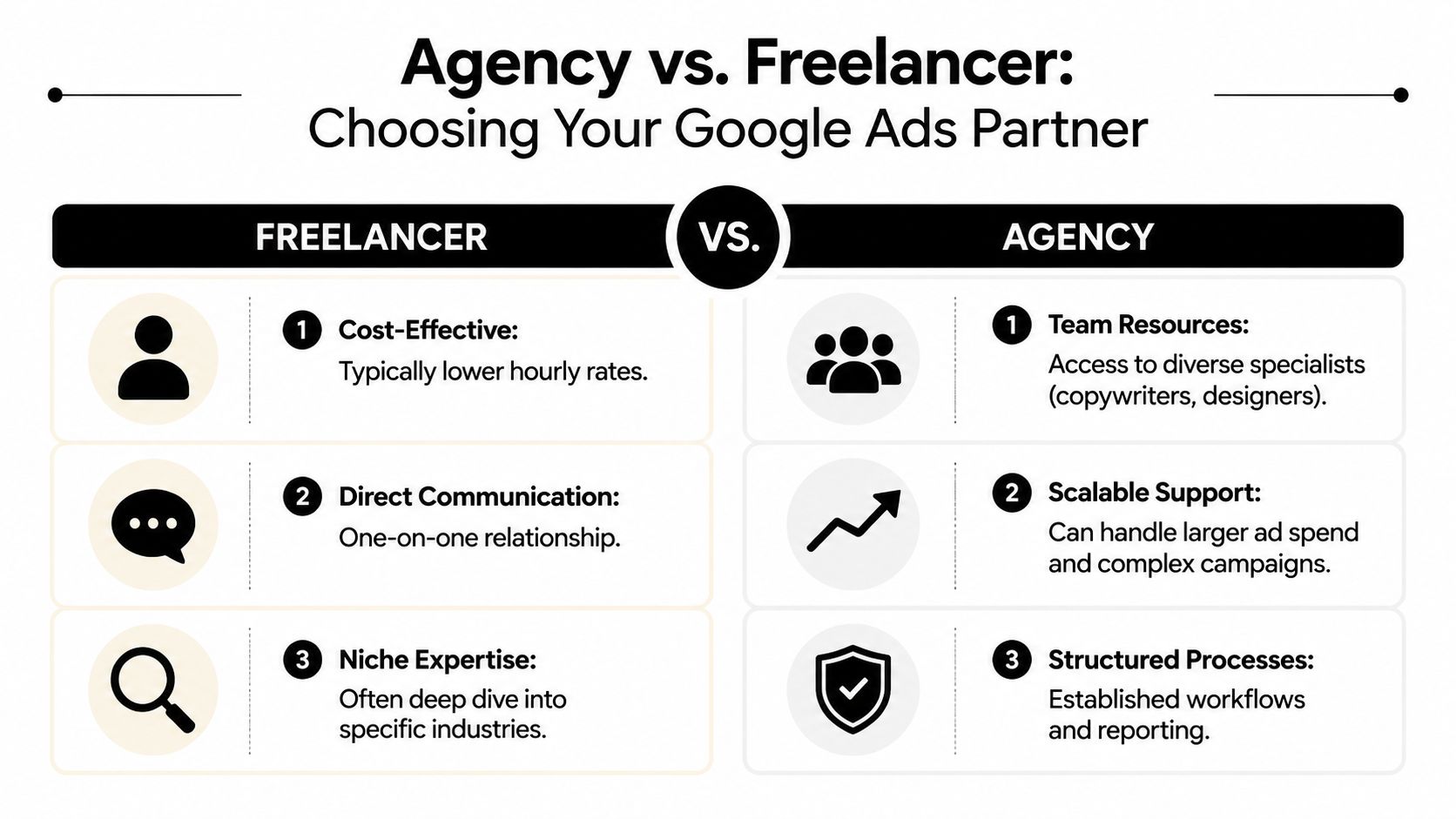
Freelancer strengths and limits
Freelancers often suit smaller businesses with a straightforward offer, a modest account, and a preference for direct contact.
The appeal is obvious. You usually speak to the person doing the work. Communication can feel faster. The relationship is often more personal. If the freelancer has strong category knowledge, you may get very focused expertise.
The downside is capacity. One person can only cover so much. If you also need landing pages, feed work, design input, CRO thinking, or technical tracking fixes, a solo operator may need outside help.
Agency strengths and limits
An agency makes more sense when the account is broader, the growth target is more aggressive, or the campaign touches multiple disciplines.
You may get access to a paid media lead, a copywriter, a designer, and technical support around analytics or tracking. That can help when Google Ads performance depends on more than bid changes inside the platform.
But there are trade-offs. Communication may pass through an account manager. Some agencies are process-heavy. Others over-service the pitch and under-service the account.
Choose the model that matches the complexity of the problem, not the one that sounds more impressive.
Freelancer vs Agency at a Glance
| Factor | Freelance Specialist | Digital Agency |
|---|---|---|
| Cost structure | Often simpler and leaner | Often higher, with broader service coverage |
| Communication | Direct with the operator | May involve account management layers |
| Skill breadth | Deep in one area, narrower across adjacent tasks | Wider team capability across media, tracking, creative, and landing pages |
| Scalability | Best for simpler or moderately complex accounts | Better for larger, multi-campaign, or multi-location setups |
| Continuity risk | Higher if one person becomes unavailable | Lower if the agency has documented processes and backup coverage |
| Speed of execution | Fast for focused work | Faster on cross-functional work if the internal team is coordinated |
A simple way to decide
A freelancer usually fits if:
- Your offer is narrow
- Your location targeting is simple
- You want hands-on contact
- You don't need broad creative or dev support
An agency usually fits if:
- Your campaigns span multiple products or locations
- You need technical tracking support
- Landing page performance is part of the job
- You want reporting and process consistency across the business
Neither model guarantees performance. The operator matters more than the label. But the model still shapes how smoothly the work gets done.
Vetting Candidates with the Right Questions
Finding candidates isn't hard. Shortlisting properly is where owners often slip.
Start close to your market. Ask local business peers who they trust. Speak to accountants, web developers, and business network contacts who see marketing suppliers over time, not just during the pitch. Referrals usually reveal more than polished portfolios.
If you need flexible offshore support for adjacent marketing or admin roles, platforms like best latam staffing agency can be worth understanding as part of your broader hiring mix. But for first-time Google Ads management, most Australian SMBs benefit from speaking with candidates who understand local service areas, buyer language, and reporting expectations.
Ask questions that force real thinking
Don't ask, “Are you experienced with Google Ads?” Everyone says yes.
Ask questions that require diagnosis, prioritisation, and commercial judgement.
Here are strong ones:
Walk me through your first month in an account like ours.
Good answer: they discuss audit, tracking validation, search term review, structural fixes, and a testing plan.
Red flag: they jump straight to “increase budget” or vague automation talk.How do you decide whether poor performance comes from traffic quality or landing page issues?
Good answer: they compare search intent, query relevance, ad-to-page alignment, and conversion behaviour.
Red flag: they blame the market without evidence.What access should the business owner always retain?
Good answer: your business should own the Google Ads account, GA4, Tag Manager, and core assets.
Red flag: they want everything under their own master account with limited visibility.How do you manage location targeting for a Brisbane service-area business?
Good answer: they mention service areas, exclusion logic, query review, and suburb relevance.
Red flag: they rely only on broad radius settings.
Use one hard Performance Max question
This question exposes whether someone understands current campaign risk.
Ask: How would you reduce wasted spend in Performance Max for a local services account?
A strong answer should acknowledge that Performance Max can create opacity and low-intent drift. One relevant source notes that in Australia, Performance Max can waste 32% more budget on low-intent traffic for local services due to poor geo-fencing. A capable specialist should respond with practical controls such as exclusion lists, tighter asset grouping, signal refinement, careful location settings, and regular review of lead quality outside the Google Ads interface.
If a candidate treats Performance Max as “set and forget”, keep looking.
Test how they think about competition
Ask them how they'd size up your market before changing campaigns. Good candidates should want to review your offer, your current search presence, who else is bidding, and where your landing pages are weak.
If you want to sharpen your own evaluation before those conversations, this guide on how to conduct competitor analysis gives you a practical frame for spotting whether a candidate's observations are thoughtful or generic.
What good answers sound like
A strong candidate usually sounds measured.
They won't promise instant wins. They'll talk about data integrity before scale. They'll mention search term quality, negative keywords, location nuance, and what they need from you internally. They'll also ask questions back, especially about margins, close rates, seasonality, and service geography.
Weak candidates tend to do the opposite. They overpromise, stay vague, and talk as if Google Ads success happens entirely inside the platform.
Onboarding Your Specialist for Measurable Success
A strong hire can still fail with a sloppy start.
Most underperforming engagements begin with missing access, unclear goals, fuzzy reporting, and a business owner who assumes the specialist will “just sort it out”. They can't. They need assets, context, and decision rules from day one.

Give access and define ownership early
In the first week, your specialist should have the right level of access to:
- Google Ads
- GA4
- Google Tag Manager
- Google Business Profile if local search visibility affects lead flow
- Merchant Centre if you run ecommerce or product feeds
- Landing pages and CMS access, or a clear path to whoever controls them
- CRM or lead management system where outcome quality can be checked
Ownership matters. Your business should retain admin control of core accounts. The specialist should get the access needed to operate, not permanent ownership of your digital infrastructure.
If landing page quality is likely to affect performance, it helps to align early on what a landing page is supposed to do and how it differs from a standard website page. This explanation of what is a landing page is useful if you need internal clarity before review rounds start.
Set targets that reflect Australian reality
Many small businesses are pulled off course by generic benchmarks in this scenario.
A useful reminder comes from Improvado's discussion of Google Ads data challenges. While global average ROAS figures are often cited at 400-800%, that same source notes that Australian campaigns need more specific goals because local competition and higher CPCs change the economics. It also highlights that attribution accuracy can show an 18% discrepancy in AU campaigns.
That means your specialist shouldn't promise neat benchmark outcomes in month one. They should work with you to set targets based on your margins, sales cycle, and data quality.
The first win in a new engagement is often cleaner measurement, not immediate scale.
A practical 30-day onboarding rhythm
Use a simple operating cadence.
Week 1
Confirm access, conversion actions, campaign ownership, reporting method, and commercial goals.
Week 2
Audit account structure, search terms, locations, budgets, ad copy, extensions, feed quality, and landing page alignment.
Week 3
Start priority fixes. That may include restructures, exclusions, tracking repairs, new landing page recommendations, or budget reallocation.
Week 4
Review the first body of clean data. Decide what to scale, what to pause, and what still needs validation.
Ask for reporting that tells a business story
A monthly report should do more than dump platform screenshots.
Ask for these elements:
| Reporting element | Why it matters |
|---|---|
| Goal summary | Keeps the account tied to calls, leads, sales, or bookings |
| Conversion view | Shows whether volume and quality are improving |
| Spend and pacing commentary | Explains where budget went and whether it was controlled properly |
| Search insight or audience insight | Helps you understand intent, not just totals |
| Landing page observations | Connects ad performance to what happens after the click |
| Next actions | Shows that the specialist has a plan, not just a report |
The most useful reports are plain English. They tell you what changed, why it changed, what the specialist learned, and what happens next.
Good onboarding creates accountability on both sides. You provide access, context, and feedback on lead quality. The specialist provides structure, measurement, and decisions you can clearly evaluate.
If you want local help from a Brisbane team that understands websites, landing pages, tracking, and Google Ads together, Website Builder Australia is a practical place to start. They work with Australian businesses that need more than campaign setup alone, especially when ad performance depends on the quality of the site, the conversion path, and the ongoing technical support behind it.


