

How Much Does Google PPC Cost: Your 2026 Guide
You're probably in one of two camps right now.
You've either been told Google Ads is one of the fastest ways to get leads, or you've heard stories about businesses burning through budget with very little to show for it. Both can be true. That's why “how much does google ppc cost” feels like such a hard question to answer when you're running an Australian business and trying to plan properly.
A Brisbane tradie might want more phone calls. A Melbourne online store might want more product sales. A Sydney consultant might want booked discovery calls. All three can use Google Ads, but they won't pay the same amount per click, and they shouldn't use the same budget either.
The good news is that Google Ads isn't a black box once you understand what drives the cost. You're not buying a fixed-price ad slot like a newspaper ad. You're entering an auction where relevance matters just as much as money. That means cost is partly shaped by your market, but also by the quality of your campaign.
If you have been trying to work out whether Google Ads is affordable for your business, the actual answer is more useful than "it depends". It depends on your industry, your goals, your location targeting, your campaign quality, and how well your landing pages match what people searched for. Once those pieces are clear, your budget becomes far easier to forecast.
The Big Question How Much Does Google Ads Really Cost
A lot of Australian business owners ask the cost question as if Google Ads has a standard price tag. It doesn't.
Google Ads works more like hiring a stall at a busy market where several businesses want the same foot traffic. If you're a plumber bidding on urgent local searches, the competition is different from an online retailer selling low-cost products nationwide. The clicks won't cost the same, and the monthly budget won't either.
That uncertainty puts many owners off. Fair enough. If you're already paying for staff, stock, vehicles, software, rent, or warehousing, the last thing you want is another marketing line item that feels open-ended.
Why the price feels unclear
Google Ads cost is made up of moving parts. Your bill is affected by what keywords you target, how competitive those searches are, how strong your ad is, and how useful Google thinks your landing page will be to the person clicking.
That's why two businesses in the same city can target similar services and still pay very different amounts.
Google Ads cost isn't just about what you're willing to bid. It's also about how relevant and trustworthy your campaign looks to Google and to the searcher.
What Australian business owners usually want to know
Advertisers often aren't looking for a technical breakdown. They are asking practical questions like:
- Can I start small: Is there a workable starting budget, or do I need a large monthly spend from day one?
- Will my industry be expensive: Are trades, retail, or professional services likely to cost more?
- Can I control the spend: Will Google drain the budget, or can I set limits and tighten the targeting?
- What does a realistic monthly budget look like in Australia: Not globally. In local business terms.
Those are the right questions.
The rest of the article tackles them in plain English, with benchmarks that are useful for Aussie SMBs and examples you can utilize when planning your own campaign.
The Engine Room What Determines Your Google Ads Cost
Google Ads is often described as an auction, but “auction” can be misleading. Advertisers often hear that word and assume the highest bidder wins.
That's not how Google wants its search results to work. Google wants ads that match the search, attract clicks, and send people to useful landing pages. So the platform runs more like a relevance auction than a simple bidding war.
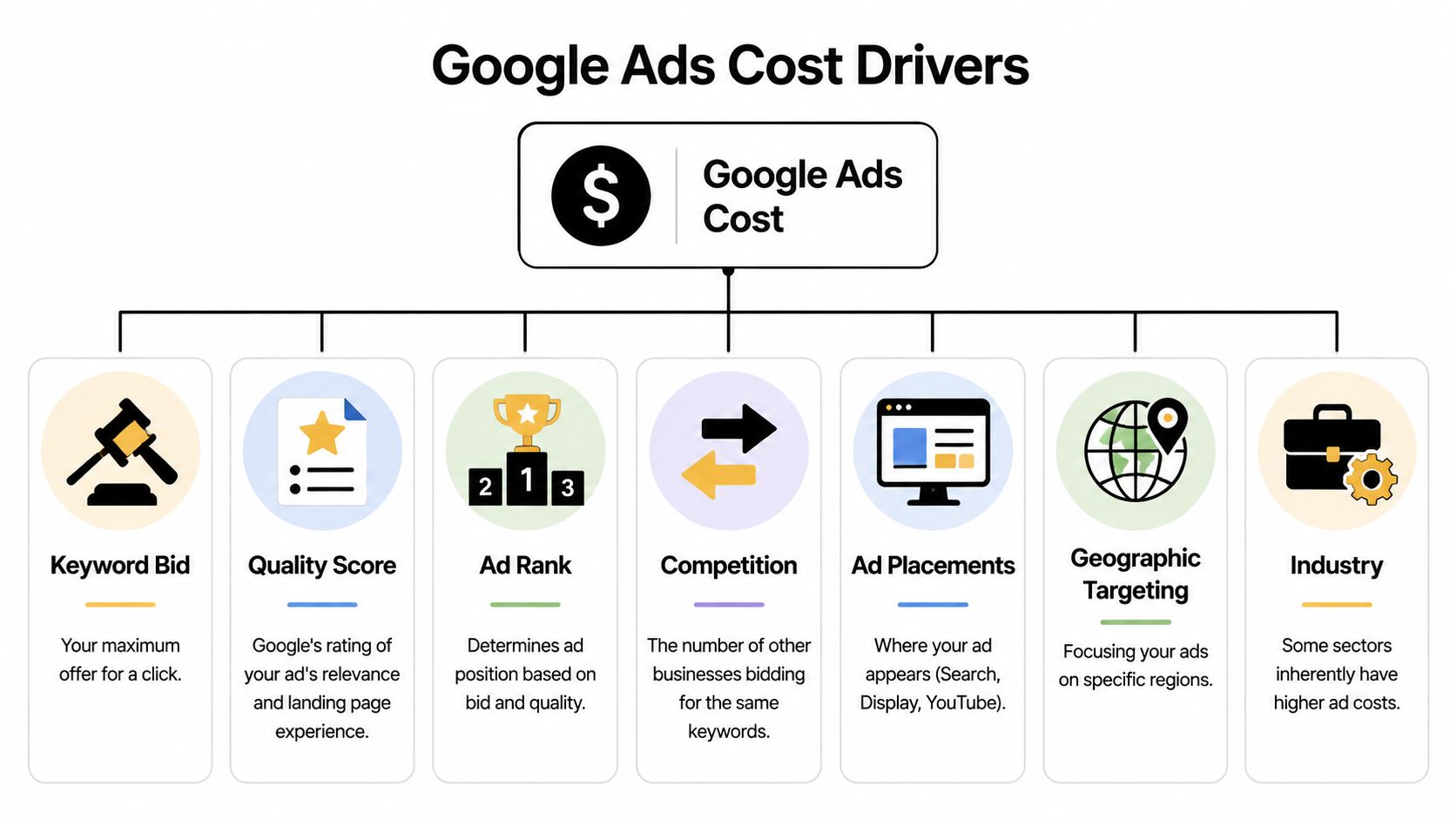
Ad Rank decides more than your bid
The core formula to understand is Ad Rank = Bid Amount × Quality Score, as explained in Power Couch Media's overview of Google Ads costs.
That means your actual cost per click is not determined by bid alone. A business with a stronger Quality Score can often win a better position while paying less than a competitor that bids the same amount. The same source gives a simple example: if two advertisers both bid $3 per click, the one with a Quality Score of 8/10 can beat the one with 5/10 and still pay less per click.
That's one of the most useful things a small business owner can learn about PPC. Better campaigns don't just perform better. They can also become cheaper.
Think of Quality Score as a report card
Quality Score is Google's way of judging whether your ad deserves a good position. In practice, three areas matter most.
- Ad relevance: Does your ad closely match the keyword someone searched?
- Expected click-through rate: Does Google think people are likely to click your ad?
- Landing page experience: After the click, does the page help the visitor?
If any one of those is weak, your campaign can become more expensive than it needs to be.
What that looks like in real life
Say someone searches for “emergency plumber Brisbane”. One advertiser sends them to a generic homepage with a broad list of services. Another sends them to a fast-loading page about emergency plumbing in Brisbane with a clear phone number and callout for urgent callouts.
Google can see that the second experience is tighter and more relevant. That advertiser has a better shot at earning a stronger Quality Score.
Practical rule: If your keyword, ad copy, and landing page all say the same thing in slightly different ways, your campaign usually becomes easier to scale.
The main levers you can actually control
You can't control how many competitors enter the auction. You can control the quality of what you put into it.
Focus on these levers first:
Tighter keyword groups
Don't cram unrelated services into one ad group. Separate them so the ad text can closely match the search.Clear ad copy
Use the actual service or product name people search for. If you want tradie leads, broad and vague wording usually wastes spend.Landing page match
Don't send every click to the homepage. Build pages that reflect the search intent.Local targeting
Restricting geography can stop budget from leaking into areas you don't serve. Businesses focused on local lead generation often benefit from campaign structures built around service areas, similar to the thinking behind Google Ads for tradies.
The short version is simple. Google rewards relevance. When relevance improves, cost often becomes easier to manage.
Real-World Costs Google PPC Benchmarks in Australia
Let's look at the numbers Australian business owners usually want to see first.
There is no official Australia-wide Google Ads price list. That is part of why pricing feels murky. Linear Design's review of Google PPC charges points out that local benchmark data is limited, so many published cost guides still rely on US and UK reference points rather than a large Australian CPC dataset.
That means benchmarks are a starting point, not a quote. They help you build a realistic forecast before you spend a dollar.
The broad benchmark many businesses use as a reference point
Across all industries, the average Google Search CPC is $2.69 USD and the average Display CPC is $0.63 USD, according to WordStream's Google Ads benchmark data. In that same source, Legal Services is listed above $6.75 USD, while E-Commerce averages $1.16 USD.
For an Australian small business owner, those figures are useful in the same way a petrol price sign is useful on a road trip. They tell you the rough range, but your final bill still depends on where you drive, how far you go, and what vehicle you are running.
Some guides also use UK spending ranges as a proxy for monthly budget planning, which can at least give Australian SMBs a rough frame for what an entry-level or mid-range campaign may require.
Australia-relevant benchmark table
Because many published figures are in USD, and because local costs can vary by suburb, city, and industry, the most practical approach is to convert benchmark categories into an Australian planning range.
| Industry Sector | Average Search CPC (AUD) | Average Display CPC (AUD) |
|---|---|---|
| All industries benchmark | Roughly in line with the global Search benchmark once converted from $2.69 USD | Roughly in line with the global Display benchmark once converted from $0.63 USD |
| E-commerce | AUD ~$1.75 | Often lower than Search traffic in many campaign types |
| B2B services | AUD ~$5.00 | Often lower than Search traffic in many campaign types |
| Consumer services and trades | AUD ~$9.60 | Often lower than Search traffic in many campaign types |
| Legal services | Higher-cost category, with Search CPCs benchmarked above $6.75 USD | Often lower than Search traffic in many campaign types |
What these benchmarks mean for Australian SMBs
The biggest takeaway is simple. Industry matters more than averages.
A Sydney or Brisbane tradie chasing emergency callout leads is usually playing in a more expensive auction than an online store selling low-ticket accessories nationwide. The click costs are higher because the search often carries stronger buying intent. A person searching “emergency plumber near me” is much closer to action than someone browsing products casually.
Retail often looks cheaper on a cost-per-click basis. That lowers the entry point, but it does not guarantee better returns. E-commerce businesses usually need more clicks, stronger offers, and a solid checkout experience to turn cheaper traffic into sales.
B2B and professional services often sit between those two extremes. A Perth accountant, Melbourne mortgage broker, or Adelaide commercial cleaner may not see legal-sector click prices, but they are rarely competing at bargain rates either.
That is why generic advice like “start with $1,000 a month” can mislead. For an Australian retailer, that might buy enough traffic to test properly. For a competitive local service business, it may only buy a small pool of clicks.
A better starting point is your likely CPC in your industry, your service area, and how many clicks you need to generate enough leads or sales to judge performance.
If you are comparing channels, it also helps to weigh high-intent search traffic against awareness-focused paid social. This guide to Facebook advertising cost in Australia gives you a useful side-by-side reference point.
Building Your Budget Sample Monthly Spends for Aussie SMBs
A Melbourne plumber, a Brisbane gift shop, and a Sydney consultant can each put $1,000 into Google Ads and get very different results. The reason is simple. That budget buys a different number of clicks in each market.
A practical starting point is this:
Monthly Budget = Target Clicks × Average CPC
It is the PPC version of working out how many litres of fuel you need for a trip. You still need the car to run well and the route to make sense, but this formula gives you a realistic starting budget instead of a guess.
Example one Brisbane tradie
A local plumber or electrician usually cares about leads from a tight service area, not website traffic from across Australia. That changes how you should budget.
Using the earlier consumer services benchmark of about AUD $9.60 per click, the numbers look like this:
- 50 clicks a month = about $480
- 100 clicks a month = about $960
- 150 clicks a month = about $1,440
That gives you a useful reality check. If your average click cost is close to $10, a $300 monthly budget will not buy enough traffic to properly test multiple services, suburbs, and ad messages.
For many tradies, a better opening budget is enough to get a clear read on what is working. That often means picking a small set of high-intent services first, such as emergency plumbing, blocked drains, or switchboard repairs, rather than spreading spend across everything at once.
Example two online boutique retailer
An online store often pays less per click than a local service business, which means the same budget can stretch further.
Using the earlier retail benchmark of about AUD $1.75 per click:
- 50 clicks a month = about $88
- 200 clicks a month = about $350
- 500 clicks a month = about $875
That lower click cost gives retailers more room to test product categories, promotions, and seasonal offers. It also means a modest starting budget can generate enough traffic to spot patterns.
There is a catch. Retail usually needs more clicks before the numbers become clear. A service business might only need a handful of good leads to judge quality. An e-commerce store may need many more visits before sales data means much, especially if the average order value is low. Businesses investing in ecommerce digital marketing support should budget for both traffic and website improvement, because product pages, shipping information, and checkout friction all affect whether those cheaper clicks turn into revenue.
Example three B2B consultant in Sydney or Melbourne
A consultant, adviser, or specialist service often sits between retail and trades on click cost, but the lead value can be much higher.
Using the earlier B2B benchmark of about AUD $5.00 per click:
| Business type | Target clicks | Average CPC | Estimated ad spend |
|---|---|---|---|
| Brisbane tradie | 50 | AUD $9.60 | $480 |
| Online retailer | 50 | AUD $1.75 | $88 |
| B2B consultant | 50 | AUD $5.00 | $250 |
This is why two businesses with the same $500 budget can walk away with very different outcomes. The retailer may get a large sample of traffic. The consultant may get fewer clicks, but each one could carry stronger commercial intent.
A simple way to set your first test budget
If you are not sure where to start, work backwards from a useful test size.
Ask:
- How many clicks would give me enough data to judge lead quality or sales quality?
- What is a realistic CPC range for my type of business and location?
- Can my website turn those clicks into enquiries or purchases?
That last question trips up a lot of small businesses. Paying for traffic before fixing a weak landing page is like paying to fill a bucket with a hole in it.
A budget is really a learning budget. You are paying for enough clicks to find out which services, products, suburbs, and search terms deserve more spend, and which ones should be cut.
Beyond the Click Factoring in Agency and Setup Fees
A lot of Australian small business owners set a Google Ads budget, then get a surprise when the invoice is higher than the media spend alone.
That happens because clicks are only one line item. The other cost is the work required to keep the account pointed in the right direction.

Google Ads works a bit like a work ute. Paying for clicks is the fuel. Management is the mechanic, route planner, and driver discipline that stops you burning through the tank with nothing to show for it.
If you run a Brisbane plumbing campaign on a $1,500 monthly ad spend, or a Melbourne ecommerce campaign on $3,000 a month, you still need someone to build the campaigns properly, check search terms, improve ads, track enquiries, and fix problems early. Without that work, waste creeps in.
Common agency pricing models
Agencies usually charge in one of three ways:
Percentage of ad spend
The fee increases as ad spend increases. This can suit accounts that become more complex as budget grows across more campaigns, locations, or services.Flat monthly retainer
You pay the same management fee each month. Many business owners prefer this because cash flow is easier to forecast.Hybrid or performance-linked pricing
Part of the fee is fixed, and part changes based on spend or agreed results.
No model is automatically better. The better question is what work is included, how often the account is reviewed, and whether reporting is clear enough for you to see where the money is going.
What you are actually paying for
Good PPC management is part setup, part maintenance, and part decision-making.
A new account often needs:
Campaign build and account structure
This covers keyword groupings, ad copy, location targeting, bidding setup, and conversion tracking.Ongoing optimisation
Search behaviour shifts. Competitors enter the auction. Some keywords waste money. Others produce strong leads. Someone needs to adjust for that.Reporting and explanation
A spreadsheet of clicks and impressions is not much use on its own. You need someone to explain what changed, what worked, and what should happen next.Landing page feedback
If the ad promises one thing and the page delivers another, performance suffers. Strong managers usually spot these gaps quickly.
In practical terms, many Australian SMBs will see agency or freelancer fees charged as a separate monthly cost on top of ad spend, plus an initial setup fee for the first build. The exact number varies widely by account size and complexity, so it is safer to ask for a clear scope than to chase a cheap headline fee.
A low monthly fee can still be expensive if tracking is broken, search terms are ignored, or leads are poor quality. A higher fee can make financial sense if it cuts wasted spend and helps you turn more clicks into real enquiries or sales.
Website Builder Australia offers factual PPC management options as part of its broader digital services, including a Bronze PPC package noted in the publisher background. That kind of arrangement can suit businesses that want help with both the ads and the website side of the funnel.
Smarter Spending Actionable Tips to Lower Your PPC Costs
The cheapest click isn't always the best click. Still, there are several practical ways to stop overpaying.
These tactics work because they improve relevance, reduce waste, or help Google understand your campaign more clearly. In other words, they support the same Quality Score logic covered earlier without relying on bigger bids.
Cut waste before you chase scale
Many accounts spend too much because they attract the wrong searches.
Use these habits early:
Build a negative keyword list
If you don't sell cheap, free, DIY, jobs, training, or unrelated services, filter those searches out. Negative keywords stop the budget leaking into traffic that was never likely to convert.Separate your services or product categories
Don't mix everything into one campaign. A clearer account structure usually leads to more relevant ads and cleaner reporting.Target only the areas you serve
Local businesses should be strict here. If you don't service a region, don't pay for that click.
Improve what happens before the click
Small changes in the ad itself can affect both cost and quality.
Try this:
Write ads that match intent
If someone searches for a specific service, say that service clearly in the ad. Generic ads often earn weaker engagement.Use strong landing page alignment
The page should continue the same promise made in the ad. If the ad mentions emergency repairs, the landing page should focus on emergency repairs.
Better alignment usually means less friction. Less friction usually means stronger campaign efficiency.
Control when and how your ads show
Not every hour, day, or device is equally valuable.
A practical review often includes:
Ad scheduling
If your team only answers calls during business hours, it may make sense to focus spend when follow-up is possible.Location refinement
You might find that some cities, suburbs, or service areas produce stronger enquiries than others.Device checks
If mobile traffic lands on a clunky page, fix the mobile experience before pushing harder.
Don't set and forget
Google Ads punishes neglect. Search behaviour changes. Competitors enter and leave. Campaigns drift.
A healthier routine looks like this:
- Review search terms regularly
- Pause weak keywords
- Refresh ad copy when performance stalls
- Tighten landing pages around your best-performing themes
That's how you make cost more manageable over time. Not by guessing lower bids, but by making the campaign more relevant and easier for Google to trust.
Your Google Ads Cost Is Within Your Control
Google Ads cost isn't fixed. That's the main takeaway.
Yes, your industry matters. Yes, some keywords are more competitive than others. But what you pay is also shaped by the quality of your setup, the relevance of your ads, the usefulness of your landing pages, and how disciplined you are with targeting and optimisation.
That's why two businesses can enter the same market and get very different results from similar budgets.
If you came here asking how much does google ppc cost, the most accurate answer is this: it costs what your market demands, moderated by how well you run the campaign. Strong structure, relevant ads, and a good website give you more control than many advertisers realize.
Start with a realistic benchmark. Build a sensible test budget. Watch the search terms, tighten the targeting, and improve the landing page experience as you go.
If you'd like a practical budget estimate for your business, Website Builder Australia can help you map out a Google Ads strategy based on your industry, target locations, website, and growth goals, so you can start with a clearer plan instead of guessing.


