

How To Sell On Facebook Marketplace: 2026 SMB Guide
You’ve probably got one of two problems right now. Either sales are too dependent on your website traffic and paid ads, or you’ve got stock, services, demo units, samples, or clearance items that could sell faster if more local buyers saw them.
That’s where Facebook Marketplace fits. Not as a side hobby channel. Not as a dumping ground for old stock. Used properly, it can become a practical acquisition tool for an Australian small business that wants enquiries now and repeat customers later.
Most guides on how to sell on facebook marketplace stop at “take better photos” and “write a clear description”. That advice isn’t wrong. It’s just incomplete. A business owner needs a system that protects time, reduces risk, and turns Marketplace attention into ongoing sales through a proper online store.
Why Marketplace is a Key Channel for Australian Businesses
A Brisbane retailer with slow-moving stock, a tradie with spare installation capacity, or a local service business trying to cut ad spend all face the same problem. They need buyers now, but they also need a channel that can feed future sales back to their own website.
Facebook Marketplace does both if you treat it as an acquisition channel instead of a one-off classifieds board. According to Facebook Marketplace statistics from SQ Magazine, the platform holds a 51.19% social commerce market share, reaches over 1.1 billion monthly shoppers across 228 countries, and 40% of Facebook’s 3.07 billion users actively shop. For an Australian small business, that means access to buyers who are already comparing options, messaging sellers, and making purchase decisions inside a familiar app.
That changes the cost equation.
A Shopify or WooCommerce store still needs traffic. Paid search can produce sales, but clicks are expensive in competitive categories. SEO is valuable, though it takes time to build. Marketplace gives small businesses another route to attention, especially for local demand, clearance stock, tested product lines, and fast-turnaround offers.
It also suits the way many Australians buy. They want to ask a quick question, check suburb-level location, compare sellers, and decide without filling out a long form.
Marketplace works for more than second-hand goods
Many Australian business owners still file Marketplace under “used furniture and garage sale leftovers”. That leaves money on the table. The platform can work well for:
- Retail products such as homewares, accessories, tools, gift items, and seasonal stock
- Service-based offers where the listing starts the enquiry and the booking happens through your normal sales process
- Clearance, samples, seconds, and surplus inventory that need faster exposure
- Customer acquisition where the first sale or first conversation happens on Marketplace, then repeat orders shift to your main e-commerce site
That last use matters most.
The strongest Marketplace sellers do not rely on it as their only sales system. They use it to bring in local buyers cheaply, prove demand, and direct serious customers into a better long-term buying experience on their own website, where margins, branding, and retention are easier to control.
If you’re comparing channels, Ebay vs Facebook Marketplace is a useful reference for how each option suits different product types, fulfilment setups, and seller expectations.
Why many businesses still underuse it
The friction is real. Buyers message late. Some never reply again. Some ask if an item is available and disappear. Lowball offers happen. Pickup coordination can chew up staff time if the process is loose.
Those problems do not make Marketplace ineffective. They mean the channel needs rules.
Businesses that get results usually have three things in place:
- A seller presence that looks legitimate and local
- Listings that answer buying questions quickly
- A process that turns first contact into payment, review, and repeat business
That is where Marketplace becomes more than a place to offload spare stock. It becomes a low-cost source of enquiries and first-time customers you can later convert on your own site.
Setting Up Your Stall Professional Account Preparation
Most Marketplace problems start before the listing goes live. If your profile looks half-finished, your product details are vague, or your messages feel inconsistent, buyers hesitate. On this platform, trust sits right next to the Buy button.

Build a profile that looks accountable
You don’t need to overcomplicate this. You do need to look real, reachable, and organised.
For a small business, that usually means:
- Use a clear profile image. A recognisable business logo or a professional headshot works better than a random graphic.
- Complete your basic profile information. Buyers want signals that you’re established and local.
- Keep your tone consistent. If your website sounds polished but your Marketplace replies sound abrupt, trust drops.
- Make location expectations clear. Mention suburb, service area, or pickup zone early.
If you’re new to the mechanics, this guide on how to set up a Facebook Marketplace listing is a useful walkthrough of the listing basics. The key advantage comes from pairing those steps with stronger operational discipline.
Check Facebook’s rules before stock goes live
A lot of rejected listings happen because sellers assume Marketplace works like a general classifieds site. It doesn’t. Facebook has commerce policies and community standards, and if your product type, claims, or listing format falls outside them, you can get flagged.
Review your inventory with a practical filter:
| Question | Why it matters |
|---|---|
| Is the product allowed on Marketplace? | Some categories face restrictions or rejection |
| Is the item accurately described? | Misleading wording creates complaints and poor ratings |
| Are photos of the actual item? | Generic or borrowed images reduce trust and can trigger issues |
| Can you fulfil what you promise? | Slow fulfilment damages response quality and buyer confidence |
A business should also decide which stock belongs on Marketplace and which doesn’t. Commodity items, clearance lines, refurbished products, display stock, and local-delivery products often work well. Complex made-to-order offers can work too, but only if the listing explains timelines and scope clearly.
Prepare inventory like a retailer, not a casual seller
Before listing anything, gather the details buyers always ask for. If you don’t, your inbox becomes your admin burden.
Use a simple prep checklist:
- Clean and inspect the item. Dust, marks, and missing parts create avoidable objections.
- Record exact dimensions. This matters for furniture, equipment, storage products, signage, and bulky goods.
- Note the condition accurately. New, near-new, refurbished, used, ex-display. Pick one and explain it.
- List inclusions. Chargers, accessories, manuals, packaging, installation hardware.
- Decide fulfilment in advance. Pickup, local delivery, shipping, or website checkout only.
Practical rule: if a buyer has to message you for basic details, the listing wasn’t finished.
Video also helps with setup and presentation because it shows condition, scale, and operation more clearly than still images alone.
Set internal rules before the first enquiry
A business differentiates itself from a casual seller in this way. Decide your process now, not while juggling enquiries.
A workable approach looks like this:
Who responds to messages?
One person should own first replies, even if others handle fulfilment.What counts as a reserved item?
Some businesses hold stock only after payment. Others hold for a short confirmed window.Which payment methods are accepted?
Choose these before listing and state them consistently.When does a lead move to your website?
If the buyer wants shipping options, invoice payment, product bundles, or repeat ordering, your own store should take over.
Small changes here save hours later. Marketplace rewards sellers who look easy to buy from.
Crafting Listings That Convert Australian Buyers
A buyer in Parramatta finds your product at 8:15 pm, taps into the listing, scrolls your photos, checks the price, and decides in under a minute whether to message you or keep going. That moment matters. For an Australian small business, the listing is not just a sales ad. It is often the first touchpoint before a buyer visits your website, asks for delivery, or comes back later to buy again through your main store.
Start with category and title
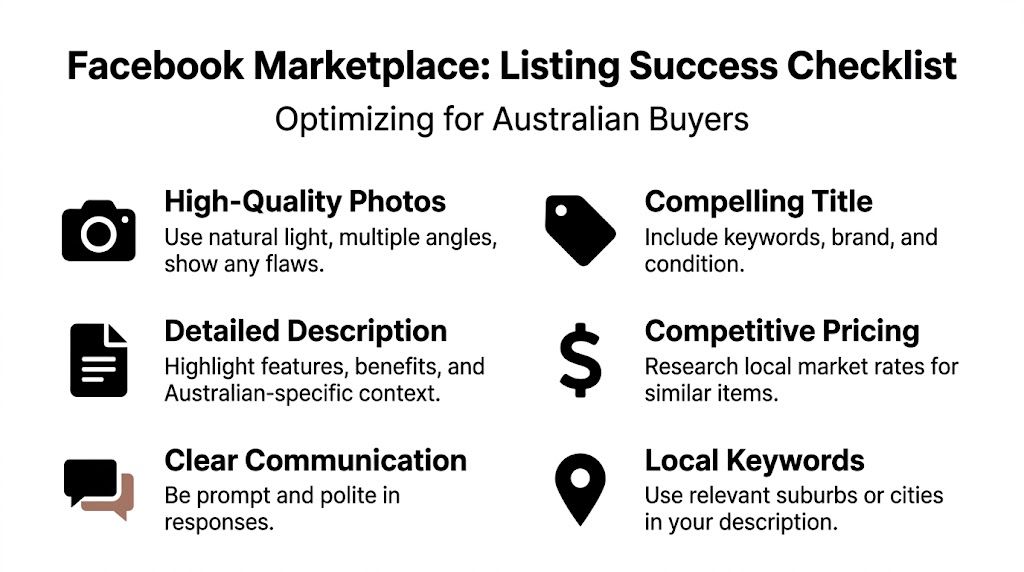
Category choice affects who sees the listing and how relevant your enquiries are. A refurbished coffee machine listed under the right appliance category will usually draw better buyers than the same item dropped into a broad home category. The same rule applies to furniture, tools, electronics, and service-based lead listings.
Write titles the way buyers search on Marketplace:
Brand + product type + key feature + condition
Examples:
- Dyson cordless vacuum, refurbished, with charger
- Solid timber dining table, six-seater, excellent condition
- Mobile mechanic service, Brisbane northside, logbook servicing
- Shopify POS stand, ex-display, black
Good titles do two jobs. They help Marketplace match your listing to the right searches, and they pre-qualify buyers before the first message. That matters if your real goal is not just one sale, but attracting the kind of customer who may later buy accessories, book a service, or place a larger order on your own site.
Photos should remove doubt fast
Photos are where many business listings fall short. The product may be fine, but the images leave too much unanswered. Buyers then message for details that should have been obvious, or they move on because the seller looks careless.
Use a practical sequence:
- Cover image with the full item clearly visible
- Front, side, and rear angles where relevant
- Close-ups of materials, controls, labels, ports, branding, or finish
- Flaw photos showing scratches, dents, repairs, or wear
- Size reference or dimension shot
- Context image if use or scale is easier to understand in a room, workshop, or vehicle
For business sellers, honest photos do more than help one transaction. They protect margin. They reduce wasted messages, lower the chance of disputes, and build enough trust that a buyer is willing to continue the purchase through your website if needed.
Add video when function matters
If the item opens, folds, powers on, heats up, reclines, pairs, or dispenses, video usually helps. It answers the question buyers ask: does this work the way the seller says it does?
That is especially useful for:
- furniture with drawers, hinges, or moving parts
- tools and workshop gear
- appliances
- refurbished electronics
- products with cosmetic wear
- service demonstrations where showing the result is stronger than describing it
Keep it short. Show the item from several angles, demonstrate the key function, and point out any wear without trying to hide it. A simple phone video is enough.
Show defects clearly. Serious buyers stay. Refund-seekers and tyre-kickers drop off early.
Write descriptions that help the buyer decide
Marketplace descriptions work best when they read like a capable staff member answering the obvious questions in one go. Decorative copy wastes space. Specifics sell.
Include:
- what the item is
- who it suits
- condition
- dimensions or specifications
- what is included
- pickup, delivery, shipping, or website checkout options
- accepted payment methods
- whether the price is firm or open to offers
Weak description
“Beautiful table in great condition. Selling due to moving. Pick up only.”
Stronger description
“Solid timber dining table, seats six comfortably. Ex-display piece with minor surface wear shown in photos. Measures 180 cm x 90 cm x 76 cm. Table only, chairs not included. Pickup from Brisbane southside. Can assist with local delivery by arrangement. If the listing is visible, it’s available.”
That second version reduces back-and-forth and helps the right buyer act faster.
If you want Marketplace to feed your main store, say so carefully. For example, if a buyer wants shipping, invoice payment, bundles, or extra colour options, direct them to your website checkout or product page. If your business takes online payments, it also helps to understand your Australian payment gateway options for e-commerce checkout before you start pushing Marketplace buyers into your store.
Price for buyer behaviour on Marketplace
Marketplace buyers compare quickly. They are not browsing with the same mindset they bring to a polished product page on your website. They are scanning local options, checking condition, and deciding whether your asking price feels fair right now.
That changes how businesses should price.
A practical method is to search comparable listings in your area, review condition accurately, and leave room for negotiation only if you are prepared to handle it. New stock with plenty of local competition usually needs a tighter price. Ex-display, clearance, and refurbished items can still hold margin if the photos and description clearly justify the condition. Rare items can carry a stronger price, but only if the listing explains why.
Here is a workable approach:
| Listing type | Pricing stance |
|---|---|
| New item with multiple competitors | Stay close to comparable local offers and make value obvious |
| Ex-display or clearance stock | Price to move and explain condition clearly |
| Vintage or hard-to-source item | Leave room for negotiation and support the price with detail |
| Service-based lead listing | Lead with the starting offer and the next step |
If you hate negotiating, say the price is firm. Then keep it firm. Mixed signals create bad enquiries.
Use location naturally
Australian buyers care about distance. They want to know whether pickup is realistic, whether delivery is available, and whether the seller is local enough to trust.
Include location in ways that help the buyer:
- pickup suburb
- delivery radius
- service area
- shipping availability across Australia
That is enough. Repeating suburb names throughout the copy makes the listing look forced.
Build a repeatable template your team can use
If multiple staff list stock, consistency matters. A simple format improves quality control and makes your business look more reliable.
Use this structure:
- Item name and condition
- Core specs or compatibility
- What is included
- Any faults or cosmetic wear
- Pickup, delivery, shipping, or website checkout options
- Clear call to action
A strong Marketplace listing should do more than get a message. It should qualify the buyer, reduce wasted admin, and create a clear path into your broader sales process, including your own e-commerce site where repeat purchases are easier to manage.
Managing the Sale Safely and Efficiently
A good listing gets attention. A good sales process turns attention into paid, low-drama transactions.
Many businesses lose time, not because buyers aren’t interested, but because messages are slow, pickup details are loose, payment expectations are unclear, and staff improvise instead of following a process.
Reply fast, but don’t type from scratch every time
Marketplace favours responsiveness, and buyers often message several sellers at once. If you take too long, they move on.
Use saved replies for common messages:
“Yes, it’s available. Pickup is from [suburb]. Payment options are [methods]. Let me know your preferred pickup time.”
“Thanks for your message. The price is firm at the moment because of condition and demand, but I can confirm availability now if you’d like to proceed.”
“Yes, shipping is available. Send your postcode and I’ll confirm the next step.”
Short, polite, and direct beats casual banter. You’re not trying to win a personality contest. You’re trying to reduce friction and sort serious buyers from time-wasters.
Decide how you handle holds and no-shows
No-shows are common enough that you need a rule, not an emotional reaction. The simplest business rule is this: first confirmed buyer with payment, or first confirmed buyer with a defined pickup window.
If someone wants you to hold the item, set conditions clearly:
- hold until a specific time
- hold only after deposit or payment if that suits your business
- no indefinite reservations
- if they stop responding, the item goes back to available
That protects your time and inventory.

Choose payment methods that fit the risk
Different products require different payment handling. A low-value local pickup can be simple. A higher-value shipped item needs more structure.
Use this decision guide:
| Sale type | Best practice |
|---|---|
| Local pickup, low complexity | Confirm payment method before meetup and keep handover simple |
| Higher-value item | Verify cleared payment before release |
| Shipped order | Use a checkout or invoicing process with clear order records |
| Repeat customer | Move them to your normal website checkout flow |
If you’re building a more structured setup for online payments, checkout, or card processing, this guide to payment gateways in Australia helps frame the choices for website-based transactions.
Pickup versus shipping
Neither option is universally better. Each has trade-offs.
Pickup works well when the product is bulky, fragile, urgent, or better inspected in person. It also suits tradies, local retailers, and furniture sellers.
Shipping works well when the item is easy to package, margins support freight, and your website or internal process can handle addresses, dispatch, and confirmations cleanly.
For pickups:
- meet in a safe, practical location
- give the exact address only when timing is confirmed
- keep records in Messenger
- have the item ready before the buyer arrives
- avoid drawn-out negotiation at the handover point
For shipping:
- confirm postage terms before payment
- pack the item as if the courier will not be careful
- send tracking promptly
- document condition before dispatch with photos or video
Watch for scam patterns
You don’t need paranoia. You need discipline.
Common warning signs include:
- buyers who ignore the listing details and jump straight to odd payment requests
- pressure to move the conversation off-platform too early
- requests involving third-party pickups with vague explanations
- overcomplicated payment stories
- urgency that doesn’t match the product
If anything feels off, end the transaction. There’s no shortage of buyers for a well-presented product. One avoided scam is worth more than a rushed sale.
Ask for the rating after a smooth handover
Seller reputation matters on Marketplace. Don’t beg for reviews, but do ask professionally after a clean transaction.
A simple follow-up works:
“Thanks again. Glad that went smoothly. If you’re happy with the item, I’d appreciate a rating on Marketplace.”
That’s enough. Good ratings make future buyers less hesitant, especially when you’re selling under a business identity or using Marketplace regularly.
Advanced Growth Strategies Beyond the Basic Listing
A single listing can produce sales. A system produces momentum.
Once you know which products attract the right buyers, don’t stay stuck in one-off posting mode. Serious sellers use Marketplace as part of a broader sales operation. That means better inventory control, clearer promotion decisions, and stronger links to Facebook’s wider commerce tools.
Don’t boost everything
Boosting can help, but only when the listing already works organically. If the photos are weak, the category is wrong, or the description is vague, paid reach just puts a weak offer in front of more people.
Boost listings when the product has these characteristics:
- broad local appeal
- healthy margin
- clear visual appeal
- easy fulfilment
- proven enquiry history from similar listings
Don’t boost niche products just because they’re expensive. High ticket doesn’t automatically mean high demand.
For businesses comparing paid visibility options, it helps to understand the wider economics around Facebook advertising cost before deciding whether boosted listings or broader ad campaigns make more sense.
Use Commerce Manager if inventory is growing
Once you’re listing regularly, manual posting starts to break down. Products sell in one place but stay visible in another. Staff answer messages with different wording. Reporting becomes guesswork.
Commerce Manager matters because it gives businesses more structure around catalogues, product organisation, and cross-platform selling. It’s especially helpful if you already sell through Facebook and Instagram alongside your own store.
You don’t need every advanced feature on day one. You do need a single source of truth for:
- product names
- images
- stock status
- pricing consistency
- fulfilment notes
That reduces overselling and keeps your brand presentation tighter.
Read the signals, not just the inbox
Too many sellers judge Marketplace performance by whether messages arrived. That’s incomplete.
A better review looks at patterns:
| Signal | What it usually means |
|---|---|
| Lots of views, few messages | Listing attracts curiosity but not enough trust or value |
| Plenty of messages, few sales | Pricing, fulfilment, or buyer qualification is off |
| Fast sales with repetitive questions | Your offer works, but the description needs to answer more upfront |
| Enquiries from the wrong locations | Listing needs tighter location and fulfilment wording |
This kind of review helps you improve without guessing.
A listing that gets attention but creates admin isn’t performing well. A listing that filters the wrong buyers out is.
Treat Marketplace like a merchandising channel
Retailers already understand merchandising on a website. Hero images, product grouping, bundling, seasonal offers, and clearance logic all matter. Apply the same thinking here.
Examples:
- pair complementary products in the description
- mention matching stock availability
- use Marketplace to move discontinued lines
- rotate featured categories based on seasonality
- test whether ex-display stock performs better under a value angle or a quality angle
For service businesses, the equivalent is offer design. Don’t just list “plumbing” or “web design”. List a specific job type, outcome, or starter package that gives the buyer a reason to message.
Build operational rules before scaling volume
The businesses that struggle with Marketplace growth usually hit process friction first. Listings go live faster than the business can manage the replies, pickups, shipping, or stock sync.
Before increasing volume, tighten these areas:
Message ownership
One person or one inbox process should control first response.Inventory updates
Remove sold items promptly. Archive stale listings. Relist selectively.Website handoff
Have a clear rule for when Marketplace stays the checkout point and when the customer moves to your website.Offer selection
Not every product belongs here. Keep what sells well and drop what attracts poor-fit buyers.
At that point, Marketplace stops being a side channel. It becomes a low-cost feeder into your wider sales system.
Connecting Marketplace to Your E-commerce Website
A buyer messages you about a single product on Marketplace. By the end of the chat, they ask whether you have other colours, whether you ship interstate, and whether they can pay by card. That is the point where a basic Marketplace sale can turn into a website customer.
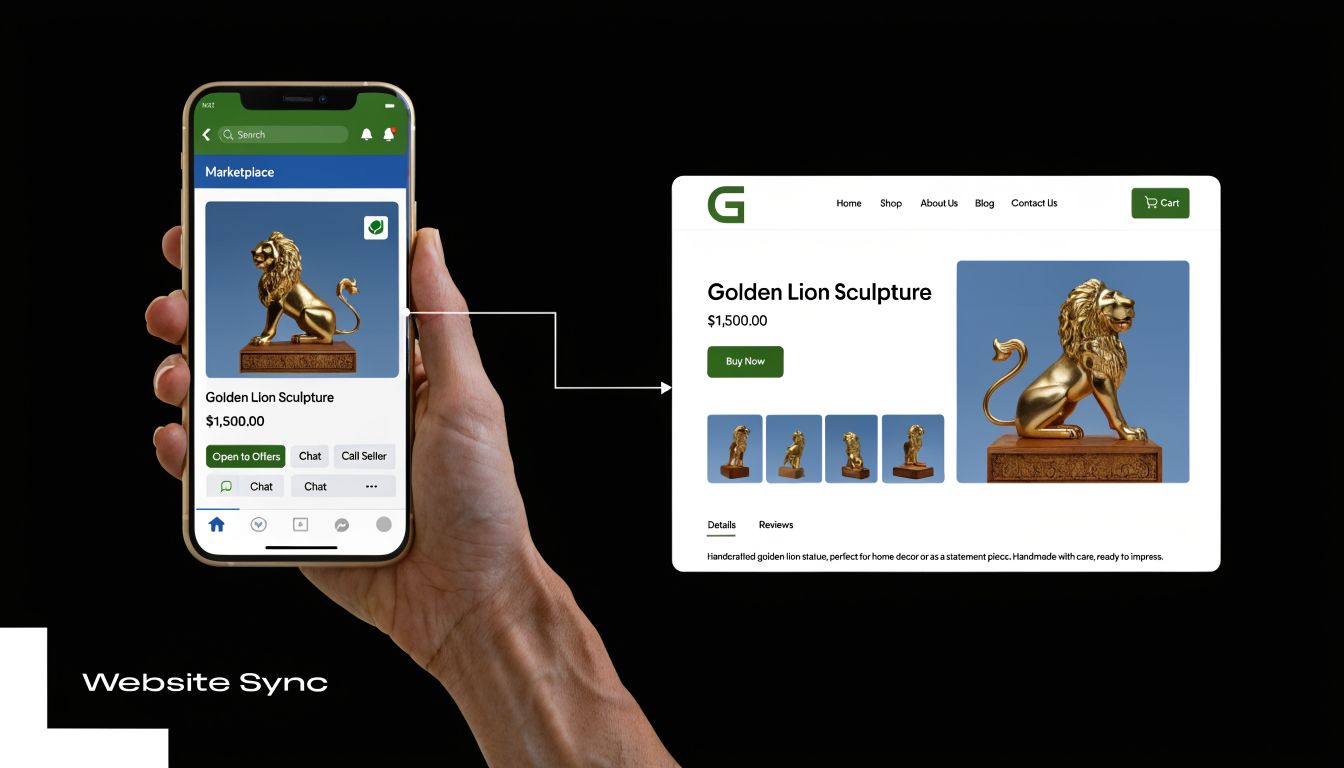
Many Australian businesses treat Marketplace as the end of the transaction. That leaves money on the table. Used properly, Marketplace brings in local intent at low cost, while your website handles the parts of the sale that need better structure, broader choice, shipping rules, and customer retention.
According to Nifty’s Marketplace article, over 1.2 million Australians were active daily sellers in 2025, only 12% of Australian small businesses were using Marketplace for omnichannel strategies, and hybrid sellers in Queensland saw 40% higher repeat revenue when they directed Marketplace buyers to their own hosted websites. Those numbers point to the same commercial reality. Marketplace can generate the first enquiry, but your website is where you build a repeatable sales system.
What your website does better
Marketplace is strong at discovery. Your website is better suited to the parts of the buying process that need control and consistency.
Use your site for:
- your full catalogue
- bundles, upsells, and quantity discounts
- shipping rates and delivery rules
- secure card checkout
- invoice requests and tax details
- email capture and remarketing
- repeat orders from past customers
This matters most for product businesses with depth in the range. A buyer may find one listing on Marketplace, then spend more once they land on a proper product page and can see related items, delivery options, and your broader brand.
Move buyers across when it helps them buy
Do not push every buyer off Marketplace too early. That creates friction and can kill a simple sale.
Send buyers to your website when the site clearly improves the transaction, such as when they:
- want delivery outside your local area
- need to browse size, colour, or style variations
- are buying more than one item
- want standard checkout with card payment
- look like a good repeat customer
In practice, the handoff should feel natural. If someone asks for shipping, send the product page. If they ask what else you stock, send the collection page. If they want a more formal checkout, send the cart link.
If you are still building that setup, this guide on setting up an online store for an Australian business covers the core pieces.
Track Marketplace as an acquisition channel
Treat Marketplace the same way you treat any other source of customer acquisition. Know which listings send the best buyers to your site. Track which products lead to repeat orders. Watch where people drop off.
A simple approach works well for most small businesses:
- create dedicated product or collection pages for Marketplace traffic
- use website analytics to track visits and conversions from Facebook
- note which listings lead to higher-value enquiries
- capture email or SMS consent on your website, not inside Messenger
- follow up with first-order offers, back-in-stock alerts, or reorder reminders
That is how Marketplace stops being a stream of one-off chats and starts feeding your main store.
Keep the transition compliant and commercially sensible
Facebook Marketplace buyers are still platform buyers first. Respect that. Do not make every interaction about dragging people off-platform. Answer the question they asked, make the purchase path clear, and move them to your website when it gives them a better buying experience.
For Australian SMBs, that is the main opportunity. Marketplace gets attention. Your website keeps the customer.
Frequently Asked Questions for Marketplace Sellers
Should I accept lowball offers?
Sometimes. It depends on the product, age of the listing, and how costly it is to hold the stock.
For fast-moving items, it’s usually better to price properly from the start and stay firm. For clearance, bulky goods, or stale inventory, a lower offer may still be commercially sensible. Respond professionally, not emotionally. A short “Thanks, I can do X if collected today” keeps control without turning the chat into a debate.
What if a buyer doesn’t show up?
Set a clear pickup window in advance and confirm shortly before the meeting time. If they go silent, move on to the next buyer. Don’t hold stock indefinitely for people who haven’t earned the hold.
For popular items, keep a backup buyer informed that they’re next in line.
How should I handle returns or disputes?
Decide your policy before you list. If the item is used, ex-display, or clearance, say so clearly and document its condition in the listing. Keep Messenger records, photos, and payment confirmation.
When a dispute happens, stay calm and stick to what was described and agreed. Most problems come from vague listings, rushed handovers, or condition issues that weren’t shown properly.
Can I sell services on Marketplace?
Yes, but the offer needs to be concrete. Broad listings like “digital marketing available” or “handyman services” are weak. A defined offer such as website fixes, lawn mowing by suburb, pressure cleaning, or appliance installation gives buyers something clearer to respond to.
The goal is to start a conversation with a real service need, then qualify and move the lead into your normal quoting process.
Is it better to use Marketplace or my website?
Use both. Marketplace is strong for reach, speed, and local intent. Your website is stronger for brand control, repeat purchases, and structured checkout. The most practical setup uses Marketplace to attract and pre-qualify buyers, then uses your website to support scale and retention.
If you want a proper online store behind your Marketplace activity, Website Builder Australia can help you build a website that handles product pages, payments, shipping, and lead capture without the usual complexity. For Brisbane businesses and Australian SMBs ready to turn Marketplace traffic into long-term revenue, that kind of setup makes the channel far more valuable.


