

Law Office SEO: Expert 2026 Marketing Guide
A partner in a suburban Brisbane firm usually notices the same pattern before they call an SEO strategist. Referrals still come in, past clients still ring, and the website still looks respectable. But when someone searches for “family lawyer Brisbane” or “commercial lease dispute solicitor Brisbane”, a competitor appears first, their Google Business Profile gets the call, and your firm never even enters the conversation.
That's what law office seo is really about. It isn't vanity rankings. It's whether a potential client finds your firm at the exact moment they've decided they need legal help.
For Australian firms, there's another layer that generic legal SEO advice keeps missing. You're not just trying to rank. You're trying to rank without breaching advertising rules, overreaching on claims, or creating trust issues that hurt both enquiries and compliance. The firms that do this well build a search presence that is commercially strong and ethically defensible. The firms that copy US-style “best lawyer” tactics often create avoidable risk.
Why SEO is a Non-Negotiable Investment for Your Firm
If your firm depends on referrals alone, you're leaving too much to chance. Referrals are valuable, but they're not predictable enough to act as your only growth engine. Search fills that gap because it captures demand that already exists.
The strongest reason to treat law office seo as core business development is simple. Organic search accounted for 53% of all website visits for law firm websites in 2024, and average law firm SEO delivered a 3-year ROI of 526% with a 14-month break-even period, according to Everspark Interactive's legal SEO analysis. That matters because it shifts SEO out of the “marketing extra” category and into the “how new matters start” category.
Paid ads still have a place. So do networking, referrals, and directory listings. But paid traffic disappears the moment you stop funding it. Organic visibility compounds. A strong practice area page, a properly structured local service page, and a credible profile in search can keep producing enquiries long after the initial work is done.
What this means at partner level
A partner usually asks one of two questions. “How many leads will this get us?” or “Why not just spend more on Google Ads?” Both are fair questions.
The commercial answer is that SEO and PPC solve different problems:
- Google Ads buys immediacy: You can appear quickly for high-intent terms, but your visibility stops when spend stops.
- SEO builds durable visibility: Your pages continue to attract searches after publication and refinement.
- Search trust is different: Many legal prospects prefer organic results because they read them as more established and less promotional.
Practical rule: If your firm wants steadier enquiry flow, SEO can't sit behind redesigns, logo changes, or occasional blog posts. It needs the same discipline you'd apply to business development.
A lot of firms also jump into content before they've done the strategic groundwork. That's where proper targeting matters. If your team needs a practical primer on effective keyword research for legal practices, start there before you approve another generic article that targets no real search intent.
The firms that win in search aren't always the biggest. They're usually the ones that pick the right services, target the right suburbs or cities, and keep improving the pages that generate enquiries.
Conducting Your Initial SEO and Technical Audit
Before you write a word of new content, audit the site you already have. Most law firms don't have a visibility problem alone. They have a foundation problem. Slow pages, oversized images, indexing issues, broken internal links, and mobile friction effectively stop good content from performing.
A 2025 Law Institute of Victoria report found that 68% of Australian law firms saw 15-25% organic traffic growth within 6 months of implementing a technical SEO methodology focused on Core Web Vitals. It also identified image compression as a problem for 72% of Australian law sites and highlighted secure HTTPS as a critical fix. That benchmark should shape how you prioritise your first audit.
Start with the tools that matter
You don't need a bloated software stack to get a useful read on technical health. For most firms, these tools are enough to begin:
- Google Search Console for indexing, search queries, page coverage, and crawl issues.
- PageSpeed Insights for page-level performance and Core Web Vitals signals.
- A crawler such as Screaming Frog for title tags, redirects, broken links, duplicate pages, and thin content.
- Your browser on mobile because real device checks often reveal friction reports miss.
A technical audit should answer practical questions, not abstract ones. Can Google access your priority pages? Do your service pages load quickly enough on mobile? Does the site make it easy for a person in distress to call, read, and enquire without pinching and zooming?
Check the pages that actually make money
Many firms waste time polishing low-value pages while their core service pages remain weak. Start with the pages tied to enquiry intent:
- Primary practice area pages: Family law, conveyancing, wills and estates, employment law, commercial disputes.
- Key location pages: Brisbane, Gold Coast, Sunshine Coast, Toowoomba, or the specific service area your firm serves.
- Contact and consultation pages: If these break, your conversion path breaks with them.
Look for common technical faults:
- Oversized hero images: Lawyer headshots and office banners often look polished but load badly.
- Mixed HTTPS issues: A secure padlock isn't enough if embedded assets still trigger browser warnings.
- Orphan pages: Useful pages that aren't linked from the main site structure rarely perform well.
- Thin metadata: Duplicate title tags and weak meta descriptions make it harder to earn clicks even when you rank.
If a family law page takes too long to load on mobile, a prospect won't wait for your credentials. They'll tap back and call the next firm.
Audit site structure before you touch design
Law firm websites often become cluttered over time. New practice areas get added. Staff profiles move. Old blogs pile up. Menus become overloaded. Search engines and users both struggle when structure gets messy.
A practical hierarchy usually looks like this:
| Page type | What it should do |
|---|---|
| Home page | Establish firm credibility and route users to major services |
| Practice area pages | Target clear legal intent and explain service scope |
| Location pages | Support local relevance where the firm genuinely serves clients |
| Lawyer profiles | Build trust, qualifications, and authorship signals |
| Contact page | Remove friction and make the next step obvious |
For firms that want a broader benchmark on foundational optimisation, this guide to SEO for small business in Australia is a useful reference point because many of the same technical priorities apply.
What to fix first
Don't try to solve everything in one pass. Fix in this order:
- Indexing and crawlability first: If search engines can't properly access the page, nothing else matters.
- Speed second: Compress images, trim heavy scripts, and improve load performance on the pages that drive enquiries.
- Mobile experience third: Menus, tap targets, forms, and call buttons need to work cleanly on phones.
- Internal linking fourth: Connect related service pages and supporting articles so authority flows through the site.
That order works because it follows the actual path from visibility to enquiry. First the page must be found. Then it must load. Then it must be usable. Then it must guide the visitor to the next step.
Winning the Local Battle with Google Business Profile
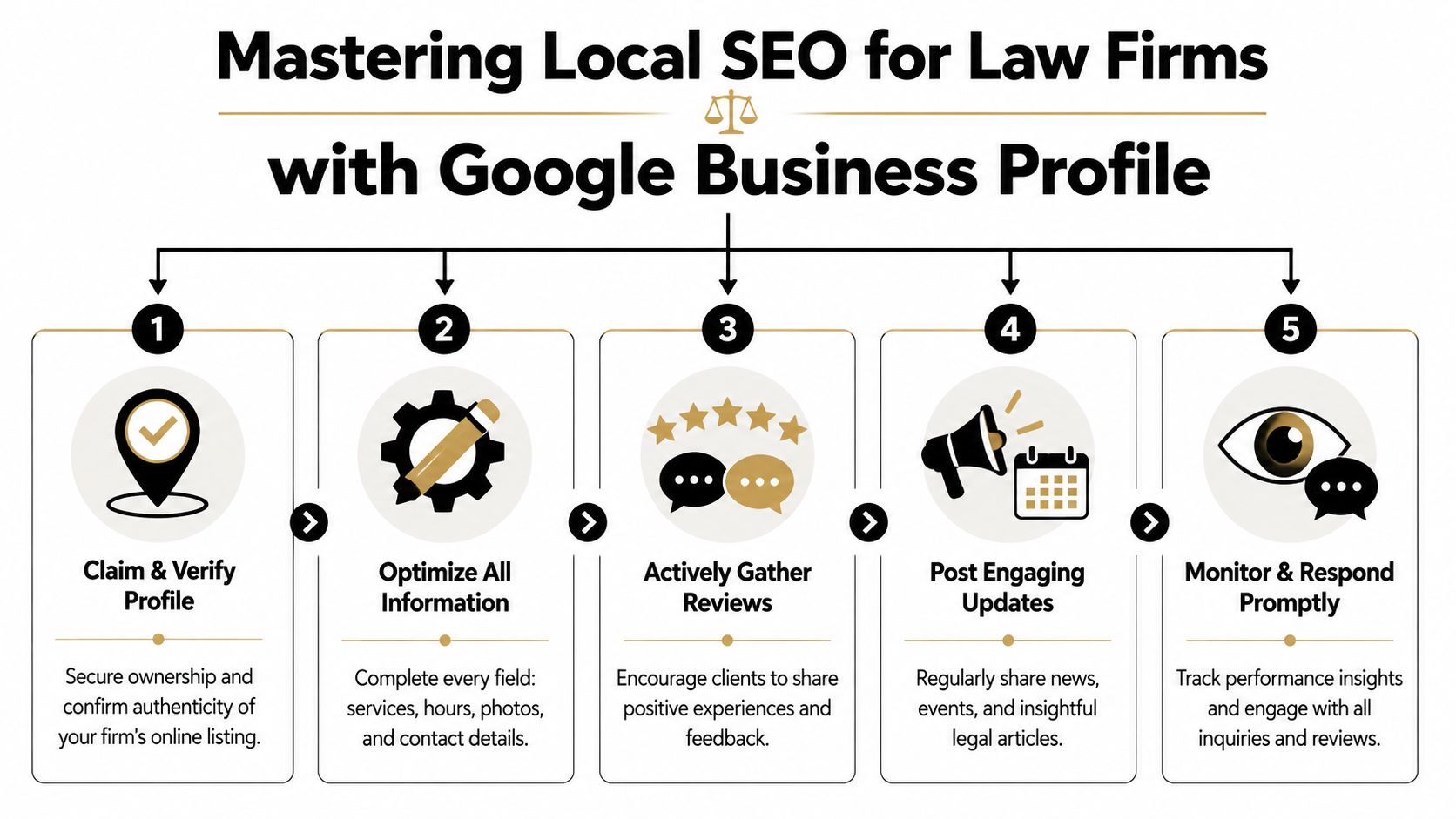
For many firms, the Google Business Profile serves as the primary homepage. A prospect searches, sees the map pack, checks reviews, glances at opening hours, and decides whether to call. Sometimes they never visit the website at all.
That's why local law office seo needs more than a claimed listing. A 2026 ALTA study found that niche keyword targeting combined with local schema helped 73% of Brisbane and Melbourne firms overcome ranking plateaus, delivered a 47% higher conversion rate from lead to consultation, and that an updated Google Business Profile earned 5x more local calls. Those are direct commercial outcomes, not soft branding metrics.
Build the profile like a serious acquisition channel
Most law firms complete the basics and stop there. Name, address, phone, maybe a website link. That isn't enough in competitive suburbs or major cities.
A high-performing profile needs to be managed like an active business asset:
- Service alignment: Your listed services should reflect the work you want more of.
- Accurate firm details: Phone, office hours, address, and website destination must stay current.
- Relevant imagery: Office photos, team photos, and location cues help establish legitimacy.
- Review management: New reviews and professional responses signal activity and trust.
- Consistent updates: Posts and profile maintenance keep the listing from looking neglected.
Use specific search language, not broad vanity terms
Broad keywords often attract poor-fit traffic. A firm ranking for “lawyer Brisbane” may still get fewer usable matters than one that targets “child custody lawyer Brisbane” or “commercial lease lawyer Brisbane”.
That's where local intent and niche service language matter. Instead of treating your profile as a directory card, shape it around the legal matters you want. A compensation practice on the Gold Coast should not present the same local search footprint as a CBD commercial firm in Brisbane.
Here's a useful way to pressure-test keyword choices:
| Weak targeting | Better targeting |
|---|---|
| Lawyer Brisbane | Family lawyer Brisbane |
| Solicitor Gold Coast | Property settlement solicitor Gold Coast |
| Law firm near me | Commercial lease dispute lawyer Brisbane |
Use the same language consistently across your profile, service pages, and local business schema on the site. When those elements line up, Google gets a clearer signal about relevance.
A short explainer on local optimisation can also help visualise where firms get this wrong:
What firms often miss inside GBP
A lot of missed opportunity sits inside details that look minor but influence action:
Primary and secondary categories
Choose categories that match your real work, not the broadest label available.
Services section
Add specific services rather than relying on generic “legal services” language.
Questions and answers
Seed sensible, factual questions your team hears often, then answer them clearly.
Photos
Use current office and team photos, not stock imagery that weakens trust.
Review responses
Respond professionally and without disclosing confidential matter details.
A neglected profile tells prospects the same thing a neglected reception area tells walk-in clients. This firm may be competent, but it doesn't feel active.
The firms that gain traction locally usually do the basics consistently. They keep details accurate, align the profile with profitable services, and make it easy for someone to call from a mobile device without hunting for information.
Creating Legal Content That Attracts and Converts
Most law firm content fails for one reason. It's written to fill a blog calendar, not to answer the questions a potential client asks before making contact.
Good legal content does two jobs at once. It helps search engines understand the page, and it helps a nervous, time-poor prospect decide your firm is credible enough to call. That second part is where many firms underperform. They publish bland, generic summaries that say little and convert poorly.
Law firms that frequently update and add new content generate 400% more traffic than firms with inactive blogs. Also, 62.2% of first-page law firm websites operate on WordPress, and the March 2025 Google core update penalised sites with generic, outdated content, according to On The Map's attorney SEO statistics.

Build around practice area pages first
If your site has ten blog posts but weak service pages, your priorities are backwards. Practice area pages usually carry more commercial intent, especially in legal search.
A strong practice area page should cover:
- What the matter involves: Plain-English explanation of the legal issue.
- Who the service is for: Individuals, families, employers, employees, business owners.
- How your firm handles it: Process, scope, and what happens next.
- Common concerns: Timing, likely process, urgency, practical next steps.
- A clear enquiry path: Call, form, consultation request.
Then support that page with focused articles that answer adjacent questions. For example, a family law page can be supported by articles about parenting arrangements, property settlement process, and what to bring to a first appointment.
Freshness matters, but only if the content is worth refreshing
A lot of firms misunderstand content freshness. They assume it means publishing constant news posts. It doesn't. In legal SEO, freshness often means revisiting your existing pages so they remain useful, current, and better structured than competing pages.
That usually includes:
- updating references to laws or procedures where appropriate
- improving examples and FAQs based on real client conversations
- adding internal links to related services
- tightening headings so the page matches search intent more clearly
- replacing generic statements with more specific, practice-based guidance
A page written three years ago isn't automatically weak. A page written three years ago and never improved usually is.
Show real expertise without sounding self-important
Legal websites sit in a trust-sensitive category. Prospects want confidence, but they also want clarity. The content that converts best usually combines expert signals with straightforward language.
Use visible trust elements:
| Trust element | Why it helps |
|---|---|
| Author bios | Shows who wrote or reviewed the content |
| Lawyer credentials | Reinforces expertise and standing |
| Office details | Supports legitimacy and local relevance |
| FAQ sections | Addresses practical concerns without forcing a call too early |
| Clear review date | Signals maintenance and accuracy |
Editorial standard: If a page could sit on any law firm website in Australia with only the logo changed, it's too generic to be a competitive asset.
WordPress remains common among first-page legal sites for a practical reason. It gives firms flexibility to publish, update, structure, and expand content without rebuilding the site every time strategy changes. The platform itself won't make you rank, but a system that supports ongoing content work is a major operational advantage.
The best-performing content also respects commercial reality. It doesn't answer every question in a way that replaces legal advice. It gives enough clarity to move the visitor forward. That's the point. You're not trying to turn every searcher into a legal scholar. You're trying to help the right person choose your firm.
Building Trust Through Ethical Links and Reviews
A lot of law firms still hear old SEO advice that reduces authority to one idea: get more links. That thinking is risky in legal marketing, and in Australia it can create problems that go beyond rankings.
For law office seo, trust signals matter. But not every trust signal is safe, and not every visibility tactic is compliant. A 2025 QLS ethics survey found that 68% of small Brisbane firms risk sanctions for misleading SEO claims. It also found that LPUL-compliant pages using wording such as “experienced family lawyer” ranked 42% higher in local search than aggressive, non-compliant keywords, as noted in this Australian legal marketing compliance discussion.
The shortcut mindset causes problems
The firms that run into trouble usually make one of three mistakes:
- They use inflated claims: “Best”, “top”, “leading”, or similar language without support.
- They chase low-quality backlinks: Irrelevant directories, paid placements, or spammy guest posts.
- They mishandle reviews: Either by soliciting them carelessly or responding in ways that create confidentiality and ethics issues.
That's the wrong frame for legal marketing. Your SEO strategy should strengthen professional credibility, not test the edge of advertising rules.
If a phrase would make your practising certificate insurer uncomfortable, it probably shouldn't sit in your title tag either.
Ethical link building that actually helps
The safest and most effective links usually come from relevance, not volume. In practice, that means earning mentions and links from places that make sense for a law firm:
- Professional memberships: Law associations, business chambers, local professional directories.
- Community involvement: Sponsorships, legal education events, local partnerships.
- Expert commentary: Contributing informed, factual insight to reputable publications or industry bodies.
- Useful resources: Publishing practical guides that other local organisations are willing to reference.
This is slower than buying links or farming directory placements. It's also much more defensible.
Review strategy falls into the same category. Good reviews help because they mirror how real clients judge a firm. But firms should build a repeatable process that asks satisfied clients at an appropriate time, uses compliant wording, and keeps responses measured and professional. This practical guide on how to get more Google reviews is useful for building that process without turning reviews into an afterthought.
Handle reputation like part of intake
Reviews aren't separate from business development. They influence whether a prospect calls. They shape first impressions before a receptionist answers the phone.
A sensible review policy should include:
Internal timing rules
Decide when the team asks for reviews and who makes the request.
Response guidelines
Thank positive reviewers professionally. For negative reviews, stay calm, avoid client detail, and take resolution offline where possible.
Escalation process
Some reviews aren't a marketing issue. They're a risk issue and need partner visibility.
For firms wanting a broader perspective on the operational side of reputation, this online success guide for attorneys gives useful context on how review management and trust signals affect enquiries.
Ethical SEO isn't a handicap. In Australian legal markets, it's often the cleaner route to stronger rankings and better-fit enquiries because it aligns with the trust signals prospects already look for.
Turning Website Traffic into Client Enquiries
Traffic is only useful if it turns into a phone call, a form submission, or a booked consultation. Plenty of firms improve rankings and still feel disappointed because the site doesn't convert the attention it earns.
That usually comes down to friction. The visitor lands on the right page, but the next step isn't obvious. The phone number is buried. The form asks too much. The page answers questions but never asks for action. Here, law office seo and conversion work have to operate together.
What high-intent legal visitors need
A legal prospect is rarely browsing casually. They're often stressed, uncertain, or comparing firms quickly. The website should help them act with minimal effort.
Focus on these elements first:
- Visible phone number: Especially on mobile and on every key service page.
- Clear call to action: “Book a consultation”, “Speak with a lawyer”, or “Request a call back”.
- Simple forms: Ask only for what intake needs at first contact.
- Credibility near the CTA: Lawyer names, office details, trust signals, and review cues placed close to enquiry prompts.
- Fast mobile experience: If the page lags or jumps, conversion drops even when intent is strong.
Separate traffic quality from page performance
When partners look at results, they often combine two different issues. One is whether the right people are arriving. The other is whether the page gets those people to contact the firm.
A quick diagnostic helps:
| Symptom | Likely issue |
|---|---|
| Traffic rising, enquiries flat | Weak calls to action or poor page fit |
| Many enquiries, poor-fit matters | Keyword targeting too broad |
| Good service page traffic, low form completion | Form friction or weak trust signals |
| Strong mobile traffic, few calls | Mobile layout or click-to-call issues |
That distinction matters because the remedy changes. More traffic won't fix a weak enquiry path. A better form won't fix poor keyword targeting.
Use PPC as a testing tool, not a replacement
A smart Google Ads campaign can complement SEO well. It gives immediate visibility for high-intent terms and helps firms learn which searches produce consultations rather than empty clicks.
That data is useful for SEO because it shows:
- which practice areas justify more content investment
- which location terms produce serious enquiries
- which call to action wording gets stronger response
- which landing page structures reduce drop-off
Paid and organic should inform each other. If PPC shows that a very specific service query produces high-quality consultations, that term may deserve its own SEO landing page rather than being buried inside a broader service page.
Reporting that partners can actually use
Most SEO reporting is too vague for decision-making. Rankings, impressions, and sessions matter, but they don't answer the partner's real question: is this producing matters?
Use a simple monthly report that keeps attention on commercial movement.
| Metric | Last Month | Current Month | % Change | Note |
|---|---|---|---|---|
| Organic enquiries | ||||
| Organic phone calls | ||||
| Consultation bookings | ||||
| Top converting page | ||||
| Best performing location page | ||||
| Form completion issues | ||||
| Mobile conversion observations | ||||
| Review activity |
That table works because it forces the conversation back to lead quality and operational action. If calls increased but consult bookings didn't, intake may need work. If one page converts far better than others, that page should shape future content and layout choices.
The best SEO report for a law firm is the one that lets a partner decide what to change next, not the one with the most charts.
If your team wants sharper landing pages and enquiry flows, these practical ideas to boost your conversion rates are worth reviewing through a legal-services lens.
Conversion improvements that usually pay off
The most reliable gains often come from simple changes:
Shorter forms
Ask for essentials first. Extra detail can come during intake.
Stronger page-message match
If the search is about parenting arrangements, don't route the visitor to a broad family law page by default.
Clearer next steps
Tell the visitor what happens after they call or submit.
Better mobile hierarchy
Keep the phone button, CTA, and core trust signals visible early on small screens.
Tighter intake feedback loop
Marketing should hear which leads were good, poor-fit, or unbooked.
That last point is often the missing piece. Without feedback from intake and partners, SEO can generate volume without improving matter quality. The strongest firms close that loop quickly and refine pages based on real consultation outcomes, not assumptions.
Executing Your 12-Month Law Firm SEO Plan
A law firm doesn't need to do everything at once. It needs to do the right things in the right order. The firms that get durable SEO gains usually follow a sequence that matches how search visibility is built. Foundation first, then content depth, then authority, then refinement.
Months 1 to 3
Start with the assets and systems already in place. Audit the website, review technical issues, tidy the site structure, and fix the pages that matter most for enquiries. At the same time, clean up your Google Business Profile and make sure core firm details are consistent everywhere a prospect might find you.
This is also the point where many firms decide whether to handle work internally or bring in outside help. If your team needs support on technical delivery and execution discipline, a practical look at outsourced SEO services can help frame what should stay in-house and what should not.
Months 4 to 6
Build or rebuild your core practice area pages. Don't start with random blog topics. Start with the services that drive revenue and enquiries. Then create supporting content that answers the practical questions prospects ask before they contact the firm.
Use this quarter to improve lawyer bios, tighten internal links, and make sure every key page has a visible next step. For Australian firms, this is also where compliance review should sit. Check claims, wording, review usage, and positioning before content scales further.
A page that ranks but creates compliance risk is not an asset. It's a deferred problem.
Months 7 to 9
Shift attention to trust and authority. That means ethical link acquisition, local business mentions, reputation management, and a structured review process. This stage often exposes operational gaps because marketing can't generate trust signals alone. Reception, intake, and lawyers all affect how reviews are requested and how reputation is maintained.
Refine local landing pages only where they reflect genuine service coverage. Thin location pages created purely for search are usually weak commercially and can damage credibility.
Months 10 to 12
Evaluate performance through a strict commercial lens. Which pages produce consultations? Which practice areas attract poor-fit leads? Which local searches generate calls but not matters? Successful firms use these insights to separate surface growth from profitable growth.
Use the answers to tighten strategy for the next cycle:
- Expand what converts: Build out adjacent content around your strongest pages.
- Fix weak conversion paths: Improve forms, calls to action, or mobile layouts where traffic underperforms.
- Retire weak tactics: If a content type or location strategy isn't producing enquiries, stop feeding it.
- Keep refreshing key pages: Mature pages often outperform new ones when they're updated properly.
By the end of 12 months, the goal isn't perfection. It's momentum. You want a technically sound site, stronger local visibility, a set of commercially useful service pages, and a reporting rhythm that ties search activity to real client enquiries.
SEO for a law firm works best when it's treated like practice development with operational discipline. That means clear priorities, ethical guardrails, and consistent follow-through.
If your firm needs a website or SEO setup that's built for Australian search, local compliance realities, and actual lead generation, Website Builder Australia can help. Their Brisbane-based team handles design, development, performance, and digital growth work for businesses across Australia, with practical support that suits firms that want results without unnecessary complexity.


