

Local SEO for Businesses: The 2026 Playbook to Boost Local Rankings
Let's be blunt: if local customers can't find you online, you might as well not exist. Local SEO isn't some optional extra anymore; it's the engine that drives growth for Aussie businesses, making sure you show up for those crucial searches like 'best cafe near me' or 'emergency plumber Brisbane'.
Why Local SEO Is Non-Negotiable for Your Aussie Business
Think about it – when was the last time you reached for the Yellow Pages? Those days are well and truly over. Now, everything happens on a smartphone with a quick, location-based search. This is a huge opportunity to get in front of customers who are right in your neighbourhood and ready to buy.
When someone searches for a local service, they're not just kicking tyres. They have a problem that needs solving now.
We see it happen all the time. A Brisbane tradie suddenly gets calls from a suburb they've never advertised in. A Melbourne cafe sees a steady stream of new faces, all thanks to a simple 'coffee near me' search. This isn't luck; it's the direct result of a smart local SEO strategy.
The Power of Being Close and Relevant
At its heart, local SEO is about connecting with people in your area at the very moment they need what you offer. It levels the playing field, letting a small local shop compete with the big national chains by being the best option for their community.
Search engines like Google are smarter than ever. They know that when someone in Paddington, Sydney, searches for a "bakery," they want options they can walk to, not a list of bakeries across the country. By optimising for local search, you're giving Google a clear signal:
- Who you are: A plumber, a cafe owner, a dentist.
- Where you are: Your suburb, city, and service area.
- Why they should pick you: Your great reviews and a well-built online presence.
This goes beyond just being seen. It's about connecting with customers who have a genuine, immediate need for your help.
For an Australian small business, mastering local search isn't just another marketing trick. It's the most direct path to customers who are actively looking to spend money, right here, right now.
The Hard Numbers Don't Lie
Still not convinced? The stats paint a very clear picture. Local search is massive, with 46% of all Google searches now having local intent. That means almost half of the billions of searches every single day are from people looking for something nearby. For Aussie businesses, that's a massive pool of potential customers looking for local solutions. Get more insights on these local search statistics from Safari Digital.
What's even more powerful is what these searchers do next. Research shows that a whopping 76% of people who make a 'near me' search visit a related business within 24 hours. Even better, 28% of those searches end in a sale. Your next customer is probably searching for you as you read this.
Building Your Foundation with Google Business Profile and Local Keywords
Think of your Google Business Profile (GBP) as your digital shopfront. For many potential customers, it's the very first time they'll interact with your business, popping up right there in Google Maps and the local search results.
Getting this right isn’t just about ticking a box; it's the absolute bedrock of a solid local SEO strategy. This is your chance to tell Google—and your future customers—exactly who you are, what you do, and where you operate. An unloved profile is like a shop with a faded sign and no opening hours. A fully optimised one, on the other hand, is a bright, welcoming storefront that practically begs people to come inside.
Mastering Your Google Business Profile
Just claiming your GBP is the easy part. The real work, and the real results, come from diving into the details and filling it out with rich, accurate information that builds trust with both Google and the people searching.
Start with the non-negotiables: your business name, address, and phone number (your NAP). This information needs to be 100% accurate and identical everywhere it appears online. Any inconsistencies can confuse Google and hurt your rankings.
Once that’s sorted, it’s time to make your profile stand out.
- Pick the Right Primary Category: This is a big one. Be as specific as possible. If you’re a plumber who specialises in hot water systems, your primary category is still ‘Plumber,’ not something generic like ‘Home Services’. You can then add secondary categories for things like ‘Hot water system supplier’.
- Write a Compelling Business Description: You’ve got 750 characters to sell yourself. Use them wisely! Talk about what makes you different, list your core services, and sprinkle in your main local keywords. A sparky in Geelong might write something like, "Your go-to Geelong electrician for all switchboard upgrades, safety inspections, and emergency callouts."
- Show, Don't Just Tell, with Photos & Videos: A picture is worth a thousand words, especially in local search. Get high-quality photos of your team, your completed work (before and afters are fantastic!), and your van or premises. A quick video tour or an introduction from the owner can do wonders for engagement.
This simple journey is precisely what your customers are doing every day.
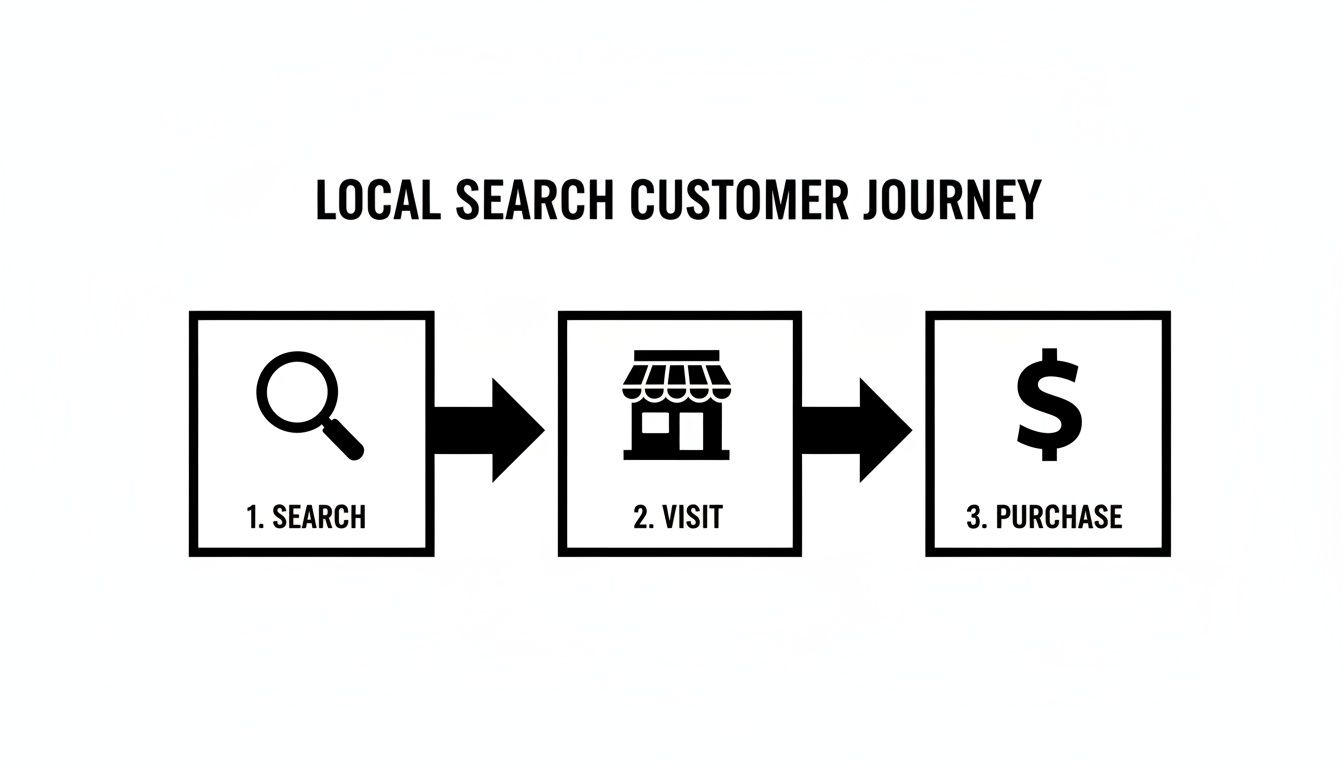
It's a clear line from a search on their phone to a visit or purchase at your business. A strong online presence makes that journey happen.
Google Business Profile Optimisation Checklist
To make it crystal clear, here’s a look at what separates a basic, forgotten profile from one that’s actively winning customers.
| Feature | Basic Profile (What to Avoid) | Optimised Profile (Your Goal) |
|---|---|---|
| Business Name | Inconsistent (e.g., "Jim's Plumbing" vs "Jims Plumbing PTY LTD") | 100% accurate and matches official branding. |
| Primary Category | Too broad (e.g., "Contractor") | The most specific, relevant category available (e.g., "Roofing contractor"). |
| Address & Service Areas | Just a postcode listed. | Full, accurate address (if applicable) and a detailed list of all suburbs/regions served. |
| Photos & Videos | A single, low-quality logo or no images at all. | A steady stream of high-quality photos of work, team, and premises, plus short videos. |
| Business Description | Blank or just a single sentence. | A full 750-character description with services, location keywords, and a unique selling point. |
| Services/Products | Left empty. | Every single service and product is listed with its own description and price (if applicable). |
| Google Posts & Q&A | Never updated or used. | Regular posts (offers, updates) and proactive answering of customer questions in the Q&A. |
This table isn't just a checklist; it's a roadmap. Your goal is to move every single feature of your profile from the "Basic" column over to the "Optimised" one.
Uncovering Powerful Local Keywords
With your GBP looking sharp, it's time to figure out what your customers are actually typing into Google. Local keyword research isn't about chasing massive search volumes; it's about zeroing in on the high-intent phrases people use when they need a local service right now.
You have to think like a customer. They're not just searching for "electrician." They're searching for "emergency electrician North Sydney" or "best coffee shop in Carlton with wifi." These longer, more specific phrases are absolute gold.
The secret formula is surprisingly simple: [Service] + [Location]. This is the foundation of almost all effective local keyword research.
Start by brainstorming all your core services. Next, list every single suburb, town, or neighbourhood you serve. Now, combine them. A landscaper based in Adelaide might come up with:
garden design Unleyretaining wall Norwoodpaving contractor Glenelg
Nailing this gives you a massive edge. Businesses that get into Google's Local Pack see 126% more traffic and 93% more actions (like calls and website clicks). Yet, a mind-boggling 58% of Australian businesses do absolutely nothing to optimise for local search.
Weaving Keywords into Your Digital Presence
Okay, you've got your list of keywords. Now what? The key is to weave them naturally into your online assets, not just stuff them in everywhere.
Your Google Business Profile is the perfect place to start. Your description, services list, and Google Posts are all prime real estate for your service and location terms. Even the Q&A section is an opportunity. If someone asks, "Do you do commercial fit-outs in the CBD?" your answer not only helps that person but also signals your relevance to Google.
From there, your website is the next piece of the puzzle. You can build out dedicated pages for your most important services and the key locations you serve, but we’ll get into that in more detail later. For a deep dive with real-world examples, check out our guide on local SEO for electricians.
Establishing Local Trust and Authority
With your Google Business Profile looking sharp, it’s time to start building trust signals that Google can see across the web. Think of it like a real-world reputation. If one person recommends you, that's nice. But if dozens of different, respected people are all saying the same great things about you, that recommendation carries some serious weight.
This is exactly where local citations and customer reviews come in. They are the twin pillars of your online reputation, proving to Google that you’re a legitimate, trusted local business.
The Critical Role of NAP Consistency
The first pillar is all about consistency, specifically with your NAP data—your business Name, Address, and Phone number. Google is basically a digital detective, scouring the web to cross-reference your business info. It wants to verify that you are who you say you are, and that you’re actually located where you claim to be.
Every time Google finds your NAP listed identically on a reputable website, it's another tick in the box, reinforcing your legitimacy. But when it finds conflicting details—an old phone number here, a slightly different business name there—it creates doubt. That confusion erodes trust and can sink your local search rankings.
Imagine a Melbourne plumber listed as "ABC Plumbing" on their GBP, but as "ABC Plumbing PTY LTD" on Yellow Pages and "ABC Plumbers" on TrueLocal. To a customer, it's a bit messy. To Google, it’s a red flag. The goal is to make your business information so perfectly consistent that it's undeniable.
Building Your Australian Citation Portfolio
A "citation" is just a fancy word for any online mention of your business's NAP, usually in an online directory. You’ll find thousands of directories out there, but this is a classic case of quality over quantity. For Aussie businesses, the smart move is to focus on a core list of high-authority local and national directories.
Get your business listed on these with perfectly consistent NAP information, and you're off to a flying start:
- Yellow Pages Australia: It might feel old-school, but it's still a major authority source in Google's eyes.
- TrueLocal: A well-known and trusted Australian directory that packs a punch.
- Yelp Australia: A huge review site that also acts as a powerful citation source.
- Hotfrog: A long-standing directory with a solid presence down under.
- Word of Mouth (WOMO): This review-focused platform provides a fantastic local signal.
Getting these listings right is a foundational task in local SEO for businesses. It’s not the most exciting job, but it’s absolutely essential for building the authority you need to rank.
Turning Customer Reviews into Ranking Fuel
The second pillar of trust is your reputation, and online, that's all about your customer reviews. Reviews are absolute gold. They provide social proof to potential customers and feed Google a steady stream of fresh, relevant content about what you do. A consistent flow of positive reviews tells Google that you're an active, trusted business that people like.
So, how do you get more reviews without being annoying? The secret is to make it incredibly easy and to ask at the perfect moment.
Don’t just hope for reviews—build a simple process to ask for them. A simple text or email with a direct link to your Google review page, sent right after a successful job, can dramatically increase your review count.
When you ask, you can even give a gentle nudge. A simple prompt like, “If you have a moment, we’d love it if you could mention the service we provided and the suburb you’re in,” is a great way to get keywords into your reviews. A customer leaving a review that says, “Fixed our blocked drain in Newtown quickly and professionally!” is pure SEO gold.
Responding to Every Single Review
How you handle the feedback you receive is just as important as getting it in the first place. Responding to every review—good and bad—shows you’re engaged and you genuinely care about your customers. It's also another chance to subtly reinforce what you do.
For Positive Reviews:
- Be Specific: Thank them by name and mention the job. For example: “Thanks, Sarah! We’re so glad we could help with the switchboard upgrade in your Fitzroy home.”
- Show Gratitude: A genuine "thank you" goes a long way.
For Negative Reviews:
- Stay Calm and Professional: Whatever you do, don't get into a public slinging match.
- Acknowledge and Apologise: Start by acknowledging their frustration and apologising that their experience wasn't up to scratch.
- Take it Offline: Offer a direct contact—a name, phone number, or email—to resolve the issue privately. This shows everyone else that you take complaints seriously and work to make things right.
Every single response is a public display of your customer service. Get this right, and your review section becomes one of your most powerful marketing assets.
Optimising Your Website to Attract Local Customers
Think of your Google Business Profile as the friendly wave from across the street, but it's your website that invites people in for a cuppa. This is where all your local SEO efforts should lead, turning someone just browsing into your next customer. It’s time to get your website working harder for you, turning it into a proper local lead magnet.
There's a straight line connecting your GBP to your website. A potential customer finds you on Google Maps, clicks through to your site to learn more, and then makes a snap judgment. If your site is clunky or generic, they'll hit the back button and land right in the lap of your competition.
Creating Hyper-Local Service Pages
Here’s a game-changer: stop thinking of your website as a single brochure. Instead, picture it as a collection of targeted landing pages, each built to attract a specific type of local customer. That means creating separate pages for each of your key services in your most important suburbs or towns.
A marketing agency in Brisbane, for instance, shouldn't just have a generic "Services" page. A much smarter play is to build out specific pages like:
Website Design BrisbaneSEO Services Fortitude ValleyGoogle Ads Management Gold Coast
Each of these pages can be fine-tuned with content, headings, and images that speak directly to customers in that specific area. This signals to Google that you're not just some general agency; you're the expert they're looking for. You're no longer just a business in Brisbane; you're the go-to for website design in the CBD.
Weaving Local Keywords into Your Content
Once you've got your local pages set up, you need to fill them with genuinely useful content that naturally includes your keywords. The aim is to show Google you're relevant to a location without sounding like a broken record.
Try to weave your "service + location" phrases into these key spots on the page:
- Meta Titles and Descriptions: The title tag is a huge ranking signal. A title like "Expert Roof Repairs in Toowoomba | Call Us Today" is miles better than a flat "Our Services."
- Headings (H1, H2, H3): Use your keywords in the main page headings and subheadings. It helps structure your content and tells Google what the page is about at a glance.
- Body Content: Don't be afraid to get local. Talk about nearby landmarks, mention specific suburbs where you've completed jobs, and use language that locals will recognise.
Another quick win is embedding a Google Map on your contact page. It’s a simple but powerful way to visually confirm your location and makes it dead easy for customers to find you, reinforcing that you’re a real, local business.
Demystifying Local Business Schema Markup
"Schema markup" sounds a bit techy, but it’s actually pretty straightforward. Think of it as a digital name tag for your business that you clip onto your website's code. This tag tells search engines all your key details in a language they can read instantly.
Local Business schema is one of the most powerful tools in your arsenal. It directly communicates your business name, address, phone number, opening hours, and business type to Google, removing any guesswork.
This structured data helps Google show off useful tidbits about your business right in the search results, like your star rating or opening hours. It does mean adding a small snippet of code to your site, but the boost it can give your local visibility is massive. Many modern website platforms and plugins make this surprisingly easy to do.
The Non-Negotiable Mobile Experience
The final piece of the on-page puzzle is making sure your website works brilliantly on a mobile phone. This is where most local searches happen—people are out and about, looking for a solution right now. If your website is slow, hard to read, or makes them pinch and zoom, you’ve already lost them.
A truly effective local SEO for businesses strategy depends on getting this right. In fact, a properly optimised mobile site can cut your bounce rate by 20%. People trust sites that work well on their phone, and Google's algorithms are paying close attention.
A smooth mobile experience is absolutely critical. To learn more about what makes a website great for users, check out our article on user experience design principles. Your site needs to be fast, simple to navigate, and make it incredibly easy for someone on their phone to find what they need and get in touch.
Measuring Your Local Impact and Planning for Growth
So you’ve put in the hard yards setting up your profiles, chasing up reviews, and building out your local pages. That’s fantastic. But how do you actually know if it’s working?
Putting in the effort without checking the scoreboard is just guessing. The real magic happens when you connect all those local SEO activities to tangible business results, proving your time and money are paying off.
The great news is you don’t need to be a data wizard to figure this out. Your Google Business Profile is a goldmine of simple, clear information that shows you exactly how real customers are finding you.
Decoding Your Google Business Profile Insights
Your GBP Insights is the most direct way to see what’s what. It cuts straight to the chase, showing you the actions that lead to actual customers walking through your door or calling your phone.
Forget getting bogged down in complex analytics. For a local business, it all comes down to a few key numbers.
These are the metrics that show people are moving from simply searching to actively getting in touch:
- Direct Calls: This is a pure gold metric. It tracks how many people tapped the "Call" button right on your profile. It's the clearest sign that your local SEO is generating hot leads.
- Website Clicks: This one shows how many people clicked through to your website from your profile. It means your GBP grabbed their attention, and now they want to dig a little deeper.
- Direction Requests: A brilliant one for any brick-and-mortar business. This counts how many people asked Google Maps for directions to your spot, signalling a strong intent to visit.
Tracking these core GBP metrics is the fastest way to see the real-world impact of your efforts. An increase in calls and direction requests is a direct line to more business, making it the ultimate measure of success for local SEO.
Watching these numbers climb is the proof in the pudding. It shows that your work on local SEO for businesses is delivering a genuine return.
Your Simple Monthly Local SEO Check-Up
To keep things moving in the right direction without getting overwhelmed, all you need is a simple monthly check-up. Just block out 30 minutes at the start of each month to see where you're at and decide what's next. It's a simple rhythm that keeps you focused.
Here’s a practical checklist to run through:
- Review GBP Insights: Pop open your insights and jot down the calls, website clicks, and direction requests from the last month. Are the numbers heading up? What’s driving the most action?
- Check Your Rankings: Open an incognito browser window and do a quick search for your top 2-3 "service + location" keywords. See where you’re sitting in the Local Pack and the regular organic results.
- Analyse New Reviews: Read through any new reviews you’ve received. Make sure you reply to any you missed and keep an eye out for feedback or patterns you can use to make your service even better.
- Plan Your Next Month: Based on what you’ve found, set one small, achievable goal for the month ahead. Maybe it's publishing two Google Posts, asking five happy customers for a review, or finally building that new service page for your website.
This routine turns SEO from a monster of a task into a manageable monthly process, ensuring you’re always making progress.
If you want to get more advanced, start looking at what your competitors are up to. Find out more in our guide on how to conduct competitor analysis and uncover the opportunities they're missing.
Knowing When to Partner for Growth
At some point, you'll likely find you've hit a ceiling. You've built a solid foundation and you're seeing results, but you're either running out of hours in the day or you're ready to start challenging the bigger players in your area.
This is the perfect moment to think about bringing in a professional team.
Partnering with an agency isn't about starting over; it's about pouring fuel on the fire you've already started. While you get back to focusing on what you do best—running your business—a dedicated partner can tackle the more advanced strategies like local link building, technical SEO, and scaling your content to dominate multiple suburbs or service areas.
They have the expertise and the tools to take the groundwork you’ve laid and build a local powerhouse, helping you scale your success and cement your spot as the go-to business in your market.
Frequently Asked Questions About Local SEO
Getting your head around local search can feel like a bit of a mission. We get it. So, let's cut through the jargon and tackle some of the big questions we hear all the time from Aussie business owners just like you.
How Long Does It Take for Local SEO to Work?
This is the million-dollar question, isn't it? I’d love to give you a magic number, but the honest-to-goodness answer is: it depends.
You might see a nice little bump in visibility within a few weeks just by sorting out your Google Business Profile. But proper, lasting local SEO is a marathon, not a sprint.
For most businesses, you're looking at seeing real, meaningful results—more calls, more website clicks, more leads—within three to six months of consistent work. Things like how crowded your local market is and what shape your online presence is in to start with will make a big difference. Think about it: a new plumber in a packed Sydney market has a much tougher climb than a boutique cafe in a quiet regional town.
The real secret isn't one big push; it's about building momentum. Consistently getting new reviews, keeping your business details accurate everywhere, and posting local content is what compounds over time to deliver those fantastic long-term results.
Can I Do Local SEO Myself or Should I Hire an Agency?
You can absolutely get the ball rolling yourself. In fact, we reckon every business owner should get comfortable with the basics.
This guide is designed to give you the power to claim and properly fill out your Google Business Profile, start getting reviews, and build those first crucial citations. Just doing those things will put you streets ahead of a lot of your competitors.
But there comes a point where calling in the pros is a smart move. If you're up against some heavy competition, feel like you've hit a wall, or just don't have the hours in the day to keep it all going, an agency can be a brilliant investment. They can handle the more technical stuff like link building, website optimisations, and deep-diving into what your competitors are up to, leaving you free to do what you do best—run your business.
What Is the Most Important Part of Local SEO for Businesses?
If you only have the time and energy to focus on one single thing, make it your Google Business Profile (GBP). Hands down, it's the absolute cornerstone of any decent local SEO for businesses.
Your GBP is the engine that gets you seen in the Google Local Pack (that map with the top three results) and on Google Maps.
When your profile is accurate, complete, and buzzing with activity—think great photos and glowing reviews—it screams relevance and trust to Google. It’s the fastest and highest return on your time, making it the non-negotiable first step.
Do I Need a Physical Address for Local SEO?
This one catches a lot of people out, especially tradies and other service-based businesses. The short answer is, it depends on how you operate.
- Storefront businesses like a café, a shop, or a clinic? Yes, you need a physical address that customers can visit. This is what will show up publicly on Google.
- Service Area Businesses (SABs) that go out to customers, like a mobile mechanic, plumber, or a cleaner? You do not need to show your address.
If you're an SAB, you can set your GBP to display a service area instead of a street address. You can define this by listing suburbs or drawing a radius on the map. You'll still need a real mailing address for Google to send your verification postcard to, but you can (and should) choose to hide it from the public. This lets you show up in searches across all the areas you serve without giving away your home or office location.
Ready to stop guessing and start getting real results from your local SEO? The team at Website Builder Australia are local experts who can build a powerful online presence that attracts more customers. Contact us today for a chat about your business goals.


