

PPC Advertising Perth: Grow Your Business Locally
You search your service on Google, and the same competitors keep showing up above the organic results. They've got the call button, the sitelinks, the promo copy, and they look established before anyone even scrolls. If you're a Perth business owner, that's usually the moment PPC stops feeling optional and starts feeling like something you need to understand properly.
The trouble is that most advice on paid search sits at one of two extremes. It either makes Google Ads sound so simple that you can launch it over lunch, or so technical that you feel like handing over your credit card and hoping for the best. Good PPC advertising in Perth sits in the middle. It's approachable, but it isn't casual. The businesses that do well tend to be the ones that get the fundamentals right early, track the right actions, and avoid letting automation make decisions before the account has enough data to support it.
Why PPC Advertising Matters in Perth Now
Perth businesses aren't experimenting with paid search anymore. They're using it as a core lead generation channel, and that changes the playing field for everyone else.
One industry source estimates that 60%–70% of digitally active SMBs in Perth run some form of PPC, with average monthly spend of $1,500–$6,000 in the metro area. The same source says 65% of Australian SMBs were running active PPC campaigns in 2024, up from 26% in 2016 (Rocking Web's Australian Google Ads usage overview). That tells you two things. First, your competitors are probably already there. Second, ad platforms now reward businesses that are organised, not just businesses that show up.
That shift matters because local search intent is often immediate. Someone looking for a plumber in Baldivis, a physio in Subiaco, or a family lawyer near Perth CBD usually isn't doing broad market research. They want a provider now, and paid search lets you appear in front of that demand while it exists.
What the Perth market reality means
If a large share of local businesses are already buying visibility, PPC becomes less about “trying ads” and more about buying qualified attention without wasting budget. A loose campaign structure, weak landing page, or poor tracking setup gets exposed fast in a competitive market.
DIY can still work. But DIY without a plan usually means paying for searches that never had a chance of turning into a customer.
Practical rule: In Perth, the question usually isn't whether paid search can work. It's whether your campaign is tightly built enough to compete against businesses already running it every month.
If you're still deciding how PPC fits into your broader mix, it helps to step back and look at the wider channels available. This guide to effective website advertising is a useful primer because it puts paid traffic in context rather than treating it like a magic switch.
Laying the Groundwork for Your First Campaign
Most bad Google Ads accounts don't fail because the platform is hard. They fail because the planning was vague from the start.

A Perth electrician, a cosmetic clinic, and an online retailer shouldn't build campaigns the same way. Their buyers search differently, compare differently, and convert differently. The campaign has to reflect that before you write a single ad.
Start with one job for the campaign
Pick the main action you want from traffic. Not five actions. One primary outcome.
That might be:
- Phone calls: Best for urgent services like plumbing, locksmiths, electrical, towing, or after-hours medical.
- Quote requests: Common for builders, garden designers, accountants, legal firms, and commercial service providers.
- Online purchases: Better for ecommerce, gift stores, specialty retail, and product-led businesses.
- Booked appointments: Often the clearest path for clinics, consultants, and professional services.
If you try to make one campaign do all of them at once, the message gets muddy. The landing page does too.
Build around search intent, not product categories
Many first campaigns often drift off course at this stage. Business owners often organise campaigns around how they think about the business. Google Ads works better when you organise around how customers search.
A Perth-based tradie might need separate keyword themes for emergency jobs, general service work, and suburb-based searches. An online store might need themes by product line, brand, or high-intent purchase searches.
A simple perspective:
| Business type | Better keyword approach |
|---|---|
| Local service business | Service + suburb, service + near me, urgent intent terms |
| Professional service | Problem-based searches, service-specific queries, appointment intent |
| Ecommerce | Product-specific terms, category intent, brand and comparison searches |
“Electrician Joondalup” and “switchboard upgrade Perth” belong in different ad groups if the intent is different. Same business, different user need.
Know what makes a lead worth paying for
Not every lead is equal. A phone call from someone outside your service area isn't useful. A quote form from a student doing price research might not be useful either. Before launch, decide what counts as a good conversion in practice.
Ask:
- Which suburbs or service areas are profitable for us?
- What jobs or products have the best margin?
- What questions does a serious buyer ask before contacting us?
- What can we exclude early to avoid junk traffic?
Those answers shape your keyword list, your negative keywords, and your ad copy.
The best first campaign is rarely the broadest one. It's the one with the clearest commercial intent.
Map the journey before you touch Google Ads
A user sees an ad, clicks, lands, and decides. That path sounds simple, but every weak point costs money.
Before launch, make sure you've got these basics sorted:
- Offer clarity: The ad and page should make it obvious what you do.
- Local relevance: If you service Perth metro, say so. If you only cover selected suburbs, say that instead.
- Contact path: Call, form, book, or buy. Don't make users guess.
- Tracking plan: Decide what actions you'll measure before traffic starts.
Good PPC account builds are boring in the best way. They're structured, deliberate, and easy to read later when you need to optimise.
Setting a Realistic PPC Budget for the Perth Market
Budget conversations go wrong when people only talk about ad spend. Google gets one part of the money. Management, tracking, landing page work, and reporting sit on top of that. If you don't model the full cost upfront, the account often gets underfunded or judged too early.
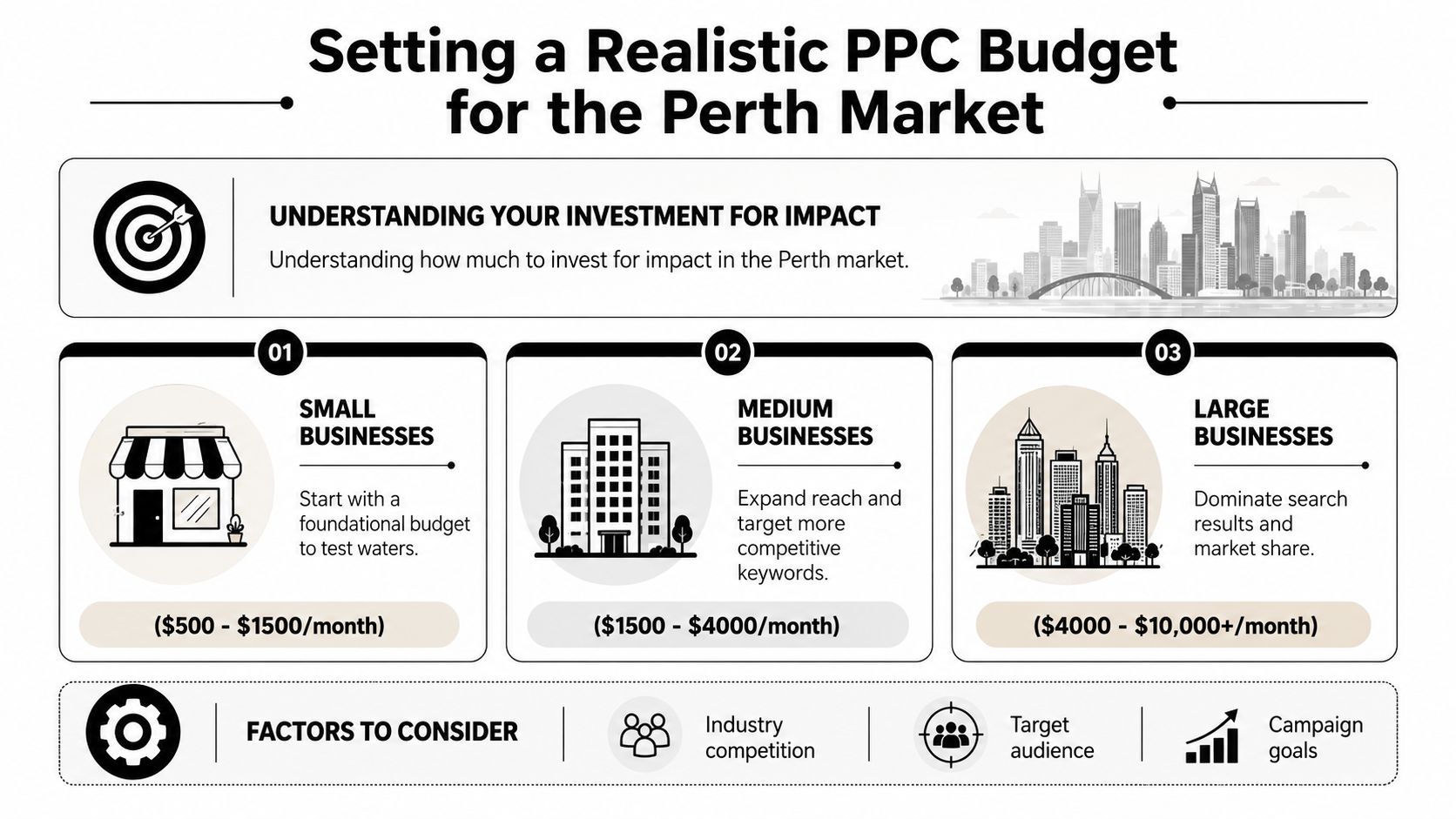
For Perth PPC accounts, a practical benchmark is A$1,500–A$5,000 per month in media spend with A$800–A$5,000 per month in management fees, depending on account complexity (Semaphore Search's Perth PPC budget guide). That same benchmark points to a smarter planning sequence. Model the total investment first, then decide how much should go into Search, Display, Shopping, Demand Gen, or Performance Max.
What smaller budgets usually require
A lean budget can work, but only if the scope is tight. Many Perth campaigns, however, lose discipline at this stage. The owner wants all suburbs, all services, all devices, and several campaign types from day one. The budget can't support that spread.
With a smaller monthly investment, you usually need to narrow the account to:
- One priority service: For example, hot water repairs instead of every plumbing service.
- One service area cluster: Such as northern suburbs rather than all of Perth metro.
- One clear conversion action: Usually calls or quote forms, not both weighted equally.
- One core network: Search first. Add the rest only when the basics are stable.
That approach doesn't limit growth. It protects budget while you learn what converts.
A more detailed Australian cost breakdown can help when you're planning spend and management together. This overview of how much Google PPC costs in Australia is useful if you want a broader pricing frame before speaking with a provider.
What broader budgets allow you to test
Once there's enough budget to support cleaner segmentation, the account gets more flexible. You can test service-based campaign splits, suburb clusters, brand protection, remarketing audiences, Shopping feeds, or newer campaign types without starving the main acquisition campaign.
This short video gives a helpful practical perspective before you finalise your numbers.
Budget for data, not just traffic
A common mistake is treating budget as a click-buying exercise. It's not. A good PPC budget buys three things at once: visibility, learning, and decision-making. If there isn't enough spend to generate meaningful patterns, you can end up making changes based on noise.
Don't ask whether a budget can “run ads”. Ask whether it can generate enough signal to tell you what to keep, cut, or expand.
That's why serious advertisers cost out the whole system first. Media spend matters. Management matters. Tracking matters. Landing page quality matters. If one piece is undercooked, the budget looks worse than it really is.
Building Your First Google Ads Campaign
A Perth business can waste a month of ad spend with a campaign that looked fine at launch. The usual cause is simple. Too many services grouped together, broad location targeting, generic ads, and no clear path from keyword to enquiry.
That is why the first build matters. A tidy account is easier to manage yourself, and it is easier for an agency to improve later if you decide to bring one in.
Build around how people actually search
Start with search intent, not with your website menu.
If you run a local service business, the cleanest setup is usually a small number of campaigns split by commercial difference. One campaign for your main revenue service. Another for a secondary service if the search terms, ad message, and page are meaningfully different. A brand campaign is often worth adding early if competitors bid on your business name or if you want control over what searchers see first.
Inside those campaigns, keep ad groups tight enough that one ad can speak directly to one theme. “Emergency electrician Perth” should not sit in the same ad group as “ceiling fan installation” and “switchboard upgrade.” They lead to different conversations, different urgency, and often different pages.
For many Perth advertisers, fewer campaigns with cleaner intent beats a bloated account full of clever labels and weak relevance.
Set location targeting to match your service area
Perth is spread out. Travel time, suburb familiarity, and call-out costs all shape campaign performance.
A business covering the whole metro area can target Perth broadly, but plenty of local operators get better results by narrowing the footprint. North of the river, south of the river, coastal suburbs, inner metro, or a radius around the office can all make sense depending on how the business runs day to day. If your team rarely books work in Mandurah or Joondalup, paying for those clicks just because they sit within a wider map setting usually adds waste.
The copy should match that targeting. “Perth metro service” sets one expectation. “Local plumber in Balcatta” sets another. Use the version that reflects your real coverage, not the one that sounds bigger.
Write ads that answer the search fast
Search ads do not need brand poetry. They need clarity.
Good ads usually cover three things. What the person wants, why your business is a credible choice, and what action to take next. In practice, that often means direct headlines such as:
- Emergency Plumber Perth
- Same-Day Hot Water Repairs
- Book a Local Tax Accountant
- Commercial Electrical Quotes
Loose claims like “trusted solutions” or “quality service at great prices” rarely help because every competitor can say the same thing.
A simple test works well here. If a rival could copy your ad word for word and nobody would notice, the message is too vague.
Use assets that remove small points of friction
Assets are not an afterthought. They help the ad take up more space and give people faster ways to act.
For local Perth campaigns, these are usually the most useful:
| Asset | Why it helps |
|---|---|
| Location asset | Shows local presence and builds trust |
| Call asset | Helps mobile users contact you straight away |
| Sitelinks | Sends visitors to the most relevant service pages |
| Callout assets | Highlights availability, guarantees, or service strengths |
| Structured snippets | Lists service types or product categories clearly |
If phone calls matter more than form fills, make calling easy. If quote requests are the goal, send traffic to a page built for that action, not a generic homepage. If you need a clearer picture of what makes a good landing page for paid traffic, sort that out before scaling spend. For quick mockups or message testing, The AI CMO landing page builder can help you shape a cleaner destination before involving a developer.
Connect tracking before you switch anything on
No Perth business should launch blind, whether you are managing the account yourself or paying an agency.
At minimum, connect form submissions, phone call tracking where practical, and key lead actions into Google Ads and GA4. Then check that the conversions reflect real business value. A contact form from a high-intent service page is not the same as a general enquiry. A phone click is not the same as a booked job. If the tracking setup treats all actions as equal, the campaign can optimise toward the wrong outcome.
Automation has made campaign setup faster, but it has not removed the need for judgement. Google can help with bidding and audience signals. It still needs clean inputs, clear goals, and a structure that matches how your Perth customers search.
From Clicks to Customers Landing Page Best Practices
Many businesses believe they have a Google Ads problem when their issue is with the page. The ad gets the click. The page closes the gap between curiosity and action.
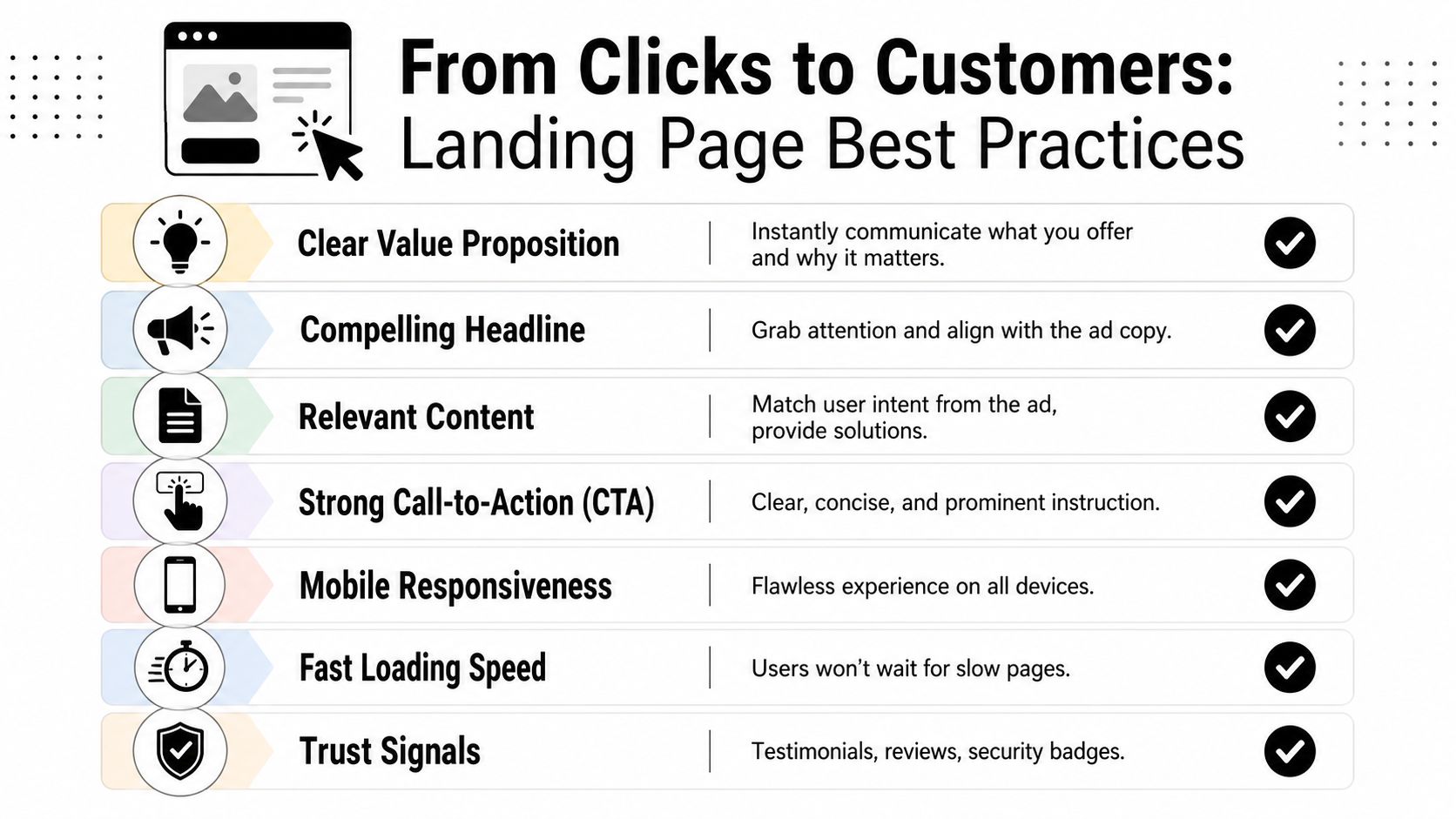
If someone clicks an ad for “emergency electrician Perth” and lands on a generic homepage with a rotating banner, five menu paths, and no obvious phone number, you've paid for confusion. That's why dedicated landing pages usually outperform broad site pages for paid traffic.
The page has to match the promise
Message match is the first checkpoint. The headline on the page should reflect what the ad offered. Not loosely. Clearly.
A strong PPC landing page usually includes:
- A headline that mirrors the search intent
- A short explanation of the service or offer
- A visible call to action above the fold
- Trust signals such as reviews, credentials, or local business details
- Minimal distractions from the primary action
If you need a quick way to prototype a cleaner destination page, tools like The AI CMO landing page builder can help you test structure and messaging before a developer gets involved.
Remove friction before you buy more clicks
Most underperforming pages suffer from one or more of these:
| Problem | What it does |
|---|---|
| Generic headline | Makes the click feel misaligned |
| Too many navigation options | Pulls users away from the intended action |
| Weak mobile layout | Loses users who arrived ready to call or enquire |
| Long or confusing form | Lowers completion rates |
| No local trust markers | Makes the business feel distant or uncertain |
For local service businesses, even simple cues help. A WA phone number, suburb references, service area copy, local testimonials, and realistic turnaround messaging all reduce hesitation.
If you need a practical refresher on how these pages differ from normal website pages, this guide on what a landing page is and how it works gives a solid baseline.
The landing page doesn't need to impress everyone. It needs to reassure the right visitor and make the next step obvious.
Treat mobile as the default
A lot of Perth lead-gen traffic comes from phones. If the page loads awkwardly, forces too much typing, or hides the call button, conversions suffer even when the ad itself is strong.
For service businesses, the best mobile pages are often the least complicated. Clear headline. Short proof section. Fast contact option. No clutter.
That's not flashy design. It's conversion design.
Measuring Performance and Optimising for Growth
A common Perth PPC pattern looks like this. The campaign starts generating clicks, the phone rings a bit more, and then the uncertainty kicks in. Which suburb is producing decent enquiries? Which keyword is bringing in tyre-kickers? Is Google's bidding helping, or is it just spending faster?
That's the point where PPC stops being a setup job and becomes a measurement job.
Track outcomes, not just platform metrics
Clicks, CTR, and CPC still matter, but they sit lower on the list than booked jobs, qualified leads, sales value, and cost per real customer. For a Perth service business, that usually means tying Google Ads back to phone calls, form submissions, and what happened after the enquiry reached your team.
A practical reporting order looks like this:
- Conversions
- Lead or sale quality
- Cost per lead, cost per sale, or ROAS
- Conversion rate
- CTR and CPC
If you want a clearer commercial view of paid media, this guide on mastering return on ad spend is a useful reference because it keeps the formula tied to actual decisions.
A campaign can produce cheap clicks and still be a poor investment. Another can have higher CPCs and become your best source of profitable work.
Perth accounts often need more measurement than DIY guides suggest
This gets harder once calls, offline quotes, and follow-up sales enter the picture. Many Perth businesses do not close the lead on the landing page. The lead comes through, the office calls back, a technician visits, or the customer walks into the showroom later.
That gap matters. If the only thing being tracked is a thank-you page, the account is learning from incomplete signals.
23 Digital makes this point well in its piece on modern PPC strategy and measurement. Privacy changes, browser restrictions, and platform automation have made attribution less clean than it used to be. That puts more weight on first-party data, offline conversion imports, and lead-quality feedback from your CRM or sales process.
For local businesses, the gap between DIY and professional support usually first becomes evident. Campaign setup is manageable. Accurate tracking across calls, forms, and closed revenue is harder.
If you are reviewing whether your account is ready for outside help, this advice on choosing a Google Ads specialist for Australian businesses gives a good benchmark.
Use automation carefully
Automation can work well. It can also make poor decisions faster if the account is feeding it weak conversion data.
That is why smaller Perth accounts often need a more hands-on approach early on. If a campaign only generates a limited number of trustworthy conversions each month, manual bidding or a tightly controlled bidding strategy is often the safer option. Once tracking is cleaner and conversion volume is consistent, automated bidding has a better chance of improving results instead of chasing noise.
The platform recommendation is not the same thing as the right recommendation for your account.
A simple warning sign is easy to spot. Spend increases, reported conversions hold steady, and lead quality drops. In practice, that usually points to weak inputs rather than a bidding breakthrough.
Review weekly, change selectively
Good optimisation is disciplined. It is not constant tinkering.
Use a weekly review rhythm that checks the parts of the account most likely to affect profit:
- Search terms: Add negatives where irrelevant traffic is creeping in
- Keyword intent: Separate high-intent terms from research-style queries
- Ads and asset relevance: Make sure the message still matches what the searcher wants
- Conversion paths: Compare pages and forms to find where leads are dropping off
- Lead quality: Check with the sales team which campaigns are producing work worth quoting
- Budget allocation: Push spend toward services, suburbs, or terms that are producing real outcomes
One change at a time is usually enough. A new headline, a tighter keyword group, a cleaner conversion action, or a better negative list can tell you more than five edits made at once.
That's how growth usually happens in PPC. Not through dramatic rebuilds every fortnight, but through cleaner tracking, better judgement, and steady account decisions based on what the business values.
Deciding to Hire a Perth PPC Agency
A common Perth scenario looks like this. A business owner starts Google Ads themselves, gets a few enquiries, then hits a wall once the account needs proper call tracking, cleaner reporting, suburb-level targeting, and better decisions about where budget should go.
That turning point matters.
Running PPC yourself is often a smart way to learn what customers search for, which services attract real demand, and how competitive your part of the Perth market really is. But the job changes once the basics are in place. Past that point, results depend less on launching ads and more on measurement, account structure, landing page quality, and knowing when Google's automation is helping versus when it is masking weak data.
DIY versus agency support
DIY can still work well if the setup is straightforward. That usually means a single location, a narrow service range, one main lead action, and enough time each week to review search terms, budgets, and lead quality.
Agency support starts to make sense when the account has more moving parts, such as:
- Multiple services with different margins
- Different target suburbs across Perth
- Phone calls, forms, and offline sales outcomes to track
- Landing pages that need regular testing
- Budget decisions that affect booked work, not just lead volume
Value lies in judgment. A decent agency should be able to explain why one campaign stays on manual bidding, why another uses automation, why leads from one suburb are cheaper but worse, and why a higher conversion count does not always mean better business performance.
That matters even more now because Google Ads is easier to start than it is to measure properly. Plenty of Perth businesses can manage the DIY phase. Fewer have the time or technical setup to keep improving once attribution gets messy and automated bidding starts relying on incomplete signals.
If you're weighing up providers, this guide to choosing a Google Ads specialist in Australia is a useful starting point.
Questions worth asking before you hire anyone
Skip the generic pitch and ask how they practically run an account.
A useful shortlist:
- How do you define a qualified lead for a business like mine?
- What will you track beyond clicks and form submissions?
- When would you avoid Smart Bidding and use manual bidding instead?
- How would you split campaigns by service, suburb, or intent?
- What do you usually fix first in month one?
- How do you report on lead quality and sales outcomes, not just lead count?
Good answers are usually clear and specific. If an agency cannot explain trade-offs in plain English, or cannot tell you what they need from your sales process, website, and tracking setup, they are probably selling management without offering much strategic help.
The best fit is not always a full handover, either. For some Perth businesses, the right option is hybrid support. You keep visibility over the account and day-to-day business context, while a specialist handles structure, testing, tracking, and the harder optimisation work. That middle ground often works well for owners who want more than a DIY setup but are not ready to outsource everything.


