

SEO for Lead Generation: SMB Guide 2026
Most advice about SEO for lead generation is built for companies with a marketing team, a content calendar, and someone whose full-time job is publishing articles. That's not how most Australian small businesses operate.
For a Brisbane tradie, a local service firm, or a five-person B2B business, the usual playbook breaks down fast. The issue isn't motivation. It's workload. Data from the Australian Bureau of Statistics shows that 78% of SMEs in Queensland have fewer than 5 employees, and a 2024 report found that 64% of these micro-businesses abandon SEO because of the ongoing content burden reported here. If your SEO plan depends on endless blog posts, it's probably the wrong plan.
Good SEO for lead generation doesn't start with publishing more. It starts with making sure the right people can find you, trust you, and contact you without friction. For most SMBs, that means focusing on buyer-intent keywords, Google Business Profile, high-converting service pages, and a small set of technical fixes that directly affect enquiries.
Why SEO Is Your Best Bet for Leads in Australia
Small businesses usually get pushed toward channels that feel fast. Paid ads. Cold outreach. Boosted posts. Those channels can work, but they often stop working the moment you stop spending.
SEO behaves differently. It builds an asset. When your service pages rank, your Google Business Profile shows up, and your site answers the commercial searches your buyers already make, you keep generating enquiries without paying for every click.
The numbers make the case
In Australia, SEO is the single most important digital channel for B2B lead generation, driving 76% of all trackable website traffic, and organic search leads convert at 14.6% compared with 1.7% for outbound marketing according to industry data compiled by First Page Sage. That gap matters because it changes how you should think about effort.
SEO isn't just about more traffic. It's about better traffic.
Someone who searches for your service is already problem-aware. They're not being interrupted. They're looking. That's why even a lean SEO setup often outperforms busier marketing programs that create a lot of activity without producing enough qualified leads.
Practical rule: If you have limited time, don't build a content engine first. Build a lead capture system around the searches buyers already make.
Why the usual advice fails SMBs
The common advice sounds like this: publish weekly, cover every topic, build funnels, nurture readers, repurpose into social content. That's fine for a funded SaaS team. It's unrealistic for a suburban electrical contractor or a small legal practice.
A more useful approach is narrower.
- Prioritise service intent: Optimise pages for searches tied to hiring, booking, pricing, and location.
- Tighten existing pages: Rewrite weak titles, headings, and calls to action before creating anything new.
- Own local visibility: For many service businesses, Google Business Profile drives more enquiries than blog traffic ever will.
- Use tools selectively: If you do want help auditing content or tightening on-page SEO, a practical roundup like best SEO tools for bloggers can help you pick lightweight tools instead of overbuying software.
That's the difference between SEO that looks impressive in a proposal and SEO that produces leads for a time-poor owner.
What works in practice
The businesses that get traction usually do three things well. They target ready-to-buy searches, remove friction from contact, and stay consistent with local signals. They don't try to out-publish national brands. They make themselves easier to find and easier to choose.
That's the version of SEO for lead generation that fits real Australian SMBs.
Find Customers Ready to Buy Right Now
Lead generation SEO starts with a simple choice. Target searches from people who need help soon, or spend months chasing traffic that never turns into enquiries.
A search like “what is blocked drain repair” can bring visits from students, DIY researchers, or people with a mild problem they might sort out later. “Blocked drain plumber Brisbane” is different. That person is trying to find someone to call.
Start with commercial intent, not search volume
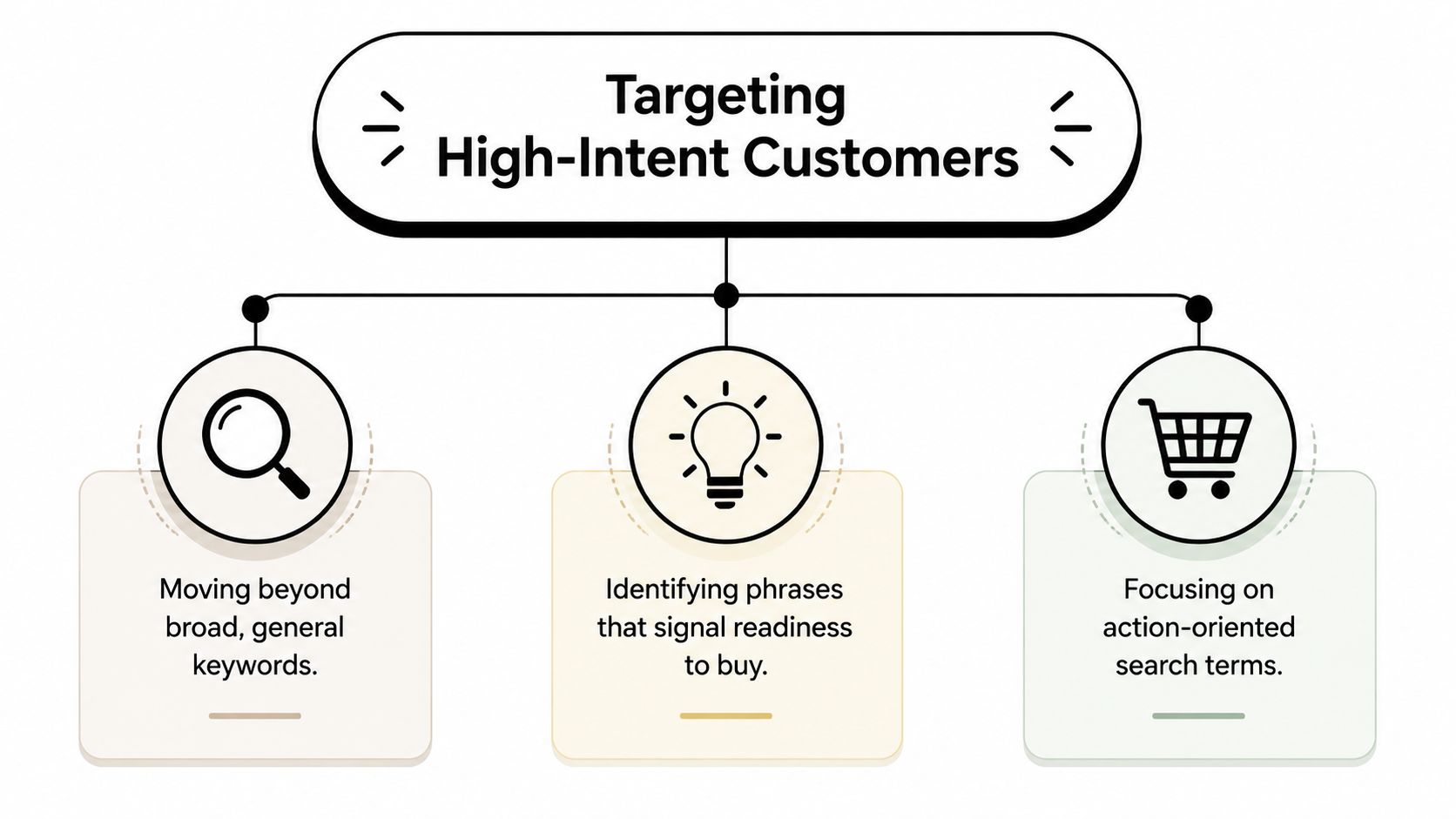
Small business owners get pushed toward big-volume keywords because the numbers look impressive in a report. The problem is intent. Broad terms often pull in people who are learning, browsing, or comparing from a distance. Service businesses usually get better results by focusing on phrases that show urgency, location, and buying intent.
I'd rather help a Brisbane plumber rank for “emergency gas fitter Brisbane” than spend six months chasing a generic term like “plumbing”. The first phrase brings fewer impressions, but the leads are worth more and the page is easier to rank because it matches a specific need.
Use a simple filter. A keyword is worth prioritising when it suggests one of these:
- They need a provider now: “emergency electrician Brisbane”
- They're comparing suppliers: “best bookkeeper for small business Brisbane”
- They want a local option: “roof plumber near me”
- They want a defined outcome: “website redesign for tradies”
That approach suits the situation of Australian SMBs. You do not need a content machine. You need pages tied to services people already search for when they are close to booking.
A practical way to find the right terms
You can build a solid keyword list without paying for enterprise SEO software. Start with Google, your own enquiry history, and the language customers use on the phone.
Search your main service in Google
Type in the plain service name, then add suburbs, cities, and buying qualifiers like “cost”, “quote”, “same day”, or “near me”. Autocomplete often shows the exact wording buyers use.Check the search results page properly
Look at page titles, map results, service ads, and the wording competitors use. If Google keeps showing local providers and service pages, that keyword has commercial intent.Use People Also Ask for objections and qualifiers
Questions about price, turnaround time, service areas, and process belong on service pages. They help the page rank and help the prospect decide.Review related searches
Here, you'll often find suburb modifiers, urgent variants, and service combinations you hadn't considered.Read your reviews and enquiry forms
Customers often describe problems better than marketers do. The phrasing in your reviews can shape headings, FAQs, and service page copy. If you need more proof points to work with, getting a steady flow of Google reviews from real customers also gives you better language for these pages.
One quick test helps here. If the phrase sounds like something a stressed customer would type on their phone, keep it on the list.
Build keyword groups that map to pages
A lot of small business sites weaken their SEO by forcing every term onto the homepage. That usually creates vague copy, weaker relevance, and a page that tries to speak to everyone at once.
Map terms to the page type that fits the search:
| Page type | Keyword style | Example |
|---|---|---|
| Service page | Core commercial phrase | “commercial pest control Brisbane” |
| Location page | Service + suburb/city | “commercial pest control North Lakes” |
| Supporting FAQ section | Buyer objections | “how often should commercial pest control be done” |
This is the practical alternative to publishing endless blog posts. One strong service page can target the main term, answer common objections, explain the process, and give people a clear next step. A matching location page can then pick up suburb-based searches without turning the main service page into a mess.
What to ignore
Skip vanity keywords that look big but have weak buying intent. Skip pages for services you do not offer. Skip copy that stuffs every variation into one paragraph.
Google is good enough now to understand closely related phrases on a clear, well-structured page.
For many SMBs, ten tightly targeted service and location pages will produce more leads than fifty low-intent articles. That is a far better trade-off for a business owner who does not have a content team, a spare twenty hours a month, or the patience to wait for blog traffic that may never convert.
Win the Local Search Battle with Google Business Profile
For a lot of Australian service businesses, the most valuable part of Google isn't the standard blue links. It's the map pack.

According to a 2025 study by the Australian E-commerce Council, 82% of local service leads in Brisbane and Melbourne originate from the Google Maps and Google Business Profile 3-pack rather than traditional organic search results. That changes the priority order for trades, home services, local clinics, and mobile operators.
If you're a local business, you can't treat Google Business Profile as an afterthought. In many cases, it is the lead-generation funnel.
Why GBP often beats your website
Google Business Profile sits closer to the decision point. Users see your reviews, service area, opening hours, phone number, and directions without clicking through multiple pages. For someone needing help quickly, that convenience matters.
That doesn't mean your website is unimportant. It means your website and GBP need to work together. Your profile earns the click or the call. Your site backs up the choice with proof, service detail, and an easy enquiry path.
What an optimised profile actually includes
A claimed profile with a business name and phone number is only the start. The profiles that generate leads usually have better operational detail and stronger trust signals.
- Accurate service categories: Choose the closest primary category, then add relevant secondary categories only where they fit.
- Clear service descriptions: Describe what you do in plain English. Mention service types and locations naturally.
- Current photos: Add real images of jobs, vehicles, team members, premises, or finished work.
- Consistent details: Your business name, address, phone, and service area should match your website and directory listings.
- Review management: Ask for reviews consistently and respond to them properly.
If review acquisition is a weak point, this guide on how to get more Google reviews is a useful reference.
Use GBP to handle sales objections
Most businesses leave easy wins on the table inside their profile.
Add common questions to the Q&A section. Post updates about service availability, seasonal offers, or common jobs. Use the profile to answer the concerns people usually raise before they contact you: Do you service my area? How quickly can you attend? What type of jobs do you handle?
That's often faster and cheaper than building extra site content no one will read.
Here's a useful overview if you want to see how Google frames business visibility features in action:
The trade-off most owners miss
Chasing organic rankings for broad service terms can take time, especially if larger directories dominate the results. GBP can give you a more direct route into local enquiries.
Local SEO reality: If you're a plumber, cleaner, removalist, electrician, or similar local operator, your map visibility often matters more than whether your homepage ranks for a broad head term.
That's why I usually recommend this order for local businesses:
- Fix and fully optimise GBP.
- Build strong service pages that support the profile.
- Tighten citation consistency and review flow.
- Expand content only if there's a clear commercial gap to fill.
That sequence respects the way local buyers search.
Build Landing Pages That Convert Visitors to Leads
More traffic does not fix a weak page.
I've seen plenty of Australian small businesses rank for the right service terms, then lose the enquiry because the landing page asks too much, says too little, or makes the next step harder than it should be. If you do not have time to publish endless blog posts, this page matters even more. It is where existing search demand turns into calls, quote requests, and booked jobs.
The core structure of a lead page
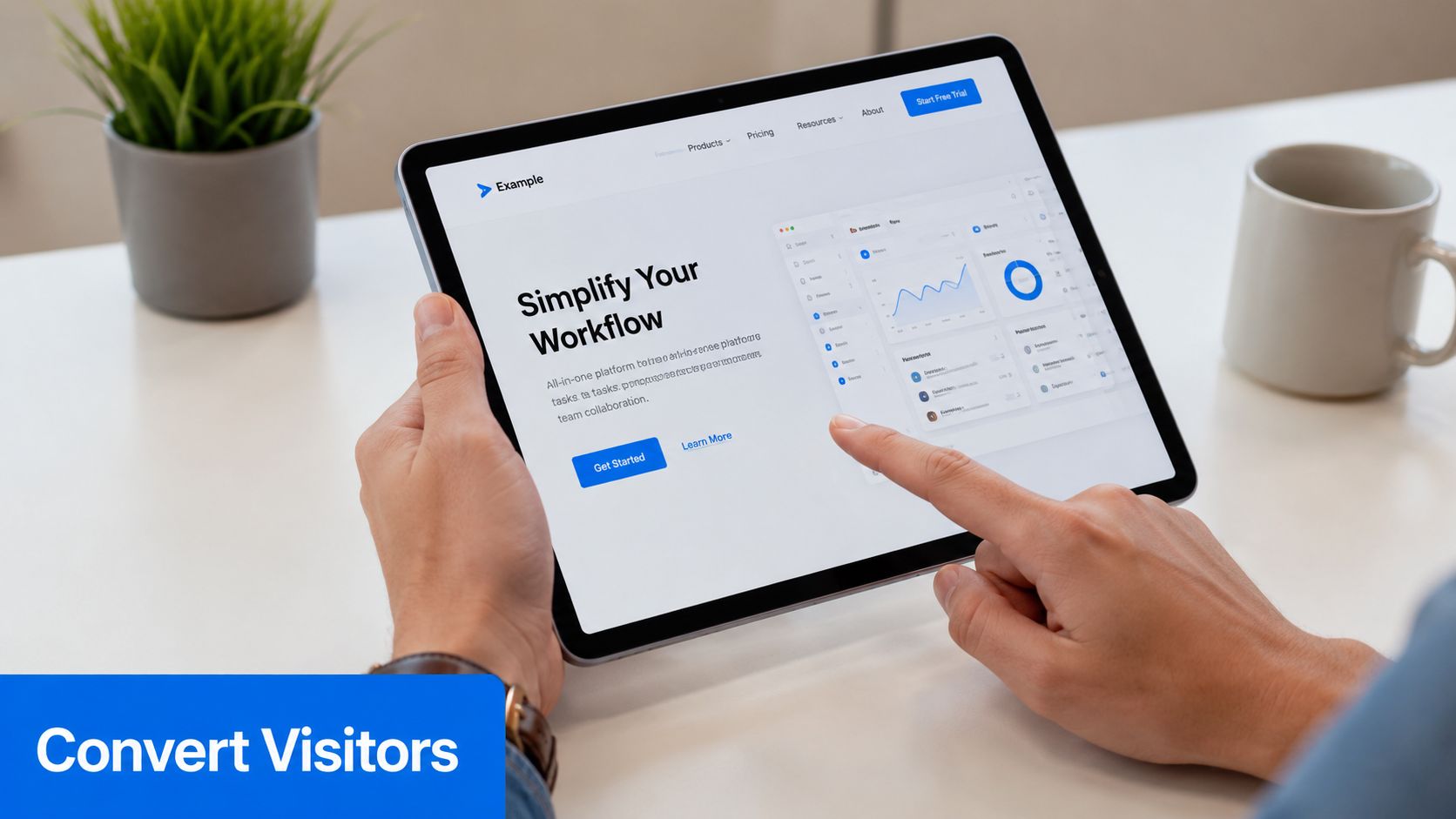
A service page should do four jobs quickly. Confirm the visitor is in the right place. Show why your business is credible. Explain what you offer. Make the next step obvious.
For many local businesses, that means keeping the top of the page tight and specific:
A clear headline
Name the service and the location or audience. “Emergency Electrician in Parramatta” gives a buyer far more confidence than a broad headline about solutions or quality.Proof near the top
Add review snippets, licence details, years in business, supplier accreditations, or recognisable client types. Local buyers want a reason to trust you before they fill out anything.A plain-English service summary
Explain what you do, who it suits, and what happens after contact. Skip padded copy. Buyers scanning on mobile will not read six vague paragraphs.One primary call to action
Quote request, phone call, booking, or callback. Pick the main action based on how your sales process works.A short contact path
Ask for enough information to qualify the lead, but not so much that the form feels like work.
If you want a simple reference point, this guide on what is a landing page explains the job the page is meant to do.
Reduce friction before you add more copy
Many owners assume a page needs more words to convert better. Usually it needs better decisions.
The common problem is friction. A form asks for full project details before trust is built. The headline is broad. The phone number is buried. The page offers three different actions, so the visitor chooses none. These are conversion problems, not traffic problems.
A softer CTA often works better for service businesses, especially for higher-value jobs or first-time enquiries. Instead of pushing every visitor to “Book Now”, test actions like:
- Request a quick quote
- Check availability
- Ask a question
- Get pricing
- Request a callback
These give cautious buyers a lower-pressure way to make contact.
Practical rule: Every extra decision on the page lowers the chance of an enquiry.
What usually hurts conversions
The same issues show up again and again on local lead gen sites:
- Generic hero copy that could belong to any competitor
- Weak trust signals such as no reviews, no licences, no proof of past work
- Long forms that ask for unnecessary detail too early
- Cluttered layouts with multiple buttons fighting for attention
- Poor mobile usability where buttons are hard to tap and contact details are easy to miss
There is a trade-off here. A shorter page often converts better for urgent services like locksmiths, plumbers, and emergency electricians. A longer page can help for higher-consideration services like commercial fit-outs, legal matters, or financial services, where buyers need more reassurance before they enquire. The right length depends on how much trust the buyer needs before making contact.
If you run ecommerce alongside lead generation, the same conversion principles carry across. This article on how to boost your Shopify sales covers CRO thinking that also applies to service pages.
What to keep on the page
A strong landing page usually answers these questions in order:
| Visitor question | What your page should show |
|---|---|
| Am I in the right place? | Specific service headline and location relevance |
| Can I trust you? | Reviews, credentials, examples, business details |
| Do you solve my problem? | Clear service scope and who it's for |
| What do I do next? | One obvious CTA and a short form |
That is the standard I use for SEO lead pages. Get the right visitor onto the page, remove doubt quickly, and make contact easy without turning the site into a content factory.
Implement Technical Fixes That Boost Conversions
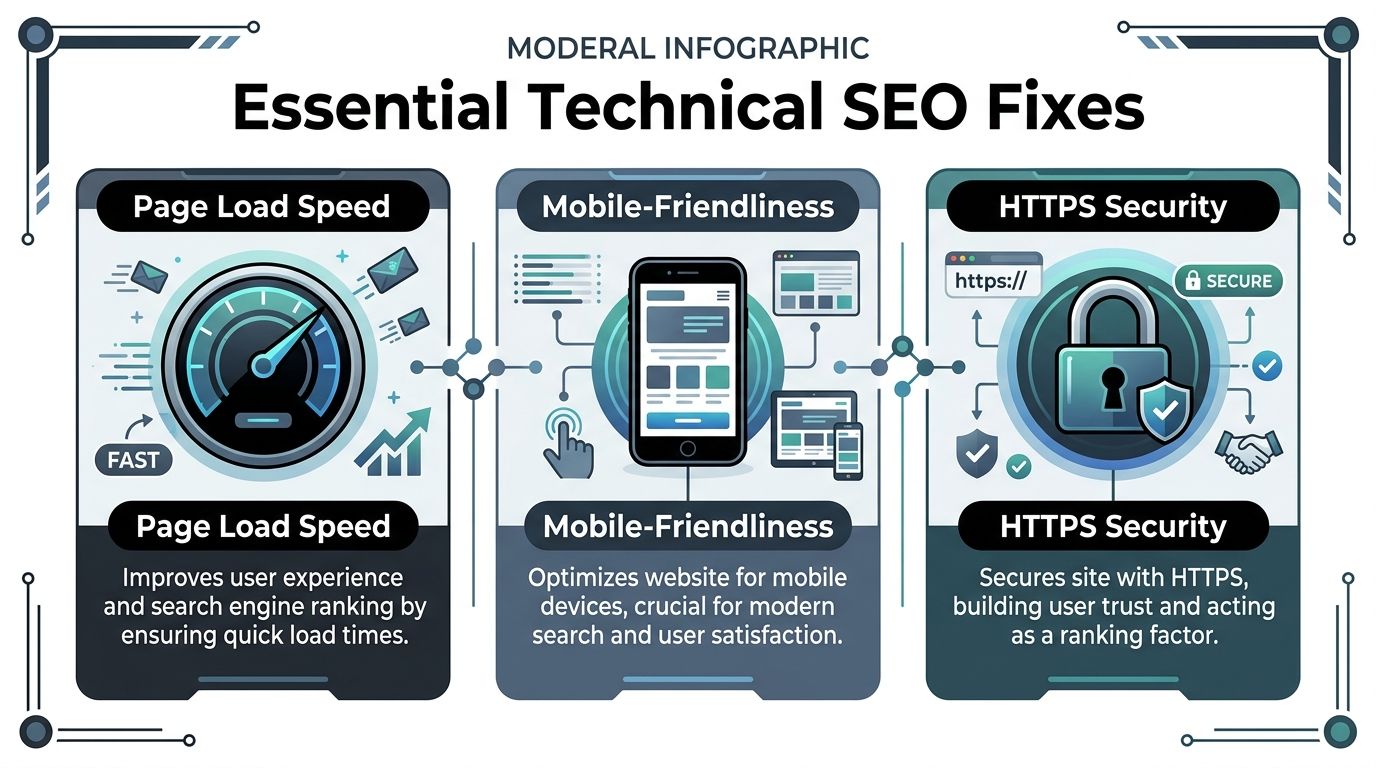
Technical SEO gets overcomplicated. For lead generation, only a handful of fixes consistently matter. They affect visibility, trust, and how many visitors stay long enough to enquire.
The key is to connect technical work to business outcomes. Faster pages reduce drop-off. Clear local signals help Google understand where you operate. Basic security supports trust at the moment someone considers submitting a form.
Fix speed on mobile first
Most owners check their site on desktop in the office. Buyers don't. They search on phones, often while distracted, travelling, or comparing providers quickly.
That's why the practical question isn't “Is the site beautiful?” It's “Does it load fast and let me act immediately?” Compress oversized images, remove bloated plugins, trim unnecessary scripts, and use caching. If your hosting is weak, fix that before redesigning the homepage.
If you're weighing performance tools, a guide on what is a CDN gives a useful overview of one common speed fix.
Add local schema where it matters
Schema won't rescue a poor site, but it helps search engines interpret your business details more reliably. For local businesses, that usually means marking up business identity information clearly and keeping it aligned with what appears on your site and profiles.
The important part is consistency. If your service area, contact details, and business type are muddled across the site, technical markup won't solve the underlying problem.
Don't ignore trust basics
HTTPS, clean forms, working mobile buttons, and readable layouts don't feel glamorous. They affect whether someone feels safe enough to contact you.
Fast, secure, easy-to-use pages don't just support rankings. They support decisions.
A lot of technical work has no direct lead-gen payoff. Chasing edge-case fixes while your enquiry form is broken is wasted effort. For most SMBs, I'd put the technical priority list in this order:
- Page speed and mobile usability
- Form functionality
- HTTPS and basic trust checks
- Clear indexable service pages
- Local business markup and consistency
That list won't satisfy every SEO purist. It will usually help a small business generate more enquiries.
Your Practical Monthly SEO Task List for Lead Generation
The businesses that get SEO working usually do less than people expect.
They do not publish four blogs a month, chase every ranking fluctuation, or spend half a day inside audit tools. They keep a short monthly routine tied to enquiries. That matters more for an Australian small business than an ambitious content calendar you will abandon by month three.
A sustainable rhythm beats bursts of effort
SEO maintenance should fit around the business, not compete with it. For a local service business, the monthly job is simple: keep your main lead sources accurate, keep your money pages current, and catch problems before they cost enquiries.
The highest-impact tasks are operational, not creative:
- Check your Google Business Profile
- Review your main service and location pages
- Track enquiry flow
- Ask for reviews and check local business mentions
- Run a quick technical check
That list is enough for many SMBs. Done consistently, it keeps lead generation moving without creating a permanent content workload.
Monthly SEO Checklist for Australian SMBs
| Week | Focus Area | Action Items (Est. 30-60 mins) |
|---|---|---|
| Week 1 | Google Business Profile | Update hours, add recent photos, check for new questions, review calls or direction requests, and publish a short post if you have a genuine update. |
| Week 2 | Service pages | Review your top service or suburb pages. Tighten headings, improve the main call to action, check mobile click-to-call buttons, and remove outdated copy or old offers. |
| Week 3 | Trust and authority | Ask a few recent customers for reviews, confirm your business details are consistent across major listings, and look for one relevant local mention, supplier link, or community partnership. |
| Week 4 | Technical health | Test every form, check page speed on key pages, scan for broken links, and confirm your priority pages can still be indexed and used properly on mobile. |
How to use the list without overcomplicating it
Treat this as maintenance. If you find a problem, fix that first.
A broken form matters more than a new blog post. A weak service page matters more than another round of informational keywords. Old photos on your profile, missing reviews, and inconsistent phone numbers can drag down lead flow even if rankings look fine.
This is the trade-off I see all the time. Business owners assume SEO progress means adding more pages. In practice, many get better results by improving the pages already attracting visits and making it easier for people to contact them.
A provider can help selectively. Website Builder Australia offers website development, SEO, hosting, and maintenance services, which gives businesses a way to outsource technical fixes and page improvements while keeping the monthly review process simple in-house.
What consistency looks like
After a few months, a practical SEO routine should leave you with:
- A current Google Business Profile
- Service pages that match what buyers are searching for
- Forms and phone buttons that work every time
- A site that loads properly and is easy to use on mobile
- A monthly process you can keep doing without a content team
That is enough to beat a lot of competitors. Not because the plan is complicated. Because it gets done.


