

A Guide to Small Business SEO in Australia
For most small business owners, 'SEO' sounds like another bit of tech jargon you just don't have time for. But what if I told you it’s the single most powerful tool you have for getting local customers walking through your door, or calling you for a quote?
It’s about making sure that when someone in your suburb whips out their phone and searches for a "plumber in Perth" or a "cafe near me," your business is the one they find. It’s how you turn online searches into real-world customers.
Why Small Business SEO Is Your Secret Weapon
Think about it. Whether you're a plumber in Sydney or you run a local cafe in Perth, your next customer is probably searching for you on Google right now. The difference between a phone that rings off the hook and one that stays silent often comes down to one thing: can people actually find you online?
This is where small business SEO stops being a buzzword and starts being your best employee. It works 24/7 to make sure you show up in Google's search results, especially in the "Local Pack" map listings. It’s not just about website clicks; it's about real results.
- More Foot Traffic: It puts you on the map, literally, guiding local customers straight to your shop.
- Better Leads: You attract phone calls and quote requests from people who are ready to buy, right now.
- Become the Local Go-To: It builds your reputation as the trusted expert in your area.
The True Power of a Local Search
That link between someone searching on their phone and making a purchase is incredibly direct. Get this: in Australia, a massive 78% of local searches on a mobile lead to an offline purchase within 24 hours.
That stat tells a powerful story. People search locally when they need something now.
When your business pops up in Google’s Local Pack (that map with three listings at the top), you’re golden. Those listings get a 40% higher click-through rate than anything else on the page. With almost half of all Google searches having local intent, not focusing on local SEO is like leaving money on the table.
I get it. SEO can feel like a dark art, but the idea is simple: just be the most helpful, relevant answer when a local customer asks Google for help. Your website becomes your best salesperson.
Local SEO vs. Paid Ads
So, what about just running some Google Ads? While paid ads give you a quick burst of traffic, organic SEO builds something much more valuable—a sustainable asset that you own. It creates a foundation of trust and authority that doesn't vanish the second you stop paying.
This is a critical difference for any small business working with a real-world budget. To put it simply, SEO is an investment that pays you back over and over again.
Here’s a quick breakdown to make the choice clearer.
Local SEO vs. Paid Ads: A Quick Comparison
| Aspect | Local SEO (Organic) | Paid Ads (PPC) |
|---|---|---|
| Cost | Investment of time or money in strategy; no cost per click. | Pay-per-click model; costs can add up quickly. |
| Timeframe | Takes time to build momentum (months), but results are long-lasting. | Immediate visibility and traffic as soon as the campaign starts. |
| Trust | Builds high levels of trust and credibility with searchers. | Often viewed as advertising; some users skip over paid results. |
| Sustainability | Your rankings are an asset you own; they work for you 24/7. | Traffic stops the moment you turn off the ad spend. |
| ROI | Delivers compounding returns over the long term. | Can be profitable, but requires constant budget and management. |
Choosing SEO is the difference between renting an audience and building your own community of loyal customers. It's how you stop just competing and start creating a real, lasting advantage in your local market.
Mastering Your Local SEO Footprint
If you run a local business in Australia, getting seen by nearby customers is everything. Forget fancy global strategies for a moment; your bread and butter is right here in your community. And the single most powerful tool for grabbing their attention? It’s completely free, and it’s called a Google Business Profile (GBP).
Think of it as your digital front door. Long before someone even considers clicking on your website, they'll see your GBP pop up in Google Search and Maps. They'll see your phone number, your address, photos of your work, and what other customers are saying about you. For any Aussie small business, this isn't just an optional extra—it's ground zero for getting found.
Fleshing Out Your Google Business Profile
Just "claiming" your profile and walking away is a massive missed opportunity. You need to treat it like a core part of your marketing, constantly keeping it fresh and full of helpful info. A well-maintained profile tells Google you’re active, you’re legitimate, and you’re exactly what a local searcher needs.
Here’s what to focus on:
- Fill in every single field. Seriously. Don't skip the details. Add your services, products, opening hours, payment methods, accessibility info—the works. The more complete your profile, the more Google trusts you.
- Write a description that sells. This is your chance to shine. Weave in your main keywords, of course, but don't sound like a robot. Talk about what makes you different. What problem do you solve for your customers better than anyone else?
- Nail your categories. This is crucial. Choose a primary category that perfectly sums up your main business. Then, add secondary categories for everything else you do. For instance, a marketing agency in Brisbane might set "Marketing Agency" as primary, but also add "Web Designer" and "SEO Service" to capture those specific searches.
The path from a potential customer searching online to them walking through your door (or calling your phone) is shorter than you think. It's all about being there at the right moment.
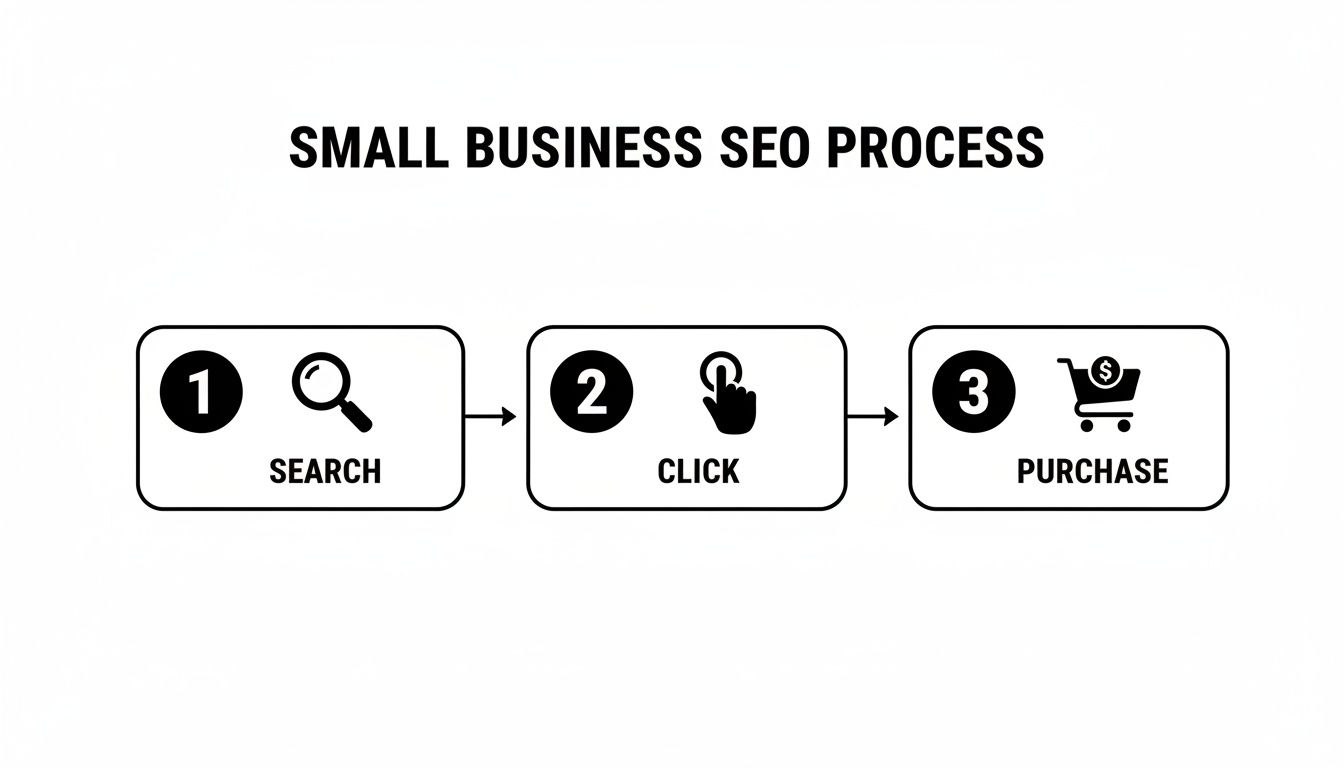
A polished online presence intercepts customers right when they’re ready to act.
Think Hyper-Local
To really stand out in the Aussie market, you need to go beyond just naming your city. You serve specific suburbs, right? So tell Google!
A plumber in Melbourne’s eastern suburbs, for example, shouldn't just list "plumbing services." They should be creating Google Posts and service descriptions that mention "emergency plumbing in Ringwood," "blocked drain clearing in Hawthorn," or "hot water system repairs in Box Hill." You’re directly answering the exact phrases people are typing into their phones.
Pro Tip: Weave postcodes and suburb names into your GBP description, services, and Google Posts. It’s a powerful signal to Google that reinforces your service area and can give you a serious leg-up in those super-specific local searches.
Another great trick is to geotag your photos. Before you upload pictures of your latest project or your team on-site, use a free online tool to add GPS data to the image file. This gives Google cold, hard proof of where you actually do business.
Put Google Posts to Work
Think of Google Posts as free, temporary ads right on your profile. They’re brilliant for grabbing attention. You can use them to announce a special offer, show off a new product, or share a helpful tip.
A cafe in Adelaide could post about a "2-for-1 coffee" deal this week. A Sydney-based financial advisor could share a link to their latest blog post on end-of-financial-year tax tips. Just remember they expire, so get in the habit of posting something new every 7-10 days to keep your profile looking active.
Build Your Local Citation Power
Your GBP is the star of the show, but it needs a supporting cast. That’s where local citations come in. These are simply mentions of your business name, address, and phone number on other websites, especially online directories.
For Australian businesses, you’ll want to make sure you’re listed on the big ones:
- TrueLocal
- Yellow Pages Australia
- Yelp Australia
- Local Business Directory
The golden rule here is NAP consistency. Your Name, Address, and Phone number must be identical everywhere. Even a small difference like "St" versus "Street" can confuse Google and dilute your authority. If you're just starting out, checking out a comprehensive guide to local SEO can really help get these foundations right.
If you really want to go deep on this, we’ve put together a dedicated resource on https://websitebuilderaustralia.com.au/local-seo-for-businesses/ that you'll find incredibly useful.
By turning your Google profile from a set-and-forget listing into an active sales tool and ensuring your business details are consistent across the web, you'll build a dominant local presence that drives real, measurable results.
Building a Website That Both Google and Your Customers Will Love
Once you've nailed your local presence with your Google Business Profile, it’s time to focus on your digital headquarters: your website. If your GBP is the initial handshake, your website is where the real conversation happens. It's your chance to build trust, prove you know your stuff, and turn a casual searcher into a loyal customer.
But a great website is more than just a pretty face. It has to be built from the ground up to work for both humans and search engines.
For most Aussie small businesses I work with, WordPress is the go-to platform, and for good reason. It’s incredibly flexible, letting you start small and add features as you grow. Crucially, you own and control everything, so you’re never stuck in a proprietary system that limits your SEO potential down the track.

Whatever platform you choose, there's one rule you absolutely cannot ignore: mobile-first design. With well over 60% of all searches now happening on a phone, Google has shifted to primarily using the mobile version of your site to decide how to rank you. If your site is a pain to use on a mobile, your rankings will tank. It's that simple.
Organising Your Site for Success
A messy website is a death sentence for user experience. If people can't find what they're looking for quickly, they'll leave. Think of it like a sprawling Bunnings with no signs—you’d just get frustrated and walk out. Your website needs a clear, logical structure that guides both visitors and Google's crawlers.
One of the most effective ways to do this is with a hub-and-spoke model.
- The Hub: This is your main, top-level service page (like 'Plumbing Services'). It gives a broad overview of everything you do.
- The Spokes: These are individual pages for each specific service that branch off the hub (e.g., 'Blocked Drains', 'Hot Water System Repairs', 'Gas Fitting Services').
This structure is brilliant for two reasons. First, it makes it dead simple for a potential customer to find the exact service they need. Second, it creates a powerful internal linking structure that shows Google how your pages are related, funnelling authority from your main hub page to your specific service pages. This kind of thoughtful organisation is the bedrock of solid on-page SEO.
A simple way to think about it is to act like a librarian. Every piece of content needs a logical home, making it easy for anyone—or any search engine—to find exactly what they need without having to guess.
A well-structured site is a critical piece of the puzzle, but it's part of a much bigger picture. To really connect with your audience and dominate your local market, you need to build a strong online presence for small business across all fronts.
Nailing the Technical Details
With your site structure mapped out, it's time to sweat the small stuff. These are the technical one-percenters that might seem minor, but they send huge signals to Google about what your pages are about, making it much easier for them to rank you for the right searches.
Craft SEO-Friendly URLs
Your page URLs are like the street address for your content. They should be short, easy to read, and contain your target keyword.
- Bad URL:
yourwebsite.com.au/page?id=8&cat=4 - Good URL:
yourwebsite.com.au/brisbane/emergency-plumbing
The good one immediately tells both the user and Google what the page is about before they even click.
Use Headings as a Road Map
Headings (H1, H2, H3, etc.) aren't just for making text look nice; they create a logical outline for your content.
- H1: The main title of the page. Use it only once, and make sure it includes your primary keyword.
- H2s: Use these for the main sections of your page.
- H3s: Use these to break down the topics within your H2 sections.
This hierarchy is essential. Search engines scan your headings to understand the structure and key topics of your page. If you want to get this right, our deep-dive article explains exactly what on-page SEO optimisation is and how to apply these techniques.
Implement Basic Schema Markup
This sounds way more technical than it is. Schema markup is just a bit of code that helps search engines understand the context of your information. For any local Aussie business, the most important type is LocalBusiness schema.
It explicitly tells Google your business name, address, phone number (NAP), and opening hours, directly reinforcing all that good work you did on your Google Business Profile. Many WordPress plugins (like Yoast SEO or Rank Math) can add this for you with just a few clicks. It's a quick win that gives you a genuine advantage in local search results.
Creating Content That Attracts Local Customers
Alright, with the technical foundations sorted, it’s time to get to the good stuff: the words and pictures that actually grab a customer’s attention. This is your content.
Think of it as the fuel for your entire SEO engine. Without great content, all the technical tweaks in the world won't matter. It’s how you prove you know your stuff, build trust, and ultimately convince a potential customer that you’re the one to call.
For a local business, this isn't about pumping out generic articles just for the sake of it. It’s about creating genuinely helpful, strategic content that answers the exact questions your local customers are typing into Google. This is how a small Aussie business can punch well above its weight.
Uncovering What Customers Really Want
Before you write a single word, you need to get inside your customers' heads. Guesswork is a fast track to wasting time and money. What you need is a bit of good old-fashioned keyword research, and no, you don't need a pricey subscription to get started.
One of the best free tools is right under your nose: Google's search bar. Start typing a service you offer, like "electrician eastern suburbs," and pay close attention to the autocomplete suggestions. Those aren't guesses; they are real searches people are making every day.
Once you hit enter, scroll down the results page to the "People also ask" and "Related searches" sections. These are absolute gold mines for content ideas.
This simple exercise helps you move away from broad, hyper-competitive terms (like "web design") and towards the specific, high-intent phrases your local customers are actually using.
- Instead of "electrician," you'll find people searching for "emergency electrician eastern suburbs."
- Instead of "roofing," they're asking "how much does a new roof cost in Australia."
- Instead of "web design," a local client might search for "boutique web design Gold Coast."
These longer, more specific phrases (we call them long-tail keywords) have far less competition and are often used by people who are much closer to making a decision. They are the bread and butter of effective small business SEO.
Building Your Content Cornerstones
A solid content strategy really comes down to two key things: service pages that are built to sell, and blog posts that are designed to solve problems. Each plays a different, but equally crucial, role.
Pillar 1: Location-Specific Service Pages
These are arguably the most important pages on your entire website for bringing in leads. Each of these pages needs to be tightly focused on a single service you offer in a specific location. They need to do more than just list what you do; they have to persuade a visitor to pick up the phone.
For a builder in Bayside Melbourne, this means creating dedicated pages for "Home Extensions Brighton," "Kitchen Renovations Sandringham," and "Custom New Builds Black Rock." Each page should clearly explain the service, showcase photos of relevant projects, feature glowing customer testimonials, and have a can't-miss call to action, like "Get a Free Quote Today."
Think of each service page as your best salesperson, working 24/7. It needs to be clear, convincing, and laser-focused on a single customer need in a specific area.
Pillar 2: Helpful Blog Posts
While your service pages are for people ready to buy now, your blog is for everyone else. These articles attract customers who are still in the research phase. They answer their biggest questions, solve their annoying problems, and quietly establish you as a trusted expert.
This is where you start building a relationship before they even realise they need you.
A great blog post answers a real-world question, like "What's the best type of flooring for a family with pets?" or "5 signs you need to call a plumber immediately." By providing genuine value with no strings attached, you build authority and trust. When that reader eventually does need your service, guess who they’ll think of first?
Planning Your Content for Success
Consistency is everything. A simple content calendar—even a basic spreadsheet—is all you need to stay on track. Just map out your blog post ideas and service page priorities for the next few months. This turns what feels like a massive task into a series of small, manageable steps.
To get the ball rolling, here are some practical content ideas for a few different Aussie small businesses.
Content Ideas for Different Small Businesses
| Business Type | Service Page Idea | Blog Post Idea |
|---|---|---|
| Local Cafe | "Catering for Corporate Events in Parramatta" | "The Ultimate Guide to Brisbane's Best Dog-Friendly Cafes" |
| Plumber | "Emergency Blocked Drain Service Northern Beaches" | "DIY vs. Pro: When to Call a Plumber for a Leaky Tap" |
| Accountant | "BAS Lodgement for Sole Traders in Adelaide" | "EOFY Checklist for Australian Small Businesses" |
| Landscaper | "Drought-Tolerant Garden Design in Perth" | "5 Native Australian Plants That Will Thrive in Your Backyard" |
See the pattern? By focusing on solving your customers' problems first, you'll naturally weave in your target keywords and create content that doesn't just rank well—it genuinely helps people. This problem-solving mindset is the heart of a brilliant content strategy and a cornerstone of smart small business SEO.
Earning Trust Through Links and Reputation

When you hear "link building," you might picture some geeky, complicated process. For a small business, it's nothing like that. It's really just building your reputation—think of them as digital handshakes within your local community.
These links, known as backlinks, are simply when another website points to yours. Google sees them as a vote of confidence. When a well-regarded local site links to you, it sends a strong signal that you're a legitimate, trusted part of the community. This is a cornerstone of any decent small business SEO strategy.
Build Your Digital Reputation, One Local Link at a Time
Forget trying to get a link from a massive national newspaper. For Aussie small businesses, your most powerful links are going to come from right in your own backyard. These are the digital relationships that mirror your real-world connections, showing Google you’re an active, valued local player.
Here are a few practical, no-fluff ways to earn these valuable local backlinks:
- Sponsor a local team: That junior footy club or netball team your kid plays for? They almost always have a sponsors page on their website. Your logo and a link back to your site are usually part of the deal.
- Team up with complementary businesses: Find a nearby business that serves the same type of customer but doesn't compete with you. A local mortgage broker could collaborate on a blog post with a real estate agent, with each linking to the other's site. It’s a win-win.
- Join your local business association: Organisations like your local Chamber of Commerce have member directories. A link from their site is a high-authority signal confirming you're a verified local business.
These aren't just SEO tricks; they're smart business moves that happen to have brilliant online perks. You're forging community ties that translate directly into digital trust.
Getting a backlink is just a digital recommendation. The more nods you get from respected local sources, the more Google will trust your website and show it to people searching for what you do.
The Power of Customer Reviews
While backlinks build trust with Google, it's your online reviews that build trust directly with customers. Your Google Business Profile reviews are often the first thing a potential customer sees. A steady stream of recent, positive feedback can be the one thing that makes them call you instead of the next person on the list.
Think about how you search for things. When you're looking for a new cafe or a tradie, you check the reviews, right? Your customers are exactly the same. They want that social proof that you’re the real deal.
How to Get and Manage Your Reviews
Getting reviews doesn't have to be awkward. The secret is making it dead simple for happy customers to give you feedback. It’s not about pestering them for five stars; it's about making the review process a natural part of how you do business.
- Strike while the iron is hot: The absolute best time to ask for a review is right after you've finished a job or a customer has just told you how happy they are.
- Keep it simple: Send them a follow-up email or SMS with a direct link to your Google review page. The fewer clicks it takes, the higher the chance they'll actually do it.
- Reply to every single review: Thank people for positive comments. For the odd negative one, respond professionally and calmly. Acknowledge the issue and offer to take the conversation offline to sort it out. This shows everyone else that you care and take feedback on board.
Getting a handle on how you look in search and what customers are saying about you is fundamental. To really nail this, learning more about online reputation management for small business will give you the specific strategies needed to build a rock-solid online presence.
Are Your SEO Efforts Actually Paying Off? Here’s How to Tell
You can't fly blind. After all the hard work you’ve put into your website, content, and links, you need to know if it’s actually moving the needle for your business. The good news is you don’t need a complicated, expensive dashboard to figure this out. Google gives you everything you need, for free.
The trick is to sidestep the vanity metrics and focus on what truly impacts your bottom line. It’s incredibly easy to get bogged down in a sea of data, so we’re going to zero in on the handful of numbers that signal real, tangible growth.
The Only Metrics That Really Matter
To get started, you'll need two free tools set up and connected to your site: Google Analytics 4 (GA4) and Google Search Console. These are your windows into what's working.
Forget everything else for a moment and concentrate on these three areas:
Is more organic traffic coming to your site? In GA4, just look at the number of users coming from "Organic Search". Is that number trending up month after month? This is the clearest sign that your hard work is bringing more potential customers to your digital doorstep.
Are you ranking for the right keywords? Pop over to Google Search Console and see which queries are bringing people to you. Are you finally showing up for those money-making terms like "kitchen renovations Sandringham"? A steady climb in rankings for these high-intent phrases means you're not just getting more traffic, you're getting the right traffic.
Is your phone ringing more often? Your Google Business Profile is where the magic happens for local businesses. Check its Insights. Are the number of phone calls, website clicks, and requests for directions increasing? These aren't just abstract numbers; they are genuine leads and potential sales.
The Big Question: Keep Going DIY or Hire an Agency?
As you start watching these metrics, you’ll inevitably face a crossroads: should you keep managing your SEO yourself, or is it time to hand the reins to a professional agency?
There’s no one-size-fits-all answer here, but it usually boils down to two things: your time and your results.
Have an honest look at your schedule. Proper, consistent SEO takes a good few hours every single week for creating content, building links, and keeping an eye on the technical side. If you're constantly struggling to carve out that time, or if your results have hit a wall after a solid few months of effort, that's a pretty clear signal it's time to call in the experts.
When you start talking to agencies, don't be shy. Ask to see case studies from other local businesses, preferably in a similar field to yours. A great agency will be completely upfront about their methods and give you realistic expectations for what they can deliver within your budget, focusing on the same revenue-driving metrics we just covered.
A Few Common Questions About Small Business SEO
Even with a solid game plan, a few questions always pop up. It's completely normal. Let's run through some of the most common ones I hear from Australian business owners who are just getting their sea legs with SEO.
How Long Does SEO Actually Take to Work?
This is the million-dollar question, isn't it? The honest answer is: it depends. SEO isn't a light switch you can flick on for instant traffic. It's more like planting a garden; it takes time and consistent effort to see the fruits of your labour.
For a completely new website starting from scratch, you're looking at a six to twelve-month journey before you start seeing significant, meaningful results. But if your site has been around for a while and has a bit of history, you could see some positive shifts in rankings and traffic in as little as three or four months, especially with some smart local SEO tactics.
The secret ingredient is consistency. A huge push for one month followed by radio silence just won't cut it. SEO is all about momentum—the steady, consistent effort you put in today builds on itself and pays you back for years to come.
Think of it like getting fit. You don't walk out of the gym with a six-pack after one session. But if you keep showing up, week after week, the results become undeniable. SEO builds your website's strength in the exact same way.
What's a Realistic SEO Budget for a Small Business?
The cost of SEO can be all over the map. It really ranges from a few hundred dollars a month for some light local upkeep to several thousand for a full-blown national campaign in a crowded market.
For most small Aussie businesses looking to work with a freelancer or a small agency, a realistic starting point is usually somewhere between $1,000 to $2,500 per month.
What you pay really hinges on your goals, how competitive your industry is, and the scope of work—are we talking content creation, technical SEO, link building, or all of the above? The most important thing is to stop thinking of it as a cost and start seeing it as an investment. Good SEO will always generate a return that far outweighs what you put in.
At Website Builder Australia, our whole approach is about creating SEO strategies that fit your business goals and your budget. If you're ready to make a real impact locally, let's have a chat about a plan that’s right for you.


