

Finding the Right Website Development Company Australia in 2026
Let's be honest, for any Australian business in 2026, a great website isn't just a 'nice to have' – it's the very engine of your growth. Picking the right website development company in Australia is a massive decision, one that can set the course for your success online for years to come.
Your Guide to Choosing a Website Development Partner
Think of your website as your digital storefront or your flagship location. It's your top salesperson, brand ambassador, and support desk, all rolled into one, working 24/7. It's easily one of your most valuable business assets. So, when you invest in building it, you're not just paying for a pretty design; you're funding a high-performance tool built to bring in customers and generate real revenue. A smart investment here starts with knowing what a good web partner actually does and how to spot one.

This guide is your roadmap to making that call with confidence. We’re going to pull back the curtain on the whole process, from the core services you should expect to what it all costs, so you can choose the perfect team to help you hit your goals.
What You Will Learn in This Guide
Our aim is simple: to give you a clear framework for vetting potential web companies and building something that delivers genuine business results. Here’s what we’ll cover:
- Essential Services: We'll break down what top-tier agencies really deliver. This isn't just about looks; it's about building high-performance WordPress sites, solid eCommerce platforms, and even custom mobile apps.
- Budgeting and Timelines: Get a realistic feel for project costs and how long things should take here in the Australian market. No more guesswork.
- Vetting and Selection: We'll arm you with a checklist of questions you absolutely must ask and the red flags to watch out for when you're talking to potential partners.
- Avoiding Pitfalls: Learn from the common mistakes other businesses make. We'll show you how to sidestep those costly errors and frustrating delays.
By the time you're done with this article, you'll have the know-how to pick a web development company that doesn't just build you a beautiful website, but becomes a genuine partner in your growth. It's a strategic choice, and making the right one is fundamental to building a strong, profitable presence online.
What Does an Australian Web Development Agency Actually Do?
So, what exactly do you get when you partner with a website development company in Australia? It’s a lot more than just making a pretty-looking page. Think of it as a mix of high-level strategy, creative design, and rock-solid technical engineering, all working together to build, launch, and grow your digital home base.
It’s a bit like commissioning a new retail store. You need an architect for the design (that's web design), a builder for the construction (that's web development), and a facilities manager for ongoing upkeep. A proper agency does it all, ensuring your digital asset is built to perform from day one and keeps delivering results for years to come.
To give you a clearer picture, we've broken down the essential services a full-service agency provides and what each one means for your business's bottom line.
Key Web Development Services and Their Business Impact
| Service Offering | What It Delivers | Why It Matters for Your Business |
|---|---|---|
| Custom Web Design | A unique, user-friendly design (UX/UI) tailored to your brand. | Creates a professional first impression and guides visitors to take action. |
| WordPress Development | A functional, fast, and easy-to-manage website built on a flexible platform. | Gives you a powerful and scalable online presence you can control. |
| eCommerce Solutions | A secure online store with payment gateways, shipping, and inventory management. | Opens up a direct revenue stream, allowing you to sell products 24/7. |
| Mobile App Development | A dedicated iOS/Android app to connect with your loyal customers. | Boosts customer engagement and offers a personalised, direct marketing channel. |
| Hosting & Maintenance | Secure server space, regular backups, software updates, and security monitoring. | Keeps your website fast, safe, and online, protecting your investment. |
| SEO & Digital Marketing | Strategies to improve search rankings (SEO) and run targeted ad campaigns (PPC). | Drives qualified traffic to your site and generates valuable leads. |
Each of these services is a crucial piece of the puzzle, designed to work together to create a powerful digital presence that supports your business goals.
Custom Website Design and Development
This is where it all starts. The process kicks off with a deep dive into your business, your customers, and what you want to achieve. The design phase is all about creating an intuitive user experience (UX) and an appealing user interface (UI) that makes it easy for visitors to find what they need and take the next step. You can see how we handle this in our own Australian website design services.
Once the blueprint is locked in, the development work begins, turning those static designs into a living, breathing website. For countless Aussie businesses, WordPress is the go-to platform—it powers over 43% of the internet for good reason. It's incredibly flexible and user-friendly. A good dev team will build you a site that not only looks brilliant but is also lightning-fast, works perfectly on any device, and is simple for you to update yourself.
Having a professional website is no longer a 'nice-to-have'—it's essential. Yet, a surprising 41% of Australian small businesses still don't have one, even though 75% of consumers say they prefer to buy from brands with an online presence. That gap is a massive opportunity waiting to be filled.
eCommerce and Online Store Solutions
If you’re selling products, a solid eCommerce setup is non-negotiable. This is all about building a secure, seamless online shop that makes buying from you a breeze. An expert agency will handle everything from integrating secure payment gateways like Stripe and PayPal to setting up complex shipping rules and managing your inventory systems.
A great eCommerce site isn't just a product catalogue; it guides the customer smoothly from the moment they land on your site to the final thank you page. We’re talking about features like customer accounts, order tracking, and abandoned cart reminders—all designed to maximise your sales and keep customers coming back for more.
Mobile App Development
In a world where everyone is glued to their phones, a dedicated app for iOS and Android can be a game-changer for customer loyalty. This is about creating native applications that deliver a faster, more personalised experience than just a mobile website.
Whether it’s for booking appointments, running a loyalty program, or offering exclusive content, a mobile app gives you a direct line to your most valuable customers. A development partner will guide you through the whole journey, from the initial idea to getting it published on the Apple App Store and Google Play Store.
Web Hosting and Ongoing Maintenance
Getting your site live is a huge milestone, but the work doesn’t stop there. Reliable web hosting gives your website a home on the internet, ensuring it’s online and accessible to your customers 24/7. A quality agency will provide performance-tuned hosting that prioritises speed and uptime.
On top of that, proactive website maintenance is your site’s insurance policy. This isn't optional; it's essential for security and performance. Key tasks include:
- Regular Backups: Creating safety copies of your site so you never lose your hard work.
- Software Updates: Keeping your platform and plugins up-to-date to patch security holes.
- Security Monitoring: Actively scanning for malware, hacks, and any other suspicious activity.
Any decent web development agency won’t just build your site and walk away. They’ll stick around to implement crucial website security best practices and keep your digital investment safe, fast, and working hard for your business.
Digital Marketing Services That Drive Growth
Launching a beautiful new website without a marketing plan is a bit like opening a fantastic shop down a hidden laneway with no signs. You could have the best products in the world, but if nobody knows you're there, you won't see a single customer. This is where a smart website development company in Australia really shows its value, weaving powerful digital marketing services into the fabric of your project from day one.
These services all share a single, crucial goal: turning your website into a machine that consistently brings in leads and sales. A great website is the destination; great marketing is the map that guides your ideal customers right to your virtual doorstep.
Search Engine Optimisation (SEO)
Search Engine Optimisation, or SEO, is the absolute bedrock of long-term online growth. It’s the craft of getting your website to show up high on search engines like Google when people are looking for exactly what you sell. Think of it as earning a prime spot in a bustling digital shopping centre, but without paying rent.
We get this done by fine-tuning your site’s technical health, creating genuinely useful content built around the phrases your customers actually use, and building your website's reputation online. The aim is to increase organic traffic—visitors who find you naturally through a search, not because you paid for an ad. It’s a slow burn, but the results are incredibly powerful and long-lasting. You can get a better feel for this by exploring some effective marketing strategies for small business that build on this very foundation.
Pay Per Click (PPC) Advertising
While SEO is your long game, Pay-Per-Click (PPC) advertising gets you seen right now. Using platforms like Google Ads, PPC lets you place targeted ads at the very top of the search results page. The best part? You only pay when someone actually clicks on your ad, making it an incredibly efficient way to attract motivated, ready-to-buy customers.
A well-run PPC campaign is like a tap you can turn on for instant traffic and leads. It’s perfect for launching new products, pushing a special offer, or just getting the phone ringing while your SEO efforts are warming up.
PPC is also a fantastic source of data. It tells you exactly which keywords are converting into sales, and those insights can be fed directly back into your SEO strategy. It creates a powerful feedback loop where your paid and organic efforts make each other stronger. It also opens the door to more advanced tactics, like using AI-powered conversion optimisation best practices to get more value from every visitor.
Content and Social Media Marketing
Beyond just search engines, a good agency helps build your brand through smart content and social media. This means creating helpful articles, practical guides, and engaging videos that answer your customers' questions and position you as the go-to expert in your field. This content doesn't just feed your SEO; it builds genuine trust.
This is a massive opportunity for Aussie SMEs, who are jumping on digital tools faster than ever. In fact, small and medium businesses are expected to drive 58.20% of Australia's digital marketing software market, which is forecast to hit USD 3.21 billion by 2030. This boom shows just how vital it is to have marketing and analytics baked into your site from the beginning. You can check out more stats on the Australian digital marketing software market on mordorintelligence.com.
Social media then takes this great content and gets it in front of the right people, starting real conversations where your audience already spends their time. It’s all about building a community around your brand, turning passive followers into loyal advocates. When working together, these services create a complete system for attracting, engaging, and winning over your target audience.
How to Vet and Choose Your Development Partner
Picking a website development partner is easily one of the most critical decisions you'll make for your business's future online. Get it right, and you've got a growth partner who builds an asset that pays you back for years. But get it wrong, and you’re looking at budget blowouts, missed deadlines, and a final product that just doesn't hit the mark. So, how do you tell the difference?
It all comes down to asking the right questions and knowing what to look for beyond a slick portfolio. This isn't just about hiring a supplier; it’s about finding a genuine partner who gets your vision and has the technical chops and business smarts to make it a reality. A bit of a systematic approach here will protect your investment and set your project up for a win from day one.
Crucial Questions to Ask Any Potential Agency
Before you even think about signing a contract, you need to sit down with any potential partners and run them through a solid list of questions. Their answers will tell you a lot about their process, their expertise, and whether they’re actually a good fit for you. Think of it as a job interview for a key role in your company—because that's exactly what it is.
Here are the non-negotiable questions you absolutely have to ask:
- Can you show me case studies from businesses like mine? A pretty portfolio is one thing, but proven success in your specific industry is gold. It shows they actually understand your market and what your customers are looking for.
- Who will be my main point of contact? You need a clear, consistent line of communication. Find out if you’ll be dealing directly with a dedicated project manager who can give you regular updates and answer your questions without a fuss.
- How do you handle project communication and feedback? Do they use a project management tool? How often will you have check-in meetings? A transparent, well-oiled communication plan is essential to keeping everything on track.
- What's your development and testing process look like? A professional agency will have a structured process for design, development, quality assurance testing, and deployment. This is what ensures a smooth project and a bug-free launch.
- What happens after the website goes live? Ask about their ongoing support, maintenance plans, and any warranty periods. A reliable partner sticks around to make sure your site stays secure, fast, and up-to-date.
To help simplify this critical evaluation, the following chart gives you a clear path for picking the right development partner.
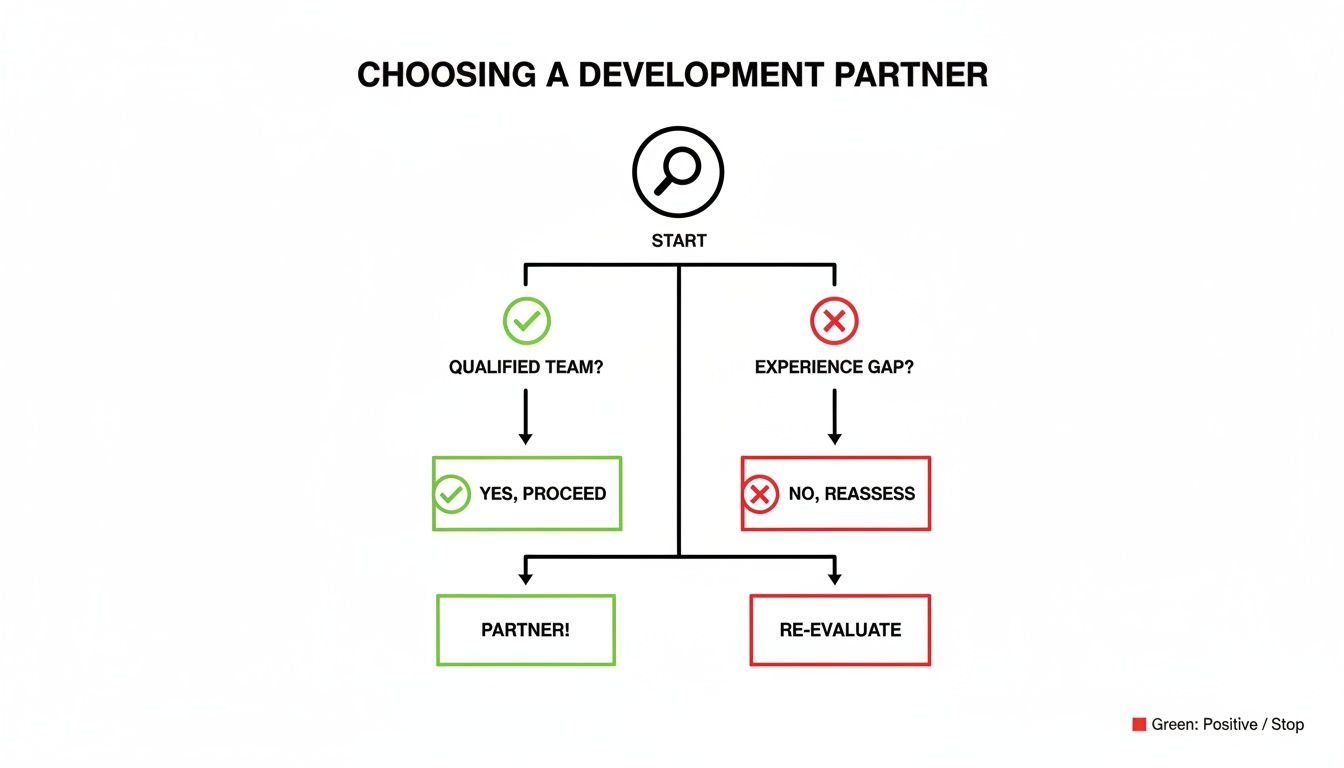
This decision tree really highlights that a solid technical foundation, clear communication, and relevant experience are the absolute pillars of a successful partnership.
Red Flags to Watch Out For
Just as important as knowing what to look for is knowing what to run away from. Certain warning signs can scream a lack of professionalism or experience, and they can lead to massive headaches down the road. Keep an eye out for these red flags during your chats.
A vague proposal is a massive red flag. If the scope, deliverables, and costs aren't clearly itemised, you’re basically opening your business up to unexpected fees and arguments over what was 'included' in the original price.
If an agency can’t give you clear, detailed answers, it’s often a sign that they don't have a structured process. Here are a few other warning signs to be wary of:
- High-Pressure Sales Tactics: An agency that pushes you to sign a contract immediately without giving you time to think is a big worry. A true partner wants you to be 100% confident in your decision.
- A "One-Size-Fits-All" Approach: If they jump straight to a solution without asking detailed questions about your business goals and who you're trying to reach, they're probably just selling a cookie-cutter service.
- Lack of a Local Presence: Partnering with an in-house website development company in Australia gives you a huge advantage. It means they get the local market, are available during your business hours, and give you an accessible point of contact for support when you need it.
- No Post-Launch Support Plan: A company that thinks the job is done the moment the site goes live isn't invested in your long-term success. You want a team that offers clear maintenance and support packages.
By carefully asking the right questions and watching for these red flags, you can confidently filter your options. This diligence will help you find a skilled and reliable partner who lines up with your business goals and is committed to delivering a top-quality digital asset.
Understanding Australian Web Development Costs and Timelines
Let’s get straight to it. The two questions we hear most are, ‘How much will it cost?’ and ‘How long will it take?’ Fair questions, and getting straight answers is crucial for any Aussie business owner trying to budget properly and plan a launch for 2026.
The truth is, the investment can swing wildly depending on what you need. Think of it like buying a vehicle for your business. A simple, template-based site is like a reliable ute you drive straight off the lot—it’s functional, gets the job done quickly, and won’t break the bank. But a fully custom eCommerce platform with all the bells and whistles? That’s more like a purpose-built road train, engineered from the ground up for a highly specific, heavy-duty job. They both have their place, but they come with very different price tags and build times.
What Influences the Final Cost
So, what actually drives the price up or down? A few key things determine the final bill. The more complex and custom your needs are, the more time and expertise it demands from your website development company in Australia, and that's what you're really paying for.
Here’s what moves the needle:
- Bespoke vs Template Design: A unique site designed from scratch will always be a bigger investment than one built using a pre-made template.
- Advanced Functionality: Need a booking system, a customer login portal, a membership area, or complex calculators? That’s specialised development work.
- eCommerce Integration: Setting up a proper online store isn't just about listing products. It involves secure payment gateways, shipping calculators, and inventory management.
- Third-Party Software Integrations: If you need your site to talk to your other business tools—like a CRM, accounting software, or marketing platform—that connection adds another layer of work.
It’s worth noting that Australia’s IT services sector is booming, projected to jump from AU$57.17 billion in 2025 to AU$70.26 billion by 2030. This demand, plus our local labour costs, often means Aussie development prices are 15-25% higher than in places like the US.
Typical Project Costs and Timelines in Australia
To help you get a ballpark idea, we've put together some typical figures for the Australian market. Remember, these are just estimates. The only way to get a firm price is to get a detailed quote for your specific project. For a more detailed breakdown, have a look at our guide on understanding website design costs in Australia.
Here's a quick look at what you can generally expect.
Australian Website Project Cost and Timeline Estimates (2026)
| Website Type | Estimated Cost (AUD) | Typical Timeline |
|---|---|---|
| Small Business Website | $3,000 – $8,000 | 4 – 8 Weeks |
| eCommerce Store | $8,000 – $25,000+ | 8 – 16 Weeks |
| Custom Enterprise Solution | $25,000 – $150,000+ | 16+ Weeks |
Let's quickly unpack that.
A small business website (often called a 'brochure site') is your digital shopfront. It’s perfect for showing off your services and getting new leads, and can be built relatively quickly.
An eCommerce store is a much bigger project. The cost and timeline stretch depending on how many products you have, the payment options you need, and any custom features required to make shopping easy for your customers.
A custom enterprise solution is the top tier. These projects involve deep business analysis, bespoke software development, and complex integrations. They are serious, long-term investments designed to solve unique challenges and give you a massive edge over the competition.
At the end of the day, clarity is your best friend when planning a new website. With these cost brackets and timelines in mind, you can go into conversations with potential developers with confidence, making sure you find a solution that nails your business goals without blowing your budget.
Common Questions About Website Development in Australia
Jumping into a new website project always brings up a bunch of questions, and that's completely normal. For most business owners, getting clear, straightforward answers is the first step toward feeling confident about the investment. Let's tackle some of the most common queries we hear from Aussie businesses just like yours.
We'll cut through the jargon and give you the plain-English answers you need on costs, timelines, and who does what in the world of web development.
How Much Does a New Website Typically Cost in Australia?
This is the big one, and the honest answer is: it varies a lot depending on what you need. Think of it like buying a car – a basic runabout has a very different price tag to a custom-built performance machine.
A simple, professional 'brochure' website for a local service business usually lands somewhere between $3,000 and $8,000 AUD. This kind of site is perfect for showcasing what you do, building trust, and getting potential customers to contact you.
If you’re planning to sell products online, you're looking at an eCommerce store. These start around the $8,000 mark and can go up to $25,000 or more, depending on the number of products and features like inventory management and payment systems. For large-scale, completely custom builds with unique software integrations, the budget can easily pass $50,000. The key is to get a detailed quote that breaks everything down based on your specific goals.
What Is the Difference Between a Web Designer and a Web Developer?
It’s a great question, and the easiest way to explain it is with a house-building analogy.
The web designer is your architect. They're focused on the big picture—the blueprint, the user experience (UX), and the overall look and feel. They map out how visitors will move through the site, choose the colour schemes and fonts, and design everything to be intuitive and visually appealing.
The web developer is the builder who brings those plans to life. They take the designer's mockups and use code (like HTML, CSS, and JavaScript) to construct a real, functioning website. A proper agency has both roles working together, hand-in-glove, to make sure the finished product is not only beautiful but also works flawlessly under the bonnet.
A seamless partnership between designers and developers is the mark of a truly professional agency. One creates the vision, the other builds it into reality, resulting in a website that shines in both form and function.
Is SEO Really Necessary for a Brand New Website?
In a word: absolutely. Launching a new website without Search Engine Optimisation (SEO) is like opening a fantastic shop down a back alley with no sign. Nobody will know you're there.
SEO is the fundamental work of making your site visible to people who are actively searching on Google for the exact products or services you offer. For any Australian business that wants to grow online, a solid SEO foundation isn't just a 'nice to have'—it's essential. It’s the engine that drives consistent, long-term traffic and is one of the best investments you can make.
How Long Does It Take to Build a Professional Website?
Like cost, the timeline is tied directly to the complexity of the job. A standard website for a small business can typically be designed, built, and launched within 4-8 weeks.
For a more involved eCommerce site or a project needing custom features, you're more likely looking at 12-16 weeks from kickoff to launch. That timeline covers everything: initial planning, design mockups, development, adding all your content, and thorough testing. The single biggest cause of delays? Waiting on content or feedback from the client. Staying involved and providing timely input is the best way to keep things moving and hit your launch date.
Ready to get answers tailored specifically to your business? The team at Website Builder Australia is here to give you clear, no-nonsense advice for your next web project. Get in touch with us today for a free consultation and quote.

