

Build and Grow With Websites For Trades in Australia
Let's get straight to it: if you're a tradie in Australia, a professional website isn't a 'nice-to-have' anymore. It's the most important tool in your kit. The days of getting by on word-of-mouth or a dusty old directory listing are well and truly over. A properly built site is your 24/7 salesperson, pulling in leads while you're busy on the tools.
Why a Professional Website Is No Longer Optional for Tradies
The game has changed. The way homeowners and commercial clients find and check out tradies is completely different now. Before they even think about picking up the phone, they’re online, sizing up local experts and looking for proof you know your stuff. Your website is your handshake—the very first impression you make.
Put yourself in your customer’s shoes. Someone in Perth has a burst pipe at 10 PM on a Tuesday. They aren't digging through a phone book. They're grabbing their mobile and searching "emergency plumber Perth." If you don't have a slick, mobile-friendly website that shows up, you're invisible when it matters most.
Your Website vs. a Social Media Page
I get asked this all the time: "Can't I just use a Facebook page?" While social media is great for showing off your work, it's like renting a market stall instead of owning your own shop. You don't control the platform, the algorithm can change overnight, and it just doesn't have the same professional weight. A real website is an asset you own.
Here's a direct comparison to make it crystal clear.
| Feature | Professional Website | Social Media Page (e.g., Facebook) |
|---|---|---|
| Ownership & Control | You own it completely. No one can shut it down or change the rules. | You're "renting" space. The platform controls your page and reach. |
| Professionalism | Seen as a credible, established business. Builds instant trust. | Can feel less professional or temporary. Customers may see it as less serious. |
| Lead Generation | Custom forms, quote calculators, and CRM integration for powerful lead capture. | Basic contact forms and Messenger. Harder to qualify leads automatically. |
| SEO & Visibility | Can be optimised to rank high on Google for your services and location. | Very limited SEO potential. You're not likely to rank for "plumber near me." |
| Branding | Complete control over your brand's look, feel, and messaging. | Limited by the platform's templates and branding. You look like everyone else. |
| Analytics | Deep insights into who visits, what they do, and how they find you. | Basic analytics that focus on "likes" and "shares," not business goals. |
A social media presence is a good supplement, but it should always point back to the central hub of your business—your website. That's where you convert interest into actual, paying jobs.
The Business Case for Your Digital Storefront
A strong online presence takes you from being just another name on a directory page to being the obvious, go-to choice for the job. It’s your chance to control the story, show off your best work, and build trust before you even have a conversation. It’s a huge mental shift from just waiting for the phone to ring.
And the numbers don't lie. A recent Sensis survey focusing on the Aussie trades sector found that 72% of tradies saw an increase in enquiries after getting a website. Even more telling, 45% said that online leads accounted for at least 30% of their yearly revenue.
Your website is much more than a digital business card. It's a lead-generating machine that qualifies customers, answers their first questions, and sets you up as the local authority. It's out there working for you, even when you're not.
With 85% of Australian consumers now researching tradies online before they even think about making contact, being offline means you’re invisible to the vast majority of your market.
A well-planned site is also the heart of all your marketing. It’s the destination you link to from your Google Business Profile, your Facebook page, and any ads you run. If you're putting together a roofing contractor business plan, for instance, a website isn't just a line item—it's a core part of your strategy for getting clients and growing the business.
Beyond a Brochure: The Modern Tradie Website
An effective website for a tradie does so much more than just list what you do. It's a dynamic tool that should be working hard for your business.
A good one will:
- Showcase Your Craftsmanship: A gallery filled with high-quality photos of your finished projects says more than a page of text ever could. Before and after shots are pure gold here.
- Build Instant Credibility: Plaster your site with customer testimonials, reviews, and any industry certifications or licences you hold. This helps new visitors feel confident they’re making the right choice.
- Generate Qualified Leads: Smart quote request forms are essential. They should get you all the key details you need to provide a decent estimate, saving you countless hours on back-and-forth phone calls.
- Establish You as an Expert: A simple blog or FAQ section where you answer common questions shows you know your trade inside and out. It also does wonders for helping you rank higher in Google search results.
Blueprint for a High-Performing Tradie Website
Right, before you start picking out colours or arguing about logos, we need to talk strategy. A solid plan is the difference between a website that just sits there and one that actively brings in work.
Jumping straight into the design phase without a blueprint is like trying to build a house without the architectural drawings. You’ll just end up with an expensive mess that doesn’t do what you need it to.
First things first: who are you actually trying to talk to? The answer to this question shapes absolutely everything else. Are you chasing high-end residential clients who want premium finishes, or are you the go-to guy for commercial maintenance where speed is everything?
Think about it. An electrician specialising in luxury smart-home installations needs a sleek, modern site with a gallery overflowing with incredible project photos. But if you're an emergency plumber, your site needs to shout "Fast, reliable, and available 24/7!" with a phone number so big you can't possibly miss it.
Defining Your Ideal Client
Seriously, who are you building this for? Nail this down, and the rest of your website—from the words you use to the photos you choose—will fall into place.
- Residential vs. Commercial: Are you dealing with homeowners or other businesses?
- Project Type: Is your bread and butter big, scheduled projects or small, urgent repair jobs?
- Service Area: Are you the local hero for one specific suburb, or do you cover the entire metro area?
Once you have a clear picture of who you're talking to, you can start building the pages that will turn their visit into a phone call.
Here's a common mistake we see all the time: trying to be everything to everyone. A website that speaks directly to one perfect customer—say, a Brisbane family looking for a new deck—will always bring in more leads than a generic site trying to appeal to all of Queensland.
Must-Have Pages for Your Tradie Website
Every single tradie website that actually gets results has a core set of pages. This isn't just for show; it's about guiding a potential customer from being mildly interested to picking up the phone. It's your digital sales process.
Here’s the absolute bare-minimum site map you’ll need:
- Homepage: This is your digital front door. It must immediately tell people who you are, what you do, and where you work. It also needs a clear call-to-action, like a massive "Get a Free Quote" button.
- Service Pages: Don’t just throw up a bullet-point list of your services. Give each core service its own dedicated page (e.g., 'Blocked Drain Repairs,' 'Switchboard Upgrades,' 'Custom Decking'). This is massive for your Google rankings and shows you’re an expert in that specific area.
- About Us Page: This is your trust-building page. Tell your story, show off your team, and put your licences and certifications front and centre. People hire people they know, like, and trust.
- Project Gallery: Let the work do the talking. A gallery full of high-quality photos is one of your most powerful sales tools. Before-and-after shots are pure gold here.
- Contact Page: Make it dead simple for people to get in touch. Your phone number, email address, a simple contact form, and a map of your service area are non-negotiable.
Your Pre-Build Checklist
Want your website build to go smoothly without a bunch of frustrating delays? Get all your materials ready before you start. It’s just like prepping for a job on-site.
- High-Quality Photos: Get professional shots of your team, your branded van, and your best work.
- Customer Testimonials: Round up at least 5-10 solid reviews from happy clients.
- Service Descriptions: Write out exactly what's involved in each of your main services.
- Business Details: Have your ABN, licence numbers, and insurance details ready to go.
Having all this ready from day one will make the whole process a hell of a lot faster and lead to a site that’s built to grow your business.
Essential Features That Convert Visitors Into Booked Jobs
Having the right pages is a great start, but that alone won't get your phone ringing. To turn your website from a digital business card into a proper lead-generating machine, you need features that actively persuade visitors to get in touch.
It’s all about making your site work for you. It needs to convince potential customers you’re the right choice and then make it ridiculously easy for them to book a job.
Think about it. When a customer has a blocked drain or needs a quote for a new fence, they’re almost always on their phone. Your website has to be built with a mobile-first approach. This means it absolutely must look great and be effortless to use on a small screen, not just a desktop computer.
Make Contact Effortless
The number one goal for most tradie websites is to get a potential customer to call you or fill out a form. Don't make them dig around for your contact details.
- Click-to-Call Buttons: Your phone number needs to be front and centre, right at the top of every single page. On a mobile phone, this number must be a "click-to-call" button, letting someone dial you with a single tap.
- Clear Calls-to-Action (CTAs): Use bold, direct buttons like "Get a Free Quote" or "Book a Service Call" throughout your site. These should pop off the page and tell the user exactly what to do next.
This simple flow shows how you can guide a potential customer from the moment they land on your site to the point where you have everything you need.
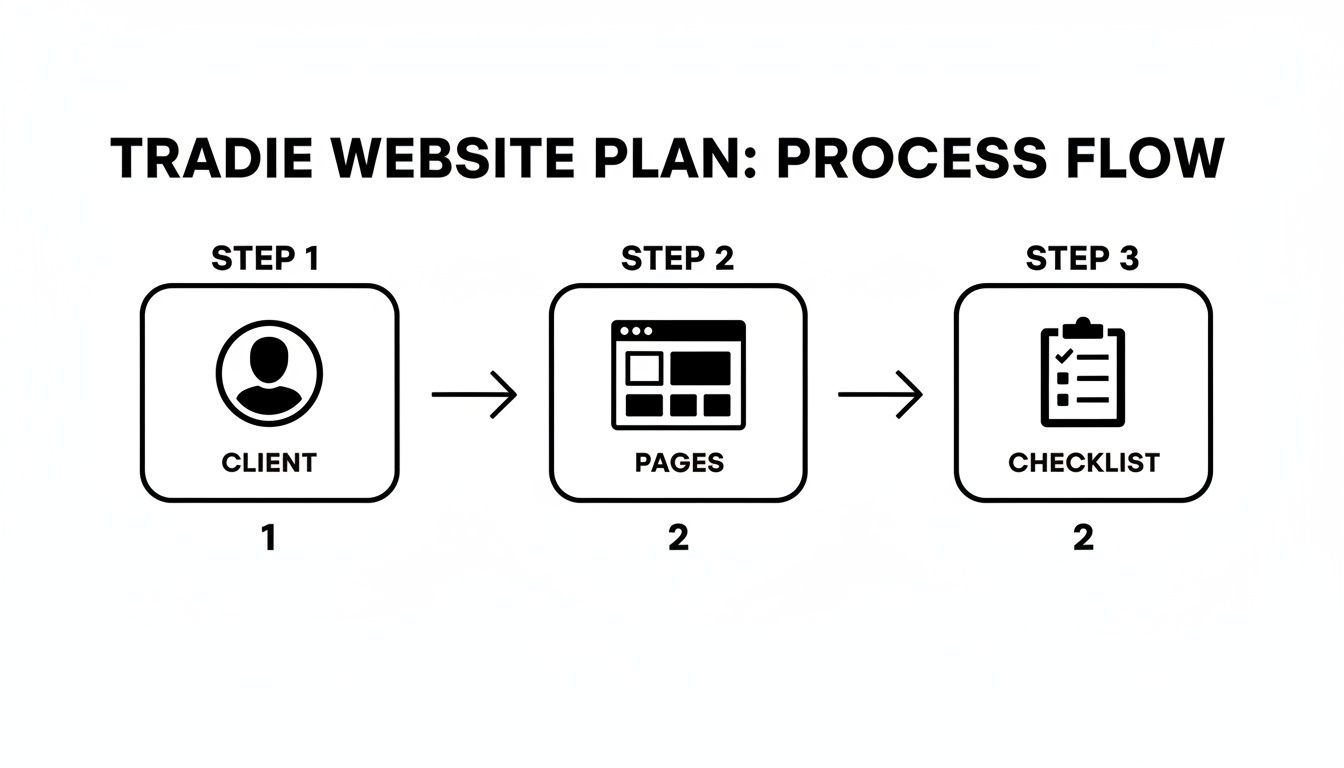
The real takeaway here is that a great website isn’t just a collection of pages; it’s a planned journey. It starts with understanding what the client needs and ends with you having all the info required to give them a quote.
Design Forms That Actually Work
Nothing kills a lead faster than a long, complicated quote form. People are busy and impatient. Your form needs to grab just enough information to qualify the lead and kick off a conversation, without feeling like they’re doing their taxes.
For example, an electrician’s initial contact form doesn’t need every technical spec. It might just ask for:
- Name
- Phone Number
- Suburb
- A quick description of the job (e.g., "Need three new power points installed in the living room.")
- An option to upload a photo of the issue.
This gives you plenty to work with for a callback, and you’ll already have a good idea of what they’re after. You can learn more about creating these smooth interactions by looking into good user experience design principles that keep visitors on your site.
Build Instant Credibility and Trust
When someone lands on your website, their first thought is, "Can I trust this tradie?" You need to answer that question with a resounding "yes" straight away, using powerful social proof.
Nothing sells your services better than your past work and happy clients. This isn't just about looking professional; it's about removing risk from the customer's decision-making process.
Showcase your expertise and build that crucial trust by including:
- High-Quality Photo Galleries: Have a dedicated gallery showing off your completed projects. Use clear, high-resolution images. "Before and after" shots are absolute gold—they’re incredibly effective at showing the value you provide.
- Customer Testimonials: Don't just stick them all on one page. Scatter genuine reviews from real clients throughout your site, especially on your homepage and service pages. Including the client's name and suburb makes them feel much more authentic and trustworthy.
Let Customers Book & Pay Online (While You Sleep)
Imagine this: you wake up, check your phone, and see your schedule for the day is already locked in with new jobs. The best part? You didn't have to answer a single call or reply to a text. That’s the reality when you integrate a booking and payment system into your website. It puts an end to the endless phone tag and lets clients book non-urgent work whenever it suits them, day or night.
This is a complete game-changer, especially for services with straightforward pricing. A landscaper, for example, could offer a standard “Garden Tidy-Up” package for a set price. A customer can just find a time that works, pay a deposit, and the job is booked. Your cash flow gets a nice boost, and you’ve secured the work while you were on another job—or even asleep.
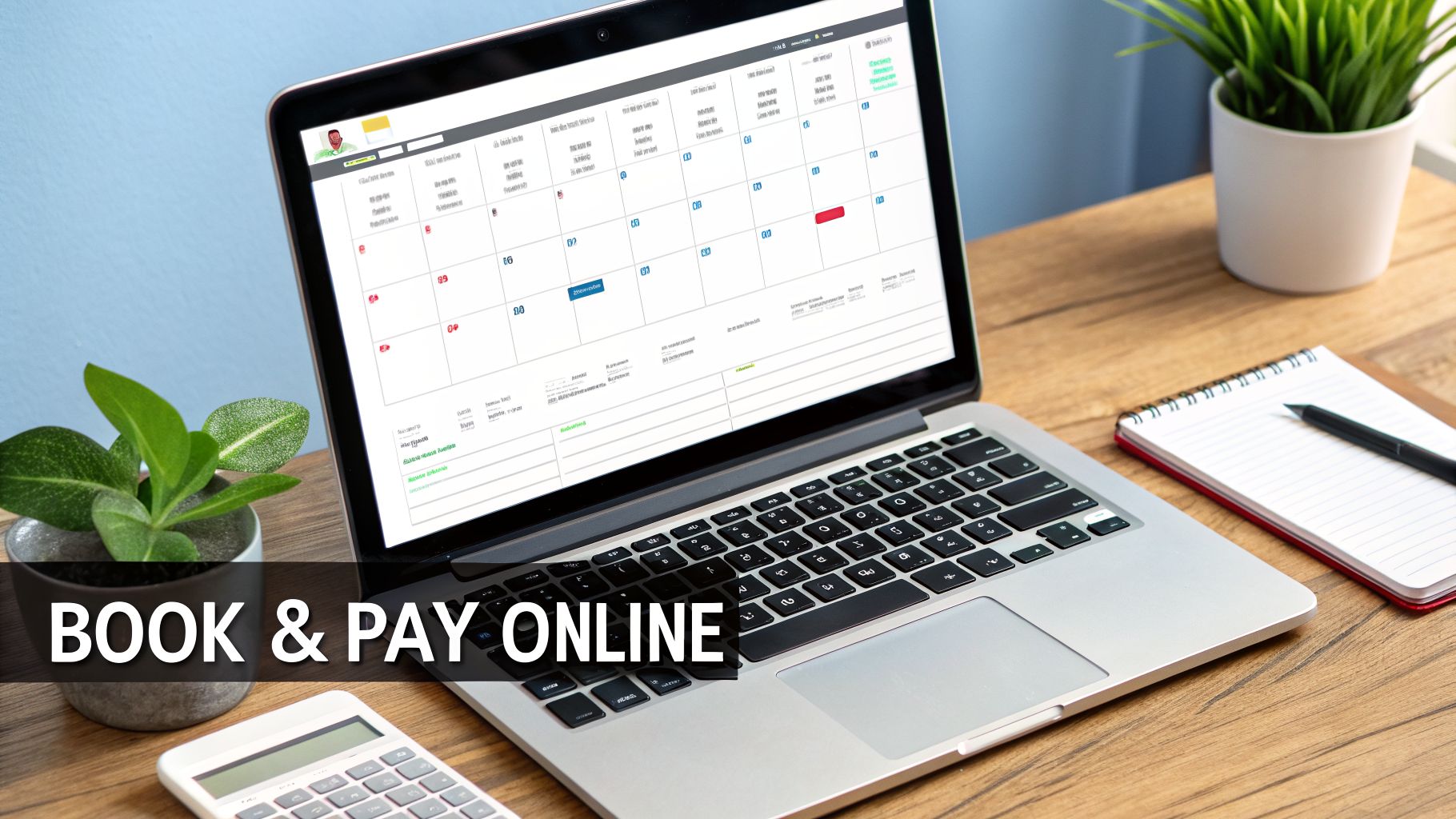
Let Your Calendar Do the Heavy Lifting
An online booking calendar is your new secret weapon for winning back time. It gives your customers the convenience and control they've come to expect, while freeing you from the admin grind.
When clients can see your availability and book themselves in for a quote or a standard job, you immediately slash the back-and-forth emails and calls. It’s a simple, automated system that captures committed leads, often well outside of your normal 9-to-5.
The numbers don't lie. We've seen from client experiences that a 24/7 booking system can cut admin tasks by up to 40%. Even better, it can boost repeat business by 27% simply because Aussie customers overwhelmingly prefer the ease of booking online. A website with this feature gives you a serious leg up on the competition.
Secure Jobs and Cash Flow with Online Payments
Taking payments on your website isn't just about making things easy for customers; it's a solid business strategy. By integrating a payment gateway to take deposits or even full payments upfront, you seriously improve your financial stability.
Securing a deposit before you order materials or schedule your team is one of the smartest moves you can make. It dramatically reduces no-shows and last-minute cancellations, protecting your time and money.
For Aussie tradies, the results are undeniable. Recent data shows that trade businesses adding online payment options saw a massive 92% increase in transaction volume after going live. For many, this has translated to an average of $180,000 in extra yearly sales. It's proof that customers are more than willing to pay for a smooth, secure process.
Getting these systems set up is more straightforward than you might think. Plenty of platforms are built specifically for service businesses and plug right into a modern website. If you're thinking about adding this, have a look at our guide on how to choose a payment gateway in Australia to get started.
Get Found by Local Customers with Tradie SEO
You can have the best-looking website in the world, but if local customers can’t find you when they’re in a panic, it’s not doing its job. This is where Search Engine Optimisation (SEO) comes in. It’s not some complicated tech wizardry; it’s simply about making sure you show up on Google when a homeowner desperately searches for ‘emergency plumber Geelong’ or ‘best painter Western Sydney’.
The whole point is to land your business in that coveted "map pack" at the top of the search results. For local tradies, this little box is where the real action happens. It's prime digital real estate.
Master Your Google Business Profile
Let me be blunt: your Google Business Profile (GBP) is the most powerful free marketing tool you have. It’s that business snapshot that appears in Google Maps and the local search results. Not giving it your full attention is like leaving cash on the table.
To really own that map pack, your profile can't just exist; it needs to be active and packed with detail. Here’s what I mean:
- Get specific with services: Don't just list "Plumbing." Think like a customer. Add 'Hot Water System Repair,' 'Blocked Drain Clearing,' and 'Gas Fitting.' The more specific you are, the better.
- Pinpoint your service areas: Tell Google exactly which suburbs and postcodes you cover. This is how you start showing up for all those "near me" searches.
- Show, don't just tell: Upload plenty of high-quality photos. Get shots of your team on the job, your clean, branded van, and the fantastic results of your finished work. This builds trust before they even call you.
- Post regular updates: Share photos of a recent job, a quick tip, or a special offer. This shows Google (and potential customers) that you’re an active, thriving business.
The Power of Local Keywords and Reviews
You have to think like your customer. They aren’t searching for "qualified plumbing solutions." They're frantically typing "leaking tap repair Ballarat" into their phone. Your website pages, especially your service pages, must use these real-world, location-based keywords to have any chance of being found.
Just as crucial are your customer reviews. We know that 89% of Aussies check reviews online before choosing a business. Making it a habit to ask happy customers for a quick Google review is one of the single most effective things you can do. These reviews don't just build confidence in new clients; they're a massive signal to Google that you're a reputable business worth showing.
The numbers don't lie. A 2023 MYOB report revealed that 81% of trades using SEO and Google Ads who ranked in the top-3 local searches generated 200% more leads. In Queensland, 62% of construction trades saw their revenue jump by 25-40% from websites optimised for 'tradie services near me.' You can find more helpful insights into the industry by looking at recent Australian trade balance data.
Think of your optimised website as your 24/7 digital receptionist, constantly working to bring in local jobs. By focusing on your Google Business Profile and using the right local keywords, you're not just building a site—you're building a lead-generation machine.
While SEO helps new customers find you in the first place, consistent new lead generation is what keeps the phone ringing and ensures your website is a reliable source of new work. For any tradie, that steady stream of local enquiries is the lifeblood of the business.
If you want to dive deeper, we have a complete walkthrough on how to put this all into action in our guide to local SEO for Australian businesses.
Right, getting your new tradie website live is a massive win, and you should be stoked. But don't put your feet up just yet—this is the starting line, not the finish. A website isn't a tool you set and forget; it's a living part of your business that needs regular attention to keep it working for you.
Think of it this way: your domain name (like yourtradiebusiness.com.au) is your workshop's street address, and your web hosting is the block of land it’s built on. You've built the workshop; now you need to keep it secure and well-maintained.
Non-Negotiable Security and Upkeep
Once your site is live, security is job number one. Your website absolutely must have an SSL certificate. This is the little padlock you see in the browser bar, and it keeps your customers' details safe when they fill out a form. Google loves secure sites, and not having an SSL certificate is a surefire way to hurt your rankings and look untrustworthy.
From there, ongoing maintenance is just as critical as servicing your work ute. You wouldn't skip an oil change and expect your vehicle to run smoothly, and your website is no different.
A slow, broken, or insecure website is worse than having no website at all. It actively damages your reputation and sends potential customers straight to your competitors. Regular maintenance is a non-negotiable part of owning this business asset.
A simple upkeep routine is your best defence. It prevents the most common headaches and keeps your site running like a well-oiled machine, protecting you from performance issues and hackers.
Your Simple Maintenance Checklist
You don't need to be a tech whiz to handle the basics. Here’s a straightforward checklist to follow yourself or to make sure your website provider is taking care of for you.
- Regular Backups: This is your safety net, plain and simple. Your site needs to be backed up automatically, at least once a day. If the worst happens, you can restore a recent version without losing everything.
- Software Updates: The core software your site is built on (like WordPress and its plugins) gets updated all the time to patch security holes. Running outdated software is the number one reason websites get hacked.
- Performance Checks: Every now and then, check how fast your site loads. A website that takes more than 3-4 seconds to load will lose visitors faster than you can say "G'day".
- Broken Link Scans: Click around your site and make sure all your links work. Broken links are frustrating for customers and can even drag down your Google ranking.
Keeping your website in top shape ensures it stays a powerful tool for bringing in leads and growing your business. It's all about protecting your investment and your hard-earned reputation.
Your Top Questions About Tradie Websites, Answered
When you’re thinking about getting a new website for your trade business, a few questions always come up. It's only natural. You want to know what you’re getting into, how much it’ll set you back, and what the process looks like.
We've built a lot of sites for sparkies, plumbers, chippies, and builders across Australia. Over the years, we've heard the same questions time and again. So, let's get right into it and clear things up.
A good web project shouldn't have any secrets. We believe in being upfront about costs, timelines, and how you’ll manage your site down the track. No nasty surprises, just a solid plan.
Think of it this way: you’re not just buying a website. You’re investing in a tool that’s going to bring in leads and make running your business a whole lot easier.
How Much Does a Tradie Website Cost in Australia?
This is usually the first question, and the honest answer is: it depends. The cost for a professional tradie website can vary quite a bit.
For a sharp, streamlined site that covers all your bases, you might be looking at a starting price of a few thousand dollars. If you need a more complex, custom-built solution with features like a slick online booking system or an advanced quote calculator, the investment could be closer to $10,000 or more.
It all comes down to what you need your website to do for your business.
How Long Does It Take to Build?
You’ve got a business to run, so you need to know the timeline. A typical, professionally built tradie website usually takes between 4 to 8 weeks from start to finish.
That window gives us enough time for everything that matters: initial strategy sessions, design mock-ups, writing the content, building it all out, and thorough testing before we go live.
If your site needs more custom features, it’ll naturally take a little longer. But no matter what, we’ll lock in a clear timeline right from the get-go.
Can I Update the Website Myself?
Yes, one hundred percent. We build our sites on user-friendly platforms like WordPress for this exact reason. Once it’s live, we’ll give you all the training you need to feel confident making your own updates.
You'll be able to add photos to your project gallery, pop up new testimonials, or tweak your service descriptions whenever you like.
Of course, if you'd rather just focus on what you do best, we also offer ongoing support and maintenance packages to handle all that for you.
Ready to build a website that brings in more jobs and simplifies your business? The team at Website Builder Australia are local experts in creating high-performing websites for trades. Get in touch for a no-obligation quote today.


