

Affordable Website Design for Small Business a 2026 Budget Guide
Getting an affordable website designed for your small business is more than just possible—it’s one of the smartest investments you can make. The real question isn't whether you can afford a website, but can you really afford not to have one? In this day and age, relying only on social media is like building your business on rented land. It’s a huge risk.
Why a Professional Website Is Non-Negotiable in 2026
I see it all the time—small business owners pour their hearts and souls into building a great following on Facebook or Instagram, thinking that’s enough. While these platforms are fantastic for connecting with your audience, they are ultimately borrowed spaces. You don't own your profile, you don't control the algorithm, and you certainly don't make the rules.
That’s a shaky foundation for any business. One little algorithm tweak can completely tank your reach overnight. A surprise account suspension could sever your main line to your customers without a moment's notice. Your website, on the other hand, is your digital headquarters. It’s an asset you own outright.
The Credibility Gap Social Media Can’t Fill
Let’s get practical. Imagine two plumbers in Perth, both brilliant at what they do. One, let's call him "Plumber A," runs his whole business off a Facebook page. "Plumber B" has a sharp, professional website to go along with their social media.
Now, picture a homeowner with a burst pipe at 10 PM. Are they scrolling through Facebook? Not likely. They’re frantically Googling "emergency plumber Perth."
Plumber B’s website pops right up, giving the stressed-out homeowner everything they need:
- Clear info on services and call-out fees.
- Glowing customer reviews that build instant trust.
- A big, obvious phone number and a simple contact form.
Plumber A is completely invisible in that moment of need. The homeowner calls Plumber B, not because he's a better tradie, but because he looks more credible, professional, and ready for business. Your website is your best salesperson, working tirelessly for you 24/7.
A website gives you a level of ownership and professionalism that social media just can't match. You control the design, the message, and most importantly, the customer journey.
Digital Presence Showdown: Website vs. Social Media Alone
| Feature | Professional Website | Social Media Only |
|---|---|---|
| Ownership | You own it 100%. It's a permanent business asset. | You're renting space. The platform owns your profile and can change rules anytime. |
| Credibility | High. Establishes you as a serious, professional business. | Moderate. Often seen as less formal and can lack professional trust. |
| Control | Full control over design, content, and user experience. | Limited by the platform’s features, layouts, and character limits. |
| Discoverability | Optimised for search engines (like Google), attracting new customers actively looking for you. | Dependent on the platform's algorithm and users stumbling upon your content. |
| Customer Data | You can collect emails, analyse traffic, and build your own marketing lists. | The platform owns the data. Your access to followers can be restricted at any time. |
The verdict is clear: while social media is a great tool for engagement, a website is the essential foundation for long-term growth and stability.
Owning Your Digital Future
The divide between businesses with a proper website and those without is wider than you might think. Projections show that in 2026, a staggering 41% of Australian small businesses still won't have a website, leaving them dangerously dependent on the whims of social media. As you can see from this report on Australian website statistics, this reliance can seriously damage credibility and stunt growth.
Your website is the one piece of the internet you truly own. It’s the central hub for your brand, your content, and your customers—a permanent asset that social media profiles can never replace.
The good news is that you don't have to break the bank. Modern agencies now specialise in affordable website design for small businesses, offering packages that deliver a real return and grow with you.
Think of it this way: investing in a professional website isn't just another expense. It’s you planting your flag and claiming a permanent, powerful spot on the web.
Setting a Realistic Website Budget and Goals
Before you even start looking at designers or website builders, we need to get two things crystal clear: what does this website actually need to do for your business, and how much can you realistically invest?
It's easy to have vague goals like "I want more leads." But a successful project is built on specifics. Think about it this way: a Sydney-based consultant might just need a sharp, professional site that acts like a digital business card. Their main goal? To generate five qualified enquiries a month through a contact form. Simple.
On the other hand, a local artisan in Melbourne might need a small ecommerce site. Their goal is totally different: selling 20 products online each month. Nailing down these concrete targets is your best defence against a budget that spirals out of control.
Breaking Down the Costs
One of the biggest mistakes I see small business owners make is only budgeting for the initial design. To get a true picture, you have to understand how much a small business website costs from start to finish. Your total investment is always a mix of one-off setup fees and ongoing running costs.
Here are the main things you need to factor into your budget:
- Design and Development: This is the big one-time fee to actually build your site. It's the largest upfront expense and can vary wildly depending on what you need.
- Domain Name: This is your website address, like
yourbusiness.com.au. It's a small annual fee, usually around $20-$30. - Website Hosting: Think of this as the rent you pay for your website's spot on the internet. For good, reliable Australian hosting, you should budget for $25-$50 per month.
- Ongoing Maintenance: This is crucial. It covers security, backups, software updates, and tech support. A solid maintenance plan might run you $50-$200+ per month, but it’s what protects your website long-term.
Aligning Your Budget with Business Needs
Okay, so how do those costs translate into a real-world website? Thinking about your budget in tiers is a great way to manage expectations and see what’s actually achievable for your money.
| Budget Tier | Typical Cost (AUD) | Best For | Key Features |
|---|---|---|---|
| Starter / Brochure | $2,000 – $4,000 | Consultants, tradies, local services | 3-5 pages, contact form, mobile responsive, basic SEO setup. |
| Business Growth | $4,000 – $8,000 | Growing businesses, professional services | 5-15 pages, blog, lead magnets, advanced contact forms, CRM integration. |
| Basic Ecommerce | $6,000 – $12,000+ | Artisans, small retailers | Product pages, secure checkout, payment gateway integration, inventory management. |
This table should give you a decent starting point. If you want to get into the nitty-gritty, we break these figures down even further in our guide to the complete website design cost in Australia.
A well-defined budget and clear goals are the most powerful tools you have. They let you have confident, productive conversations with designers and make sure you only pay for what will actually help your business grow.
When you have your requirements and budget sorted upfront, you change the entire conversation. It stops being "How much for a website?" and becomes "How can we achieve my specific business goals within this budget?" That clarity is the real secret to getting a fantastic, affordable website that pulls its weight.
Right, you've got your budget and your must-have features sorted. Now comes the big decision: who’s actually going to build this thing?
Choosing how you get your website built is a massive fork in the road. It will dictate not just your upfront cost, but also how much of your own time you’ll sink into it and what your site can truly become down the track.
You’ve basically got three paths to choose from. Let's get real about the pros and cons of each.
Comparing Website Build Options for Small Businesses
This table gives you a quick snapshot of the trade-offs you'll be making with each option. It breaks down what you can realistically expect in terms of cost, time, and the final result.
| Factor | DIY Website Builder | WordPress Template | Custom Agency Build |
|---|---|---|---|
| Upfront Cost | $0 – $50/month | $300 – $1,500+ | $5,000 – $25,000+ |
| Time Commitment | High (40-80+ hours) | Medium-High (20-60+ hours) | Low (5-15 hours) |
| Technical Skill | Low | Medium | None Required |
| Flexibility | Limited | High | Unlimited |
| Best For | Startups, hobbyists, or businesses on a shoestring budget. | Businesses with some tech skills who need more power than a DIY builder. | Serious businesses focused on growth, ROI, and a professional online asset. |
As you can see, the "cheapest" option often costs the most in time, while the most expensive option saves you time and delivers a professional outcome. It all comes down to what you value most.
The DIY Website Builder Route
Platforms like Wix and Squarespace have made building a website seem as easy as making a slide deck. Their drag-and-drop tools are genuinely simple to start with, and the low monthly fees are incredibly tempting when every dollar counts.
But the cheap price tag can be a bit of a mirage. The biggest hidden cost is your own time. Honestly, you can easily burn 40, 60, even 80 hours learning the platform, designing pages, and banging your head against the wall when something doesn’t work. That’s time you’re not spending on sales or serving your customers.
You'll also run into walls with what the platform can actually do. They're fine for a simple "digital brochure," but if you need specific features or want to properly optimise for Google, you might find yourself stuck. For a closer look, check out our guide to the best website builders for small businesses to see if this path really aligns with your goals.
The WordPress Template Approach
This is the classic middle-ground option. You start with a pre-designed WordPress theme—some are free, others are a few hundred dollars—and then customise it to match your brand. It’s a step up from a DIY builder because the power and flexibility of WordPress are immense.
The catch? The learning curve can be brutally steep. One minute you're changing colours, the next you're trying to debug PHP code or figure out why two plugins are fighting each other. It can get technical, and it can get frustrating, fast.
You’re also the captain of your own ship, which means you’re solely responsible for security, backups, and updates.
A WordPress template gives you a fantastic head start. But if you don't have a bit of a technical mind, you can easily spend more time trying to fix it than actually using it to find customers.
The Professional Agency Build
Hiring a web design agency is usually seen as the "expensive" route, but for a business that’s serious about growth, it often provides the best return on investment. This isn't just about getting a pretty design; it’s about entering a partnership focused on hitting your business goals.
This decision tree can help you visualise where you fit.
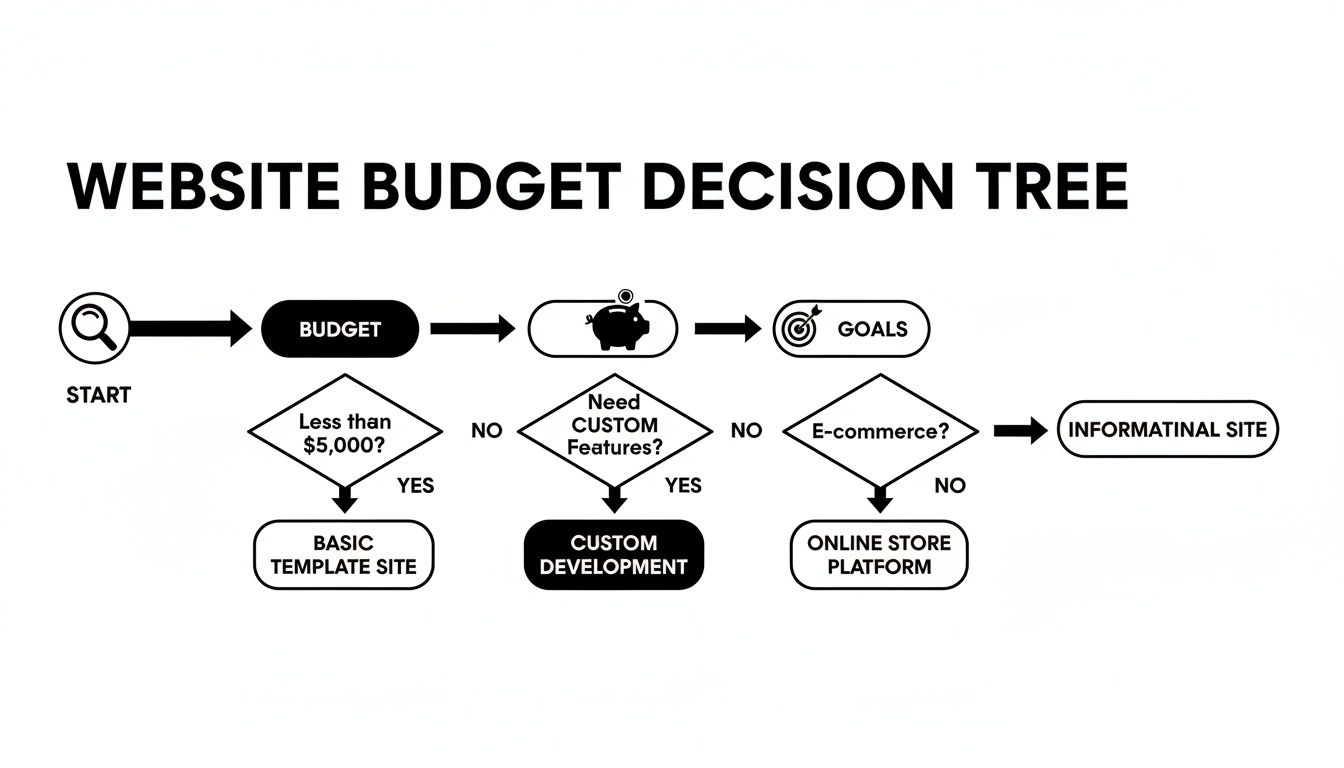
As you can see, the more you want your website to do for your business, the more sense it makes to invest in a professional, custom solution.
An agency takes care of everything—strategy, custom design, development, SEO foundations, and a smooth launch. The result is a high-performing website built correctly from day one, which frees you up to do what you do best. It's the sweet spot for getting an affordable website design for a small business that’s also a powerful, scalable asset built for the long haul.
Essential Features for a Hardworking Small Business Website
Getting an affordable website for your small business doesn’t mean you have to settle for something that just sits there looking pretty. The secret is to be strategic, putting your budget into the core features that actually win you customers. Anything else is just digital window dressing.
The absolute, non-negotiable starting point is a mobile-first design. This isn't just a trendy phrase I’m throwing around; it’s a fundamental business necessity in this day and age. The simple reality is that most of your potential customers will find you on their phones, not on a big desktop computer.
This is especially true right here in Australia. By 2026, we’re looking at 27 million smartphone users, with a staggering 72% of all internet access happening exclusively on mobile. If your website isn't built for that experience, you're already behind the eight ball. You can get a deeper dive into these trends in this 2026 web development report.
Must-Haves for Mobile Performance
A mobile-first approach means your designer literally builds the smartphone version of your site first, then adapts it for tablets and desktops. It’s a smart process because it forces a laser focus on what truly matters to someone on the go.
- Lightning-Fast Load Speed: Did you know more than half of mobile users will give up if a page takes longer than three seconds to load? Your budget must prioritise optimised images and clean code to make your site snappy.
- Simple, Obvious Navigation: On a tiny screen, no one has the patience for confusing menus. Your most important pages—like ‘Services,’ ‘About Us,’ and ‘Contact’—should be dead easy to find, usually tucked into a clean "hamburger" menu.
- Thumb-Friendly Buttons: Every single clickable element, especially your main call-to-action buttons, must be big enough to be tapped easily with a thumb. Nothing is more frustrating than trying to hit a tiny button and missing.
Think of a local cafe's website. A potential customer on their phone doesn't want to read a long-winded history of the business. They want the opening hours, the menu, and a "Book a Table" button they can tap without pinching and zooming.
Features That Turn Visitors into Customers
Once you’ve nailed the mobile experience, the next step is to add features that are designed to guide visitors towards taking action. Every single part of your website should have a job.
A clear call-to-action (CTA) is vital. Don't make people guess what you want them to do. Whether it's "Get a Free Quote," "Shop Now," or "Call Us Today," your main CTA needs to be front and centre on every page, especially "above the fold" on your homepage (that's the bit people see without scrolling).
Finally, make it incredibly easy for people to get in touch. A simple contact form and a clickable phone number in your site's header and footer are essential. If you have a physical location, embedding a map is a brilliant touch that builds trust and helps local customers find you in the real world.
When you focus on these core elements, you ensure your investment delivers what it’s supposed to: real, measurable results for your business.
How to Find and Vet the Right Website Design Partner
Choosing who to build your website can feel like a massive decision, and honestly, it is. It's the most important step in getting an affordable website design for your small business that actually gets results. You’re not just looking for a coder or a designer; you’re looking for a partner who gets your vision and is genuinely invested in seeing your business succeed.
So, where do you start looking? While you could trawl through global freelance sites, there’s a real advantage to partnering with a local Australian agency. A team that’s on the ground here understands the Aussie market in a way others can't—from the way people shop in Sydney to the search terms a customer might use in Adelaide.
Asking the Right Questions
Once you have a shortlist of potential partners, it’s time to dig deeper than just asking, "how much?". A flashy portfolio is one thing, but it won't tell you about their process, their experience with businesses like yours, or what happens after your site goes live.
Here are the questions I always recommend asking any web design company you're considering:
- Can you show me sites you've built for businesses in my industry? You need to see relevant work. Someone who specialises in building sites for tradies will have a different approach than someone who designs for cafes.
- What does your process look like from start to finish? A professional agency will walk you through a clear, structured plan. This should cover everything from discovery and design to feedback, development, and launch. If their answers are vague, that’s a red flag.
- How do you build local SEO into the website? This is a big one. You want a partner who builds search engine optimisation in from day one, not as an afterthought bolted on at the end.
- What happens after the site launches? What kind of support do you offer? A website is a living thing; it needs ongoing care. Ask about their maintenance plans, what’s included (like backups, security, and updates), and what the costs are.
A great partner won’t just build what you ask for. They’ll challenge your ideas and make expert recommendations to help you hit your business goals. They should feel like an extension of your team, not just a contractor you’ve hired.
The Power of Local Expertise
I can't overstate the value of local knowledge, especially for getting found online. Local search is an absolute powerhouse for Australian small businesses. In fact, it now drives 46% of all searches with localised intent, making it a massive priority if you're looking for affordable website upgrades that pay off. A partner who truly gets this can give you a huge leg up on the competition. Exploring these digital marketing statistics will show you just how much this matters to your bottom line.
Spotting Red Flags
Knowing what to look for is only half the battle; you also need to know what to avoid.
Be very wary of any agency that throws a quote at you without having a proper chat about your business goals first. A price that seems too good to be true usually is. It often means they're cutting corners on essentials like mobile-friendly design, security, or proper testing.
Other warning signs include wild promises like "guaranteed #1 rankings on Google" or a reluctance to let you speak with past clients. A trustworthy partner will always be transparent.
If you want to dig deeper into finding the right fit, our guide to choosing a website development company in Australia has a lot of useful info. And if you're thinking about a more hands-off approach down the track, learning how to hire a webmaster can also be incredibly valuable as you vet potential partners.
Alright, you've done the hard yards. You've mapped out why you need a site, crunched the numbers on a budget, and weighed up your build options. But I bet there are still a few nagging questions rattling around in your head.
Let's clear up those final queries. Think of this as the last chat we need to have before you can confidently take the next step. Getting a great, affordable website for your small business is completely within reach once you know exactly what to expect.
How Much Should a Small Business Website Cost in Australia in 2026?
Let's cut straight to the chase. For a professionally built website from a good local Aussie agency, you should be looking to budget somewhere between $3,000 and $8,000.
A simple, sharp-looking brochure site will land on the lower end of that scale. If you need some basic e-commerce features to start selling online, you’ll be looking closer to the higher end.
A word of warning: if you get quotes that are dramatically lower than this, be very wary. A rock-bottom price usually means corners are being cut somewhere important—think a non-existent SEO foundation, poor mobile performance, or zero support once the site is live. The goal isn't to find the absolute cheapest option, but the best value that will actually make you money.
Can I Get a Good Website for Under One Thousand Dollars?
Honestly? Yes, you can, but you're going to be making some big trade-offs. For under $1,000, your main choices are DIY platforms like Squarespace or hiring an overseas freelancer. While they look cheap on paper, there are hidden costs.
The DIY path means you’ll be sinking a massive amount of your own time into the project—time you could be spending running your business. On the other hand, a cheap freelancer might get a site built, but they often won't have a clue about the Australian market or the local SEO tactics you need to actually get found by Aussie customers.
For a reliable business asset that’s built to grow, investing a bit more in a professional local solution almost always pays for itself in the long run through better performance, saved time, and peace of mind.
How Long Does It Take to Build a Small Business Website?
When you work with a professional agency, a standard small business website typically takes about 4 to 8 weeks from start to finish.
This timeframe gives us enough room to do things properly. It covers everything from the initial planning and design mockups, right through to the build, loading your content, testing, and finally, launch day. It ensures we're not rushing critical steps like SEO setup and making sure everything works perfectly on mobile. Of course, a very simple site might be a bit quicker, while a more complex project will naturally take longer.
What Are the Ongoing Costs After the Website Is Built?
Getting your website built is the first step, but there are a few ongoing costs you need to budget for to keep it online, secure, and running smoothly. Think of them as your site's running costs.
- Domain Name: This is your website address (like yourbusiness.com.au). It's a small annual fee, usually around $20-$30 per year.
- Website Hosting: This is the service that keeps your site live on the internet. For fast, reliable hosting, you should plan for about $25-$50 per month.
- Maintenance Plan: This is basically your website's insurance policy. For $50-$200+ per month, it covers essential software updates, security scans, regular backups, and access to technical support when you need it. It’s what protects your investment.
At Website Builder Australia, we specialise in creating high-performing, affordable websites that help small businesses thrive. If you're ready to get a site that works as hard as you do, contact us for a free, no-obligation quote today.


