

Best Web Hosting for Small Business Australia 2026
You're probably looking at a dozen hosting tabs right now. One says it's cheapest, another says it's fastest, another pushes “unlimited” everything, and half of them assume you already know the difference between shared hosting, WordPress hosting, VPS, cloud, SSL, DNS, backups, and CDN.
That's where most small business owners in Australia get stuck. The decision feels technical, but the key question is simpler. What kind of hosting fits your business model today, and what won't become a problem six months from now?
If you run a local service business, a simple and reliable setup is usually enough. If you run an online store, a campaign-heavy site, or a content business, the wrong host can turn into slow pages, support delays, backup headaches, and lost enquiries at the worst possible time. Recent Australian guidance also points to a more practical issue many owners miss: with heavier websites, unpredictable campaign traffic, and stronger security expectations for small organisations, features like backups, DDoS protection, and Australian support hours often matter more than the lowest sticker price, as discussed in Crucial's Australian hosting guidance.
The best web hosting for small business Australia isn't one universal provider. It's the host that matches your stage, your risk level, your traffic pattern, and how hands-on you want to be.
| Business type | Best starting hosting type | What matters most | Likely trade-off |
|---|---|---|---|
| New local service business | Shared or managed WordPress | Low admin, reliability, email, simple updates | Less control |
| Growing ecommerce store | VPS, cloud, or quality managed hosting | Speed, backups, security, scaling | Higher monthly cost |
| Content-heavy blog or resource site | Managed WordPress, cloud, or VPS | Performance under traffic spikes, caching, storage | More technical setup if unmanaged |
| Established company website | Business hosting or managed hosting | Local support, compliance clarity, stable uptime | Paying more for support and management |
| Campaign-driven business | VPS or cloud | Flexible capacity, recovery options, support response | Needs better planning |
Choosing Your First Host Can Feel Overwhelming
A lot of hosting advice starts in the wrong place. It starts with server specs.
Small businesses don't buy hosting because they want server specs. They buy hosting because they want their website to load, collect leads, process enquiries, handle email, stay online, and not create a mess every time they run a promotion or need an update.
Why the cheapest plan often stops being cheap
The cheapest plan looks sensible when you're launching a basic site. That works for a while. Then the business adds a booking tool, a few more pages, some image-heavy service galleries, maybe a blog, maybe ecommerce, maybe a Google Ads campaign that sends a burst of traffic all at once.
That's usually when the original hosting decision starts to show cracks.
Practical rule: Choose hosting for the site you'll be running after your next growth step, not just the one you're launching this week.
A host isn't just renting space on the internet. It's part of your operating stack. It affects page speed, contact form reliability, backups, malware recovery, and whether someone can help when things go wrong outside standard business hours.
A better way to choose
For Australian businesses, the smarter path is to match hosting to three things:
- Your business model: brochure site, lead generation, ecommerce, publishing, memberships
- Your growth stage: new launch, steady growth, active scaling
- Your operating reality: how much technical work you can manage
If you keep those three in view, the market gets easier to read. You stop comparing vague promises and start asking better questions. Does this host fit a local tradie with five core pages and a quote form? Does it fit a retailer with sales spikes? Does it give you local support when your team needs answers quickly?
That's the frame that matters.
Decoding Australian Web Hosting Types
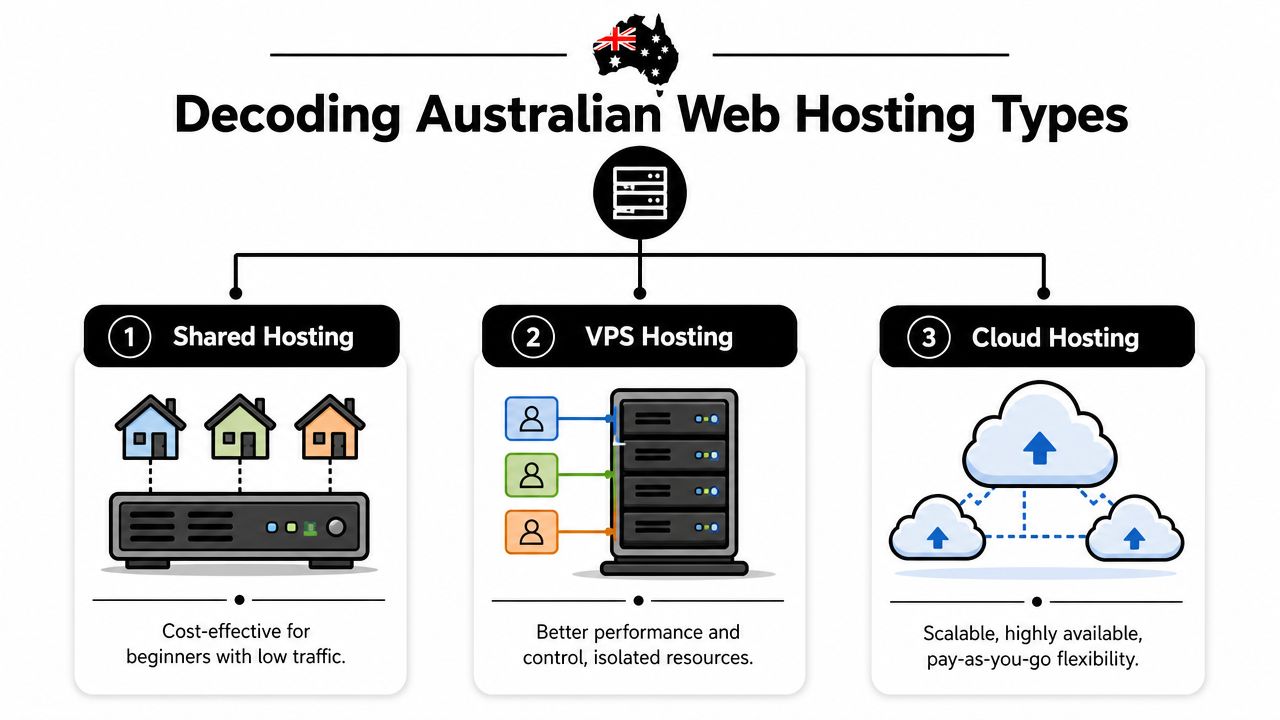
The main hosting categories sound more complicated than they are. For most small businesses, each one maps to a different level of traffic, control, and responsibility.
Shared hosting
Shared hosting is like renting a room in a share house. You've got what you need, but you're sharing the property with other tenants.
This is often the right starting point for a small service business, consultant, sole trader, or early-stage brand with a simple website and modest traffic. It's affordable, easy to set up, and usually bundled with the basics a small business expects.
The downside is resource sharing. If your site gets busier, or if neighbouring sites on the same environment create performance issues, you've got less insulation.
Shared hosting suits:
- Simple brochure sites: home, about, services, contact
- Early launches: when cost control matters more than fine-tuned performance
- Low-maintenance setups: especially if you're not changing the site every week
VPS hosting
A VPS is closer to leasing a townhouse. You still sit inside a larger complex, but your space is partitioned and your resources are more isolated.
That gives you more consistent performance and more control. For a growing business, that matters. If you're running ecommerce, custom plugins, heavier media, or regular campaigns, VPS hosting can remove a lot of the bottlenecks that appear on entry-level plans.
It's a better fit when the website has become part of operations rather than just a digital business card.
Cloud hosting
Cloud hosting works more like a flexible commercial tenancy network than a single premises. The infrastructure is designed around scalability and resilience.
That makes it useful for businesses with uneven traffic patterns. If you run product drops, promotions, event registrations, or seasonal campaigns, cloud setups can be easier to grow with. They're also common in modern managed environments.
The catch is complexity. “Cloud” doesn't automatically mean easier. A well-managed cloud product can be straightforward. An unmanaged one can demand more technical know-how than many small business owners want to carry.
Managed WordPress hosting
If your site runs on WordPress and you don't want to be your own server administrator, managed WordPress hosting is often the cleanest option.
The value isn't just speed. It's reduced maintenance overhead. Updates, caching, security layers, and support tend to be more optimized for WordPress itself, which can save time and reduce breakage.
For many owners, this is the middle ground that works. You pay more than bare-bones shared hosting, but you spend less time fixing things.
If you're still sorting out the basics of domains versus hosting, this guide on domain hosting for Australian businesses helps clear up where each piece fits.
Ecommerce hosting
Ecommerce hosting isn't always a separate technical category. Sometimes it's shared, VPS, cloud, or managed hosting packaged around online selling needs.
What matters is whether the environment supports the demands of a store:
- Security layers: especially around checkout and account data
- Reliable backups: so recovery is less painful
- Performance under pressure: during promotions or catalogue growth
- Plugin compatibility: for shipping, payments, inventory, and marketing tools
If your website directly earns revenue, don't choose hosting like it's a side utility. Treat it like part of your sales infrastructure.
For most Australian small businesses, the shortlist usually narrows quickly. A new service business often lands on shared or managed WordPress. A growing store typically moves toward managed, VPS, or cloud. That's a more useful starting point than comparing feature lists in isolation.
Key Decision Criteria for Aussie Businesses
A host can look fine on a comparison table and still be the wrong fit for your business once invoices, support, backups, and growth start to matter.

The better way to choose is to match hosting to your business model and stage. A solo consultant with a brochure site usually needs predictable support, simple billing, and enough speed for local visitors. A growing retailer needs stronger performance under load, faster recovery if something breaks, and a plan that can scale without a disruptive rebuild.
Local infrastructure and support
For Australian businesses, local hosting decisions affect more than page speed. They affect who answers the phone, where your data sits, and how easy it is to sort out problems during business hours.
VentraIP's guidance for choosing a host highlights Australian server locations, technical support quality, included security and backups, easy plan upgrades, and clear pricing as the main comparison points. It also recommends checking whether the provider has an Australian presence and local reputation, as outlined in VentraIP's hosting provider guide.
That advice holds up in practice. If most of your customers are in Australia, Sydney or nearby infrastructure usually makes more sense than sending every request offshore. If your business relies on email enquiries, bookings, or quote requests, AU-based support can also save hours when something stops working at 9 am on a Tuesday.
Look for: Australian data centre options, support that operates on Australian time, and billing that reflects local business needs.
Performance and uptime
Performance should be judged against what the site does.
A trades business with a simple services site can tolerate a modest setup if the pages load cleanly and forms work every time. A clinic with online bookings or a WooCommerce store with active campaigns needs more headroom. Slow admin screens, laggy checkouts, and timeouts during busy periods cost real money.
Uptime promises are still worth checking, but they are only part of the picture. The better question is how the provider handles incidents. Ask what happens during a server issue, how quickly support responds, whether backups are available for self-restore or handled by staff, and how upgrades work if traffic jumps.
This is often where cheap entry plans start to show their limits.
Security, backups, and recovery
Security matters most when something goes wrong. A plan that looks inexpensive can become expensive fast if malware cleanup, restores, or SSL are treated as extras.
Check for:
- Automated backups: how often they run, how long they are kept, and whether restores cost extra
- SSL inclusion: needed for browser trust, form security, and search visibility
- Account isolation and malware protection: especially on shared hosting
- Clear recovery steps: who handles the restore, cleanup, and follow-up if the site is compromised
If you're reviewing SSL and SEO together, this explainer on how to boost rankings with HTTPS is a useful companion because it connects security setup to search visibility in plain language.
Pricing, renewals, and plan upgrades
Price matters, but small businesses usually get into trouble at renewal or upgrade time, not on day one.
The practical question is whether the plan still makes sense six or twelve months from now. A startup may be fine on a low-cost shared plan. If that business adds bookings, extra staff email accounts, location pages, or a shop, the cheapest plan can turn into false economy if support slows down or migration becomes necessary too early.
For businesses comparing lower-cost options, this guide to cheap website hosting in Australia is useful for judging what a budget plan should still include.
Business admin fit
This gets overlooked far too often.
Australian businesses often need tax invoices that are easy to reconcile, clear ABN and GST treatment, and support processes that make sense locally. If your bookkeeper has to chase unclear billing or your team has to work through generic offshore ticket loops, the hosting relationship starts creating admin cost instead of saving time.
That is why the best web hosting for small business Australia is rarely the provider with the longest feature list. It is the provider that fits your current site, supports your next stage of growth, and handles the local operational details properly.
Top Web Hosts for Australian Small Businesses 2026
Some businesses want the strongest performance they can get for the money. Others care more about local support, billing clarity, and having someone in Australia answer when things go wrong. A useful shortlist should reflect those different priorities rather than pretend one host wins every category.
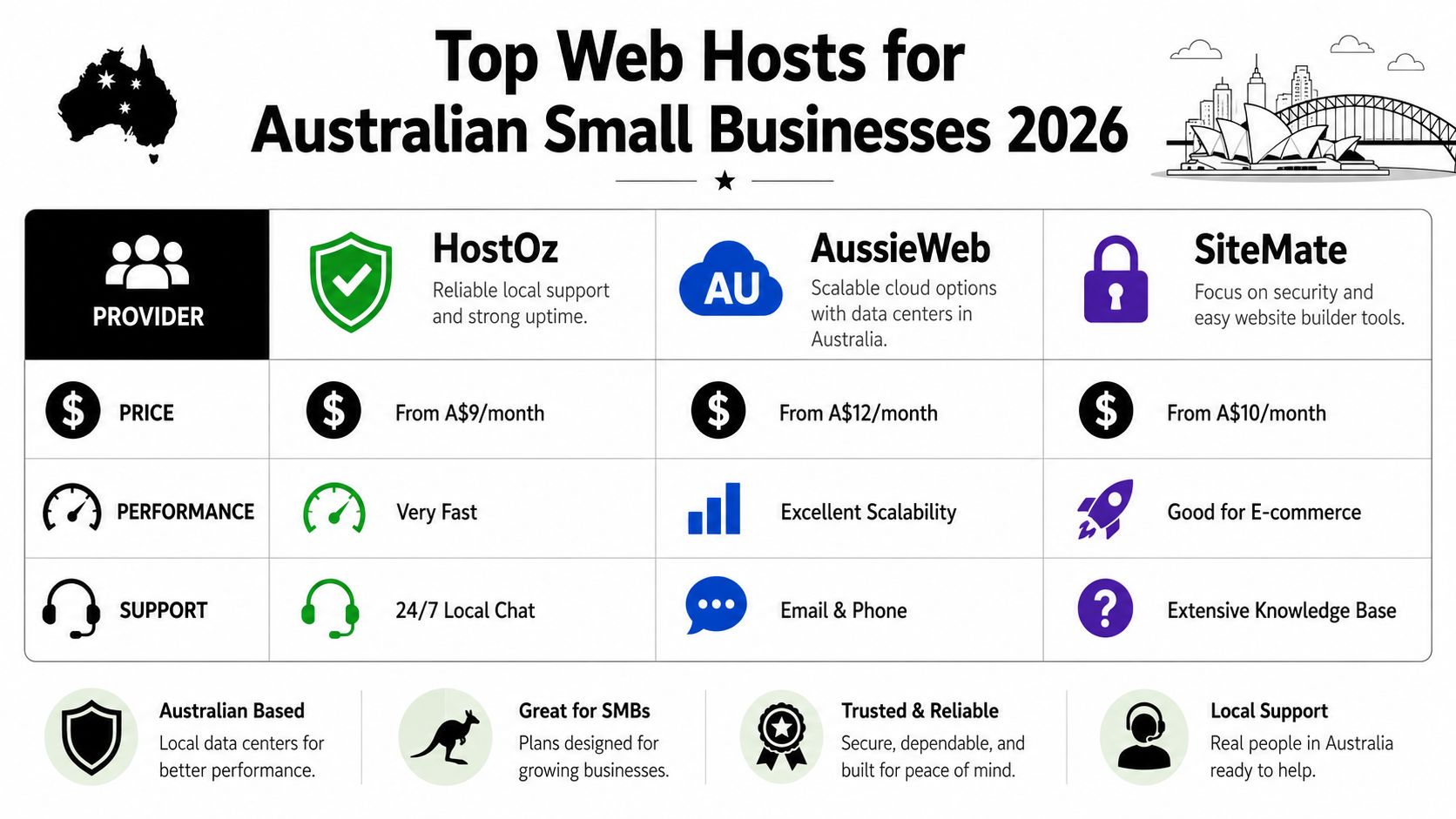
| Provider | Best for | Main strength | Main trade-off |
|---|---|---|---|
| Hostinger | Performance-focused small businesses | Strong performance and server resources in independent testing | Less local positioning than an Australian-owned support-first host |
| VentraIP | Businesses wanting Australian-based support | Local support model and Australian market focus | May not be the first pick if raw performance is your only decision point |
| GoDaddy | Businesses wanting familiar entry-level options | Clear low-entry pricing in the Australian market | Costs rise as needs become more demanding |
| Website Builder Australia | Businesses wanting hosting tied to build and maintenance support | Hosting, email hosting, maintenance, and site work under one service relationship | Best fit when you want a service partner, not just a standalone hosting dashboard |
A quick walkthrough can help if you prefer hearing the concepts explained visually.
Hostinger for speed-conscious businesses
If your priority is performance, Hostinger deserves a serious look. Cybernews ranked Hostinger as the best overall Australian web host because it “has great performance” and “good server resources”, which makes it especially relevant for businesses where latency-sensitive page loads matter, according to Cybernews' Australian hosting review.
That doesn't automatically make it the best fit for every small business. Performance is only one part of the buying decision. But for a business with a content-heavy site, an online store, or campaigns that depend on fast page delivery, it's a strong contender.
Hostinger is usually a good fit for:
- Businesses running speed-sensitive campaigns
- Online stores that need stronger baseline resources
- Owners comfortable with a more platform-driven support experience
VentraIP for local support and Australian alignment
VentraIP stands out when local support is the deciding factor. The company states that its business hosting plans are built for “faster speeds than ever” and include 24/7 technical support from a 100% Australian-based team, which is highly relevant for SMEs that want local coverage and support responsiveness, as described on VentraIP's business hosting page.
That kind of support model matters more than many owners realise. If your website supports leads, bookings, or customer communication, getting help from a local team can reduce stress during urgent issues.
A business owner who values local response and local context will often be happier on a slightly less flashy host with stronger support than on a faster host with weaker human help.
VentraIP is usually the right shortlist option for businesses that want:
- Australian-based support as essential
- Hosting from a provider with local market focus
- A business plan rather than a bare-minimum starter package
GoDaddy for low entry cost and familiarity
GoDaddy is worth including because it sets a clear pricing benchmark in Australia. It's often one of the first providers small business owners encounter, and its pricing helps anchor market expectations.
For a simple launch, those entry points can be attractive. The issue isn't that the plans are unusable. It's that many businesses outgrow a basic plan faster than expected once they add more features, richer pages, or more ambitious marketing.
If you're building a basic site and want a familiar provider with low entry-level pricing, GoDaddy can be a workable starting point. Just go in with open eyes about future needs.
Website Builder Australia for businesses wanting hosting plus implementation
Some businesses don't really want “just hosting”. They want hosting bundled with practical help. That usually means someone can handle the website build, email hosting, updates, maintenance, and troubleshooting without passing the problem between multiple vendors.
In that case, a service provider like Website Builder Australia can make sense as one option in the market. It offers website hosting and email hosting alongside website development, ecommerce builds, maintenance, and related digital services. That model is a better fit for owners who'd rather have one relationship covering the site itself and the underlying hosting environment.
Which host is best depends on your operating style
There isn't one universal winner.
Pick Hostinger if performance is at the top of the list. Pick VentraIP if local Australian support is central to the decision. Consider GoDaddy if you need a familiar low-entry path and understand the limits of entry-level plans. Look at a service-led option if you want hosting connected to design, support, and ongoing site work.
That's usually where the market separates. Not good versus bad. More often, it's DIY-friendly performance, local support-first hosting, or service-wrapped delivery.
Hosting Scenarios Which Plan Is Right for You
A Brisbane sparky with a five-page site does not need the same hosting setup as a Melbourne retailer processing online orders every day. That is the mistake I see most often. Small businesses buy for the server label instead of the business model, then either overspend or hit limits too early.
A better approach is to match hosting to what the website does, how much risk downtime creates, and how much technical work your team can realistically handle.
The local tradie or service business
If your website mainly brings in calls, quote requests, and local search traffic, keep the hosting decision simple. Shared hosting or managed WordPress is usually enough for a brochure-style site, service pages, and a contact form.
The priorities are practical. Good uptime, backups you can restore quickly, email that is set up properly, and support that answers during Australian business hours. If you trade under an ABN and want clean invoicing with GST handled properly, check that before you sign up. It saves admin headaches later.
For this stage, paying extra for a bigger plan rarely changes the business result.
The growing online boutique
An ecommerce store is different because revenue depends on site speed, checkout stability, and how the host performs during sales, ad campaigns, and seasonal spikes. A cheap shared plan can work at the very start, but once traffic and plugin load increase, it often becomes the bottleneck.
This is usually the point to move into managed ecommerce hosting, a solid VPS, or cloud hosting with room to scale. The right choice depends on your growth pattern. If sales are steady, managed hosting may be the easier option. If traffic jumps hard during promotions, more flexible infrastructure can make more sense.
For Australian stores, I would also check where support is based, whether the host can help with SSL, DNS, and recovery issues quickly, and whether local data handling matters for your industry or customer expectations.
The content-heavy site or publisher
A site built around articles, guides, videos, or education content needs consistency more than bargain pricing. Search traffic is unpredictable. One newsletter send or media mention can push a sudden spike through the server.
Caching, storage performance, image handling, and CDN support matter here. Managed WordPress, cloud hosting, or a properly configured VPS is usually the safer fit. If your domain and DNS are already spread across providers, even simple record changes can slow things down, so keeping documentation handy helps. If you need to sort out a domain record issue, this guide on Server Scheduler GoDaddy CNAME is a useful reference.
If content is the asset, hosting needs to protect traffic you have already earned.
The established business with a small internal team
Some businesses have outgrown the startup phase but still do not have an in-house developer or IT manager. The website might support leads, bookings, client communication, or a member area, yet nobody on staff wants to troubleshoot plugin conflicts at 4 pm on a Thursday.
In that case, managed hosting or a service-led provider is often the better financial decision, even if the monthly fee is higher. You are paying for fewer interruptions, faster fixes, and less internal time wasted chasing technical issues.
This is also where local factors carry more weight. AU-based support, clear billing for Australian businesses, and data residency options can matter more than a slightly cheaper overseas plan.
The right plan depends on where your business is now, not where a hosting company wants to upsell you. Choose the setup that fits your current revenue model, risk level, and growth stage, then review it again when the business changes.
Your Website Migration Checklist
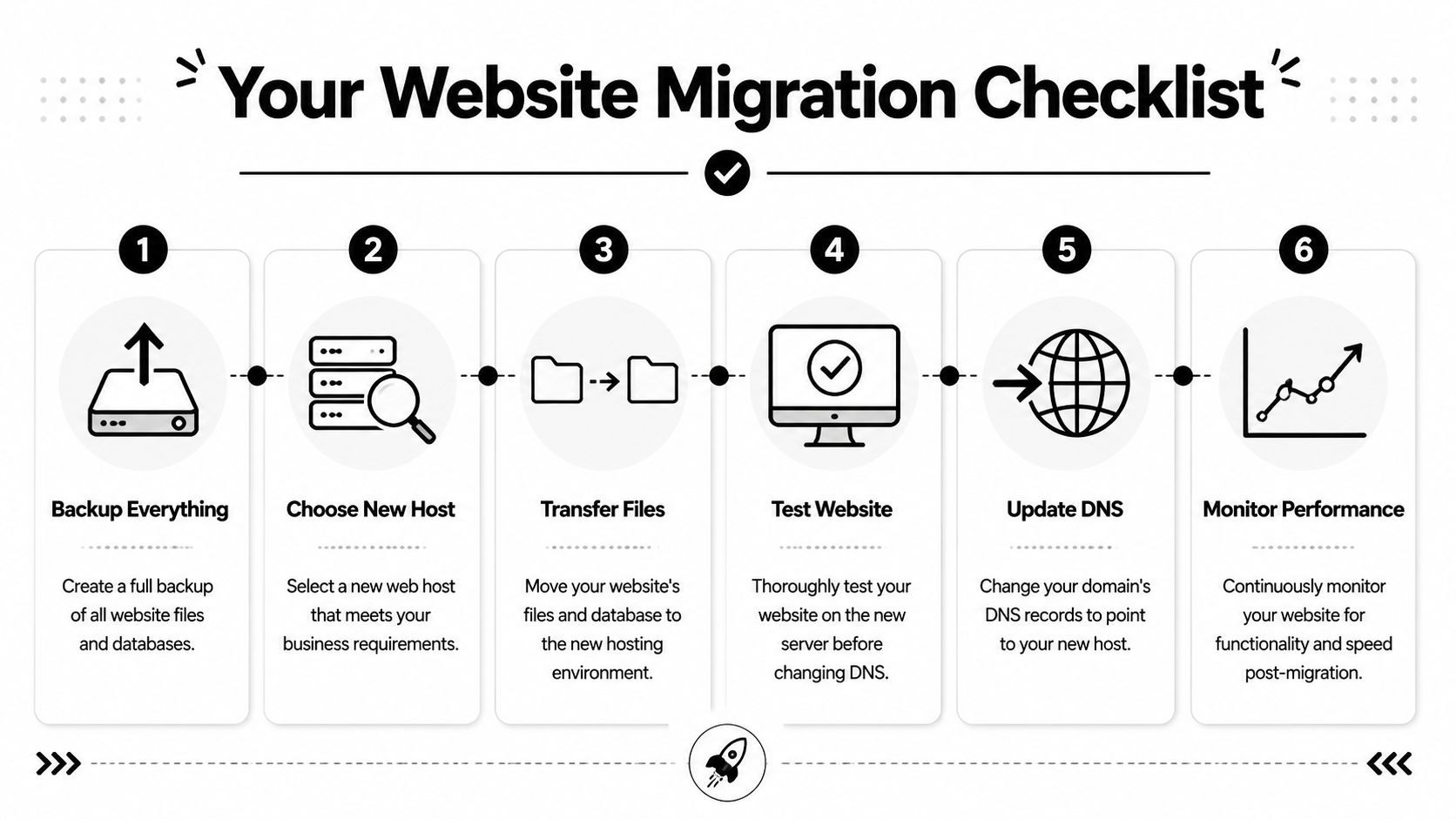
Switching hosts sounds riskier than it usually is. Most migration problems happen because businesses skip a few boring but important checks.
Before you move
Start with an inventory, not a transfer.
- Back up the full site: website files, database, media, forms, and any custom settings
- List all email accounts: many businesses remember the website and forget the mailboxes
- Document key functions: contact forms, bookings, checkout, CRM integrations, newsletter forms
- Check domain access: make sure you can log in to the domain registrar account
- Record current DNS-related details: you don't need to edit anything yet, but you do need access
If your domain is tied to email, this guide on choosing a domain name with email hosting is worth reviewing before the move so you don't separate services accidentally.
During the migration
Move the site to the new host and test it before pointing the domain live.
That means checking page layouts, image loading, forms, checkout flows, logins, and any plugin-dependent functions. A migration is only “done” when the site behaves properly in the new environment.
If your domain is registered with GoDaddy and you need a plain-English walkthrough for nameserver changes, NameSnag's guide for GoDaddy nameservers is a handy reference.
Don't cancel the old hosting account until the new site is live, tested, and email is confirmed working.
After launch
The first day after migration is for monitoring.
Use a checklist:
- Test forms and emails: send real test submissions
- Review key pages: home, service pages, cart, checkout, contact
- Check mobile rendering: especially menus and image-heavy pages
- Watch for missing assets: broken images, scripts, styling issues
- Confirm backups are active: don't assume they're set up by default
Most migrations are manageable when handled as a controlled project rather than a last-minute switch.
Frequently Asked Hosting Questions
Do I need a .com.au domain for my business?
Not always, but many Australian businesses prefer one because it signals local presence and trust. The right choice depends on your brand, market, and how strongly you want to position yourself as Australian.
What matters more is keeping domain ownership, hosting, and email responsibilities clear. Confusion usually starts when those services are split across different providers and nobody knows who controls what.
What's the difference between web hosting and a website builder?
Web hosting is the server environment where your site lives. A website builder is the tool used to create the site.
Some companies bundle both together. That can be convenient for simple sites, but it can also limit flexibility later. If you expect custom features, redesigns, or platform changes, it's worth checking how portable the site will be.
Can I get reliable web hosting for free in Australia?
Free hosting is usually fine for experiments, internal demos, or hobby projects. It's rarely the right fit for a business website.
The trade-offs often show up in branding limits, weaker support, fewer backup options, and less control. If the website matters to your leads, sales, or reputation, paid hosting is the safer call.
What if I need to connect subdomains or third-party tools?
That's common. You might need to connect email services, landing pages, booking platforms, or branded subdomains. In those cases, you'll often end up working with DNS records through your registrar or host dashboard. If your domain is with GoDaddy and you need a beginner-friendly explainer, this walkthrough on GoDaddy CNAME setup gives useful context.
Should I choose based on price alone?
No. Price matters, especially for small businesses, but it should come after fit.
A host should match your business model, support expectations, and likely growth. A slightly more suitable plan usually costs less than fixing performance issues, migration stress, and lost leads later.
If you want help choosing or setting up hosting without sorting through it all alone, Website Builder Australia offers website hosting, email hosting, website development, ecommerce builds, and ongoing maintenance for Australian businesses that want local support and a practical setup that fits how they operate.


