

Digital Marketing Consultations: Guide for SMBs 2026
You're probably in one of these spots right now. Your website exists, your social pages are active enough, and you've maybe boosted a few posts or run some Google Ads, but the results feel patchy. Or you've had a few different people tell you to “do SEO”, “post more reels”, “fix your funnel”, or “set up email automation”, and now it all sounds like expensive noise.
That's where digital marketing consultations can help. Not as a glossy sales pitch, and not as a giant report that sits in your inbox unread. For a Brisbane tradie, retailer, clinic, consultant, or service business, a good consultation should bring order to the mess. It should tell you what matters, what can wait, and what's most likely to help your business grow.
The main thing I'd want any small business owner to know is this. A proper consultation isn't about buying “more marketing”. It's about getting clear on how your business wins online in your local market, with your budget, team, and goals.
What Is a Digital Marketing Consultation
A digital marketing consultation is a structured conversation and review process that helps you work out how your business should grow online. It's part diagnosis, part planning, and part decision-making.
Think of a Brisbane café owner who knows customers are searching nearby, checking Instagram, reading reviews, and looking up menus before they visit. The owner knows they need better visibility, but they're stuck choosing between Google Ads, local SEO, email offers, content, or a website refresh. A consultation helps sort that out.
It's closer to a blueprint than a sales pitch
The easiest way to think about it is this. You wouldn't build a house without plans. You'd want someone to inspect the block, understand the layout, and map the right approach before money gets spent. Digital marketing consultations work the same way.
A consultant should look at things like:
- Your current website: Is it easy to use, fast, clear, and built to convert?
- Your traffic sources: Are people finding you through Google, social media, referrals, or paid ads?
- Your customer journey: What happens between first click and actual enquiry or sale?
- Your business goals: Do you need more bookings, more foot traffic, higher-value leads, or stronger repeat business?
That matters because your customers are already online. The Australian Communications and Media Authority reported that 95% of Australians aged 16 and over used the internet in 2023–24, spent an average of 4 hours 18 minutes online per day, and 81% of adults used the internet for shopping, which makes consultation work less about “getting online” and more about lining your business up with how people already search and buy (ACMA figures referenced here).
What a good consultation feels like
A useful consultation should feel like clarity, not pressure. You should leave understanding what's broken, what's working, and what to do next.
A consultant's job isn't to make digital marketing sound complicated. It's to make your next decision simpler.
If you want a practical overview of what a full-service team can help with, this breakdown of Rebus' marketing agency expertise gives a solid picture of the kinds of capabilities businesses often compare during the consultation stage.
The best part is that a consultation doesn't have to lock you into a long-term arrangement. Sometimes it leads to ongoing support. Sometimes it gives you a roadmap your internal team can execute. Either way, it should start as a partnership built around business outcomes, not channel hype.
The Real Value for Australian Small Businesses
For most Australian SMBs, the biggest win from a consultation is clarity. Not motivation. Not buzzwords. Clarity.
A lot of businesses already have digital pieces in place. They've got a website, some social media activity, maybe an online store, maybe even paid ads running. But those pieces often don't work together well. That's why a consultation can be so valuable. It helps turn scattered activity into a joined-up growth plan.

Presence isn't the same as performance
Many owners often get caught. Being online doesn't mean your marketing is doing its job.
The Australian Bureau of Statistics found that 67% of businesses used social media and 51% had a website, but only 1 in 5 made an e-commerce sale in February 2024, which shows plenty of businesses have a digital presence without turning that presence into revenue (ABS figures referenced here).
That gap is exactly where digital marketing consultations earn their keep.
For example:
- A Brisbane electrician might be getting website visits but poor-quality leads from suburbs outside their preferred service area.
- A local retailer might be getting decent Instagram engagement but losing sales because the checkout process is clunky.
- A service business might rank for broad keywords yet fail to convert because the website doesn't answer the questions buyers care about.
What that value looks like in practice
A solid consultation usually creates value in a few very practical ways:
- It cuts waste: You stop throwing money at channels that look busy but don't bring business.
- It sets priorities: Instead of trying to fix everything, you work on the few changes most likely to move the needle.
- It gives an outside view: Owners are often too close to the business to spot friction points on the site, weak offers, or unclear messaging.
- It connects marketing to outcomes: The focus shifts from clicks and impressions to leads, sales, bookings, and repeat customers.
Practical rule: If a recommendation doesn't connect back to profit, lead quality, customer acquisition, or conversion efficiency, it probably isn't a priority for a small business.
This is also why measurement matters so much. If you want a plain-English refresher on how to think about that side of the equation, Adwave's ROI measurement guide is a useful companion read.
For Australian SMBs, especially in trades, retail, hospitality, and local services, value isn't that a consultant knows more marketing terms. It's that they help you make fewer expensive guesses.
Core Services Typically Included
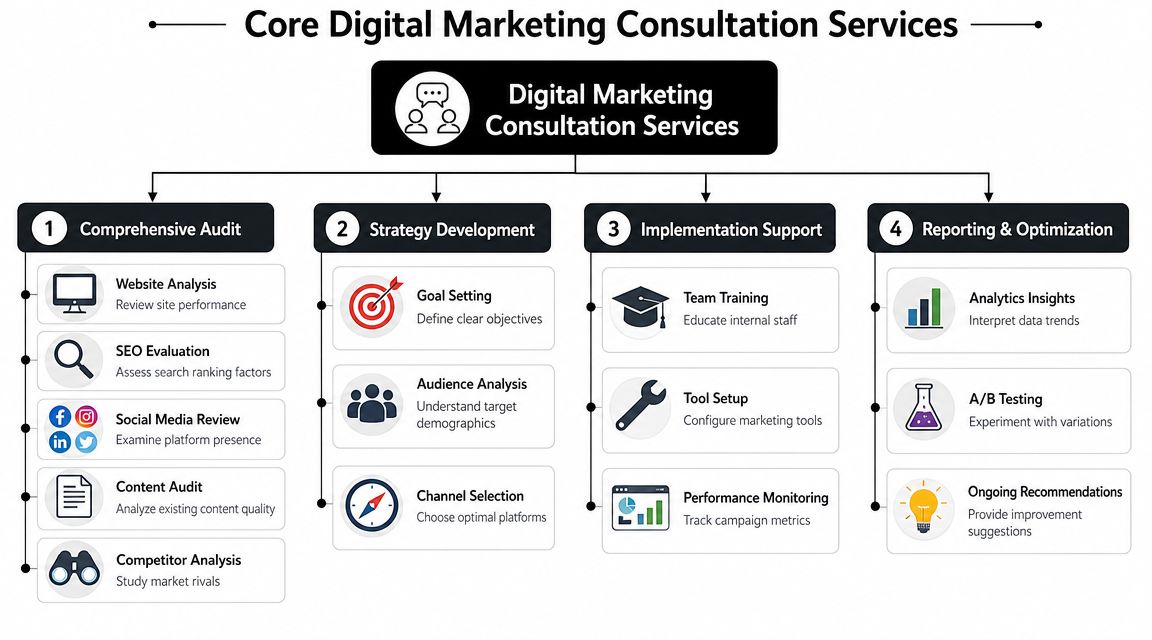
When a consultant says they'll deliver “strategy”, that can sound vague. So let's make it concrete. A proper consultation usually includes a set of connected services, each doing a different job.
It's similar to renovating a shopfront. You don't start by buying signage. You first inspect the building, work out the layout, decide what customers need to see, then fix the systems behind the counter so the place runs smoothly.
Audit and diagnosis
This is the starting point. Before anyone recommends SEO, Google Ads, landing pages, email flows, or content, they should inspect what already exists.
That often includes:
- Website review: structure, messaging, mobile usability, calls to action, speed, and enquiry flow
- Traffic review: where visitors come from and what they do after arriving
- SEO check: indexing basics, on-page relevance, local signals, and content gaps
- Paid media review: account structure, targeting choices, conversion tracking, and ad relevance
- Competitor review: how similar businesses in Brisbane or your wider Australian market position themselves online
A consultant isn't just hunting for problems. They're identifying key opportunities. Sometimes the fastest win is a homepage rewrite. Sometimes it's fixing contact forms. Sometimes it's cutting underperforming ad spend.
Strategy and channel planning
Once the audit is done, the next step is deciding what to do, in what order, and why.
At this stage, the consultant should answer questions such as:
- Which channel deserves attention first?
- Should you invest in local SEO or paid search?
- Do you need new landing pages?
- Is your offer clear enough?
- Should your team post more content, or is that a distraction right now?
A good strategy doesn't treat every business the same. A suburban dentist, an online gift store, and a commercial plumbing business need different plans.
If your focus is selling online, this guide to ecommerce digital marketing is relevant because it covers the practical overlap between online stores, traffic generation, and conversion planning.
Tools, systems, and marketing technology
Here's the part many SMBs don't expect. Good digital marketing consultations often involve fixing the tools behind the scenes, not just the ads or content on the surface.
A strong consultation functions as a marketing technology integration exercise, connecting business goals with the right CRM, automation, analytics, and AI tools so decisions aren't made in a vacuum (martech integration perspective here).
That could mean:
- Choosing a CRM so leads don't disappear in email inboxes
- Connecting forms to automation so follow-up happens quickly
- Cleaning up analytics so you can trust what you're seeing
- Using reporting dashboards to compare channels properly
One practical example in this space is Website Builder Australia, which offers website builds, ecommerce development, SEO, Google Ads, and maintenance as part of a broader digital setup. For some businesses, that kind of combined web-and-marketing support makes implementation simpler.
If the website, tracking, forms, CRM, and campaigns don't talk to each other, you don't have a marketing system. You have disconnected parts.
That's why the output of a consultation should be more than a document. It should be an actionable toolkit.
The Consultation Process From Start to Finish
One reason business owners avoid consultations is simple. They don't know what's going to happen, and they don't want to be trapped in an awkward sales process.
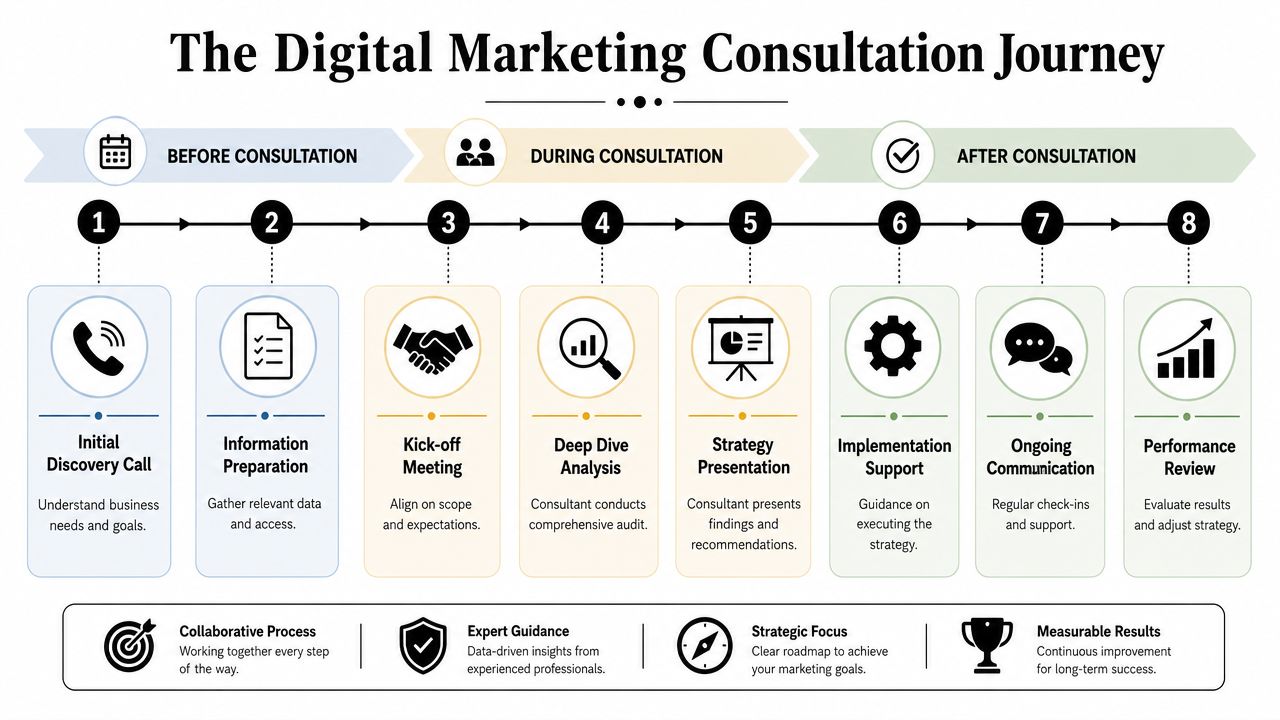
A decent consultation is usually straightforward. It has a beginning, a working phase, and a next-step plan.
Before the first meeting
Most engagements start with a short discovery call. That's where the consultant asks what your business does, who you serve, what's been tried before, and where things feel stuck.
You'll usually get the most value if you prepare a few basics:
- Business goals: more enquiries, better leads, stronger repeat sales, or improved ecommerce performance
- Access to current assets: website, analytics, ad accounts, CRM, email platform, and social profiles
- Known pain points: poor lead quality, weak search visibility, low conversion rate, or inconsistent follow-up
- Commercial context: seasonality, service area, margins, staffing limits, or capacity issues
That last point matters more than many people realise. There's no point generating more leads if you can't service them properly.
During the consultation
Crucial work unfolds. The consultant reviews the data, asks deeper questions, and starts matching marketing choices to business reality.
For a Brisbane service business, that might include things like preferred job types, high-value suburbs, or whether weekday bookings are more profitable than weekends. For an online store, it might centre on product categories, checkout friction, abandoned carts, or repeat purchase opportunities.
What you want here is reasoning, not just recommendations.
Watch for this: a consultant who jumps straight to “you need more ads” before understanding your offer, margins, and sales process is probably guessing.
After the consultation
At the end, you should have a practical roadmap. Not fluffy ideas. Actual next steps.
That may include:
- A findings summary showing what's working, what isn't, and where the gaps are
- A channel plan covering SEO, PPC, email, content, or social, depending on your priorities
- A website or landing page plan if conversion issues are holding results back
- A measurement plan so future decisions can be based on reliable data
- An implementation path that clarifies who does what next
The technical heart of many digital marketing consultations is measurement architecture. That means defining KPIs and setting up data collection, integration, cleaning, analysis, and reporting so decisions are based on attributable performance data rather than vanity metrics. In practice, that means aligning your CRM, analytics, and ad platforms before optimising campaigns (measurement architecture explained here).
That sounds technical, but the idea is simple. If you can't tell which leads came from Google Ads, local SEO, referrals, or email, you can't improve your budget decisions with confidence.
Understanding Digital Marketing Consultation Pricing
Pricing is where many SMBs get nervous, and fairly so. The challenge isn't just “how much does it cost?” It's “what am I paying for, and which model suits my business?”
Because there's no verified market-wide price data provided here, the safest way to think about pricing is by structure, not by headline figures. Different consultants package their work in different ways, and the right fit depends on whether you need advice, a full roadmap, or ongoing involvement.
The three common pricing models
Some consultants charge by the hour. Some quote a defined project fee. Others work on a retainer where they stay involved over time.
Here's the practical difference:
| Comparing Consultation Pricing Models | ||||
|---|---|---|---|---|
| Pricing Model | Best For | Typical Cost Structure (AU) | Pros | Cons |
| Hourly | Businesses that need a second opinion, a short advisory session, or targeted help with one issue | Billed per hour for time used | Flexible, simple, low commitment | Can feel open-ended if scope isn't tightly defined |
| Project-based | Businesses wanting an audit, strategy document, or fixed consultation outcome | One fee for a defined scope of work | Clear deliverables, easier budgeting, less ambiguity | Extra requests may fall outside scope |
| Ongoing retainer | Businesses that want strategy plus regular input, review, and optimisation support | Recurring monthly fee for agreed advisory scope | Continuity, accountability, easier iteration over time | Requires more trust and a longer-term budget commitment |
How to choose the right pricing model
If you're unsure, match the model to your current situation.
- Choose hourly if you already have a team or agency and want an independent expert view.
- Choose project-based if you need clarity before spending more on execution.
- Choose a retainer if your business wants a strategic partner, not just a one-off review.
A useful gut check is whether you need answers or oversight. Answers usually fit a project. Oversight usually fits a retainer.
For businesses comparing advisory costs with channel spend, this article on how much Google PPC costs helps frame the difference between paying for strategy and paying for media itself.
What to ask before agreeing to any fee
Price matters, but scope matters more. Before you say yes, ask:
- What deliverables are included?
- Will you get a roadmap, presentation, or implementation support?
- How many meetings are included?
- What access does the consultant need from you?
- What happens after the consultation ends?
If the answers are fuzzy, the engagement probably will be too.
How to Choose the Right Consultant in Australia
This is the part that saves you from buying the wrong thing. Not every consultant is a good fit for every business, and the most polished pitch isn't always the best choice.
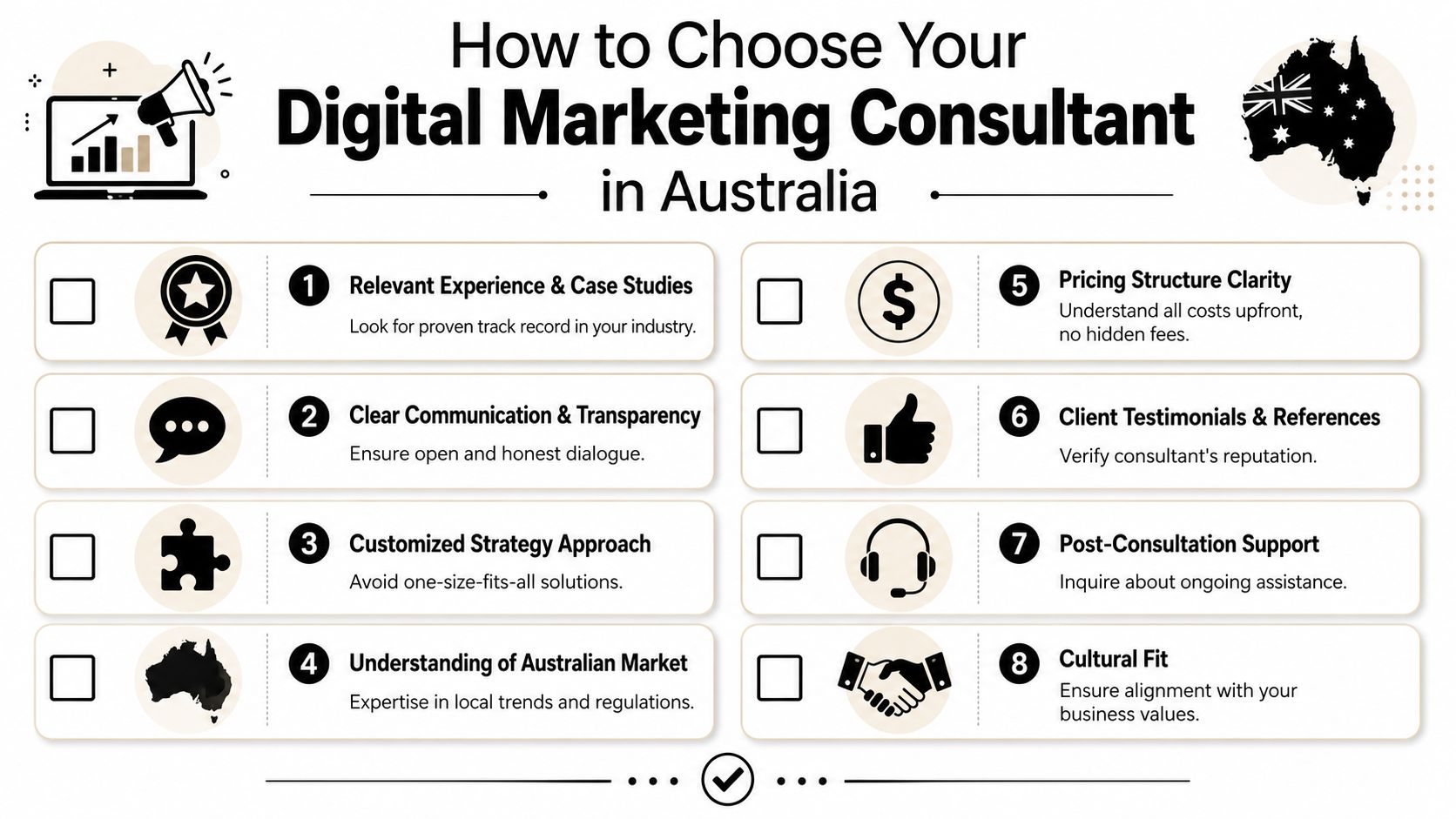
For Australian SMBs, especially around Brisbane, you want someone who understands the local market, speaks plainly, and can tie recommendations back to commercial reality. A consultant shouldn't just know channels. They should understand service areas, lead handling, seasonality, and the difference between a tyre-kicker and a proper enquiry.
Questions that reveal real thinking
The best vetting questions aren't “Do you do SEO?” or “Can you run ads?” Lots of people can say yes to that.
Instead, ask questions like these:
- How would you decide which channel to prioritise for my business?
- What would you need to see before making recommendations?
- How do you define success for a business like mine?
- What should we fix first if the website gets traffic but not enquiries?
- What kind of support do you provide after the strategy is delivered?
The strongest question of all is this one: “Which 3–5 metrics prove this consultation is working for my business?” That question matters because a good consultant should focus on outcomes like lead quality, booked jobs, and conversion efficiency, not just surface-level traffic, and should tailor the model to your business economics (SME measurement guidance here).
What to look for beyond the pitch
A consultant is easier to trust when they show signs of discipline, not just confidence.
Look for:
- Relevant experience: Have they worked with trades, retail, ecommerce, clinics, or local services similar to yours?
- Clear communication: Can they explain their thinking without jargon?
- Custom thinking: Do they talk about your margins, service area, offer, and sales process?
- Measurement maturity: Do they care about tracking, attribution, and CRM follow-up?
- Fit: Will you enjoy working with them when things get busy or messy?
A consultant who only talks about channels is selling tactics. A consultant who asks about margins, lead handling, and capacity is thinking like a growth partner.
If you're still comparing options, this guide to search marketing agencies can help you think through capability and fit when evaluating external providers more broadly.
For a local starting point, businesses can also review options for digital marketing consultants to get a feel for the kinds of services and engagement styles available in the Australian market.
Red flags worth taking seriously
A few warning signs usually show up early:
- Instant prescriptions: they recommend solutions before understanding the business
- One-size-fits-all packages: every client gets the same plan
- Traffic obsession: they only talk about visibility, not conversion or lead quality
- Unclear handover: you still don't know what happens after the consultation
- No commercial curiosity: they never ask about profitability, service limits, or customer value
Those are the conversations that lead to unnecessary services and disappointing results.
Your Next Step Towards Digital Growth
If you've made it this far, you probably don't need more marketing noise. You need a clearer path.
That's what digital marketing consultations are really for. They help you stop guessing. They help you sort urgent issues from distractions. And they give you a practical plan based on your business, your market, and your capacity to grow.
For an Australian SMB, that can mean very different things. A Brisbane tradie may need tighter suburb targeting and better enquiry handling. A retailer may need a stronger ecommerce path from product page to checkout. A service business may need better local search visibility and landing pages that answer customer questions properly. The point isn't to do everything. The point is to do the right things in the right order.
The best consultations also set the tone for what comes next. If the consultant is worth keeping, the relationship won't feel like pressure. It'll feel like having someone in your corner who can help you make better decisions as your business changes.
If your current marketing feels scattered, under-measured, or harder than it should be, starting with a conversation is often the smartest move.
If you'd like a friendly, no-obligation chat about your website, online visibility, or where your digital marketing might be leaking opportunities, talk to Website Builder Australia. They're Brisbane-based and work with Australian businesses on websites, ecommerce, SEO, PPC, and broader digital support, so you can start with clarity before committing to a bigger plan.


