

Google Ads Brisbane: Grow Your Business in 2026
You've probably had this thought already. Your business does solid work, customers are happy, and referrals still come through, but the flow isn't consistent enough. Some weeks the phone rings. Some weeks it doesn't. Meanwhile, people in Brisbane are searching for exactly what you sell or service, and your competitors are showing up before you do.
That's where Google Ads starts to matter.
For a Brisbane business owner, Google Ads isn't just “online advertising”. It's a way to put your business in front of someone at the moment they've decided to look for help. That timing is what makes it different from broad awareness channels. You're not interrupting someone. You're responding to demand that already exists.
Putting Your Brisbane Business in Front of Eager Customers
It is 10:15 on a Tuesday morning. A homeowner in Chermside has a burst pipe, a couple in South Brisbane need a conveyancer before making an offer, or a patient in West End wants to book an appointment this week. They open Google and search with a clear problem in mind.
That moment has commercial value.
For a Brisbane business, Google Ads is a way to show up when someone is already looking, comparing, and deciding. That is very different from paying to be seen by people who may have no current need for what you sell. If your service is urgent, high-consideration, or location-sensitive, search traffic often carries stronger intent than broader digital channels.
The practical appeal is straightforward. You can put a plumbing business in front of “blocked drain Brisbane” searches, a law firm in front of suburb-based family law searches, or an ecommerce brand in front of product terms with buying intent. The harder question is whether those clicks turn into profitable work after ad costs, staffing limits, missed calls, and sales conversion are factored in.
Why this matters more than generic reach
A lot of marketing activity looks fine in a report and weak in the bank account. Impressions rise. Clicks come in. The phone still does not ring enough, or the leads are poor.
Google Ads can sit much closer to revenue, but only when the account matches how people search and how your business operates. A campaign targeting all of Queensland is wasteful if your team only services Brisbane's inner north. An ad promising “fast help” falls flat if the landing page hides the phone number or the office does not answer after 4 pm.
That is the appeal of Google Ads for Brisbane businesses. It gives you a channel that can be measured against jobs booked, consults scheduled, sales completed, and gross margin, rather than against vague awareness metrics.
Practical rule: If people search before they choose a provider, Google Ads is worth assessing. If the numbers do not stack up after costs and conversion rates, it is the wrong investment.
Where local businesses usually get it wrong
The common failure is not using Google Ads. It is using it without enough commercial discipline.
- Too broad: Campaigns target suburbs and regions the business cannot service profitably.
- Too generic: Ads copy competitors and says nothing specific about urgency, location, or offer.
- Too thin on measurement: Reporting stops at clicks and form fills, with no link to qualified leads, booked jobs, or sales value.
- Too optimistic on economics: Businesses judge success on cost per lead without checking lead quality, close rate, or customer value.
I see this often with local service businesses. They ask whether Google Ads works. The better question is whether it can produce profitable demand in Brisbane after click costs, conversion rates, and operational realities are accounted for.
That is the standard worth using.
How Google Ads Works A Simple Explainer
Understanding Google Ads gets easier once you break it into four parts. Search, auction, click, conversion.
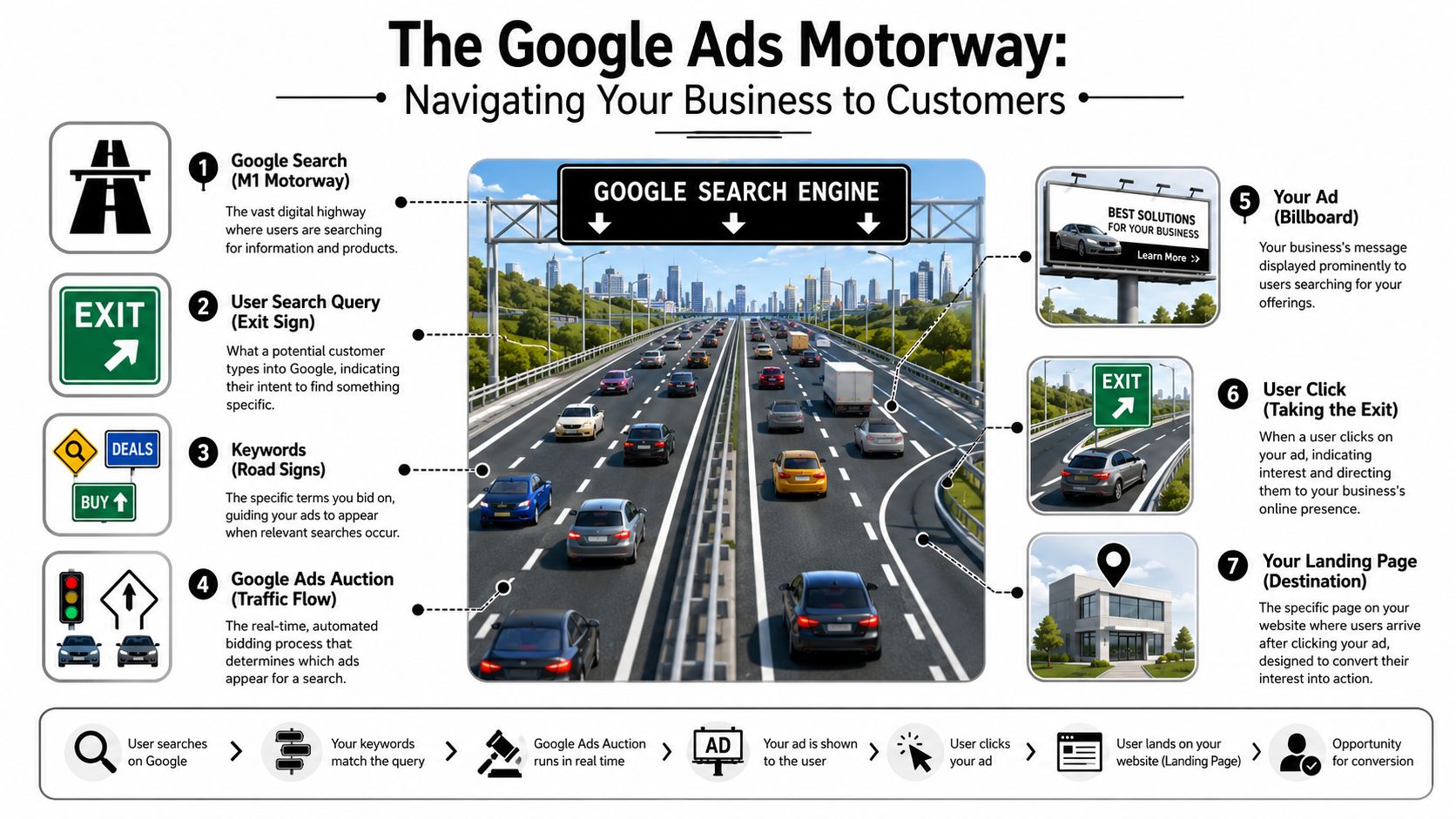
A Brisbane customer types in a search. Google checks which advertisers are eligible to show for that query. It runs an auction in real time, then ranks the ads it expects will be most useful and commercially relevant. If your ad earns the click, the visitor lands on your page and decides whether to call, book, buy, or leave.
That is the pay-per-click model. You are charged for the click, not for appearing.
For business owners, the practical point is control. Spend can be capped. Service areas can be narrowed to the suburbs you want. Weak keywords can be paused. Stronger ones can get more budget. That makes Google Ads attractive, but it does not make every click profitable. The economics still depend on what you pay per click, how well the page converts, and what a new customer is worth to your business.
The core mechanic behind the auction
Top position does not automatically go to the highest bidder.
Google also looks at how closely the keyword, ad, and landing page match the search. In day-to-day account management, that matters a lot. A smaller Brisbane business with a tightly built campaign can often compete well against a larger advertiser that sends traffic to a generic page.
Here is the part many beginners miss. Google wants to protect the search experience because that is what keeps people using Google. If your ad promises one thing and the landing page delivers something else, you usually pay for it through weaker performance.
| Part | What it does | What happens if it's weak |
|---|---|---|
| Keyword | Matches the search to your offer | Your ad shows on poor-fit searches, or misses good ones |
| Ad copy | Gives the searcher a reason to click | Impressions build, but clicks stay low |
| Landing page | Turns interest into an action | Traffic arrives and drops off |
| Tracking | Shows which searches and pages produce results | Budget keeps running without clear accountability |
Why account structure matters so much
Google Ads is not hard to open. It is hard to set up in a way that protects margin.
A common DIY setup looks like this. One campaign. Broad keywords. Every click sent to the homepage. Conversion tracking half-finished. The platform will still spend money, but the business owner learns very little from that spend.
I see this most often in local service accounts.
A plumber, dentist, or law firm may have several distinct services with different margins and different levels of urgency. If all of those searches are grouped together, the reporting gets muddy fast. You cannot tell which service is worth scaling, which suburb is overpriced, or whether the expensive clicks are leading to real enquiries or low-quality leads.
Three problems show up again and again:
- Generic landing pages: Searchers have to hunt for the answer, the price point, or the next step.
- Overloaded campaigns: Different services compete for the same budget and use the same message.
- Loose intent matching: Research-style searches get treated like ready-to-buy searches.
A better way to view Google Ads is as a matching system with a price attached. The job is to line up the search term, the ad, the landing page, and the business outcome. When those pieces fit, the account becomes easier to measure. When they do not, the platform can still generate clicks while hiding the fact that the investment does not stack up.
Smart Targeting Strategies for the Brisbane Market
The biggest strength in Google Ads for Brisbane businesses isn't reach. It's precision.
You don't need to advertise to everyone in Brisbane. You need to show up for the right people, in the right areas, at the right time, on the right device, with the right message. That's what good targeting does. It acts like a filter before your budget gets spent.
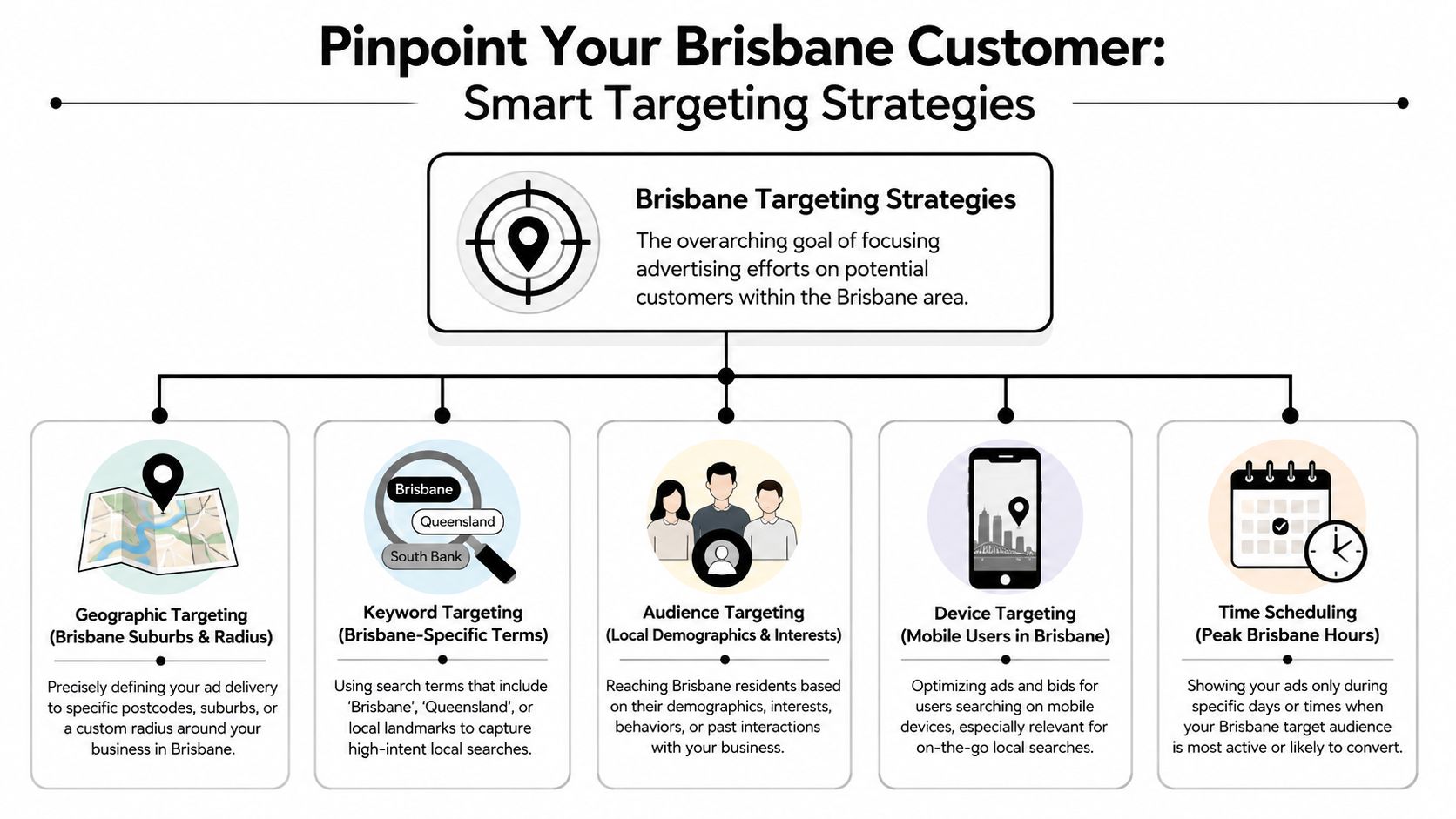
Start with geography that reflects your real service area
A Brisbane campaign should mirror how your business operates.
If you're a mobile service business, that may mean targeting specific suburbs rather than the entire metro area. A plumber might prioritise the inner north and outer west. A removalist may split campaigns by corridor. A boutique with a physical location may target a radius around the store plus branded searches from across the city.
Practical local examples:
- Trades: A roofer can target storm-affected service areas rather than wasting spend outside the reachable zone.
- Professional services: A family law firm might focus on higher-intent suburb and city-based searches where clients are willing to travel for expertise.
- Retail: A James Street retailer may target nearby shoppers on mobile and pair that with strong map visibility.
Postcode-level thinking can help too. A campaign aimed at the CBD behaves differently from one aimed at South Brisbane or suburban service zones. Search behaviour, urgency, and competition all change.
Use keyword targeting that sounds like how locals search
Local intent often hides inside plain language.
People don't always search in polished marketing terms. They search the way they talk. “Blocked drain Brisbane”, “tax accountant near me”, “wedding florist South Brisbane”, “commercial cleaner Fortitude Valley”.
That's why keyword selection needs range. Not just service terms, but also suburb terms, urgent terms, and problem terms.
A workable keyword mix often includes:
- Core service terms: what you do
- Location modifiers: Brisbane, suburb names, nearby landmarks
- Intent signals: quote, emergency, same day, near me
- Problem-based searches: what the customer wants fixed
Layer in audience signals carefully
Audience targeting helps, but it shouldn't replace intent.
For some campaigns, especially those with longer consideration cycles, audience overlays can refine who sees your ads. A mortgage broker may care about in-market finance audiences. A renovation business may want to consider homeowners rather than broad consumer reach. A retailer may use remarketing to stay visible after someone has visited product pages.
The trick is to use audience data as a refinement layer, not a blunt instrument. Search intent still does the heavy lifting.
Local insight: The best Brisbane campaigns usually narrow by geography first, then refine by audience and timing. Doing it the other way around often creates noise.
Control when ads appear
Timing changes lead quality.
A 24-hour locksmith should think differently from a B2B consultant. A medical practice might want calls only during staffed hours. A restaurant may push bookings around peak decision windows. A retailer might increase focus on mobile traffic during shopping hours and weekends.
Scheduling matters for two reasons. First, it avoids paying for clicks when no one can respond. Second, it reveals when demand is strongest.
Here's a simple planning view:
| Targeting lever | Good use case in Brisbane | Main benefit |
|---|---|---|
| Suburb targeting | Trades and local services | Reduces wasted reach |
| Radius targeting | Clinics, gyms, retail stores | Focuses on nearby buyers |
| Location keywords | Professional services | Captures strong local intent |
| Device targeting | Call-driven businesses | Improves mobile lead flow |
| Ad scheduling | Staffed service businesses | Better enquiry handling |
Targeting doesn't fix weak offers or poor landing pages. But without it, even strong campaigns become expensive quickly.
Budgeting for Google Ads in Brisbane What to Expect
The first budgeting mistake is asking, “What does Google Ads cost?” as if there's one answer.
There isn't.
What you'll pay depends on your industry, how competitive your keywords are, how tightly you target Brisbane, the quality of your landing pages, and whether you're trying to drive calls, forms, ecommerce sales, or store visits. A local florist and a criminal lawyer don't enter the same auction environment. They won't face the same click costs, and they shouldn't expect the same campaign shape.
What the market tells us
Google Ads isn't a fringe channel in Brisbane. It's already operating at meaningful commercial scale. One Brisbane-based agency says it managed more than $14 million in Google Ads spend in the last year, and the same source notes that businesses earn an average of $2 for every $1 spent on Google Ads, with typical conversion rates ranging from 3.1% to 6% depending on industry and ad type, according to this Brisbane Google Ads agency page.
Those figures are useful, but they can also mislead if you treat them as a guarantee. Average performance is not your performance. Plenty of accounts lose money because the business chased traffic before fixing tracking, targeting, and landing page quality.
Spend should follow economics. If you don't know what a qualified lead is worth to your business, your budget is just a guess.
A practical way to think about budget
A healthy Google Ads budget does three things:
- Buys enough data to tell you what's working
- Protects cash flow while the campaign learns
- Leaves room for optimisation instead of forcing panic decisions
If you want a broader breakdown of how paid search budgets are typically approached, this guide on how much Google PPC can cost is a useful reference point.
For service businesses in particular, it also helps to think beyond click price and focus on how to maximize ROI for local service ads. That's the primary budget question. Not “How cheap is the click?” but “What do I earn back from the right enquiry?”
Estimated Cost-Per-Click CPC for Google Ads in Brisbane by Industry
The exact CPC will vary by keyword, suburb, match type, and competition. The table below is intentionally qualitative because a single fixed range would be misleading without account-specific data.
| Industry Sector | Average CPC Range |
|---|---|
| Trades and emergency services | Often higher due to urgent local intent and dense competition |
| Legal and professional services | Often higher because each lead can carry significant value |
| Health and allied services | Varies widely based on speciality and local demand |
| Retail and ecommerce | Usually mixed, with branded and product-specific terms behaving very differently |
| Home services and renovations | Can become expensive on broad generic terms, more efficient on tightly targeted service searches |
What usually works better than simply raising budget
When a campaign underperforms, many business owners assume the answer is more spend. Often it isn't.
The better fixes are usually operational:
- Tighter keyword selection
- Stronger landing pages
- Better call handling
- Cleaner conversion tracking
- More selective geography
If the economics work, you can scale. If they don't, a larger budget accelerates waste.
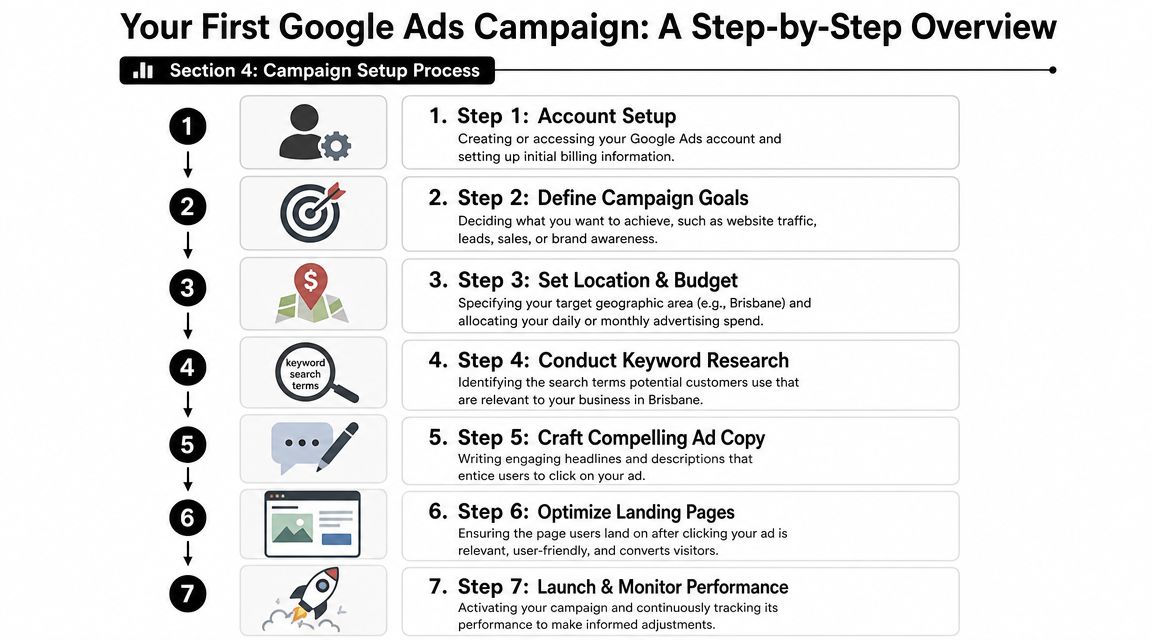
An Overview of Your First Campaign Setup
A first campaign should be built like a working system, not a collection of ads.
That means deciding what outcome matters, selecting the right campaign type, organising search intent properly, sending traffic to the right page, and installing tracking before launch. Skip one of those and the whole account becomes harder to manage.
Here's the high-level workflow most businesses should understand before a dollar gets spent.
Build around one clear goal
Campaigns fail when the objective is fuzzy.
If you want phone calls, structure for calls. If you want quote requests, structure for forms. If you want product sales, build around product intent and commercial pages. Mixing every goal into one campaign usually confuses both the platform and your reporting.
A clean setup usually starts with choices like these:
Primary objective
Calls, leads, purchases, or visits. Pick the one that matters most.Campaign type
Search campaigns are often the cleanest place to start for high-intent demand. Performance Max can become useful when you have solid conversion data and enough creative assets.Service segmentation
Separate campaigns or ad groups by service line, not by convenience.
Keyword research and ad structure come next
Keyword research isn't about making a giant list. It's about grouping searches by intent.
A Brisbane accountant, for example, may need separate groupings for tax returns, business accounting, and bookkeeping. A dentist may split emergency, cosmetic, and general care. Different searches need different ads and different landing pages.
That's why ad groups should stay tight. If one ad group contains unrelated services, your ad copy becomes generic and your landing page relevance drops.
For businesses that don't yet have dedicated ad pages, understanding what a landing page is and why it matters is worth your time. The destination page often decides whether paid traffic turns into an enquiry.
This walkthrough gives a visual sense of the setup flow:
Creative assets matter more than many owners expect
Text ads are only part of the picture now.
Modern campaign types such as Performance Max can distribute assets across Search, Maps, Display, YouTube, Gmail, and Discover. According to Google Ads campaign type guidance for Australian advertisers, these campaigns rely on conversion data and a full set of creative assets such as headlines, descriptions, images, videos, and logos. That same source notes supported image ratios include horizontal 1.91:1 at 1200×628 px and vertical 4:5 at 1200×1500 px.
That sounds technical, but the business implication is simple. Better assets create more eligible placements and give Google's automation more to work with.
Incomplete assets don't just make a campaign look rough. They can limit where it serves and how effectively automation learns.
What a launch-ready campaign should include
Before launch, check for these essentials:
- Conversion actions are installed and tested
- Location targeting matches the actual service area
- Negative keywords are in place
- Ads match the search intent
- Landing pages answer the exact offer
- Call handling is ready during ad hours
A campaign should never go live just because the platform says it's publishable. “Ready to run” and “ready to perform” are different standards.
Measuring Success Beyond Just Clicks
Clicks are a signal. They are not the outcome.
A Brisbane business can buy plenty of clicks and still lose money. That's why serious Google Ads management moves quickly past traffic metrics and into business metrics. Not “How many people visited?” but “Which clicks turned into qualified calls, booked jobs, sales, or appointments?”
Why click-based reporting falls short
Many accounts still rely on shallow reporting. The dashboard shows impressions, clicks, and maybe a few form submissions. That's often where the analysis stops.
The problem is obvious once you look at the sales process. A form fill may be junk. A phone call may be a wrong number. A lead may be unqualified. If you optimise toward raw lead volume, you can train the campaign to find more bad leads faster.
According to this Brisbane Google Ads measurement guide, many Brisbane SMBs struggle to measure true ROI because they only track clicks or basic leads. The same source notes that with Australia's changing privacy environment, enhanced conversion tracking is becoming more important for connecting ad spend to actual outcomes like qualified calls or booked jobs.
What better measurement looks like
A better setup usually includes more than one conversion layer:
- Primary conversions: qualified calls, submitted quote forms, booked consultations
- Secondary signals: page engagement, direction requests, smaller actions that support the main goal
- Offline outcomes: jobs won, revenue closed, sales confirmed in your CRM or booking system
For service businesses, this matters a lot. A call from a homeowner in your service area is usually more valuable than a casual form enquiry from outside Brisbane. Yet many accounts still treat both as equal.
Measurement rule: If your campaign can't tell the difference between a lead and a paying customer, your optimisation is only half-built.
Privacy changes make first-party data more important
Browser-based tracking is less reliable than it used to be. Consent requirements and privacy changes mean advertisers need stronger first-party data habits.
That usually means tighter integration between your website, your forms, your call tracking, and your CRM or booking workflow. It also means asking better questions in reporting meetings. Not “How many conversions?” but “Which conversions became revenue?”
If you want a straightforward primer on measuring ad campaign effectiveness, that framework is useful because it shifts the focus toward returns rather than vanity metrics.
The businesses that get the most from Google Ads usually aren't the ones with the flashiest dashboards. They're the ones that can trace spend through to business outcomes with enough clarity to make smart decisions.
DIY Google Ads vs Hiring a Brisbane Agency
DIY Google Ads can work if you've got time, patience, and a willingness to learn by making mistakes. Some owners prefer the control. Some start there because they want to understand the platform before handing it over.
The trade-off is that Google Ads isn't just a setup task anymore. It's ongoing strategy, tracking, search term analysis, landing page feedback, and budget allocation. That becomes more important in competitive Brisbane categories where auction pressure can rise and broad bidding gets inefficient. As noted in this Brisbane market perspective, the strategic issue isn't solely whether Google Ads works, but whether it remains the most efficient channel for your budget in sectors such as trades and legal services.
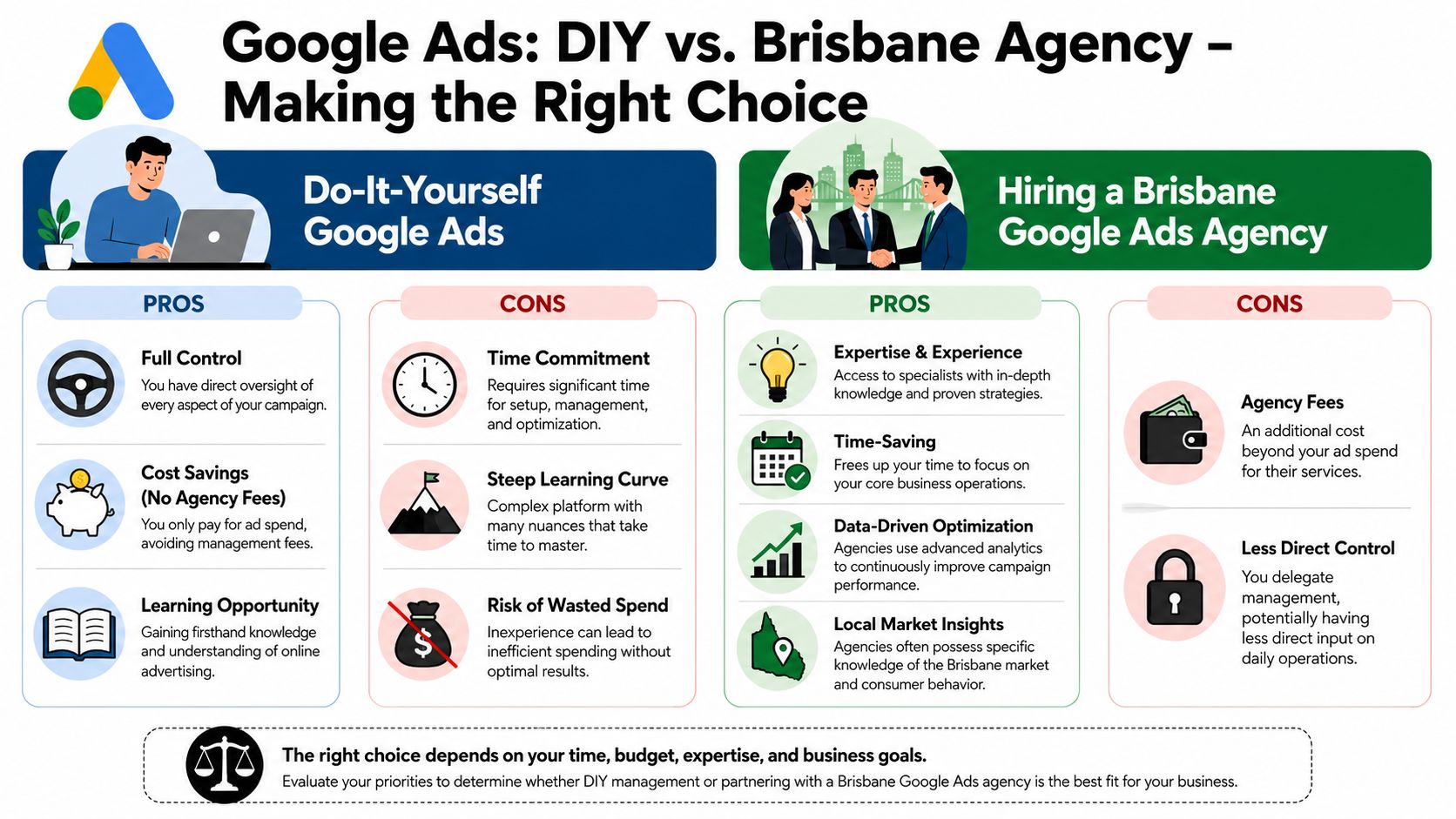
If you're comparing providers, this guide on how to find a local Google Ads agency can help you assess fit beyond sales talk. If you want specialist support, working with a Brisbane Google Ads specialist makes sense when you need someone to judge not just campaign settings, but also whether budget should shift into SEO, remarketing, or landing page optimisation.
The best agency value isn't button pushing. It's judgement. Knowing when to scale, when to cut, and when not to spend at all.
If you want a clearer view of whether Google Ads is the right investment for your Brisbane business, Website Builder Australia can help you assess the numbers, tighten tracking, and build campaigns around real business outcomes rather than empty lead volume.


