

Blog Post Examples: 7 Powerful Templates to Elevate Your Content
Staring at a blank page, wondering what to write? We've all been there. Creating blog content that not only attracts readers but also converts them into customers is a major challenge for many Australian businesses. It’s not just about having good ideas; it’s about structuring those ideas into a format that search engines favour and your audience loves.
That’s why studying effective blog post examples is one of the smartest shortcuts to success. Instead of reinventing the wheel, you can reverse-engineer what already works. To truly appreciate the impact of well-crafted content, it's essential to study various blog post examples that demonstrate successful strategies in action. This guide breaks down exceptional resources from industry leaders like Ahrefs, HubSpot, and Backlinko to give you a clear blueprint for your own content.
You'll get more than just a list. We will dissect the strategy behind each example, offering actionable takeaways, structure templates, and SEO notes. We'll show you exactly how to apply these lessons with templates tailored for Australian industries, from retail and professional services to tradies and startups. Each resource analysis includes screenshots and direct links so you can see the posts for yourself. Let's move from content anxiety to a clear, repeatable content creation process.
1. Ahrefs — 6 Simple Blog Post Templates (with examples and downloadable files)
For businesses serious about creating content that ranks on search engines, Ahrefs offers a masterclass in efficiency and structure. Their guide on blog post templates isn't just a list of ideas; it's a complete system for producing consistent, high-performing articles. By providing six reusable formats, Ahrefs helps content teams standardise their output, ensuring every post is built on a foundation of proven SEO principles.
This resource stands out because it directly connects each template to a specific search intent. Rather than just telling you to write a "how-to" guide, Ahrefs explains when to use it based on what your audience is searching for. It’s an excellent example of strategic content planning, showing how to align your article's structure with user expectations from the very beginning.
Strategic Analysis
What makes this resource special is its focus on repeatable processes. Each template comes with a clear rationale, live examples, and practical prompts for writing intros, headings, and conclusions. This is particularly useful for teams with multiple writers, as it helps maintain a consistent tone and quality across all published content.
Key Insight: Ahrefs bases its templates on SERP (Search Engine Results Page) analysis. The advice isn't arbitrary; it reflects what is already ranking well on Google for specific types of queries. This data-driven approach removes much of the guesswork from content creation.
The guide also provides downloadable Google Docs for each template, allowing businesses to immediately adopt the structures. This practical, no-fluff approach means you can go from reading the article to drafting a well-structured post in minutes. It also helps with the planning stage of content, similar to how a clear design brief is essential before starting website development.
Actionable Takeaways
- Match Template to Intent: Before writing, use the "Which template should you use?" section to match your target keyword's intent (e.g., informational, commercial) with the right format.
- Standardise Your Intros: Adopt the PSP (Problem-Solution-Proof) formula for your introductions to quickly hook readers and establish authority.
- Systematise Drafting: Give your writers the downloadable templates to streamline the drafting process and ensure SEO best practices are built-in, not added as an afterthought.
While the examples skew towards the digital marketing industry, any business-from a local trade to a national retailer-can adapt these foundational blog post examples to create content that serves their audience and ranks effectively.
Access the resource: Ahrefs Blog Post Templates
2. Backlinko — How to Write a Blog Post: The Definitive Guide
For those looking to move beyond simple content creation and into the realm of strategic publishing, Backlinko’s guide is an essential playbook. This resource is a step-by-step system for producing blog content designed not just to inform, but to rank highly and earn valuable backlinks. It provides concrete templates, such as the "Ultimate Guide" format, and lays out a clear workflow from topic discovery to promotion.

This guide stands apart by giving equal weight to content creation and promotion. It doesn’t just show you how to write; it details how to find topics with high ranking potential and then provides a distribution strategy to ensure your finished article gets seen. It’s an end-to-end approach that connects the dots between writing a great blog post and achieving tangible business results like traffic and authority.
Strategic Analysis
What makes this a standout example is its emphasis on creating "linkable assets". The guide teaches you to think like a publisher, identifying content gaps that, when filled, naturally attract links from other websites. It’s a proactive approach to SEO that goes beyond just optimising for keywords. Once you have your ideas, learning how to write SEO-friendly blog posts is the next logical step to ensure they perform well.
Key Insight: Backlinko’s methodology is built on the “Skyscraper Technique,” a process of finding popular content, creating something significantly better, and then reaching out to those linking to the original. This guide effectively operationalises that concept for any business.
The resource is full of actionable techniques, like using competitor analysis to find proven blog post ideas and incorporating specific on-page SEO elements to maximise ranking potential. It also provides clear guidance for trades businesses aiming to dominate local search, a strategy with some overlap to the specific tactics needed for SEO in the construction industry. These excellent blog post examples show how theory can be put into practice.
Actionable Takeaways
- Find Proven Topics: Use the "Barnacle SEO" method described in the guide to find keywords where larger competitors rank, and create superior content to steal their traffic.
- Structure for Links: Adopt the "Ultimate Guide" template for your cornerstone content. Create a definitive resource on a topic to make it a go-to asset for others in your industry to link to.
- Prioritise Promotion: Don't just "publish and pray". Follow the guide's promotion checklist, which includes email outreach and social media distribution, to kickstart your content's visibility.
While some of the recommended tools require a paid subscription, the core strategies are tool-agnostic. Any business, particularly those in competitive B2B or service industries, can apply these principles to create content that builds authority and drives organic growth.
Access the resource: Backlinko How to Write a Blog Post
3. HubSpot — 30 Free Blog Post Templates (Google Docs/Sheets kit)
For businesses looking to scale their content creation without sacrificing consistency, HubSpot’s downloadable template kit is an invaluable asset. It offers a massive library of 30 distinct blog post templates, moving beyond basic formats to cover everything from case studies and research posts to evergreen guides. This resource is designed for volume and variety, helping teams with multiple authors stay on-brief and on-brand.
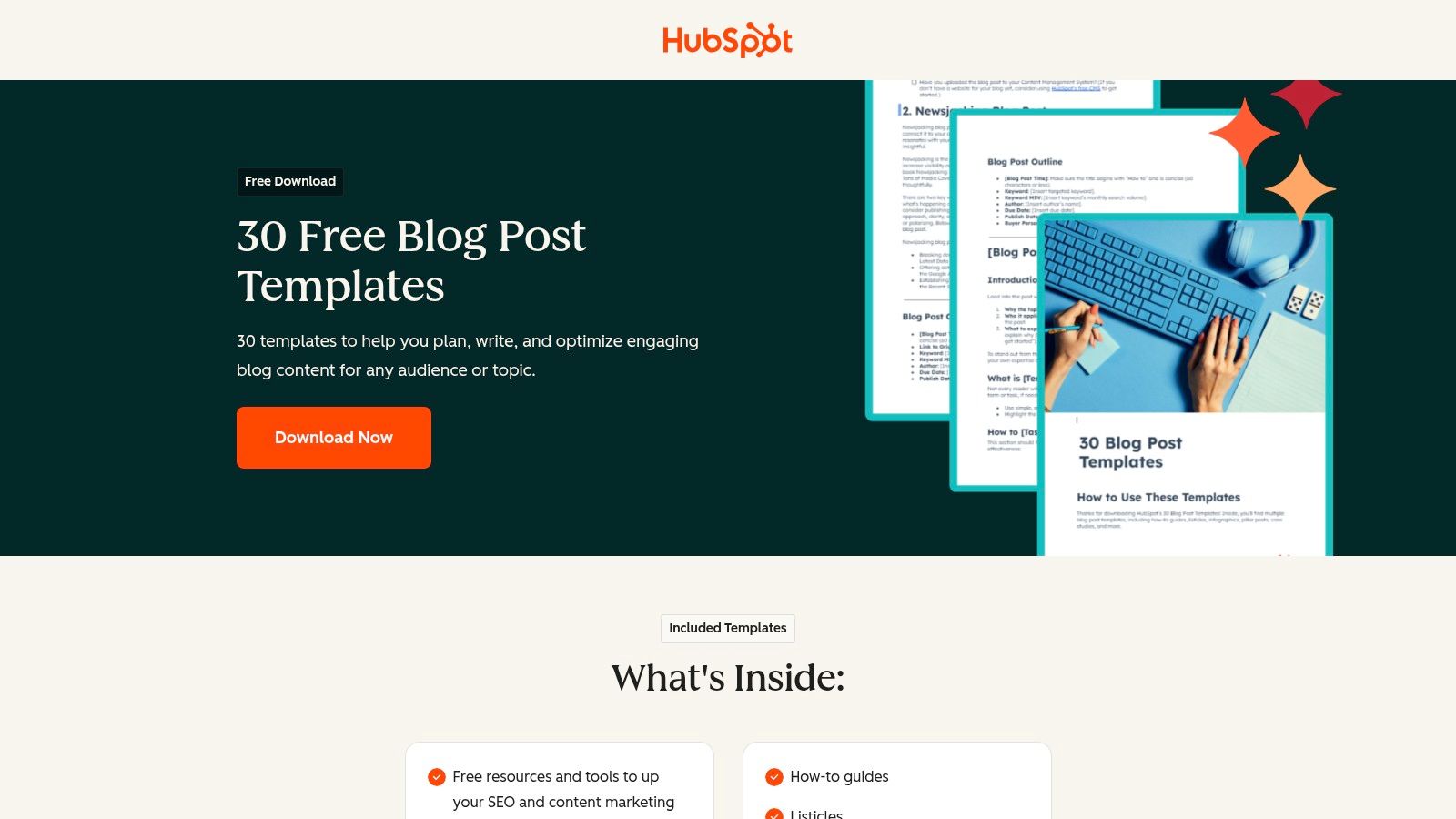
Unlike resources that simply list ideas, HubSpot provides a practical, fill-in-the-blanks system in Google Docs and Sheets. This makes it incredibly easy for small and medium businesses-from local Brisbane trades to national e-commerce retailers-to quickly adapt and deploy proven content structures. It’s an excellent example of how to operationalise a content strategy, turning abstract concepts into concrete drafting instructions. The pack even includes tips for using AI to assist with drafting and on-page optimisation.
Strategic Analysis
The key strength of this resource is its focus on systematising the content workflow. The sheer volume of templates gives writers a starting point for nearly any topic, which helps overcome writer's block and ensures a consistent editorial structure across the board. This is especially useful for onboarding new writers or freelancers, giving them a clear framework to follow from day one.
Key Insight: HubSpot’s templates are built for scalability. By providing a common structure for recurring post types (like listicles or how-to guides), it allows content managers to maintain quality and brand voice even when managing a large team of contributors with varying experience levels.
The templates come as a gated asset, meaning you must provide an email address to download them. While this is a small hurdle, the value provided is substantial. The fill-in-the-blanks outlines are particularly good blog post examples for local Australian businesses, who can easily localise the generic prompts with region-specific details, case studies, and customer pain points.
Actionable Takeaways
- Create a Content Playbook: Use the 30 templates as the foundation for your internal content playbook, assigning specific formats for different stages of the customer journey.
- Onboard Writers Faster: Provide new writers with the relevant Google Doc template for their first assignment to ensure they adhere to your desired structure and brand voice from the outset.
- Adapt for Local SEO: Take a generic template like the "How-To Post" and localise it for your service area. For example, a Brisbane plumber could adapt it for "How to Prepare Your Pipes for a Brisbane Storm Season".
While the default tone in the templates is somewhat generic, they are designed to be a starting point, not a final product. Customising them with your brand’s unique voice and local flavour is essential for making the content truly connect with your target audience.
Access the resource: HubSpot 30 Free Blog Post Templates
4. WordStream — 9 Free Blog Post Templates (with examples)
For teams needing to produce high-impact content quickly, WordStream provides a set of nine highly tactical blog post templates. This resource is less about exhaustive theory and more about speed and execution, offering clear outlines for formats proven to drive traffic and engagement. It’s an ideal starting point for businesses focused on lead generation, seasonal campaigns, and content that directly supports PPC efforts.

The guide stands out by focusing on content types that work well for both organic search and paid promotion. Rather than just offering a single "list post" template, it breaks down specific angles like the "Examples Post," complete with headline formulas and structural advice. This practical approach is great for content teams who need to move fast without sacrificing a strategic foundation, making it one of the most actionable blog post examples available.
Strategic Analysis
What makes the WordStream resource effective is its directness. Each template is a mini-brief, providing an outline, key messaging tips, and links to internal examples for inspiration. This is particularly useful for businesses where marketing managers need to assign content to junior writers or freelancers, as it provides a clear and repeatable framework for producing quality work.
Key Insight: The templates are designed with a PPC and SEO crossover in mind. The formats, such as news updates and "best of" lists, are perfect for creating landing page content for ad campaigns or for targeting timely, high-volume keywords. This dual-purpose thinking helps maximise the ROI of every article produced.
The resource also includes smart ideas for content repurposing, like turning a list post into an image library or creating spinoff articles. This encourages a more efficient content marketing workflow, where one core idea can fuel multiple marketing channels. This is similar to how a business might use a single customer persona to inform everything from ad copy to website design.
Actionable Takeaways
- Use the "Examples Post" for Bottom-Funnel Keywords: When targeting keywords like "[your service] examples," use WordStream's dedicated template to structure your post for maximum conversion potential.
- Accelerate Seasonal Content: For holidays or events, use the "News Update/Timely Post" template to quickly produce relevant articles that capture spikes in search interest.
- Align Content with Ad Campaigns: Choose a template that matches the goal of your PPC landing page to ensure message consistency and improve your Quality Score.
While the provided examples are mainly from the marketing sector, any Australian business, from a local Brisbane trade to a national retailer, can adapt these practical frameworks. The focus on speed and lead generation makes this a valuable tool for any team under pressure to deliver results.
Access the resource: WordStream Blog Post Templates
5. Ahrefs — 10 Types of Blog Posts & How to Use Them Effectively
While templates provide a structural skeleton, understanding which type of blog post to create is a foundational step many businesses miss. Ahrefs addresses this by categorising ten distinct blog post formats, explaining not just what they are, but precisely when and why each should be used. This guide helps content planners move beyond generic ideas and make deliberate choices that align with specific marketing goals and user needs.
This resource stands out by linking each format directly to search intent and the competitive landscape. It teaches you to analyse what kind of content Google is already rewarding for a keyword and then select the appropriate format, whether it’s a detailed "Expanded List Post" or a quick "News" piece. It’s a masterclass in strategic thinking before a single word is written, making it one of the most useful blog post examples for content strategists.
Strategic Analysis
The power of this guide lies in its clear taxonomy. By breaking down formats like "How-to Guides," "Definition Posts," and "VS Battles," Ahrefs gives content teams a shared language for planning. This clarity speeds up content briefing and ensures everyone understands the article's purpose, from the writer to the SEO specialist. The inclusion of live examples for each format allows for easy reverse-engineering.
Key Insight: Ahrefs strongly advises that you don't choose a blog post format in a vacuum. The correct format is dictated by what is already succeeding on the SERP (Search Engine Results Page). If the top results for your target keyword are all listicles, writing a definition post is unlikely to rank.
While it doesn't offer downloadable files like the previous Ahrefs resource, its value is in the strategic framework it provides. It helps you build a more diverse and effective content calendar by consciously mixing formats to target different stages of the customer journey. This approach is similar to how a business might use a combination of social media marketing and email campaigns to reach different audience segments.
Actionable Takeaways
- Analyse the SERP First: Before deciding on a format, search your target keyword on Google. Identify the dominant format among the top 5-10 results (e.g., are they lists, guides, or reviews?) and use that as your starting point.
- Build a Content Matrix: Use the ten types as categories to plan your content calendar. Ensure you have a healthy mix of formats to attract new audiences (e.g., definition posts) and engage existing ones (e.g., case studies).
- Reverse-Engineer the Examples: For the format you choose, click through to the live Ahrefs examples. Pay close attention to their use of headings, visuals, internal linking, and calls-to-action to learn from their success.
Although many of the examples are from the SEO industry, the principles are universal. A local Brisbane plumber could use the "VS Battle" format to compare two types of hot water systems, while an e-commerce store could use "Expanded List Posts" for gift guides.
Access the resource: Ahrefs Types of Blog Posts
6. Buffer — How to Write a Blog Post (plus the types they publish)
For small teams and startups aiming to build an editorial process from the ground up, Buffer’s guide offers a transparent, real-world look into how they produce their own renowned content. This isn't a theoretical framework; it's a "how we do it" manual that demystifies the entire content creation workflow, from initial idea to final distribution. It’s an ideal resource for businesses that need a simple yet effective system.
Buffer outlines the four main types of posts they publish: how-to guides, thought leadership articles, posts about their company culture, and product updates. This clear content mix provides an excellent blueprint for other product-led businesses or SMBs looking to balance brand-building content with practical, SEO-driven articles. It serves as one of the most practical blog post examples by showing the process behind the final product.
Strategic Analysis
What makes this resource so valuable is its focus on building a repeatable and scalable editorial workflow. Buffer details a simple six-step process: research, drafting, editing, publishing, and distribution. This structure is perfect for small teams without a dedicated content manager, as it establishes clear roles and stages, preventing content from getting stuck in an endless loop of revisions.
Key Insight: Buffer’s approach prioritises process over templates. They demonstrate that having a consistent workflow and a clear understanding of your content categories (like how-to vs. thought leadership) is more foundational than having a perfect article outline. This builds a strong editorial standard for your brand.
The guide also provides numerous links to recent articles, allowing you to see their six-step process in action. This connection between theory and practice is vital. It shows how their simple workflow results in polished, high-quality posts, helping you model not just the structure but also the professional yet approachable tone that defines Buffer's brand.
Actionable Takeaways
- Define Your Content Mix: Use Buffer’s four content types as a starting point. Decide what percentage of your content will be SEO-focused how-tos versus brand-building thought leadership or culture posts.
- Adopt the Six-Step Workflow: Implement the research → draft → edit → publish → distribute model for your team. Assign clear ownership for each stage to create accountability and streamline production.
- Analyse Their Examples: Don’t just read the process; click through to the linked blog post examples. Pay close attention to their headlines, introductions, and calls-to-action to understand how they apply their principles.
While the resource doesn't offer downloadable templates, its strength lies in providing a robust operational blueprint. It empowers any business, particularly those in the SaaS or professional services sectors, to organise their content efforts and produce consistently valuable articles for their audience.
Access the resource: Buffer How to Write a Blog Post
7. CoSchedule — 113 Types of Content Marketing You Can Add Now
For content teams facing the dreaded blank page, CoSchedule’s massive catalogue of content types is the ultimate idea bank. This resource moves beyond standard formats to offer a sprawling list of over 100 options, many of which can be adapted into compelling blog posts. It’s an excellent tool for breaking out of a content rut and diversifying your calendar with fresh angles that build both traffic and brand affinity.
What makes this resource so useful is its sheer breadth. While other guides focus on a handful of SEO-centric templates, CoSchedule provides inspiration for every stage of the marketing funnel. It includes formats for driving awareness (like roundups and infographics), building trust (like culture posts and case studies), and making sales (like comparisons and reviews), all in one place.
Strategic Analysis
The primary strength of this list is its ability to spark creative ideation. Instead of just offering structure, it provides the conceptual seeds for new articles. For a local trade business in Australia, this could mean moving beyond “how to fix a leaky tap” to creating a “behind-the-scenes” post about a complex job or a “brand story” post about the company’s origins.
Key Insight: The value here is not in step-by-step execution but in strategic variety. By categorising ideas (e.g., brand awareness, lead generation), CoSchedule encourages marketers to think more holistically about their content plan. It shifts the focus from just "what ranks" to "what builds a loyal audience."
Each of the 113 types comes with a short description and an example snippet, giving you just enough information to understand the format and adapt it for your own needs. This makes it an essential part of a broader content marketing strategy, helping fill calendar gaps with posts that support different business goals.
Actionable Takeaways
- Brainstorm by Goal: When planning your content calendar, filter the list by your immediate goal. Need to build trust? Look at culture posts, staff spotlights, or charity-focused articles.
- Repurpose Existing Assets: Use the list to find new ways to frame existing knowledge. Turn an internal company FAQ into a public "Ask Me Anything" (AMA) blog post example.
- Mix High- and Low-Effort Formats: Balance in-depth, research-heavy articles with quicker formats from the list, like quotes, stats, or "this-or-that" posts to maintain publishing consistency.
While it’s more of an idea repository than a tactical playbook, CoSchedule’s resource is a must-have for any team that needs to generate a high volume of varied and engaging blog post examples.
Access the resource: CoSchedule Types of Content
Comparison of 7 Blog Post Examples
| Resource | Complexity 🔄 | Resource requirements ⚡ | Results / Impact 📊 | Ideal use cases 💡 | Key advantages ⭐ |
|---|---|---|---|---|---|
| Ahrefs — 6 Simple Blog Post Templates | Low — plug-and-play templates 🔄 | Low — downloadable files, basic SEO know-how ⚡ | High consistency & SEO alignment; repeatable gains 📊 — ⭐⭐⭐⭐ | Standardising multi-writer content, SEO posts, tutorials 💡 | Actionable, minimal fluff, quick adoption ⭐ |
| Backlinko — The Definitive Guide | Medium–High — end-to-end playbook 🔄 | Medium–High — competitor tools, outreach/time (often paid) ⚡ | Strong ranking & link-earning potential; high uplift 📊 — ⭐⭐⭐⭐⭐ | Growth-focused content, competitive niches, link-building campaigns 💡 | Comprehensive creation + promotion tactics ⭐ |
| HubSpot — 30 Free Blog Post Templates | Low–Medium — many ready outlines 🔄 | Low — Google Docs/Sheets kit (gated); easy to adapt ⚡ | Scales multi-author programs; consistent briefs 📊 — ⭐⭐⭐ | Onboarding writers, scaling content teams, varied formats 💡 | Large variety, fill‑in‑the‑blanks, brand consistency ⭐ |
| WordStream — 9 Free Blog Post Templates | Low — tactical, concise outlines 🔄 | Low — quick to implement for sprints ⚡ | Fast traffic/lead-gen wins for campaigns 📊 — ⭐⭐⭐ | Seasonal content, lead-gen posts, PPC/SEO crossover 💡 | Highly tactical, repurposing ideas, quick starts ⭐ |
| Ahrefs — 10 Types of Blog Posts | Low — taxonomy & use-cases 🔄 | Low — guidance and examples; no downloads needed ⚡ | Speeds planning and intent alignment; steady impact 📊 — ⭐⭐⭐⭐ | Content planning, matching format to SERP intent 💡 | Clear format taxonomy, practical examples to reverse-engineer ⭐ |
| Buffer — How to Write a Blog Post | Medium — 6-step editorial workflow 🔄 | Medium — team coordination and editing time ⚡ | Improves editorial consistency and tone for small teams 📊 — ⭐⭐⭐ | Small teams building editorial standards and cadence 💡 | Replicable real-world workflow, balanced content mix ⭐ |
| CoSchedule — 113 Types of Content | Medium — ideation catalog requiring curation 🔄 | Low — idea bank (time to curate & adapt) ⚡ | Broadens content mix; indirect/variable SEO impact 📊 — ⭐⭐⭐ | Ideation, filling calendar gaps, diversifying formats 💡 | Massive inspiration pool across verticals and formats ⭐ |
Turn Inspiration Into Action with a Professional Content Strategy
Throughout this guide, we've deconstructed a wide range of powerful blog post examples from industry leaders like HubSpot, Ahrefs, and Backlinko. We moved beyond simple descriptions to analyse the specific structures, SEO tactics, and strategic thinking that make these posts successful. You now have a library of proven templates and a deeper understanding of what it takes to create content that not only ranks but also resonates with your target audience.
The core lesson is clear: exceptional blogging isn't about guesswork or a stroke of creative genius. It is a repeatable system built on a foundation of strategic planning. By adopting formats like the "Definitive Guide," the "How-To Tutorial," or the "Curated Listicle," you replace the intimidating blank page with a structured roadmap. This approach ensures every piece of content you publish has a clear purpose, a logical flow, and a direct path to engaging your readers.
Key Takeaways from These Blog Post Examples
Reflecting on the examples we've explored, several critical themes emerge. These are the principles that separate high-performing content from the articles that get lost in the digital noise.
- Structure is Your Foundation: Every strong example, from WordStream's simple templates to Backlinko's in-depth guides, relies on a solid, predictable structure. This not only makes the writing process more efficient for you but also creates a better reading experience for your audience.
- Search Intent is Paramount: Ahrefs and Buffer consistently demonstrate how to align content with what users are actively searching for. Your headline, introduction, and section headings must directly address the reader's problem or question to capture and hold their attention.
- Value Must Be Tangible: The best examples offer genuine utility. HubSpot’s provision of downloadable Google Docs and Ahrefs' inclusion of copy-and-paste templates are prime examples of giving readers practical tools they can use immediately. Think about what you can give your audience, whether it's a checklist, a template, or a step-by-step plan.
- Visual Organisation Aids Comprehension: Notice how all the top-tier examples use short paragraphs, bullet points, bold text, and custom graphics. This isn't just for aesthetics; it breaks down complex information into digestible chunks, making your content less intimidating and more scannable for busy readers.
From Blueprint to Business Asset
Now, the challenge is to move from inspiration to implementation. The templates and strategies we’ve analysed are your blueprints. The next step is to lay the foundation for your own content engine, a process that requires consistency and a clear understanding of your business goals.
Start by selecting one or two templates that feel most aligned with your industry and audience. If you're a tradesperson in Brisbane, a series of "How-To" posts that answer common customer questions could be incredibly effective for local SEO. If you're an e-commerce retailer, "Comparison" or "Product Showcase" posts can guide buyers toward a purchase.
Remember, the goal isn't just to publish articles; it's to build a valuable resource that establishes your authority, attracts qualified leads, and supports your business objectives. Each of the blog post examples shared in this article is a testament to how a well-executed content strategy can become a reliable driver of growth. This requires a commitment to quality, a focus on your audience's needs, and a persistent effort to create the best possible answer for the questions they are asking.
Ready to turn these examples into a powerful content strategy that generates leads for your Australian business? The team at Website Builder Australia specialises in creating and executing data-driven content and SEO plans that deliver measurable results. Let us help you build a blog that works as hard as you do. Contact Website Builder Australia today to discuss your content marketing goals.


