

Achieve Results with seo for construction companies: Proven Tactics
Relying on word-of-mouth and a sign on the fence just doesn't cut it anymore. Your potential clients aren't just driving by job sites; they're at home, on their phones, searching for ‘builders near me’ or ‘kitchen renovation experts Sydney’.
Getting your head around SEO for construction companies is the blueprint for dominating those search results. It’s how you build a predictable pipeline of high-quality leads, so you're not just waiting for the phone to ring.
Why Your Next Big Project Will Come from Google
Let’s be honest, while referrals will always be gold, your next major contract is far more likely to start with a Google search. Potential clients now research, vet, and compare builders online long before they even think about picking up the phone.
If you’re not showing up when they search, you simply don’t exist in their eyes.
This guide isn't about getting bogged down in technical jargon. It's a practical, step-by-step playbook designed to connect your construction company with customers who are actively looking for the exact services you offer, right in your local area.
From Digital Foundation to Profitable Leads
The whole point of this is to build a system that consistently brings in qualified enquiries. The kind that lets you spend less time chasing work and more time winning profitable projects you actually want to build.
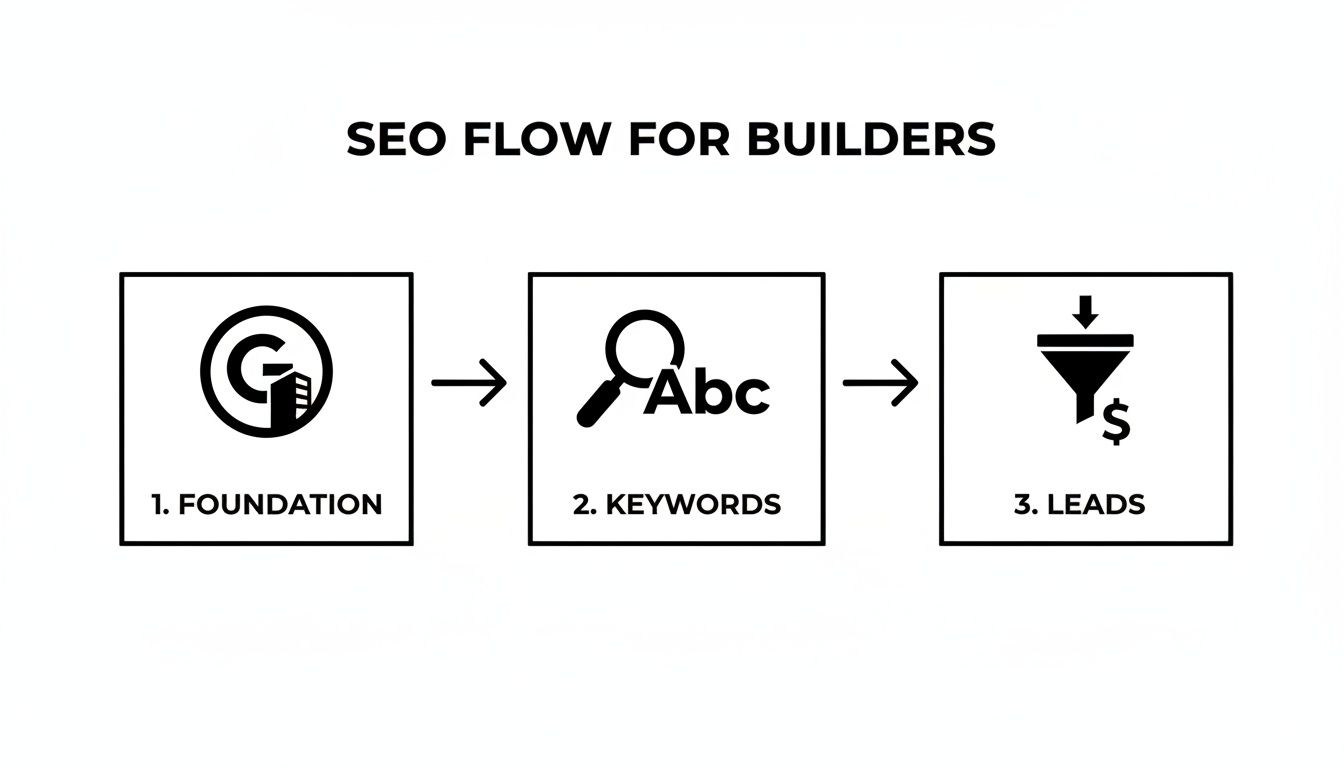
It all boils down to three core stages: setting up your online presence correctly, figuring out what your customers are searching for, and then turning those searchers into paying clients.
This flow is pretty straightforward. You start with a solid online foundation, use smart keyword research to understand your market, and then watch the project leads start rolling in.
Get these stages right, and you’ll have a powerful digital engine driving your business forward, making you far less reliant on those unpredictable, feast-or-famine lead sources.
The Undeniable Shift to Digital
The construction industry across Australia has well and truly woken up to this. The data doesn't lie: Aussie builders are investing more in their online marketing, and SEO is proving to be the undisputed king for return on investment.
In fact, well-run SEO campaigns for Australian construction firms have delivered an average return of 360-380%. That blows most other marketing channels out of the water.
Here's the kicker: SEO-generated enquiries now make up a staggering 38% of all qualified leads for builders nationwide. That’s well ahead of referrals (26%) and paid ads (22%).
This data makes it crystal clear: a strong web presence for trades is no longer a 'nice-to-have'—it's a fundamental part of running a successful building company today. By ignoring SEO, you're just handing jobs over to your competitors who are already online.
Let's dive in and start building your blueprint for success.
Your Construction SEO Blueprint at a Glance
Here are the core pillars of a successful SEO strategy for builders, what they involve, and the real-world impact they have on your business.
| SEO Pillar | What It Actually Means | Why It Wins You Jobs |
|---|---|---|
| Local SEO | Showing up in the "map pack" for local searches like 'builder near me'. | Catches homeowners actively looking for a local tradie, right now. |
| Keyword Research | Finding the exact phrases people type into Google to find your services. | You stop guessing and start targeting the actual words that lead to quotes. |
| On-Page SEO | Making sure your website's pages clearly talk about your services and location. | Google understands what you do and where you do it, so it can show you to the right people. |
| Content Strategy | Creating pages that showcase your projects, services, and expertise. | Builds trust with potential clients and gives you more chances to rank for different searches. |
| Link Building | Getting other reputable local and industry websites to link back to yours. | It's like a vote of confidence that tells Google you're a legitimate, trusted business. |
| Technical SEO | Ensuring your site is fast, mobile-friendly, and easy for Google to crawl. | A poor user experience will send potential clients running to your competitors. |
Think of these pillars as the foundation, framing, and fit-out of your online marketing. Get them right, and you'll build a lead-generation machine that works for you 24/7.
Mastering Local SEO to Dominate Your Service Area
For any construction company, the best leads aren't just anywhere—they're right in your backyard. Winning the local game means being the first name that pops up when a homeowner or developer in your service area needs a builder. This is where mastering local SEO becomes your most powerful tool for generating a steady stream of high-quality leads.
It all starts with your digital storefront: your Google Business Profile (GBP). This free listing is often the very first interaction a potential client has with your brand. Just claiming it isn't enough; you need to treat it like a dynamic, trust-building asset.
Optimising Your Google Business Profile
Think of your GBP as more than just a pin on a map. It’s an interactive hub where clients can see your work, ask questions, and decide if you're the right fit for their project.
Here's a look at the Google Business Profile interface, where you can manage all your local business information.
This dashboard is your command centre for local search visibility. It lets you control exactly how customers see your business across Google Search and Maps.
To really make it work for you, you've got to go beyond the basics. Instead of just listing "General Contractor," use specific service categories like "Custom Home Builder," "Kitchen Remodeller," or "Decking Installation." This small tweak helps Google match you to more precise, high-intent searches.
Better yet, make it a habit to regularly upload high-quality, geotagged photos from your completed projects. When you upload an image taken on-site in Fremantle, it sends a powerful signal to Google that you actively work in that specific area, boosting your relevance for local searches right there.
The Power of Consistent Business Listings
Beyond your GBP, Google looks for consistency across the web to verify that your business is legitimate and active. These consistent listings of your Name, Address, and Phone number (known as NAP citations) act like digital votes of confidence.
Securing consistent citations on reputable platforms tells Google that you are an established, trustworthy local entity. Every correct listing on sites like TrueLocal, industry-specific directories, or local business chambers reinforces your geographical authority.
Inconsistent information, like an old address or a disconnected phone number floating around online, can create confusion and actively harm your local rankings. Running a periodic audit to clean up these inconsistencies is a simple but highly effective local SEO task. To truly dominate your service area, implementing proven SEO for contractors strategies is essential for attracting local, high-intent customers.
Building Trust with Genuine Client Reviews
Reviews are the digital version of word-of-mouth referrals, and they are a massive ranking factor for local search. Both Google and potential clients rely heavily on the experiences of past customers to gauge your reliability and craftsmanship. A steady stream of recent, positive reviews is one of the strongest signals you can send.
The problem is, getting clients to actually leave feedback can be a challenge. The key is to make the process as simple and frictionless as possible.
- Strike While the Iron is Hot: Ask for a review immediately after the final walkthrough, when the client is happiest with their newly completed project.
- Make It Easy: Don't just ask them to "leave a review." Send a direct link to your Google Business Profile review form via email or SMS. This removes any guesswork and massively increases the chances they'll follow through.
- Respond to Every Review: Always reply to reviews, both positive and negative. Thanking clients for their praise shows you appreciate their business, while addressing criticism professionally demonstrates accountability. This is a crucial part of your online reputation management.
The impact of a well-executed local SEO strategy is huge, especially in the competitive Australian market. Top SEO agencies are achieving remarkable results for trade businesses by focusing on these local fundamentals. A quick look at reviews on platforms like Clutch.co shows massive gains in lead generation, with some agencies boasting perfect client feedback for skyrocketing website rankings by mastering local pack visibility and nailing keyword strategies for 'near me' searches. This just proves that dedicating resources to your local presence delivers tangible, project-winning results.
Building a Website That Converts Visitors into Leads
Think of your website as your digital showroom and your hardest-working salesperson. It’s open 24/7. But if it’s slow, a pain to navigate, or looks like it was designed a decade ago, potential clients will hit the back button and call your competitor. No second thoughts. A polished, professional site is one of the most essential site features for a modern business.
Let’s get into the on-page and technical SEO basics that turn a simple website into a lead-generating machine. This is all about making sure that when someone lands on your site, they're guided smoothly from a curious visitor into a paying customer.

Structure Your Site for Clients and Google
A messy website is just like a messy job site—it signals a lack of professionalism and makes it impossible to find what you need. The very first step is to map out a logical site structure, creating dedicated pages for each of your main services.
Don’t just dump everything onto a generic "Services" page. That’s a huge mistake. Instead, build out individual, detailed pages for your big-ticket offerings like 'Custom Home Builds', 'Bathroom Renovations', or 'Commercial Fit-Outs'.
This approach works on two crucial levels:
- For Clients: It lets a visitor who needs a specific job done find exactly what they’re looking for right away. This answers their questions and builds immediate confidence in your skills.
- For Google: It gives you a dedicated space to target specific, high-intent keywords for each service, clearly telling search engines what each page is about and massively boosting your chances of ranking.
Craft Titles and Descriptions That Earn Clicks
Getting onto the first page of Google is only half the job. Your page's title tag and meta description are the first things a user sees in the search results. They’re your ad copy—your one shot to convince them to click your link instead of the five others around it.
A lazy title like "Services | Smith & Sons Builders" is a complete waste of prime real estate.
An optimised title needs to be compelling. For example, a bathroom renovator in Perth could use something that speaks directly to what the searcher wants: "Expert Bathroom Renovations Perth | Free Quote | Smith & Sons". It has the service, the location, and a call-to-action, making it far more likely to get the click.
Your title tag is the single most important on-page SEO element. Make it count by including your primary keyword, your location, and a compelling reason for someone to click, such as 'Award-Winning' or 'Get a Free Estimate'.
The meta description is your short sales pitch (about 155 characters) that sits under the title. Use this space to highlight what makes you the best choice, mentioning things like your years of experience, quality craftsmanship, or a satisfaction guarantee.
Demystifying Technical SEO for Builders
"Technical SEO" might sound complex, but for a construction company's website, you really only need to nail a few key things that make a massive difference. Forget the confusing jargon; these are the absolute non-negotiables.
Mobile Performance Is Everything
The majority of your potential clients are looking for builders on their phones, often while out and about. If your website is slow or clunky on a mobile device, you're losing business. It's that simple. Your website must be responsive, meaning it automatically resizes to fit any screen perfectly, whether it's a desktop, tablet, or phone.
Site Speed Matters More Than You Think
A slow website is a lead killer. Study after study shows people will abandon a site that takes more than a few seconds to load. You can use free tools like Google's PageSpeed Insights to check your site's speed and get clear instructions on how to fix it. Often, simple things like compressing the images in your project gallery can make a huge difference.
Using Schema Markup to Stand Out
Schema markup is a bit of code you add to your site that helps search engines properly understand your content. For a construction business, this is a game-changer.
It lets you clearly tell Google important information like:
- Your business name, address, and phone number (NAP)
- Your hours of operation
- The specific services you offer
- Your average customer review rating
- Your exact service area
When you add this, you give Google the ability to show this info directly in the search results as a "rich snippet." This makes your listing bigger, more informative, and helps you stand out from the crowd, giving potential clients the key details they need at a glance.
Creating Content That Showcases Your Expertise
Great content does more than just fill a page. It's your best chance to answer a potential client's nagging questions, show off the quality of your work, and build rock-solid trust before you even shake hands.
Forget posting generic tips about home maintenance. Your content needs to be a direct line to winning more projects.
The foundation for any builder’s content plan rests on two absolute essentials: detailed service pages and stunning project portfolios. Think of these less as website sections and more as your hardest-working sales tools.
Crafting High-Ranking Service Pages
A single, generic "Services" page is one of the biggest missed opportunities I see in SEO for construction companies. Your clients aren't searching for "building services"; they're looking for specific solutions like 'home extension builder Melbourne' or 'commercial fit-out contractor Sydney'.
Give each of your core services its own dedicated, detailed page.
These pages need to do more than just list what you offer. Walk the client through your entire process, from the first chat to the final handover. This simple act tackles their biggest worries—timelines, budgets, and disruptions—and positions you as the transparent, reliable choice.
Your service pages are your digital sales pitch. Structure them to answer the three big questions every client has: What is the process? How much will it cost (ballpark)? And why should I trust you to do it?
To get these pages firing on all cylinders, make sure you include:
- A Clear Process Outline: Use a simple numbered list or flowchart to map out the key stages of a project.
- High-Quality Imagery: Nothing sells like proof. Show photos of relevant completed jobs.
- Frequently Asked Questions (FAQs): Get straight to the point. Answer common questions about permits, materials, or timelines right there on the page.
Turning Projects into Powerful Case Studies
Your finished work is your best marketing material, period. A killer project portfolio isn't just a gallery of nice photos; it’s a collection of case studies that prove what you can do and build massive credibility.
Each project you feature needs to tell a story.
Don't just upload photos with a one-line description. Turn each project into a mini-case study. What was the client's original problem? What unique challenges popped up? How did your team solve them and deliver the final result? This story-based approach is far more compelling than a simple image gallery.
For maximum impact, include these details:
- Project Specifics: List the location (suburb/city), scope of work, key materials, and how long it took.
- Before-and-After Photos: Nothing shows off a transformation better than a direct comparison. It’s visual gold.
- A Glowing Client Testimonial: Add a direct quote from the happy client. It’s the social proof that seals the deal.
This level of detail turns your portfolio from a simple gallery into a conversion machine, giving future clients a crystal-clear picture of what it's like to work with you.
Developing Blog Content That Attracts Early-Stage Clients
Service pages and portfolios are for clients who are ready to build now. Your blog is where you connect with people much earlier in their journey. This is your chance to become the go-to authority in your local area.
Create content that answers the questions people are asking before they're even ready for a quote.
Think about the real concerns of property owners in your service area. Instead of a generic post, write something hyper-specific and genuinely helpful. A topic like 'Costs to Consider for a Second-Story Addition in Brisbane' or 'Navigating Council Approvals for a Granny Flat in the Sutherland Shire' provides immediate value.
This isn't just theory; it gets real results. In the competitive Aussie construction game, a focused SEO and content strategy makes a huge difference. One Melbourne construction company saw its organic website sessions jump by an incredible 46.57% in just six months. Better yet, organic traffic from their target area of New South Wales grew by nearly 35%.
It’s proof that helpful, local content pulls in high-quality clients from your own backyard. You can read more about how targeted SEO drives construction industry growth on impressive.com.au. By becoming the expert they find online, you become the builder they call when it's time to get started.
Here's a look at different content types and how they attract clients at every stage of the building journey, from initial research to final decision.
Content Ideas That Generate Construction Leads
| Content Format | Main Purpose | Real-World Example |
|---|---|---|
| In-Depth Service Pages | To capture high-intent searchers ready to hire. Answers specific questions about a service you offer. | "Alfresco & Outdoor Entertainment Area Builders Perth" page with a process outline & FAQs. |
| Project Case Studies | To build trust and prove your quality. Shows potential clients exactly what you can deliver. | A post titled "Case Study: A Modern Hamptons-Style Renovation in Mosman". |
| Cost Guide Blogs | To attract clients in the research phase. Establishes you as a transparent, helpful authority. | "How Much Does a Knockdown Rebuild Cost in Melbourne's Eastern Suburbs?" |
| Local Guides | To build local relevance and rank for location-based searches. Shows you understand the local area and rules. | "A Builder's Guide to Navigating Heritage Overlay Approvals in Ballarat". |
| Comparison Articles | To help clients make informed decisions, positioning you as the expert who can guide them. | "Composite Decking vs. Hardwood: What's the Best Choice for Queensland Homes?" |
By creating a mix of these content types, you’re not just waiting for the phone to ring—you’re actively guiding potential clients right to your door, no matter where they are in their decision-making process.
Earning Trust with Links and Off-Page Signals

So far, we’ve covered everything you can control on your own website and Google profile. Now, it’s time to look at how your reputation elsewhere on the web influences your search rankings. These are known as off-page signals, and they are seriously powerful.
Think of it this way: when another reputable website links to yours, it's like a digital 'vote of confidence' in Google's eyes. The more relevant, high-quality votes you get, the more Google sees your business as a trustworthy authority in the field.
This has nothing to do with dodgy, spammy tactics or buying links. Real authority has to be earned. The goal is to build a profile of genuine backlinks that proves you’re a legitimate, respected operator in the local construction industry.
Capitalise on Your Business Relationships
The best place to start earning valuable links is within your existing professional network. These connections are gold because they're highly relevant and carry real weight with search engines, making them a top priority in any strategy for SEO for construction companies.
Take a moment to think about the businesses you work with every day. Most of them have websites and would probably be happy to list you as a trusted partner.
Here are a few low-hanging fruit opportunities:
- Supplier & Manufacturer Websites: Are you a certified installer for a specific brand of decking, windows, or cladding? Get in touch and ask to be added to their official 'find an installer' or 'preferred builders' page. This is a top-tier backlink.
- Subcontractor & Partner Links: Do you work with the same sparkies, plumbers, or architects on every job? Suggest a simple reciprocal link where you feature each other as trusted partners on your websites.
- Industry Associations: If you're a member of Master Builders Australia or the HIA, double-check that your profile is filled out completely and, most importantly, links directly back to your website. These are high-authority industry endorsements you don't want to miss.
A single backlink from a major building materials supplier’s website can often be more valuable than dozens of links from low-quality, generic directories. Focus on quality and relevance over sheer quantity every single time.
Leverage Local Community Engagement
Getting involved in your local community does more than just build goodwill—it builds powerful local backlinks that signal to Google you're a permanent and trusted part of the area you serve.
These opportunities are often simpler to find and act on than you might think.
Consider these practical ideas for a bit of digital PR:
- Sponsor a local sports team, like a kids' soccer or footy club. They almost always feature their sponsors' logos and website links on their homepage.
- Win a local business or building award. The organisation running the awards will link to your site, and you can share the news with local media outlets, who might also link back.
- Partner with a local charity on a community project. Any news coverage or even a simple mention on the charity's website provides a fantastic, contextually relevant link.
Each of these off-page signals reinforces your local authority. It tells Google that you’re more than just a website; you’re a real, active, and respected business in your community. Over time, this digital proof helps you systematically outrank competitors who have neglected to build their online reputation beyond their own homepage.
Tracking Your Results to Ensure Real ROI
Pouring your hard-earned time and money into SEO for construction companies is a complete waste if you can't tell what’s actually working. You have to move past the fuzzy, feel-good numbers and get laser-focused on the data that directly grows your bottom line. It’s not about getting a few more website visitors; it’s about getting more quote requests and winning more projects. Simple as that.
To get there, you need to measure what matters. For a builder, that means tracking your keyword rankings for your core services in the suburbs you serve, counting the leads coming through your website's contact form, and seeing how visible you are in the Google Maps pack. These are the metrics that put money back in your pocket.
Key Performance Indicators for Builders
Forget vanity metrics like "impressions." Let's get down to the data that signals genuine business growth. Using free and powerful tools like Google Search Console and Google Analytics, you can get a crystal-clear picture of how your SEO is performing.
These are the core KPIs you should be watching like a hawk:
- Organic Keyword Rankings: Are you showing up on page one for searches like "home extension builder [your suburb]" or "kitchen renovation [your city]"? A steady climb up the rankings for these money-making terms is a direct sign of progress.
- Website Lead Conversions: This is the big one. How many people filled out your "Request a Quote" form this month? This metric ties SEO activity directly to potential revenue.
- Google Business Profile Actions: Dig into your local listing data. Track how many people click to call your business, ask for directions to your office, or click through to your website straight from the map pack.
- Organic Traffic Growth: While it's not the only number that matters, a healthy increase in relevant organic traffic shows that your content and optimisation efforts are hitting the mark and attracting more potential customers.
To really connect the dots and prove a tangible ROI, you need to get a handle on understanding marketing attribution. This is how you confidently link specific marketing actions to the leads they generate.
DIY SEO vs. Hiring a Specialist Agency
With the right tools and data in hand, the next big question pops up: do you tackle this yourself or bring in a professional? There’s no single correct answer, but here’s a straightforward way to think about it.
The DIY SEO Approach
This path is best for builders who have more time than budget. If you're genuinely willing to block out at least 10-15 hours per month to learn and implement the strategies in this guide, you can absolutely get solid results, especially with local SEO. It just takes patience and a real commitment to learning the ropes.
Hiring an SEO Agency
This is the fast track for business owners who want accelerated results and would rather focus on what they do best—running a construction business. A specialist agency brings years of expertise, proven processes, and accountability to the table. They can execute more advanced strategies like technical site audits and link building far more efficiently, delivering a stronger return on your investment, much faster.
Deciding between DIY and an agency comes down to a simple trade-off. DIY saves you money but costs you significant time. An agency costs money but saves you time and typically delivers results faster due to specialised expertise.
Ultimately, the right path hinges on your available resources and your growth ambitions. Whether you decide to learn it yourself or bring in an expert, the non-negotiable part is this: consistently tracking your results against bottom-line metrics is the only way to ensure your SEO is a profitable investment, not just another business expense.
Your Top Construction SEO Questions Answered
Jumping into the world of digital marketing can feel like a lot. Let's clear up some of the most common questions we hear from builders and contractors about getting started with SEO.
How Long Until SEO Actually Starts Working?
This is the big one, isn't it? While you might see some positive signs in local rankings within 3-4 months, particularly after sorting out your Google Business Profile, the real, game-changing results usually take 6-12 months to build.
Think of SEO like pouring a solid foundation. It takes a significant upfront effort, but the strength and value it provides compound massively over time. This isn't a quick fix; it's a long-term strategy that builds a reliable pipeline of quality leads, meaning you can eventually pull back on paying for ads.
Should I Focus on Local or National SEO?
For pretty much every construction company out there, the answer is simple: local SEO is everything. Your clients aren't just looking for any builder; they're searching for one in their specific city, suburb, or region.
The real money is made by focusing your efforts on ranking in the Google Map Pack and top organic results for searches like 'custom home builder Perth' or 'renovation expert near me'. This is what brings in qualified, local leads who are ready to pick up the phone. National SEO only really comes into play for huge, multi-state firms or businesses selling building products right across the country.
For a local service business, national rankings are just a vanity metric. It's the local rankings that pay the bills. Prioritise showing up where your customers actually are.
Can I Do SEO Myself, or Do I Need an Agency?
You can absolutely get the ball rolling on your own. Simple things like optimising your Google Business Profile, consistently asking clients for reviews, and writing clear, detailed service pages are brilliant first steps that genuinely make a difference.
However, a full-blown strategy for SEO for construction companies gets a lot more involved, bringing in technical site audits, strategic link building, and constant data analysis. If you can't realistically set aside at least 10 hours a month to learn the ropes and put it all into practice, bringing in a specialist agency is often the quickest path to a solid return on investment.
Ready to build a powerful online presence that brings in a steady flow of high-quality leads? At Website Builder Australia, we create custom websites and targeted SEO strategies that get real results for builders and tradies across the country. Let's build your digital foundation together. Learn more at https://websitebuilderaustralia.com.au.
Written with Outrank app


