

Master Search Engine Optimisation Geelong: Your 2026 Guide
You know your business is good. Customers who find you tend to stay, refer others, and come back. But online, it can feel like Geelong barely knows you exist.
A café owner on Pakington Street might serve better coffee than the place down the road, yet the other venue shows up first when someone searches on their phone. A plumber in Grovedale might answer calls faster and do cleaner work, but a competitor appears in Google Maps while they're buried on page two. That gap frustrates a lot of local owners because it isn't about quality. It's about visibility.
That's where search engine optimisation Geelong matters. In plain English, SEO helps your business appear when someone is already looking for what you sell. Not interrupting them with an ad. Meeting them at the exact moment they have intent.
For Geelong businesses, that usually means being found in three places. Google Maps, local organic results, and suburb-specific searches like “electrician Highton” or “accountant Geelong West”. If your business isn't showing there, you're relying on luck, referrals, or repeat customers alone.
The good news is that local SEO isn't magic. It's a system. Once you understand the moving parts, you can make much better decisions about where to focus, what to fix first, and whether you should target a suburb, the whole city, or the wider region.
Your Geelong Business Is Great But Is It Visible
A lot of business owners assume the best operator wins online. It doesn't work that way.
Google can't taste your coffee, inspect your workmanship, or sit in on your client meetings. It has to judge your business through signals. Your website pages. Your Google Business Profile. Your reviews. Your location details. The way your services are described. The suburbs you mention. Whether all those details line up cleanly.
That's why a less capable competitor can outrank a better business. They may be easier for Google to understand.
What this looks like in real life
Take a service business based in Belmont. The owner says, “We service all of Geelong.” That sounds broad and sensible. But the website only has one generic services page, no suburb pages, and a half-complete Google Business Profile. Meanwhile, a competitor has pages for Belmont, Highton, Newtown, and Waurn Ponds, with clear headings, service details, and customer reviews tied to local jobs.
When someone searches for a suburb-specific service, Google has a clearer answer from the competitor.
Practical rule: If Google has to guess what you do or where you work, you'll struggle to rank.
SEO is the bridge between demand and discovery
SEO isn't about tricking a search engine. It's about removing ambiguity.
Consider the signage for a physical shop. If your storefront has no sign, no trading hours, and no street number, locals may walk straight past even if what's inside is excellent. Online, your website and listings are that signage.
For a Geelong business owner, the first mindset shift is simple. You don't need more people vaguely aware your business exists. You need the right people to find you when they're ready to act.
That's why local SEO usually beats broad, unfocused marketing for trades, clinics, consultants, retailers, and hospitality venues. It connects existing demand to your business instead of trying to create attention from scratch.
Why Local SEO Is Critical for Geelong Businesses
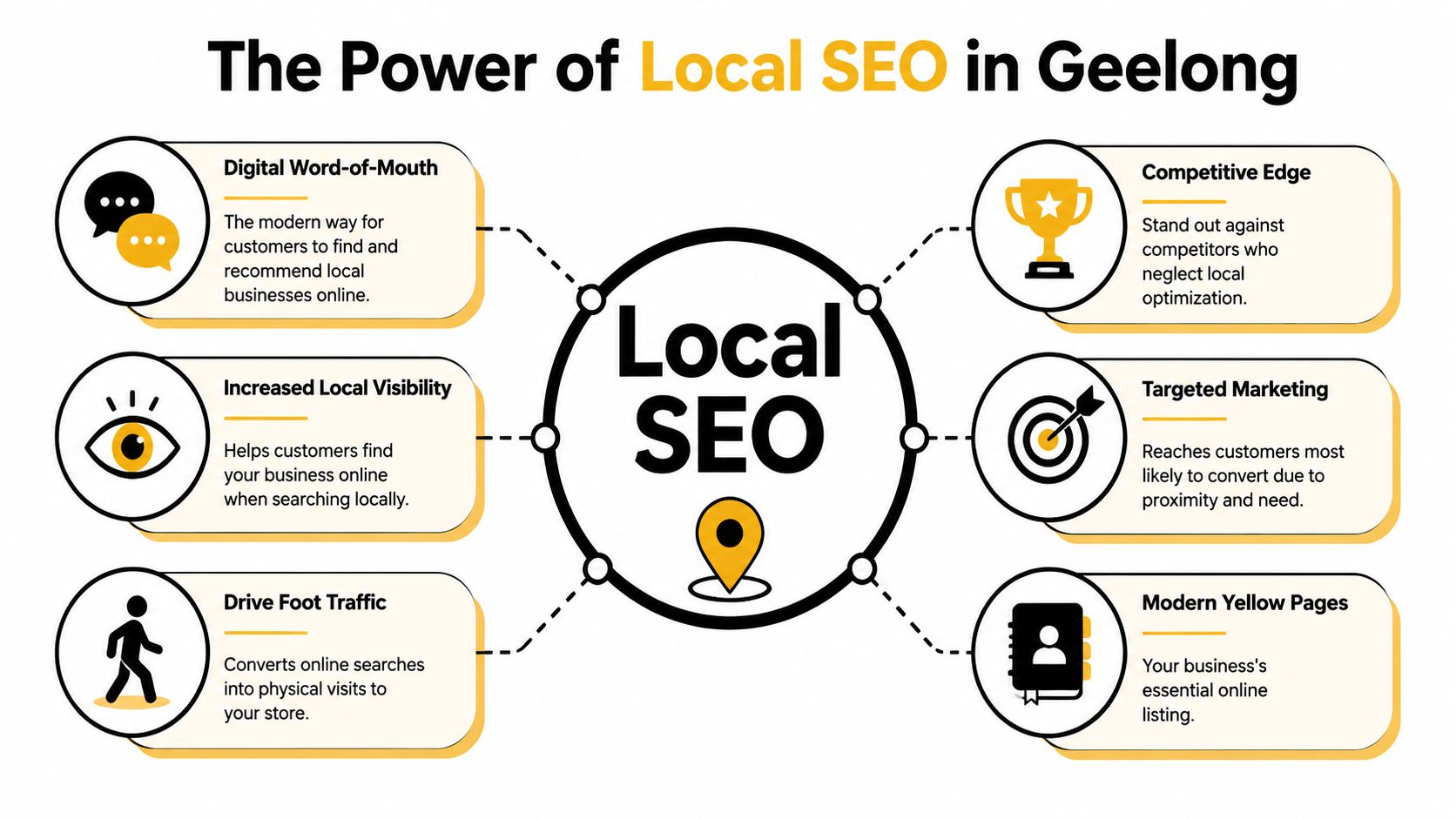
Local SEO is often easiest to understand as digital word-of-mouth with a map attached. It helps Google connect a nearby searcher with a nearby business that looks relevant and trustworthy.
Years ago, many businesses treated the web like an online brochure. Today, local search works more like the modern Yellow Pages, except it's dynamic, competitive, and tied directly to intent. When someone types “dentist near me” or “conveyancer Geelong”, they're not browsing casually. They're looking for an answer now.
In Australia, that matters even more because Google dominates search. Google holds about 95%+ of the search engine market in Australia, which means ranking improvements on Google can have outsized impact for Geelong businesses because one platform captures nearly all local search demand, according to Propeld's overview of SEO in Geelong.
Why this changes the stakes
If search were spread evenly across several platforms, you could afford to ignore one of them. That's not the Australian reality. For most local businesses, Google is the main road.
So when a Geelong owner says, “We get most of our work from referrals,” that may be true. But referrals often still check Google before calling. They look at reviews, opening hours, service areas, and whether the business appears established. If you're absent or poorly represented there, referrals can leak away before you ever hear from them.
A useful starting point is understanding local SEO for businesses, especially if you've treated your website and maps presence as separate things. They're connected.
What local SEO actually helps you do
- Be found nearby: You appear when people in Geelong or specific suburbs search for your service.
- Convert intent faster: Local searchers often want a phone number, directions, or a quote, not a long sales funnel.
- Compete smarter: You don't have to outrank the whole internet. You need to be the best local answer.
- Strengthen trust: Reviews, accurate business details, and relevant pages make you look credible before a call happens.
If map visibility is one of your weak spots, this guide on how to rank higher in maps is a useful companion because it breaks down the practical side of local map rankings.
A business that's easy for Google to verify is usually easier for customers to choose.
For Geelong operators, local SEO isn't an optional extra. It's the layer that turns your reputation, service quality, and location into visible demand capture.
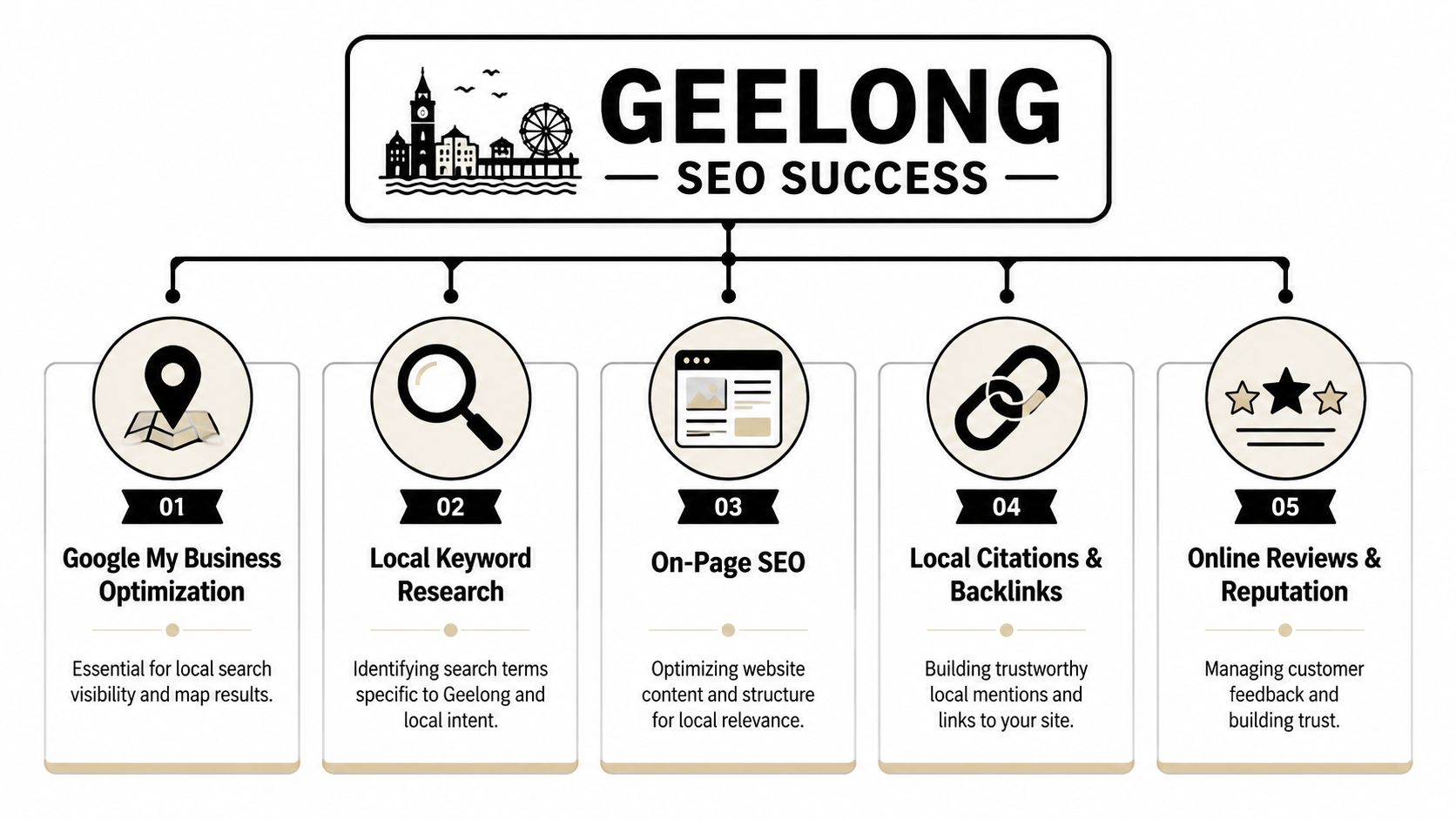
The Five Pillars of Geelong SEO Success
Most small businesses get overwhelmed because SEO sounds like fifty different jobs. In practice, local SEO becomes manageable when you break it into a handful of core pillars.
Google Business Profile and entity consistency
For Geelong-local SEO, one of the strongest levers is Google Business Profile optimisation combined with consistent Name, Address, and Phone details across your site and listings. When those signals align, Google can match your business more confidently to “near me” and suburb searches, helping separate you from Melbourne-region competitors, as explained by Pixeld's SEO guidance.
This is the first pillar because it affects both map visibility and trust. If your trading name is written one way on your website, another way in directories, and a third way in your profile, you create confusion.
Your profile should include:
- Accurate core details: Business name, address, phone, hours, and primary category.
- Clear service coverage: Service areas or location relevance that match how you operate.
- Useful business content: Photos, service descriptions, and regular updates where appropriate.
Local keyword research
Many owners choose keywords based on what they call their service. Searchers don't always use the same language.
A Geelong physiotherapist might optimise for “sports rehabilitation”, while locals search “physio Geelong” or “physio near me”. A builder may describe “residential renovations”, while the market searches “home extensions Newtown” or “bathroom renovations Geelong”.
The aim isn't to cram keywords everywhere. It's to map real search language to real pages.
On-page and technical signals
Here, your website tells Google, clearly and directly, what each page is about.
Key elements include:
- Titles and headings: Your page title and H1 should match the service and location intent.
- Page focus: One page should answer one main need well, instead of trying to rank for everything.
- Site structure: Service pages, suburb pages, contact details, and internal links should make sense.
If you want the basics explained cleanly, this overview of on-page SEO optimisation is worth reading.
Citations and reviews
Citations are mentions of your business details on directories and local platforms. Reviews are the public proof that you serve real customers well. Together, they reinforce trust.
A review profile won't fix a weak website by itself. But when someone compares two Geelong providers with similar services, reviews often influence which listing gets the click and which business gets the call.
Local links and local authority
Local link building is less about chasing random backlinks and more about relevance. A mention from a local chamber, community group, supplier, sponsorship page, or industry association can strengthen your local footprint.
A simple test: If a real Geelong customer would recognise the site or organisation mentioning you, the link is probably more useful than a generic one from an unrelated website.
These five pillars work together. If one is badly neglected, the whole system becomes weaker. Strong local SEO isn't built from one trick. It's built from consistency.
Your Step-by-Step Geelong SEO Game Plan
A Geelong business can do good work for years and still lose leads to a competitor with a clearer local search setup. The difference is often not quality of service. It is geographic focus, page structure, and consistency.
Treat your SEO plan like opening a second shopfront. Before you spend on signage, you choose the suburb, fit out the space, then make sure people can find it. Your website needs the same order. If you skip ahead and publish a stack of location pages before deciding whether you really want Belmont, Newtown, central Geelong, or the wider region, you usually end up with thin pages and scattered effort.
A practical sequence looks like this.
Start with the base layer
Set up your Google Business Profile properly
Fill out the core details with care. Your category, hours, phone number, service area, photos, and business description should match what appears on your website. If Google sees one version and customers see another, trust drops.Check whether your website can support local search
Look for gaps that block performance. Do you have a clear page for each core service? Can a visitor tell where you work? Is your contact information easy to find on mobile? If one page tries to cover every service and every location, Google has to guess what the page is really about.Choose your geographic target before building new pages
This decision shapes everything that follows. A physio clinic in one suburb usually needs a tighter radius than a trades business that travels across Greater Geelong. A law firm may need a strong Geelong page first, then a small number of suburb pages where demand and client fit are strongest.
That third step matters more than many owners realise. SEO is not won by publishing the most pages. It is won by matching the way customers search with the way your business delivers.
Build pages that match real search intent
Once your target area is clear, create pages that answer one local need at a time. Google is trying to sort pages by purpose. A good page makes that easy.
For a Geelong business, that usually means a core service page, then selected location or suburb pages only where they make commercial sense. A plumber servicing Highton, Belmont, and Armstrong Creek may need separate service area pages. A café probably does not. The goal is not to mention more place names. The goal is to create the right page for the right search.
A useful page structure includes:
- A precise heading: “Family Lawyer Geelong” or “Electrician in Belmont”
- A clear opening: explain what you do, who you help, and the area you serve
- Service detail: describe the problem, your process, and what a customer can expect
- Local context: mention service areas and local customer needs naturally
- FAQs: answer the questions people ask before they call
- Schema markup: help search engines classify the page correctly
If you are writing these pages yourself, avoid the common shortcut of cloning one page and changing only the suburb name. That is like printing the same flyer for ten different storefronts and hoping each one feels local. It rarely does.
This short video is useful if you want a visual walkthrough before changing content on your own site.
Modern SEO workflows also use clear headings, short answer sections, and schema because search engines and AI systems read page structure as well as page text. The guidance discussed in this YouTube SEO workflow explanation is useful for understanding how that works in practice.
Add signals that support the pages
After the pages are live, strengthen them with evidence from outside your site.
- Keep listings consistent: your business name, address, phone number, and service details should match across directories and platforms
- Ask for reviews as part of the job process: right after a completed service is better than asking occasionally
- Get relevant local mentions: chambers, suppliers, sponsorships, community groups, and local associations can all help if the connection is genuine
For a simple practical refresher on content and site improvements, this article on optimize your website for SEO is a useful read.
Review what is working, then adjust
Local SEO usually improves through iteration, not one big launch. One suburb page may attract impressions but no calls, which often means the intent is off. Another page may rank but convert poorly, which usually points to weak copy, poor trust signals, or an unclear offer.
Review your search terms, page performance, calls, and enquiry quality. Then decide whether to improve the page, merge it with another, or shift your effort toward a better geographic target. That is how a Geelong SEO plan becomes commercially useful rather than just technically tidy.
Beyond Geelong Choosing Your Geographic Focus
Many businesses make an error in their strategy. They assume more locations means more opportunity, so they create pages for every suburb they can think of. Conversely, others target only “Geelong” when their actual work comes from a broader area.
The smarter question is simpler. What geographic focus matches the way customers buy from you?

A major gap in Geelong SEO advice is knowing when to prioritise suburb pages versus broader regional targeting. Modern search, shaped by AI, rewards tight alignment between page purpose and user intent rather than loose keyword repetition, as outlined in the University of Wyoming's SEO guidance.
A practical decision framework
Use this as a quick filter:
| Business type | Best starting focus | Why |
|---|---|---|
| Shop, café, clinic, salon | Hyper-local suburb and nearby area | Customers care about proximity and convenience |
| Trades and mobile services | Service-area pages plus Geelong core page | Customers search by suburb, but you travel |
| Professional services | Geelong city page plus selective suburb pages | Trust and specialisation matter as much as distance |
| Regional operator | Geelong plus broader regional pages | Search intent may include Bellarine, Surf Coast, or nearby centres |
When suburb pages make sense
Suburb-level pages work well when:
- Customers search locally: Think “plumber Highton” or “dentist Newtown”.
- You actively service that area: You can talk credibly about the suburb and its needs.
- The service is high intent: People want a provider near them, not a general information page.
When broader targeting is better
A wider Geelong or regional strategy makes more sense when:
- Your buyers choose on expertise first: Legal, B2B, consulting, and specialist services often work this way.
- You cover multiple areas with one process: A broad service page may fit better than many thin suburb pages.
- Your budget is limited: One strong regional page is usually better than ten weak local pages.
Don't create location pages just because suburbs exist. Create them because each page serves a distinct search intent.
A good rule is to start with the smallest set of pages that matches real buying behaviour. Then expand only after you've seen which locations produce enquiries.
If you're a Geelong retailer with a fixed storefront, hyper-local relevance often wins. If you're a service-area business covering Geelong, the Bellarine, and the Surf Coast, you'll usually need a layered structure: one strong city page, selected suburb pages, and a broader regional footprint where demand justifies it.
Measuring What Matters and Realistic Timelines
SEO gets confusing when people measure the wrong things. More traffic sounds good, but traffic alone doesn't pay wages. A local business needs leads, bookings, calls, and direction requests from the right searches.
That matters because local SEO has shifted toward intent-based search. Businesses in Geelong compete on service-area and buyer-intent queries, not just broad keywords, and success is better measured by lead capture from relevant local searches than by raw traffic volume, as reflected in the historical development of search engine optimisation.
The metrics worth watching
For most Geelong businesses, focus on these:
- Map pack visibility: Are you appearing for your important service and location searches?
- Google Business Profile actions: Calls, website clicks, and direction requests indicate real intent.
- Organic enquiries: Contact form submissions, quote requests, booking actions, and tracked phone calls from organic search.
- Landing page performance: Which service or suburb pages attract qualified visits and enquiries?
- Review quality and frequency: Not as a vanity score, but as trust support for conversion.
What a realistic timeline looks like
SEO usually behaves like compounding groundwork, not an overnight switch. You may notice early movement after core fixes, especially if your profile, pages, and local signals were weak. More meaningful traction often comes after repeated improvements, better content targeting, and stronger local authority signals.
That's why bad SEO promises are easy to spot. If someone talks only about rankings and never asks about service areas, enquiry quality, or conversion paths, they're probably focused on the wrong outcome.
What to ask instead: Which pages are meant to generate leads, which search intents they target, and how results will be tracked from search to enquiry.
If you're comparing providers or trying to budget the work internally, this breakdown of search engine optimisation cost helps frame the investment side more clearly.
The right timeline depends on your starting point, your competition, and how much work gets implemented well. But the broad expectation should stay grounded. Good local SEO is built through steady improvement, not bursts of activity followed by neglect.
Bringing It All Together for Your Business
A Geelong business can do solid work, answer the phone, and treat customers well, yet still lose enquiries to a competitor that is easier to find. This is the purpose of search engine optimisation Geelong. It helps Google understand who you serve, where you serve, and which pages deserve to appear for the searches that lead to work.
By this point, the pattern should be clear. Local SEO works like a map, a shopfront, and a sales process combined. If the map points to the wrong area, the shopfront describes the wrong service, or the contact path feels unclear, visibility drops and enquiries weaken.
The strategic choice matters most. Some Geelong businesses should focus tightly on suburb-level searches because customers care about proximity and fast response. Others should target the whole city because people compare providers across Geelong before they enquire. Some need a broader regional footprint because the main opportunity sits in nearby areas, not just within the city boundary. Choosing the wrong geography is like printing flyers for the wrong neighbourhood. The effort is real, but the return is thin.
That is why a clear plan beats SEO jargon every time. Strong local results usually come from businesses that are easy to understand, easy to verify, and easy to contact. Google rewards clarity because searchers reward clarity.
If your visibility feels uneven, simplify the decision-making. Start by asking three questions. Where do your best customers come from? Do they search by suburb, by service plus Geelong, or by a wider regional term? And can your website support that focus with pages that match those searches?
Once those answers are clear, the next actions become much easier to choose. Tighten your geographic focus. Improve the pages that deserve to rank. Remove vague wording, duplicate service areas, and weak location signals. Then keep building on what produces qualified enquiries.
If you want help turning that strategy into practical website and local SEO work, Website Builder Australia can assist with site improvements, geographic targeting, and ongoing optimisation aligned with how your business operates in Geelong and across Australia.


