

The True Cost of Domain in Australia for 2026 Explained
So, what’s the real cost of a domain name in Australia? It’s not one simple price tag. A standard .com.au or .au domain might set you back less than a good coffee each month. But a premium, highly sought-after name could be a major investment, running into the thousands.
Think of it like digital real estate. Some web addresses are like a standard block in the suburbs, while others are prime storefronts on the main street with foot traffic already built-in.
Your Quick Guide to Australian Domain Costs
When you’re hunting for that perfect domain, the first step is getting your head around the costs. The price you see isn't just a one-time fee. It’s shaped by the domain extension you pick, who you buy it from, and whether it’s a brand-new registration or a renewal down the track.
For most Aussie businesses, the main players are .com.au, the newer and shorter .au, and the global heavyweight, .com. Each one sends a different message to your customers. A .com.au builds that local trust we all look for, a .au feels modern and snappy, and a .com gives you that international reach. Figuring out which one fits your business is crucial.
The price of a domain really just comes down to its value, scarcity, and the trust people have in its extension. It’s less about finding the absolute cheapest option and more about matching your digital address to your business goals.
To give you a clear idea of what to budget for, we’ve put together a quick look at the typical annual costs for these popular choices in Australia.
Here’s a breakdown to help you plan your spending and avoid any nasty surprises when that first-year promo ends and it’s time to renew.
Typical Annual Domain Registration Costs in Australia (2026)
| Domain Extension (TLD) | Typical First-Year Price Range (AUD) | Typical Renewal Price Range (AUD) |
|---|---|---|
| .com.au | $15 – $30 | $20 – $40 |
| .au | $15 – $30 | $20 – $40 |
| .com | $20 – $40 | $30 – $60 |
As you can see, the first-year price is often a little cheaper to get you in the door. But it's that renewal price you really need to keep an eye on for your long-term budget.
The Key Factors That Shape Your Domain Price
Ever looked for a domain name and seen one for a cool $15, only to find another that costs a staggering $15,000? It can be a bit confusing. What gives?
The truth is, a domain's cost isn't just a random sticker price. It’s shaped by a few key things. Getting your head around these factors means you can make a smart choice for your business, not just a quick purchase.
Think of your domain name as your business's digital address. Just like a physical shopfront in a prime CBD location costs more to lease than one in a quiet suburb, the value of your online address depends on what it is and where you get it from.
This flowchart gives you a quick visual breakdown of how it all works.
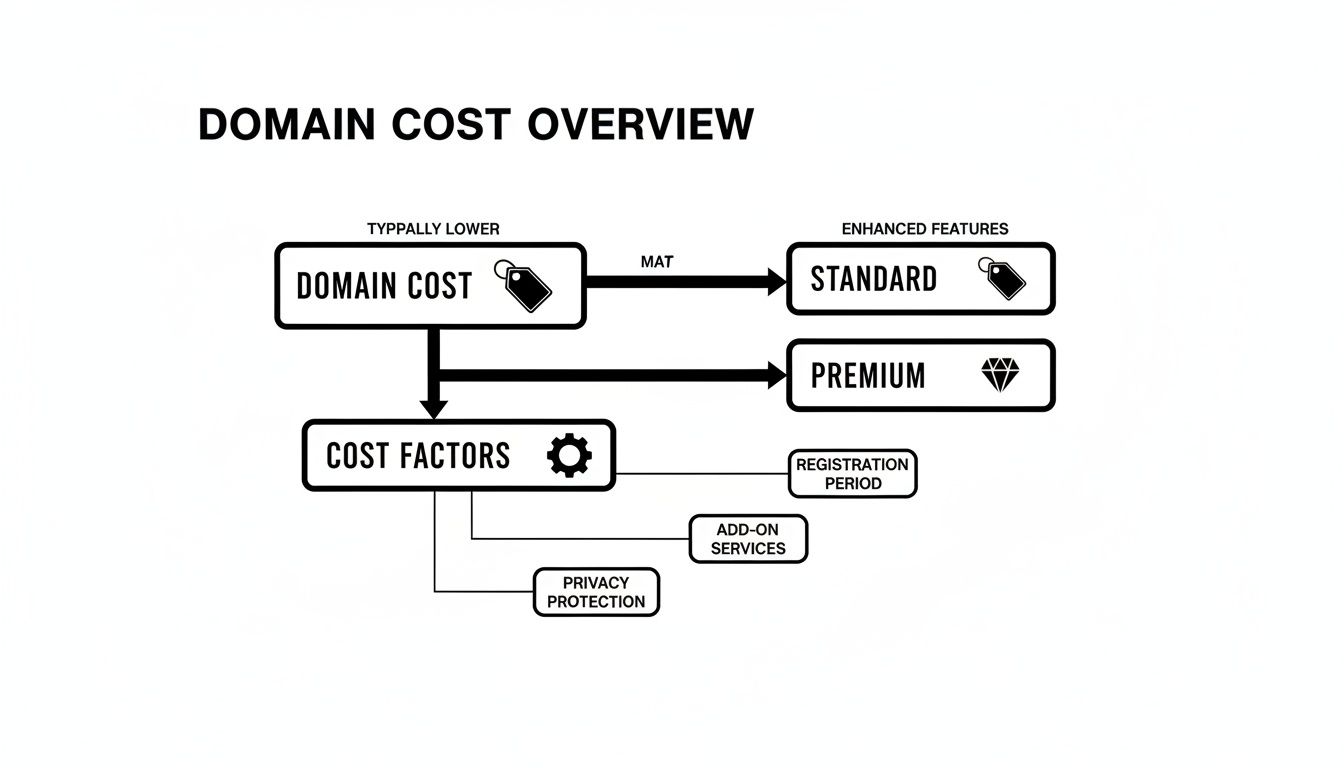
As you can see, things like brandability, length, and the domain extension itself all play a part in the final price. It's not just about grabbing any name—it's about securing the right one for your brand.
The Top-Level Domain (TLD)
The biggest influence on your domain's price is the Top-Level Domain (TLD). This is the bit that comes after the dot, like .com, .com.au, or .org.
You can think of TLDs as different neighbourhoods on the internet. Some, like .com, are globally recognised and trusted, making them the high-street addresses of the digital world. This trust and recognition often mean they come with a slightly higher price tag.
Here in Australia, we have our own clear favourite.
The local domain market is absolutely dominated by
.com.au, which accounts for a massive 64% of all Aussie domain registrations. This huge demand and local trust is a big reason why its pricing is structured the way it is compared to less common options.
On the other hand, a more specific TLD like .store or .xyz might be cheaper to get started with. They serve a niche purpose and just don't have the same level of demand.
The Domain Registrar
Who you buy your domain from—the domain registrar—also makes a huge difference to the price. Registrars are the accredited companies that sell domain names to the public.
Think of them like different car dealerships. They might all sell the same models, but the prices, special offers, and after-sales service can be worlds apart.
Here’s what you need to watch out for with registrars:
- Introductory Offers: Many will lure you in with a super-cheap first-year price, only to sting you with a much higher renewal cost. Always check the renewal rate!
- Included Services: Some registrars throw in essentials like domain privacy for free, while others will charge you extra for it. These little add-ons can really stack up.
- Customer Support: Paying a few dollars more a year might be well worth it if it means you get fantastic, responsive support when you really need it. This is especially true for a business website.
It’s all about finding the right balance between a good price and great service. If you need a hand, check out our guide to choosing the best domain registrar for your business.
The Registration Length
Finally, the registration length can influence the yearly cost. This is simply how many years you agree to register the domain for upfront.
Often, you can get a discount on the annual price by committing to a longer term, like three or five years, instead of just one. It’s a bit like getting a better deal on a long-term lease compared to renting month-to-month. The registrar rewards your longer commitment with a better rate.
Choosing Your Australian Domain Identity
For any Aussie business, picking a domain name is a bigger deal than just the yearly registration fee. It’s a proper strategic move. It sets the tone for your brand and tells every single visitor who you're here to serve.
Deciding between a .com.au, the newer .au, or a global .com is really about matching your digital address to what you want to achieve with your business.
Each one tells a slightly different story. A .com is like a global P.O. box—it works for anyone, anywhere. That’s great if you’re aiming for world domination, but it can feel a bit faceless to local customers who are trying to support an Aussie business.
On the other hand, the home-grown extensions create an instant sense of familiarity and trust.
The Power of the Australian Connection
Choosing a .com.au or .au domain is like setting up your shopfront on a well-known Aussie high street. It immediately signals to customers that you’re a legitimate local business, operating right here at home. This isn’t just a vibe; it’s backed by some pretty strict eligibility rules.
To get your hands on one of these domains, you need to have an active Australian Business Number (ABN) or Australian Company Number (ACN). This requirement acts as a built-in verification system.
Think of it as a digital badge of legitimacy. When customers see a .com.au or .au address, they know you've passed the test to trade in Australia. This small detail can give your credibility a massive boost before they even click on your link.
This built-in trust is a huge leg-up for businesses focused on the domestic market. It sets you apart from anonymous international sites and helps you build a much stronger connection with your local audience.
Matching Your Extension to Your Audience
So, how do you figure out which one is right for you? It all boils down to who you want to reach. Your choice will shape not just how customers see you, but your entire branding strategy.
Let's look at a few common scenarios:
- Serving the Local Community: If your customers are mainly in Australia, a .com.au or .au is almost always your best bet. It shouts "local" and builds trust from the get-go. A plumbing business in Perth or a café in Melbourne, for instance, gets a huge benefit from this local signal.
- Aiming for a Global Market: If your grand plan is to sell to the world from day one, a .com is the undisputed global standard. It positions your brand as international and doesn't tie you to one particular country.
- A Modern, Snappy Brand: The newer, shorter .au extension is a fantastic option for a modern, memorable brand. It’s perfect for new businesses that want a fresh name that is still unmistakably Australian.
At the end of the day, your domain extension is the very first piece of your brand a customer ever sees. Picking one that truly reflects your target market is a fundamental step in building a strong, trustworthy online presence that clicks with the right people.
Dodging Hidden Fees and Expensive Renewal Traps
We’ve all seen them. Those incredible $5 domain deals that seem too good to be true. And you know what they say about things that seem too good to be true.
While the sign-up price for a domain can look refreshingly cheap, the total price you pay over its lifetime can be a completely different story. It’s a classic bait-and-switch, loaded with hidden fees, sneaky upsells, and nasty renewal policies that catch so many Aussie business owners off guard.
The sticker price is almost always just the starting point. Many registrars will lure you in with a rock-bottom first-year fee, only to triple or quadruple the price when it’s time to renew. This is the infamous ‘renewal trap’. That domain you bought for $15 might suddenly jump to $45 or more for every single year that follows.
They're betting that once your brand is built around that domain, the hassle of moving it just isn't worth it. That's why you should always check the renewal price, not just the flashy introductory offer, before you hit "buy".
Unpacking the Common Upsells and Add-ons
It doesn't stop with the renewal trap. During checkout, you'll often be funnelled through a maze of add-on services presented as "essential". Some are genuinely useful, but others are just there to pad out your bill.
When you're buying a domain, your shopping cart can quickly fill up with extras. While some of these services are valuable, others might be completely unnecessary or available for free elsewhere. Here’s a quick look at what to expect.
Common Domain Add-ons and Potential Hidden Costs
| Add-on Service | What It Does | Typical Cost Impact (AUD per year) |
|---|---|---|
| Domain Privacy / WHOIS Protection | Hides your personal contact details (name, address, phone) from a public database, preventing spam and scams. | $0 – $20. Reputable registrars often include this for free. Others charge extra for this basic security. |
| Business Email Packages | Provides a professional email address like you@yourdomain.com.au. | $30 – $100+. Often more expensive than bundling it with your web hosting or using a dedicated service. |
| "Premium" DNS | Claims to offer faster and more reliable DNS resolution. | $10 – $50. Standard DNS from a good registrar is usually more than enough for most small businesses. |
| Website Builder | A basic tool to build a simple website. | $50 – $250+. Can be very limited. You're almost always better off with a dedicated website builder platform. |
| High Transfer Fees | A fee charged by some registrars if you decide to move your domain to another provider. | Can be $25 or more. This is purely a tactic to lock you in and make it expensive to leave. |
Seeing these costs laid out makes it clear that the initial price is only a small part of the equation.
The real secret is to calculate the total cost of ownership over three or five years. A domain that costs a bit more upfront from a transparent provider often works out far cheaper than a "bargain" deal loaded with paid add-ons and sky-high renewal fees.
Ultimately, figuring out the true cost of a domain means looking past the big, bold headline price. If you keep an eye out for these common traps, you’ll be in a much better position to make a smart choice for your business. For a deeper dive, our guide on renewing a domain name has even more tips to help you stay in control of your costs.
Understanding the World of Premium Domains
Ever searched for that perfect, snappy domain name, only to find it has a jaw-dropping $5,000 price tag attached? If so, you’ve just stumbled into the world of premium domains. These aren't your typical, off-the-shelf names; think of them as the digital equivalent of prime real estate.
A standard domain is like finding an empty block of land and claiming it for yourself. A premium domain, on the other hand, is like a perfectly located shopfront on a bustling high street—someone else saw its potential, bought it years ago, and is now selling it on.
These names carry a hefty price because they were often registered a long time ago by savvy individuals or companies who recognised their future value. They’re now being sold on the secondary market for a one-off purchase fee, which can be anything from a few hundred to many thousands of dollars, on top of the usual annual renewal fee.
What Makes a Domain Premium?
So, what exactly gives a domain its "premium" status? It really boils down to a mix of desirable traits that make it a powerful asset for branding and marketing. The higher price is directly tied to its potential to pull in traffic and build a memorable brand much faster than a longer, more complex alternative.
Here are the key factors that pump up a domain's value:
- Length: When it comes to domains, shorter is almost always better. Names like
cars.comare incredibly easy to type and remember. - Brandability: Is it catchy? Is it unique? Is it easy to say? Names that tick these boxes make for powerful, unforgettable brands.
- Keyword Richness: A domain that includes a high-value search term (like
insurance.com.au) can give you a leg up in search engine rankings. - Extension Trust: A premium
.comor.com.auwill almost always be seen as more valuable and trustworthy than the same name with a less common TLD.
A premium domain is a strategic investment. For a well-funded startup gunning for rapid brand recognition, that high upfront cost can be a very smart play. For a new small business just starting out, a standard, hand-registered name is often the more sensible financial choice.
Ultimately, deciding whether to splash out on a premium name comes down to your budget and your business goals. It's a classic case of weighing the immediate cost against the long-term branding benefits.
Smart Strategies to Save on Your Domain Purchase
Nailing the perfect domain name for your business is a great feeling, but it shouldn't leave your wallet feeling empty. It’s easy to get caught out by hidden fees and clever pricing tricks. The secret is looking past the flashy first-year price and thinking about the long-term value.
A few savvy moves can save you a bundle without cutting corners on quality or security.
First up, always look for registrars who are upfront about their pricing. Some will lure you in with a cheap deal, only to sting you with extra charges for the essentials. A big one to watch for is WHOIS privacy protection. This service hides your personal details from public view and is absolutely critical for avoiding a flood of spam. It should be included, not an expensive add-on.
Lock in Long-Term Savings
One of the easiest ways to slash the yearly cost of your domain is to register it for a longer period. It might seem cheaper to just pay for a single year, but registrars love to reward commitment. They'll often give you a hefty discount on the annual rate if you sign up for two, three, or even five years.
This simple trick gives you two massive wins:
- A Lower Yearly Bill: You lock in a better price per year and protect yourself from the inevitable price rises down the track.
- Total Peace of Mind: No more panic attacks about your domain expiring because you missed a single renewal email buried in your inbox.
Think of it this way: choosing a longer registration term shows search engines you're stable and here for the long haul. Plus, you're locking in today's prices against future inflation. It's a simple, smart move for lowering the total cost of your business website over its lifetime.
Bundle Your Domain and Hosting
Here’s another fantastic way to save: bundle your domain registration with your web hosting plan. Many providers, including us here at Website Builder Australia, will throw in the domain registration for free when you sign up for a hosting package. It simplifies your billing and can wipe out the entire first-year cost of your domain. You can learn more about how we make it happen and how to get a free domain name with your website.
At Website Builder Australia, we keep things simple and honest. We roll your domain and hosting into one seamless package with clear, transparent pricing. No nasty renewal traps here. You get a high-performance website and the confidence that comes from dealing with a local, Brisbane-based team. Unlike those huge, faceless overseas companies, our local support means you can always talk to a real person who gets your business and is genuinely here to help you succeed.
Right, so we've covered the main bits and pieces that go into a domain's price tag. But I bet you've still got a few practical questions rattling around.
Let's tackle some of the most common ones we hear from Aussie business owners. This should clear things up and help you lock in your choice with confidence.
Does a More Expensive Domain Help My SEO?
Straight up, no. Google doesn’t check your receipt and give you a leg-up in the rankings just because you splashed $5,000 on a premium name over a standard $20 one. The things that really move the needle for your SEO are top-notch content, a speedy website, and building a brand people trust.
That said, a premium domain can give you an indirect boost. Think about it: a short, memorable name that includes a key service or location is just plain easier for customers to remember and type into their browser. This can lead to more direct traffic, which is always a good thing. But the price tag itself isn't a magic SEO button.
How Much Does It Cost to Transfer a Domain?
Moving your domain from one provider (registrar) to another is pretty common. In most cases, the actual transfer process is free. What you're usually required to do is pay for a one-year renewal of the domain with your new registrar.
This renewal fee is typically just the standard annual price for that domain type, landing somewhere in the $20 to $60 range. Be wary of any registrar that tries to sting you with a separate "transfer-out" fee. That’s a massive red flag and a sneaky way to lock you in. A good registrar won’t penalise you for leaving.
Do I Ever Really Own My Domain Name?
This is a fantastic question, and the answer often surprises people. Technically, you don't "own" your domain name like you own your car or your house. What you're actually doing is leasing the exclusive rights to use it for a set period.
Think of it as a long-term lease on your digital real estate. As long as you keep paying the annual renewal fees, that online address is yours and yours alone. But if you let that registration lapse, it eventually goes back on the open market for someone else to snap up.
Ready to find the perfect domain without the nasty surprises and renewal traps? The team here at Website Builder Australia offers honest, transparent pricing. We can bundle your domain with our quality hosting, all wrapped up with friendly, Brisbane-based support. Secure your slice of the internet with a local partner you can actually talk to. Find out more at Website Builder Australia.


