

Google Ads Perth: A Guide for Local Businesses in 2026
You're probably in one of two situations right now.
Your Perth business is good at what it does, but Google isn't sending you enough leads. Or worse, you're already running ads and getting clicks that don't turn into calls, bookings, quote requests, or sales. The money goes out, the reports look busy, and the phone stays quiet.
That's where most generic advice fails local businesses. It tells you to “set up a campaign” and “choose keywords” as if every suburb, service area, and buying pattern in Perth works the same way. It doesn't. A plumber in Morley, a physio in Subiaco, an online retailer shipping from Wangara, and a café in Fremantle need different campaign setups. If you miss the local details, Google Ads becomes expensive fast.
Google Ads works when it's built around actual buying intent, tight location control, relevant landing pages, and ruthless filtering of junk traffic. If you want a broader local visibility base before scaling paid traffic, this guide on how to get found on Google locally is also worth reading.
Getting Your Perth Business Seen in a Crowded Market
A lot of Perth owners think the problem is competition. Sometimes it is. More often, the primary problem is invisibility at the exact moment a customer is ready to act.
A café owner opens early, pays staff, buys stock, and keeps standards high. By mid-morning, nearby customers seek coffee, breakfast, or a place to meet. If that café doesn't show up prominently, a competitor gets the foot traffic. The same thing happens to electricians, dentists, removalists, garden specialists, and accountants every day across Perth.

Why visibility matters more than vague brand awareness
Most small businesses don't need more “exposure”. They need to show up when someone is searching with intent. That's the value of Google Ads. It puts your business in front of people already looking for what you sell.
That's a different game from hoping someone notices a social post or remembers a flyer. Search traffic is immediate. Someone types the need into Google, sees options, and chooses.
Practical rule: If customers already search for your service, Google Ads should be one of your first acquisition channels, not an afterthought.
The Perth reality
Perth is spread out, suburb-driven, and full of local intent. People don't just search for “plumber” or “café”. They search with place names, urgency, and convenience in mind. They want something nearby, available, and credible.
That's why a generic national campaign usually underperforms for a local operator. Good Google Ads Perth campaigns speak to the local searcher directly. They match suburb, service area, urgency, and offer.
What Google Ads Is and How It Works in Perth
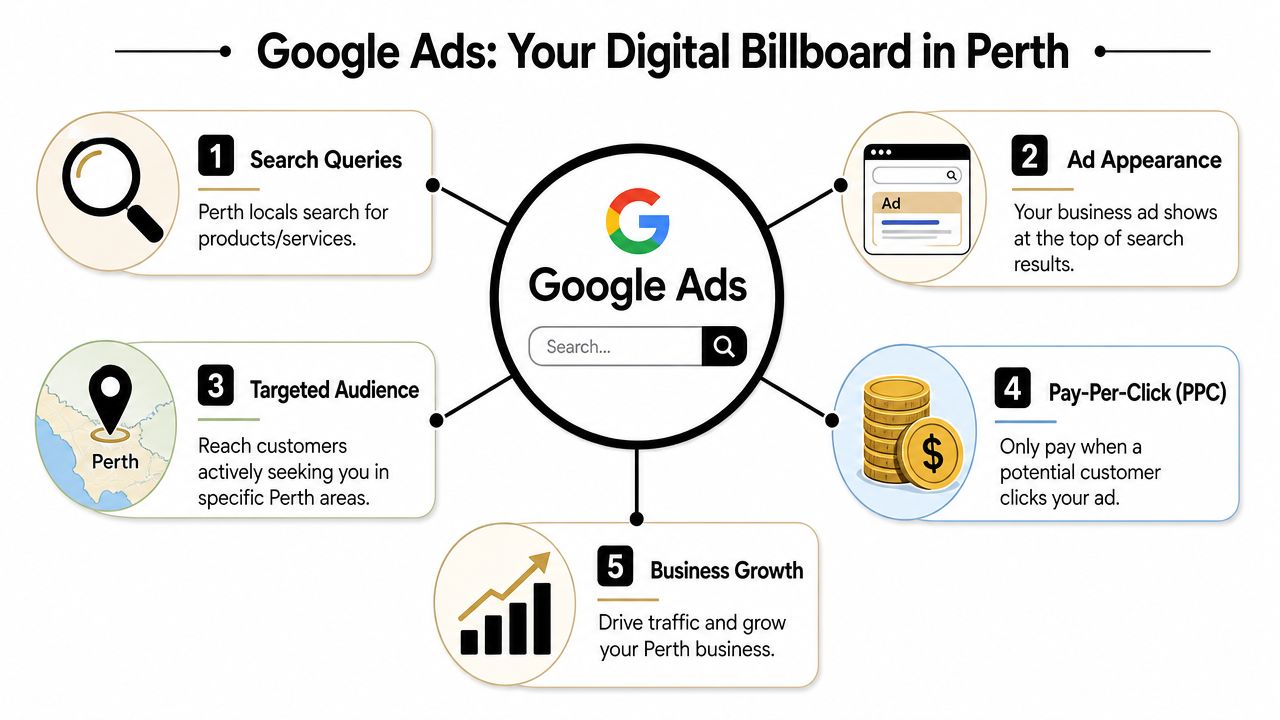
Google Ads is a pay-per-click advertising platform. You bid to appear when someone searches for terms related to your business, and you usually pay when that person clicks.
The easiest way to think about it is this. It's like renting a billboard on the Mitchell Freeway, except the billboard only appears to people actively searching for your product or service. That targeting is what makes it powerful.
Why Google matters so much in Australia
In Australia, Google holds 90% of the total search engine market share according to RankingCo's Google Ads overview. For a Perth business, that means the platform isn't optional if people search for what you offer. It's where most search demand lives.
If you're trying to decide whether to invest properly in search, stop overcomplicating it. Your customers are already on Google. The question is whether your business appears when they're ready to buy.
What happens when someone searches
A basic Google Ads process looks like this:
- A person in Perth searches for something relevant.
- Google checks which advertisers are bidding on related keywords.
- Ads compete in an auction.
- Google chooses which ads to show.
- The user clicks, visits your site, and either converts or leaves.
You don't win purely by bidding more. Relevance matters. If your keyword, ad copy, and landing page line up well, you can compete more effectively than a lazy advertiser with a bigger wallet.
What local businesses should care about
You don't need to obsess over every feature in the platform. Focus on the practical parts:
- Keywords: What people type when they need you.
- Ads: The message they see in results.
- Landing pages: Where the click goes.
- Targeting: Who sees the ad and where they are.
- Tracking: Whether that click turned into value.
If your Google account access is a mess, fix that before touching campaigns. A locked or poorly managed account can derail reporting, billing, and ownership. This guide to effective Google account recovery is useful if access has become a problem.
Good Google Ads management isn't about making the dashboard look sophisticated. It's about controlling who sees the ad, why they clicked, and what they do next.
Mastering Local Targeting to Reach WA Customers
The fastest way to waste money in Google Ads Perth is to trust the default location settings.
A lot of local businesses assume that if they target Perth, Google will only show ads to people physically in Perth. That assumption is wrong if your location options are set badly. This is one of the most expensive mistakes in small business accounts.
The location setting that burns budget
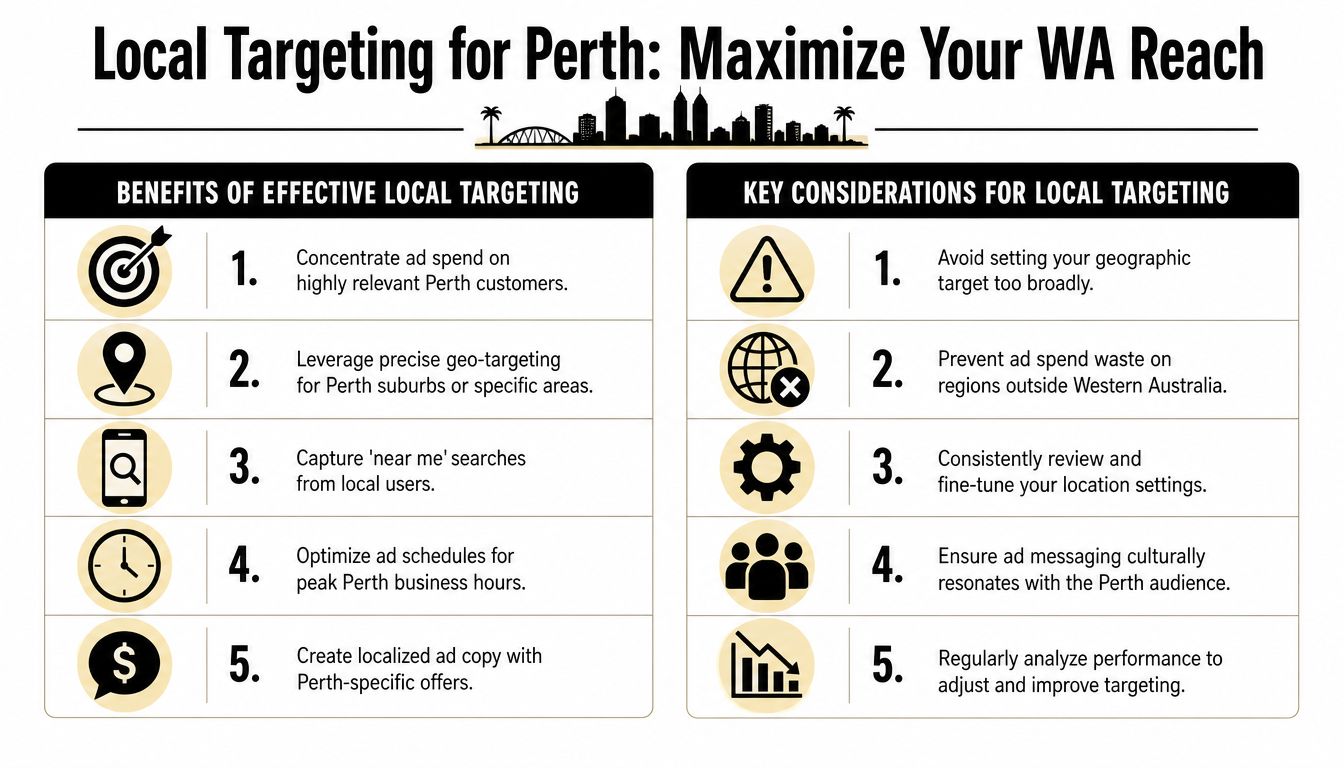
Google Ads often defaults to Presence or Interest. That means your ads may show not only to people physically in your target area, but also to people elsewhere who show interest in that area.
For a local business, that can be terrible. A Perth removalist doesn't need clicks from someone interstate researching a future move. A local clinic doesn't need traffic from people casually searching Perth suburbs from outside WA. According to Google Ads location setting guidance referenced here, the default setup can waste up to 40% of a local business's budget on irrelevant clicks outside the service area.
Switching to Presence only is one of the first changes I'd make in almost any local campaign.
If you serve a local area, don't pay for curiosity. Pay for proximity.
A short explainer can help if you want to see how location targeting works in practice.
Smarter ways to target Perth
Once the location setting is fixed, tighten the campaign further. The right setup depends on how your business operates.
Storefront businesses
If customers come to you, use targeting around your physical location and write ads that reflect convenience.
- Radius targeting: Useful around a shop, clinic, gym, or café.
- Suburb mentions: Include places people recognise nearby.
- Opening-hour alignment: Run more aggressively when staff can answer calls or serve walk-ins.
Service area businesses
If you travel to customers, build campaigns around the places you currently service, not the places you wish you serviced.
- Postcode or suburb targeting: Better than broad metro targeting when your team covers selected areas.
- Separate campaign clusters: Useful if north-of-river and south-of-river jobs behave differently.
- Location-specific copy: “Electrician in Joondalup” will usually beat generic ad text for local relevance.
Higher-value areas
Some suburbs are better for certain services. If one area consistently brings stronger leads, treat it differently. Build separate campaigns, custom ads, and dedicated landing pages. That gives you control instead of averaging everything together.
The local targeting test
Check these three settings today:
- Location option: Use Presence only for local lead generation.
- Excluded areas: Remove regions you won't service.
- Ad copy: Match the language to the geography.
Most wasted spend in local accounts isn't mysterious. It comes from lazy setup.
Choosing the Right Google Ads Campaign for Your Goals
Not every campaign type deserves your money. A lot of Perth businesses spread budget across too many options too early, then wonder why nothing works properly.
Pick the campaign type that matches the job. If the goal is leads from high-intent searches, start with Search. If the goal is foot traffic, local intent and map visibility matter more. If the goal is staying in front of past visitors, remarketing earns its place.
Search campaigns for immediate intent
Search campaigns are the workhorse for service businesses and high-intent purchases. Someone types what they need, and your ad appears if your setup is good enough.
A Fremantle emergency plumber is the obvious example. When a pipe bursts, nobody wants a brand awareness campaign. They want a phone number, a fast response, and a business that looks trustworthy. Search campaigns are built for that moment.
Search is usually the first place I'd put budget for:
- Trades
- Legal services
- Dentists
- Accountants
- Repair businesses
- Commercial service providers
If people know what they need and are actively searching, start here.
Local campaigns for foot traffic and nearby intent
A Subiaco café, boutique, or clinic has a different objective. It wants nearby people to find the business easily and act quickly. That means location cues, mobile visibility, and convenience matter.
Local-focused campaign activity works best when your business depends on proximity. If someone is choosing between two nearby venues, the winner is often the one that appears clearly, looks relevant, and makes the next step simple.
Display campaigns for visibility, not urgency
Display campaigns put banner-style ads across websites and apps. They're useful, but many small businesses use them too early.
A Joondalup real estate agency might use display to stay visible across a local audience, keep listings top of mind, or support a longer decision cycle. That makes sense when the business already understands its audience and has a clear creative strategy.
For most lead generation businesses, though, Display should not be the starting point. It catches attention, but it doesn't always capture immediate buying intent.
Search captures demand. Display supports awareness. Don't confuse the two.
Remarketing for people who didn't convert the first time
Most visitors won't act on the first visit. That doesn't mean they were bad prospects. It often means they got distracted, compared options, or needed more time.
Remarketing lets you re-engage those people. An online store selling Perth-themed products, event merchandise, or gift items can use remarketing to bring back visitors who viewed products but left without buying. A service business can use it to stay visible after someone checked a quote page but didn't submit a form.
A simple way to choose
Use this decision guide:
| Business situation | Best first campaign type | Why |
|---|---|---|
| People search urgently for your service | Search | Captures strong intent |
| You depend on nearby walk-ins or local discovery | Local-focused search activity | Reaches nearby customers ready to act |
| You need repeated visibility over a longer consideration period | Display | Supports awareness |
| People visit but don't convert first time | Remarketing | Re-engages warm prospects |
Most Perth SMBs don't need every campaign type at launch. They need the right one, managed properly.
Setting Perth Budgets and Avoiding Costly Keyword Mistakes
Budget questions matter, but most owners ask the wrong one.
They ask, “How much should I spend?” The better question is, “How tightly can I control wasted spend while collecting enough data to judge lead quality?” Spend without control is just faster disappointment.
Start with a budget tied to one outcome
Your starting budget should match a single clear objective. Leads. Calls. Quote requests. Bookings. Product sales. Pick one and build around it.
Use this as a planning framework, not a promise:
| Perth Industry | Typical Starting Budget (Monthly) | Primary Goal |
|---|---|---|
| Trades and home services | Depends on service area, urgency, and competition | Phone calls and quote requests |
| Professional services | Depends on lead value and search demand | Enquiries and consultations |
| Retail and ecommerce | Depends on product margin and search intent | Sales and revenue |
| Health and allied services | Depends on appointment value and local competition | Bookings and calls |
| Hospitality and local venues | Depends on location and offer strength | Visits, bookings, and direct actions |
If you need a practical pricing breakdown before setting expectations, review this guide on how much Google PPC can cost.
Broad match is where many Perth accounts go wrong
Broad match keywords can be useful in experienced hands. In weak accounts, they become a leak.
A Perth builder bidding on a broad term like “building services” can trigger searches that have little commercial value. That includes job seekers, students, DIY researchers, or people looking for something adjacent but irrelevant. If there's no proper negative keyword strategy in place, the campaign pays for traffic that was never going to convert.
According to Cloud Cartel's Google Ads analysis, Australian SMBs using broad match keywords without an effective negative keyword strategy see a 25% higher customer acquisition cost. That's not a small setup issue. It's a structural problem.
Broad match without negatives is not a growth tactic. It's a shortcut to bad traffic.
What to do instead
Use tighter match types first, then expand only when you've earned the right.
Start with phrase and exact match
These give you more control over search intent. You can keep your targeting closer to what a buyer would realistically type, especially in local lead generation campaigns.
Build a negative keyword list early
Negative keywords tell Google what not to match. That's where a lot of efficiency comes from.
Examples of negatives often include:
- Jobs and careers: Filters out employment searches.
- Free and DIY terms: Removes low-intent research traffic.
- Training or course terms: Stops education-related searches.
- Irrelevant product modifiers: Excludes searches for things you don't sell.
Read the search terms report properly
You uncover the truth. Not the theory. Look at the actual searches that triggered your ads, then cut what doesn't belong.
Budget discipline beats platform optimism
You don't need a fancy strategy to improve most accounts. You need tighter keyword control, stronger negatives, and less tolerance for irrelevant traffic.
That's especially true in Google Ads Perth campaigns, where local intent is valuable and junk clicks are expensive.
Your High-Level Google Ads Perth Success Checklist
Most campaigns don't fail because Google Ads is too hard. They fail because the basics were rushed.
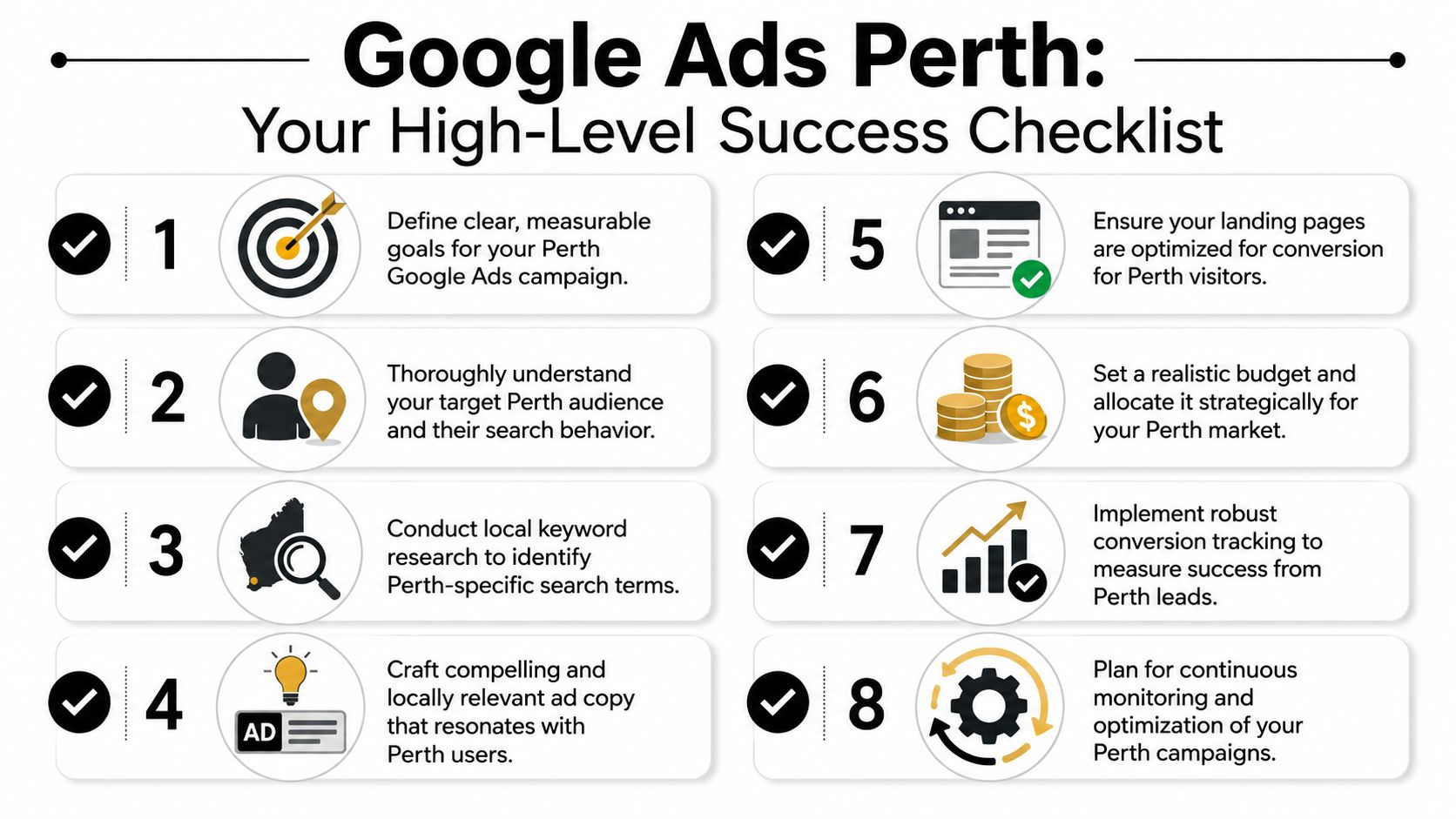
If you want a campaign that can produce useful leads, work through the checklist below with discipline. It's simple, but not optional.
The checklist that matters
Set one clear goal
Don't ask one campaign to generate calls, ecommerce sales, newsletter sign-ups, and brand awareness at the same time. Pick the primary action you want.Define your actual service area
Tight geography improves lead quality. Be honest about where you can deliver well.Use local keyword research
Look for the terms people use when they want your service in Perth, not the broad language your industry uses internally.Write ads that sound local
Mention relevant suburbs or service areas where appropriate. Local cues help with trust and relevance.Send traffic to the right page
Don't dump every click on the homepage. A person searching for a specific service should land on a page about that service.Make the call to action obvious
If you want calls, show the number clearly. If you want quote requests, keep the form straightforward.Track conversions from day one
If you can't see which keywords and ads produce value, you're guessing.Optimise every week
Cut weak search terms, improve ad copy, review landing pages, and adjust based on real behaviour.
What strong setup looks like
A solid Google Ads Perth account is usually boring in the best way. It's organised, tightly targeted, and easy to understand. The campaign names make sense. The ad groups are relevant. The landing pages match the search. Conversion tracking is in place.
That kind of account is easier to improve because it isn't fighting its own structure.
Clean account structure beats clever tricks. Every time.
Questions to ask before launch
Use these as a final pre-launch filter:
- Does each keyword reflect clear buyer intent?
- Does each ad match that intent?
- Does the landing page continue the same message?
- Can a customer act quickly without friction?
- Will the campaign attract local prospects instead of random clicks?
If any of those answers are shaky, fix them before you spend more.
Why Partner with a Results-Focused Ads Agency
DIY Google Ads is possible. Plenty of business owners try it. The problem isn't access to the platform. The problem is avoiding expensive mistakes while juggling everything else in the business.
The two traps covered above prove the point. Bad location settings can waste budget on the wrong geography. Broad match without proper negatives can drive up acquisition costs. Neither mistake looks dramatic in the dashboard at first. Both subtly diminish performance.
That's why experience matters. Not agency theatre. Not jargon. Actual skill. In Australia, only 3% of digital agencies achieve Google Premier Partner status, according to Bonfire's Google Ads service page. That tells you something important. Real Google Ads expertise is not common.
A strong agency should be able to explain, plainly:
- what traffic it's trying to buy
- what traffic it's trying to block
- how leads are tracked
- which campaign type suits your business
- how it will improve the account over time
If an agency can't explain those things clearly, don't hand over your budget. If you want experienced support beyond Perth and need a broader national paid media partner, look at PPC management in Australia.
If you want help turning Google Ads into a reliable lead channel instead of a budget leak, speak with Website Builder Australia. Their team helps Australian businesses build better websites, tighter landing pages, and performance-focused PPC campaigns that are aligned with real business goals.


