

Find Cheap Domain Names Australia: 2026 Guide for .Com.au
You've probably seen the ad already. A registrar splashes a .com.au price across the page that looks cheaper than a takeaway lunch, and for a minute it feels like the domain part of launching a business will be easy.
Then the second-guessing starts. Is that price real? Is it only for the first year? Do you need an ABN? What happens when it renews? And why does one provider look cheap while another charges far more for what seems like the same thing?
That confusion is normal. Domain pricing in Australia is full of half-truths, promo hooks, and bundled extras that make a “cheap” deal expensive once you've lived with it for a while. The smart way to buy isn't chasing the lowest sticker price. It's understanding what you're paying for, what rules apply in Australia, and what the domain will cost to keep, renew, and manage without hassles.
Your Guide to Australian Domain Names
If you're buying your first business domain, start with the basics. A domain is your web address, but in practice it's also part of your branding, your email identity, and your long-term admin stack. If you need a quick refresher on the terminology, this plain-English explainer on what a domain name is is worth reading before you compare offers.
A lot of small business owners also buy a domain early, then realise later they need to rename the site, move from one brand to another, or tidy up a rushed launch. If that happens, a practical guide to changing WordPress domains can save you from making a mess of redirects, links, and logins.
Cheap domains can be a good buy. Cheap domain decisions often aren't.
For Australian businesses, the useful question isn't “Where can I find the absolute cheapest domain?” It's “How do I get a solid Australian domain deal without being trapped by renewal pricing, eligibility rules, or bundled junk I don't need?”
That's the line to hold all the way through checkout.
The Real Cost of a Domain Name in Australia
A domain name in Australia has a base cost and then a retail cost layered on top. If you don't separate those two, it's easy to think one registrar has found some magical loophole when they haven't.
The most important benchmark is the wholesale rate. According to auDA, the wholesale price for major .au licences was AUD$9.50 per year from 1 October 2025, including .au direct, .com.au, .net.au, .org.au, .asn.au, and .id.au, and registrars set their own final customer pricing on top of that via auDA's wholesale pricing page.
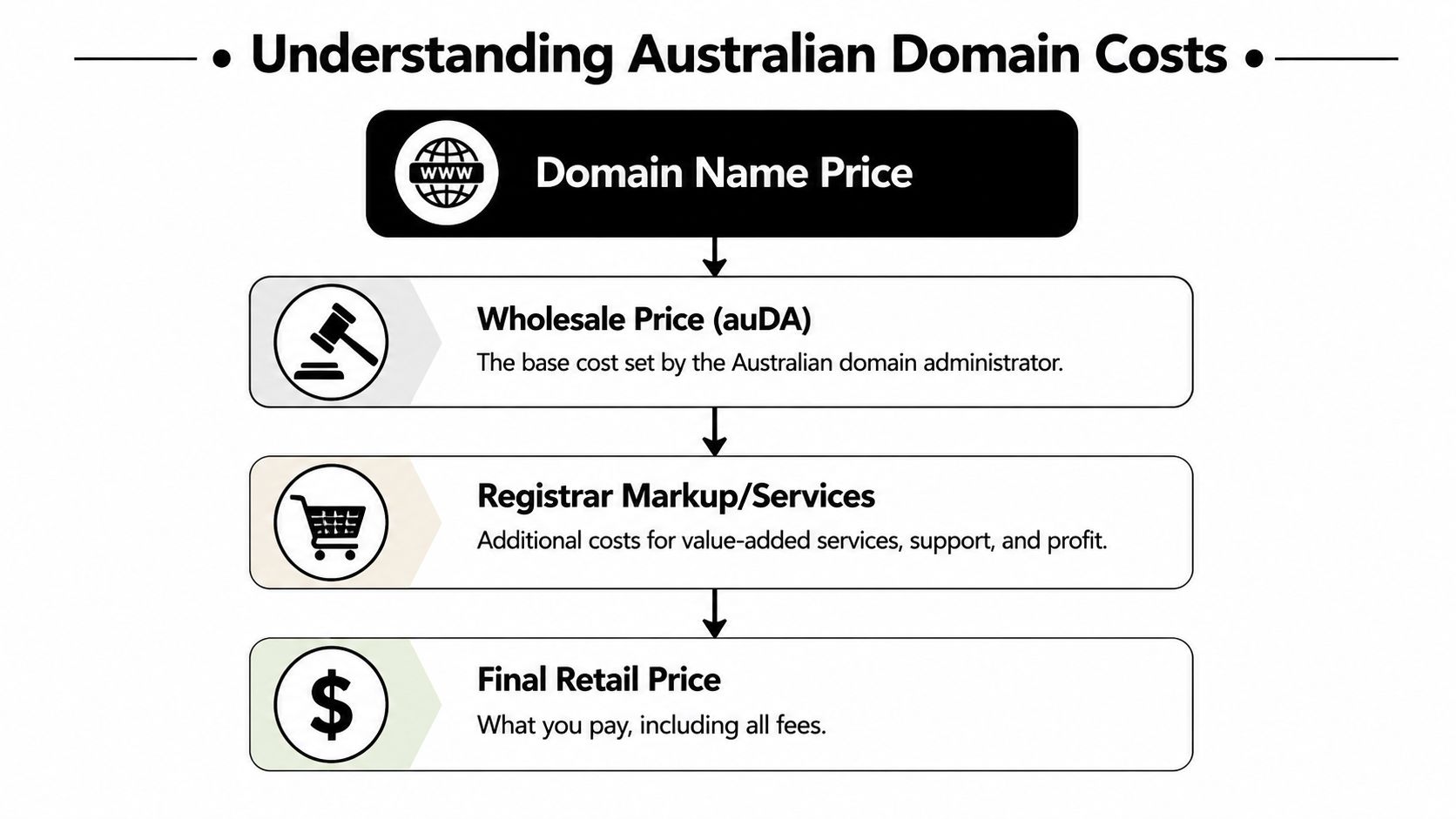
What the wholesale price actually tells you
That AUD$9.50 figure matters because it gives you a reality check. If a registrar advertises a domain below that level, they're usually doing one of three things:
- Running a first-year promotion where they make less money upfront and recover margin later
- Bundling the domain into a bigger sale such as hosting, email, or site tools
- Using the domain as a lead product to get you into a cart full of add-ons
None of that is automatically bad. Plenty of legitimate registrars do it. The problem starts when buyers assume the intro price reflects the long-term cost.
Total cost of ownership matters more than the headline price
For domains, total cost of ownership is the number that matters. That means looking beyond signup day and asking:
| What to check | Why it matters |
|---|---|
| First-year registration price | This is the marketing hook, not the whole story |
| Standard renewal price | This is what you'll likely pay to keep the name |
| Included features | Some providers charge separately for things others include |
| Bundled services | Hosting, email, and site builders can change the real cost |
| Transfer flexibility | A cheap first year loses its shine if moving away is painful |
A practical way to compare deals is to treat the flashy first-year discount as temporary noise. Look at the standard rate, what's included, and whether the provider keeps the admin side simple.
Practical rule: Judge an Australian domain deal against the wholesale benchmark first, then against the full lifecycle cost second.
That's also why comparing only ad banners is a poor way to shop. You need the details page, the cart page, and the renewal policy. The business cost of a domain isn't just what leaves your card today. It's what keeps leaving your card every year after that.
If you want a broader breakdown of the charges that sit around domain ownership, this overview of domain name charges in Australia helps put the line items in context.
Choosing Your Australian Domain Type
The cheapest domain isn't always the best domain. Sometimes the right move is paying a bit more for a name that fits your market, your trust signals, and your eligibility.
For most local businesses, the core decision is whether to use .com.au, .net.au, .au direct, or a broader extension like .com.

When .com.au makes sense
If you sell to Australians, a .com.au often feels like the most natural fit. It signals local presence. It looks familiar. For many buyers, it reads as a proper Australian business rather than a side project or a generic online brand.
There's also less ambiguity when someone hears your business name and types it into the browser. That matters more than people think. Friction at the memory stage costs enquiries.
The eligibility rule people miss
Here's the part many cheap domain roundups skip. To register a .com.au or .net.au, auDA rules require you to be a commercial entity with a valid ABN or ACN, which the Australian Government outlines in its guidance on registering an Australian domain name.
That means the cheapest advertised .com.au offer only helps if you're eligible to buy it.
If you're not set up as a commercial entity yet, don't build your whole launch plan around a .com.au cart price you can't use. Sort the business structure first, then buy the domain.
A simple way to choose
Use this rule of thumb:
- Choose .com.au if your business trades in Australia and you want a local, trusted business identity.
- Choose .net.au if it suits your business naming and you meet the same eligibility requirements.
- Choose .au direct if you want a shorter Australian domain and the shorter format fits your brand.
- Choose .com if your audience is broader, international, or your business model doesn't depend on looking specifically Australian.
A short explainer can help if you're still weighing the branding side against the practical side:
If your customers are mostly local and your business is properly registered, .com.au is usually the cleanest answer.
The wrong move is choosing an extension purely because it's on sale. Cheap domain names in Australia only make sense when the domain still fits the business using it.
Common Traps and Hidden Fees to Avoid
The biggest mistake I see is treating the domain cart like a simple purchase. It usually isn't. It's a sales funnel.
A registrar can advertise a low entry price, then recover margin through renewals, pre-ticked add-ons, premium support plans, or awkward transfer processes. That's why the “cheap domain” promise often falls apart somewhere between the product page and the payment screen.
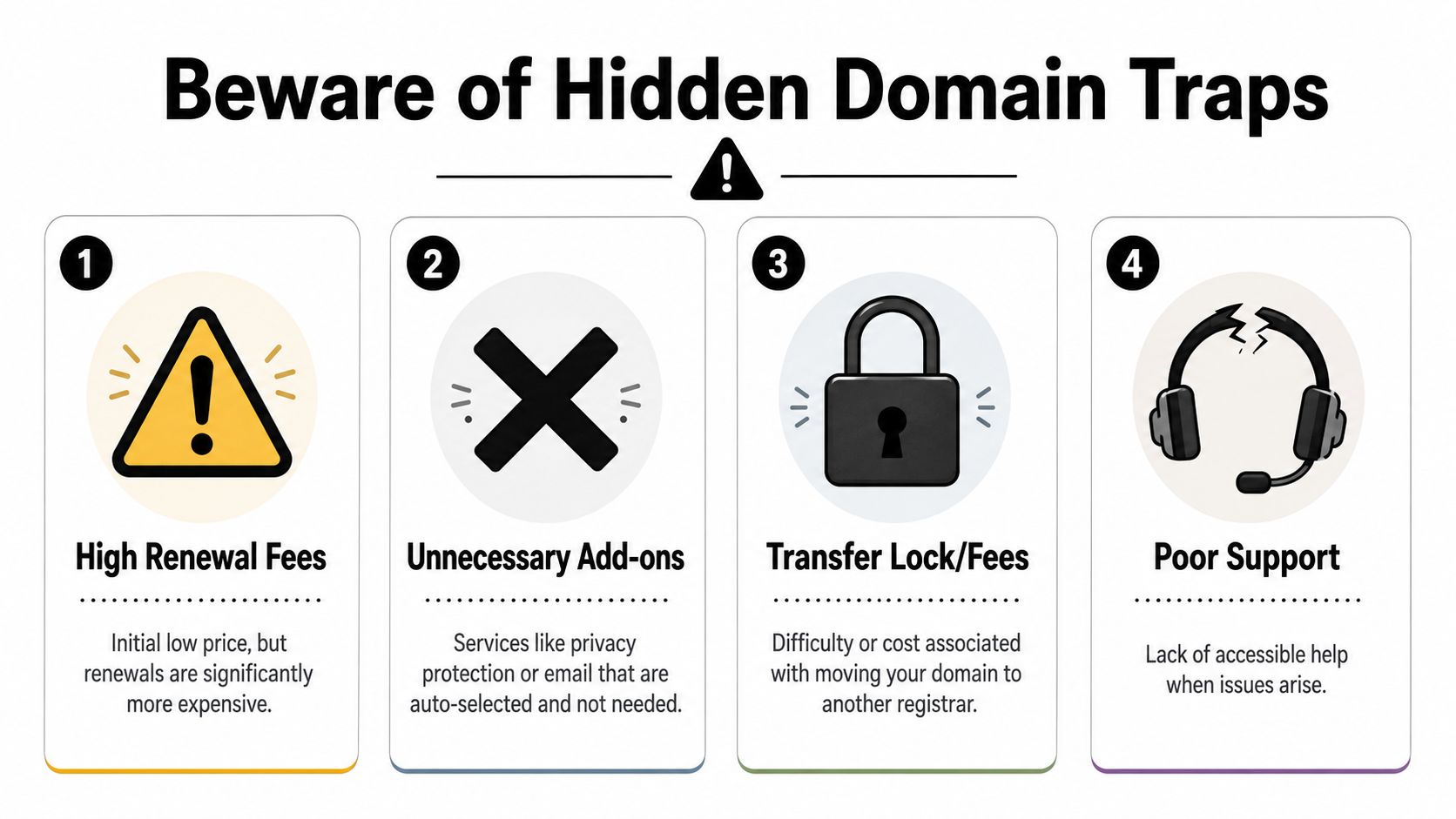
The promo price trap
A live comparison for .com.au has shown first-year prices ranging from $6.29 to $116.10 across 32 registrars on TLD List's .com.au comparison page. That range tells you something important. The extension itself isn't the whole cost story. Registrar policy is.
When one provider sits near the bottom of that spread, don't assume you've found the same product for less. You may have found:
- A loss-leader signup
- A higher renewal later
- A bundle that becomes expensive once trial terms end
- A checkout loaded with extras
The ad can still be honest while the full deal is poor value.
Add-ons that sound essential but often aren't
Watch the cart carefully. Many buyers are in a rush and click through without noticing what's already been selected.
Common examples include:
- Mailbox upsells that attach a monthly charge to your domain order
- Security add-ons sold in vague language that makes them sound mandatory
- Site builder subscriptions added before you've decided how you'll build the website
- Support upgrades that solve a problem you may never have
Some businesses need some of these. The issue isn't that they exist. The issue is when they're framed as if the domain won't work without them.
A domain and a full online business stack are not the same purchase.
The renewal shock problem
A cheap first year can still be reasonable if the renewal is fair and the provider is easy to deal with. But if the renewal is steep, the “saving” was mostly theatre.
Before you buy, check these points in plain terms:
- What's the standard renewal price? Don't stop at the promo banner.
- Is anything pre-selected in the cart? Remove what you don't want.
- Can you manage the domain easily? Clunky dashboards become a problem later.
- Can you transfer out without friction? You want options if service drops.
- Who handles support? When ownership details need updating, fast support matters.
Poor support is the hidden fee no one sees upfront. You pay for it in time, delays, and stress.
How to Register Your New Domain Name
Registering a domain is simple when you go in with a checklist and ignore the sales noise. The process is mostly admin. The trick is staying disciplined.
Start with the name and availability
Search your preferred business name with the extension you want. If your first choice is taken, don't panic and bolt on random hyphens or awkward spelling just to force it through.
A better fallback is to try:
- A clean location tie-in if your business is local
- A service qualifier if your core offer is specific
- A shorter brand variation if the original is clunky
Keep it easy to say, easy to spell, and easy to repeat over the phone.
Check the business fit before checkout
If you're registering .com.au or .net.au, make sure your business details line up cleanly with what the registrar asks for. That usually means entering the legal entity information properly and matching the details you use for the business.
Rushed buyers often create future headaches. If the registrant contact, billing contact, and business ownership details are messy from day one, fixing them later can be annoying.
Review the cart like you're looking for problems
Don't rush from search result to payment. Open every dropdown and read every line item.
Look for:
- The registration term and whether it suits your plan
- The renewal wording so you're not surprised later
- Any extra products added automatically
- Account settings related to auto-renew and notifications
Buy the domain you need. Decline the extras you haven't deliberately chosen.
Complete the purchase and save the proof
After payment, keep the confirmation email, invoice, and account login somewhere safe. Domains are low-cost assets, but they can become high-value business dependencies once your website, email, and listings rely on them.
A tidy record now saves scrambling later when someone asks, “Who owns the domain account?”
Tips for Finding Genuinely Good Value
Cheap domain names in Australia are easy to find. Good-value domains are harder. The difference is usually in restraint, not hunting skill.
The Australian domain market is mature, with over 3.6 million .au domains registered, and that scale has helped create strong registrar competition and frequent promo activity, as noted in this overview of cheap Australian domain names. That competition is good for buyers, but only if you compare with a cool head.
What usually works
- Compare registration and renewal together. A low signup number means little on its own.
- Use independent comparison tools as a shortlist, not a final answer. Then inspect each registrar's cart yourself.
- Consider bundles carefully. Sometimes hosting plus domain is sensible. Sometimes it's just harder to unwind later.
- Register a name you can live with. Rebranding because you chased a bargain is rarely a bargain.
What usually doesn't
Buying the cheapest domain available without checking the ongoing terms. Picking a hard-to-spell name because the clean version was taken. Paying for email, site tools, and add-ons before you know whether you need them.
If you're trying to tighten the branding side as well as the cost side, this guide on how to acquire cheap short domain names is useful for thinking through naming trade-offs without overcomplicating it.
A good buy is one you still like after the promo expires.
Pairing Your Domain with Hosting and a Website
A domain on its own doesn't do much. It's the address. Hosting is the space where the website lives.
That's why business owners often get stuck after buying the domain. They've secured the name but haven't connected it to anything useful yet. No website, no business email, no clear next step.
Why combining services can make life easier
If your domain, hosting, and website are handled in separate places, you can absolutely make that work. Plenty of businesses do. But it also creates more moving parts, more logins, and more opportunities for confusion when something breaks or needs updating.
For a small business, there's a lot to like about keeping things simpler:
- One support path when you need help
- Less admin friction across billing and renewals
- Fewer handoff problems between providers
- A cleaner launch process for site and email setup
If you want the plain-English version of how the two fit together, this explanation of domain hosting lays it out clearly.

The smart path is usually this. Buy a domain that suits the business, avoid bloated extras, then connect it to hosting and a website setup you can manage without technical drama. A cheap domain is only useful if it leads to a working, professional online presence.
If you want help securing a domain, pairing it with reliable hosting, and turning it into a polished business website, Website Builder Australia can handle the whole lot with local support and a practical, no-fuss approach.


