

WordPress Web Design Service: Your 2026 AU Business Guide
Your website might still be live, but that doesn't mean it's doing its job.
A lot of Brisbane business owners come to us at the same point. The site looks dated, updates feel risky, enquiries are inconsistent, and no one is quite sure whether the problem is design, speed, hosting, content, or all of it at once. The frustrating part is that the website keeps costing money, yet it's hard to say what it's returning.
That's where a professional WordPress web design service becomes useful. Not because WordPress is trendy, but because it gives Australian SMEs a practical, proven platform that can be designed properly, built properly, and maintained without turning every change into a redevelopment project.
Is Your Website Working For You or Against You
A website can subtly create drag on a business.
It happens when pages load awkwardly, contact forms fail without anyone noticing, staff avoid making updates because the back end is messy, or the design no longer reflects the quality of the service being sold. Most owners don't need a lecture on web technology. They need a site that helps customers trust the business quickly and take the next step.
That's why WordPress remains such a common choice for business websites. It isn't a niche system or a risky bet. WordPress powers over 43% of all websites globally, holds 43.3% of the CMS market, and has an ecosystem of 13,000+ free themes and 60,000+ plugins, according to these WordPress platform statistics. For an SME, that scale matters because it gives your project access to a mature pool of tools, layouts, integrations, and support options.
Why that matters to Australian SMEs
In practice, a good WordPress web design service doesn't just install a theme and swap in your logo.
It should solve business problems such as:
- Poor first impressions that make a capable company look smaller or less organised than it is
- Hard-to-manage content that leaves pricing, services, and team information outdated
- Plugin clutter that creates security and maintenance headaches
- Weak conversion paths where visitors can browse but don't enquire, call, or book
- Platform lock-in that makes future changes slow and expensive
Practical rule: If your team avoids touching the site because “something might break”, the website is already working against you.
WordPress is strong when it's governed well. It's weak when it's assembled cheaply, overloaded with plugins, and handed over without structure. That distinction matters far more than the platform logo in the footer.
What a WordPress Web Design Service Actually Includes
Many business owners hear “web design” and think it means mockups and colours. In reality, a proper WordPress web design service covers strategy, structure, build, launch, and ongoing care.
The easiest way to think about it is like a commercial fit-out. You're not only paying for the look of the front entry. You're paying for the planning, construction, systems, access, safety, and ongoing upkeep that make the building usable.
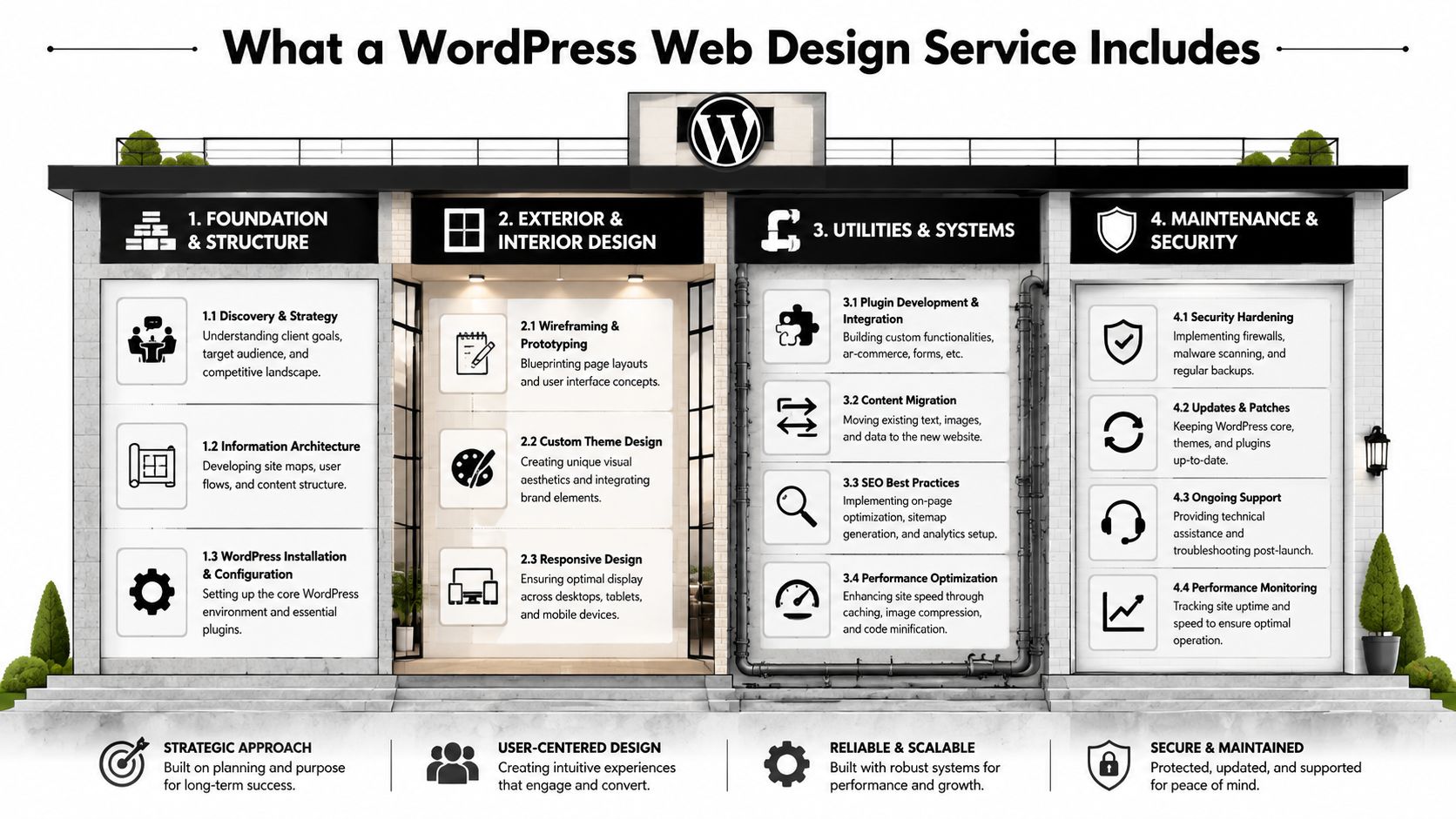
Australia is a market where that full-service approach makes sense. The Australian Communications and Media Authority reported that 96% of people aged 16+ used the internet daily in 2021–22, and the Australian Bureau of Statistics found that 89.2% of Australian households had internet access in 2022–23, as summarised in these Australian web design usage statistics. If your customers are online that consistently, the website isn't a side asset. It's part of core business operations.
Strategy before design
Good projects start with business questions, not colour palettes.
An agency should clarify who the site is for, what actions matter most, what content already exists, what needs rewriting, and what systems must connect. For some SMEs, that means lead generation. For others, it means booking requests, online payments, wholesale logins, or product catalogue management.
Typical work in this phase includes:
- Discovery workshops to understand services, audiences, objections, and goals
- Sitemap planning so the site structure makes sense to users and staff
- Content planning to identify what can be reused, rewritten, merged, or removed
- Functional scoping for forms, ecommerce, CRM connections, memberships, or quoting tools
A business that skips this phase often ends up paying for rework later.
Design and development are different jobs
Design is the blueprint. Development is the construction.
A clean homepage concept doesn't guarantee a clean WordPress build. A proper build should include responsive layouts, editable content areas, sensible plugin selection, form handling, analytics setup, and clear admin workflows. If the site looks polished but your staff can't update it without calling a developer, the job isn't finished.
For clients weighing platform options, this comparison of WordPress website builder considerations is useful because it helps frame when WordPress makes sense and when simplicity matters more than flexibility.
Hosting, maintenance, and support are part of the service
Many low-cost proposals become misleading.
A site needs reliable hosting, backups, software updates, plugin reviews, security hardening, monitoring, and someone to investigate issues when they appear. Those tasks don't stop after launch. They become more important after launch because that's when the site starts interacting with real traffic, enquiries, and business processes.
A website isn't finished when it goes live. That's when responsibility starts.
Common inclusions SMEs should expect
A practical WordPress web design service often includes a mix of these items:
| Service area | What it usually covers |
|---|---|
| Discovery | Goals, audience, competitor review, scope definition |
| UX and design | Wireframes, page layouts, responsive design, branding application |
| Development | Theme build, plugin setup, form integration, content population |
| SEO setup | Metadata structure, crawl basics, sitemap support, analytics foundations |
| Ecommerce | Product setup, payment gateways, shipping logic, transactional flows |
| Ongoing support | Updates, backups, security checks, troubleshooting, small edits |
The Typical Web Design Project Timeline
Most website problems don't come from poor intent. They come from poor process.
When a project feels vague, timelines slip, content arrives late, approvals drag out, and launch day becomes stressful for everyone involved. A structured timeline fixes a lot of that. It gives the client clarity, gives the agency accountability, and reduces expensive changes late in the build.
Discovery and planning
At this stage, the project gets defined properly.
The agency gathers business context, reviews the current site, confirms required functionality, and aligns on scope. A clear website design brief definition helps here because it turns broad ideas into something buildable. If a client says, “We just want a modern site,” that's not enough. The brief needs to translate that into page requirements, user journeys, design direction, content responsibilities, and technical needs.
Key outputs at this stage usually include:
- Project scope with agreed deliverables
- Page list and site structure
- Content plan showing who provides what
- Functional requirements for forms, ecommerce, integrations, and user roles
Design and build
Once the structure is approved, the visual direction and WordPress development can move forward.
Some agencies design every page in detail before development. Others approve key layouts first, then build a flexible design system inside WordPress. Either approach can work if approvals are disciplined and the client understands what's being signed off at each step.
This phase often includes theme development, plugin configuration, mobile adjustments, and content entry.
The smoothest projects usually have one decision-maker on the client side. Too many approvers create conflicting feedback and slow momentum.
Testing, launch, and handover
A professional launch shouldn't feel like a scramble.
Before launch, the site should be tested across common devices and browsers, forms should be checked, links reviewed, tracking confirmed, and admin access prepared properly. After launch, the client should know how to update common content and where support requests go if something breaks.
A sensible post-launch period includes bug fixes, refinement of minor issues, and support while the team starts using the new system in real conditions.
Understanding WordPress Web Design Pricing in Australia
This is the part most business owners ask first, and fair enough. You need a realistic budget.
The problem is that “How much does a website cost?” is usually asked as if the build fee is the whole answer. It isn't. For an SME, the better question is what the website costs to own, operate, and maintain over time. That includes hosting, plugin renewals, support, updates, and the occasional design or functionality revision.
Why prices vary so much
Published agency pricing shows a very wide spread. One provider quotes $4,700 for a small site and $25,000–$100,000 for larger sites depending on complexity, based on this WordPress design pricing reference. That range tells you something important. WordPress isn't one product. It's a framework that can support a simple brochure site or a large custom digital platform.
What changes the price most often:
- Scope size such as page count, templates, and content complexity
- Custom design level versus adaptation of an existing framework
- Ecommerce requirements including products, payment flows, shipping, and account logic
- Integrations with CRMs, booking systems, quoting tools, or internal platforms
- Governance after launch including support, hosting, maintenance, and issue response
Cheap quotes often look attractive because they isolate the build from everything that follows.
Total cost of ownership matters more than entry price
A low upfront fee can still be the expensive option if the site is unstable, overloaded with unnecessary plugins, or unsupported after handover.
In practical terms, Australian SMEs should look at costs across the whole ownership period, not just day one. A stronger proposal usually explains what's included after launch, who handles updates, how support requests are billed, what happens if a plugin causes a conflict, and whether hosting is part of the package. If you're comparing hosting options separately, this guide to WordPress hosting in Australia can help frame what to ask.
A website that's cheap to launch but expensive to keep stable isn't actually cheap.
A practical way to compare proposals
Use the build price as one line item, not the entire decision.
Ask each provider to break pricing into:
| Cost area | What to compare |
|---|---|
| Initial build | Strategy, design, development, content entry, launch |
| Hosting | Environment, support boundaries, backups, uptime responsibility |
| Maintenance | Core updates, plugin updates, security checks, troubleshooting |
| Licences | Premium plugins, theme subscriptions, third-party tools |
| Change requests | Hourly rate, inclusions, response times, approval process |
WordPress Website Pricing Tiers in Australia 2026 Estimates
| Tier | Typical Price Range (AUD) | Best For | Common Inclusions |
|---|---|---|---|
| Small business site | Around the lower published end of market pricing, with one published reference at $4,700 | Trades, consultants, local services, brochure-style sites | Core pages, responsive design, contact forms, standard WordPress setup |
| Mid-range custom site | Varies widely based on design, content, and integrations | Growing SMEs that need tailored structure and better workflows | Custom layouts, stronger content structure, integrations, more refined admin experience |
| Large or complex build | One published reference places larger sites at $25,000–$100,000 depending on complexity | Ecommerce, multi-service firms, custom functionality, advanced integrations | Custom development, complex functionality, deeper QA, staged rollout and support planning |
The exact figure matters less than whether the proposal is honest about what ownership will involve.
How to Choose the Right WordPress Agency in Brisbane
A Brisbane business owner often starts with the build quote, then gets caught later by the parts that were barely discussed. Hosting. Plugin renewals. Update failures. Small change requests that turn into monthly invoices. The right agency helps you judge the full ownership picture before you sign, not after the site goes live.
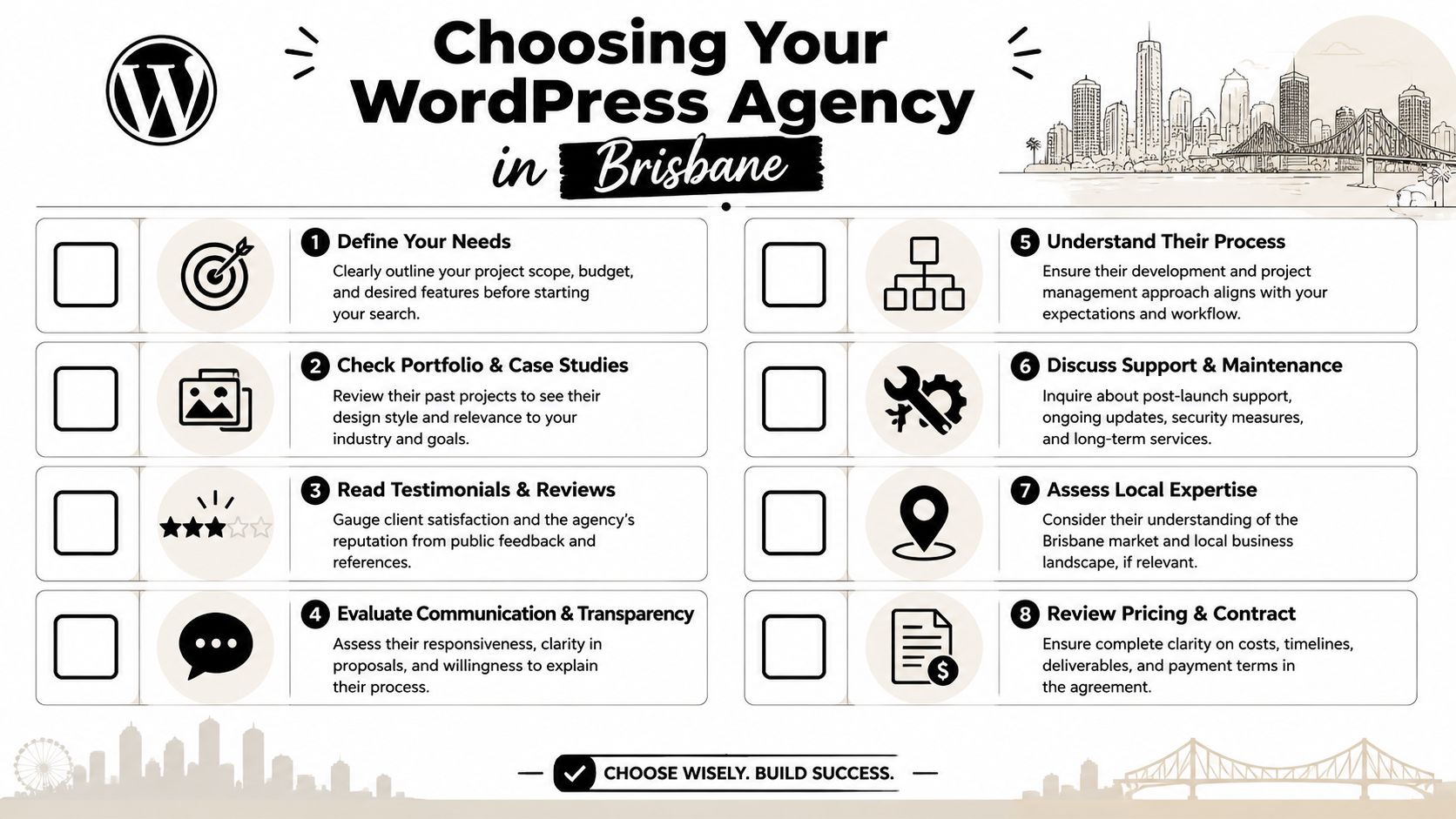
A polished proposal is only part of the decision. Any agency can promise custom design, SEO awareness, and support. The useful question is whether the team can explain what your business will need to keep the site stable, editable, and cost-effective over the next few years.
That usually shows up in the first meeting.
Questions worth asking in the first meeting
Good agency conversations get specific quickly. If the answers stay broad, the scope and future costs usually will too.
Ask questions like these:
- How do you handle performance? A capable team should be able to discuss Google's Core Web Vitals and explain how they approach Largest Contentful Paint, Interaction to Next Paint, and Cumulative Layout Shift, as outlined in this WordPress performance guidance. They should also be able to explain practical methods such as preloading key assets, reducing render-blocking files, and avoiding layout instability.
- What's your plugin selection process? Restraint matters. A site stacked with overlapping plugins often costs more to maintain.
- Who handles updates and post-launch support? If ownership is split across your staff, a freelancer, and a host, problems can sit unresolved while each party points elsewhere.
- How editable will the site be for our team? Ask which pages you can update safely, what requires developer help, and what training is included.
- What does handover include? Documentation, admin access, support limits, and response times should be clear before the build starts.
What good agencies usually do well
Strong agencies tend to share a few habits, even when their design style is completely different.
- They challenge poor assumptions instead of agreeing to every feature request
- They define scope clearly so you can see what is included, what is excluded, and what may become a variation
- They discuss ongoing care early including hosting, maintenance, licences, and who is responsible when something breaks
- They explain trade-offs plainly between custom work, flexibility, speed, and budget
- They keep the build manageable so your team is not left with a site that is expensive to update
One practical example in the local market is Website Builder Australia's WordPress development offering, which combines design, hosting, maintenance, and broader digital support. That kind of end-to-end model can suit SMEs that want fewer moving parts, but it still deserves the same checks as any other provider. Ask what is included each month, what falls outside support, and how costs change if your site grows.
Red flags that usually cost more later
Cheap websites do not always stay cheap.
Some warning signs are easy to miss when you are comparing quotes side by side, especially if one proposal looks shorter and simpler than the others.
| Red flag | Why it matters |
|---|---|
| Vague scope | Disputes and variation fees often follow |
| No maintenance plan | The site can be launched, then left without clear update responsibility |
| Heavy plugin use without explanation | Updates become riskier and troubleshooting becomes slower |
| No discussion of performance | Speed and usability issues often appear after launch |
| Overpromising on timeline | Corners usually get cut in QA, content setup, or testing |
A good agency does not just sell the build. It shows you what the website will cost to run, support, and improve over time.
If an agency cannot explain how it prevents common WordPress problems, there is a fair chance you will be paying later to sort them out.
Real Results for Australian Businesses
Good web projects rarely succeed because of design alone. They succeed because the site matches the business model, the content is structured properly, and someone remains responsible after launch.
A Brisbane trade business might need cleaner service pages, simpler enquiry paths, and easier staff updates. A retailer may need product structure, payment handling, and stable post-launch support. A professional services firm often needs stronger trust signals, clearer messaging, and a less cluttered admin experience so the team can keep content current.
What successful projects usually have in common
Across Australian SME work, the strongest outcomes tend to come from the same patterns:
- Clear scope at the start so the build matches business priorities
- Lean functionality choices instead of a pile of overlapping plugins
- Mobile-first thinking because customers browse and enquire in short sessions
- Ongoing ownership where updates, support, and hosting are planned, not improvised
One of the most reliable signs of a healthy project isn't what happens on launch day. It's what happens three months later. Can the team update content confidently? Are leads routing properly? Does the site still feel stable after software updates? That's where a well-managed WordPress web design service proves its value.
The result most owners want isn't a prettier website. It's fewer headaches and a site that supports sales, service, and day-to-day operations.
Your Next Step to a Better Website
A common Brisbane SME scenario goes like this. The quote looks reasonable, the design preview looks polished, and six months later actual costs start showing up through hosting upgrades, plugin renewals, support requests, and small fixes no one budgeted for.
That is why the next decision should be based on total cost of ownership, not the build price on its own. A WordPress web design service should be judged on how the site will be hosted, maintained, secured, supported, and improved once it is live. For many Australian businesses, that determines whether the website stays useful or turns into another monthly drain on time and budget.
Ask sharper questions before approving anything. What support is included after launch? Who handles plugin and core updates? How are software choices made in the first place? What happens if an update breaks a form, a checkout, or a page layout? How easily can your staff update content without needing to lodge a support ticket for every change?
Those answers affect cost more than the cheapest upfront quote ever will.
If your business is planning for long-term visibility as well as usability, it also helps to understand how search behaviour is changing, including optimizing for AI answer engines. That has practical implications for site structure, content clarity, and how service information is presented.
A better website starts with a clearer scope, a realistic support plan, and a frank discussion about what ownership will cost over time.
If you are comparing options for a new build, redesign, or ongoing support, Website Builder Australia offers Brisbane-based WordPress design, development, hosting, and maintenance for Australian businesses. A no-obligation conversation can help map out scope, likely ownership costs, and the level of support your site will need.


