

A Guide to Ecommerce Web Development in Australia
So, what exactly is ecommerce web development?
Think of it this way: if you were opening a physical shop, you’d need more than just a nice sign out front. You’d need solid foundations, a logical floor plan, reliable electricity, and a secure back room for your stock and cash.
Ecommerce web development is the digital equivalent of building that entire store from the ground up. It’s the art and science of creating a functional, secure, and user-friendly online shop that’s ready to welcome customers anytime, day or night.
It’s about building the powerful engine that runs your business online. This isn't just about a pretty design; it’s the technical backbone that allows you to sell to customers from Sydney to Perth, process their orders seamlessly, and build a brand that people trust.

Why It’s a Game-Changer for Aussie Businesses
For any Australian small or medium-sized business (SMB), having a professionally built online store isn't a "nice-to-have" anymore. It's an absolute must for staying competitive and tapping into a massive, growing market. The opportunity is simply too big to miss.
The numbers don't lie. Australia’s ecommerce market is projected to hit an incredible USD 604.1 billion in 2025 and skyrocket to USD 1,683.9 billion by 2034. That’s a compound annual growth rate of 12.07% from 2026 to 2034, with a huge push coming from mobile shopping.
That kind of growth also means more competition. A basic, clunky website just won’t cut it. This is where strategic ecommerce development gives you a real edge.
Think of your website as your best salesperson. It works 24/7, never calls in sick, showcases your products perfectly, answers customer queries, and handles every transaction flawlessly. Investing in its development is a direct investment in your business's ability to thrive.
What Goes Into Building an Online Store?
At its heart, quality ecommerce development is a blend of a few key disciplines that need to work together perfectly from day one.
- Front-End Development: This is everything your customers see and click on—the layout, the product photos, the 'Add to Cart' button, and the checkout process. It's the shopfront, and its job is to make shopping easy and enjoyable.
- Back-End Development: This is the 'staff-only' area of your digital store. It’s the server, the database, and all the behind-the-scenes logic that manages your inventory, processes payments, and keeps customer data safe and sound.
- Platform & Technology: This is the foundation your store is built on. It could be a user-friendly platform like Shopify or a more customisable, self-hosted option like WooCommerce.
- Integrations: This is all about connecting your store to the essential tools that make it run, like payment gateways (Stripe, Afterpay), shipping carriers (Australia Post), and your marketing software.
But truly successful development goes one step further. It's not just about getting a site online; it's about making sure customers can actually find you. That’s why we integrate search engine optimisation from the very start, a practice known as web development SEO. After all, what’s the point of a beautiful store if it's hidden down a dark alley?
Choosing the Right Ecommerce Platform
Picking the right ecommerce platform is hands down one of the most crucial decisions you’ll make on your ecommerce journey. Think of it like deciding on the real estate for a physical shop. Are you going to lease a pre-built space in a bustling shopping centre, buy a plot of land and build from scratch, or find something in between?
Each path comes with its own set of pros and cons. The best choice for you will hinge entirely on your budget, how technically savvy you are, and what your long-term goals are. Let's break down the main players for Australian businesses.
Comparing Top Ecommerce Platforms for Australian Businesses
Making this choice can feel overwhelming, so we've put together a quick comparison table. It's designed to help you see, at a glance, which platform might be the best starting point for your business based on what matters most to you right now.
| Platform | Best For | Ownership & Control | Ease of Use | Scalability |
|---|---|---|---|---|
| Shopify | Startups & SMBs wanting a fast, easy launch. | Low. You're renting the platform; Shopify owns the core software. | Very High. It’s built for non-technical users. | Good. Scales well to a point, but can become costly with apps. |
| WooCommerce | Businesses that want full customisation and control, often on WordPress. | Complete. You own your site and all its data. | Medium. Requires more technical skill than Shopify. | Excellent. Highly scalable with the right hosting and development. |
| Custom Solution | Established or high-growth businesses needing unique features and peak performance. | Absolute. You own the entire codebase and digital asset. | Low. Requires a dedicated development team. | Infinite. Built to your exact specifications to handle future growth. |
As you can see, there’s no single "best" answer. It’s all about finding the right fit for your unique situation. The path you choose will define your capabilities and limitations down the road.
Shopify: The All-in-One Solution
Using Shopify is a lot like leasing that prime retail space. It’s what’s known as a Software-as-a-Service (SaaS) platform, meaning you pay a monthly fee for everything you need in one bundle: the software, hosting, security, and support.
This makes it an incredibly popular choice for businesses that want to get up and running fast without getting bogged down in technical details. Shopify handles all the tricky backend stuff, leaving you free to focus on what you do best—selling your products.
Of course, that convenience has its trade-offs. You never truly own the platform, and your ability to customise can feel a bit fenced-in, often forcing you to rely on expensive apps to get the functionality you need.
Shopify is ideal for: Startups and small businesses who prioritise speed and simplicity over having deep, granular control. It’s the perfect launchpad for merchants who want a reliable, secure store without the headache of managing the technical side.
WooCommerce: The Flexible and Open-Source Powerhouse
If Shopify is leasing, then WooCommerce is like buying your own plot of land to build on. It’s a powerful, open-source plugin that turns a standard WordPress website—the platform that powers a massive chunk of the internet—into a fully-featured ecommerce store.
This approach gives you complete ownership and control. You can tweak, change, and customise literally every corner of your store, from the look and feel to the specific functions, without being tied to one company's rules. You also get to pick your own hosting, giving you control over performance and ongoing costs.
The flip side? That freedom comes with more responsibility. You (or your developer) are now in charge of everything: security, maintenance, updates, and hosting. It’s a more hands-on path, but one that offers incredible flexibility. For a more detailed breakdown of these platforms, check out our guide to the best ecommerce platforms in Australia.
Custom Solutions: The Path to Market Leadership
While off-the-shelf platforms get a lot of airtime, the data for the Australian market tells a fascinating story, especially for ambitious brands looking to scale.
In Australia, Shopify powers 41.65% of online stores, with WooCommerce at 27.45%. But when you look at who's actually making the most money, custom-built solutions are the clear leader, pulling in a massive $243.98 billion in sales. That's 50.11% of the platform market share by revenue. (You can dig into these numbers yourself in the full report on Aftership.com).
This tells us something important: while many businesses start on easy-to-use builders, the serious players eventually invest in custom ecommerce development. A bespoke solution is built from the ground up, perfectly aligned with your business model, customer journey, and brand.
This path delivers:
- Unmatched Performance: The code is written specifically for your needs—no bloat. This means lightning-fast load times and a superior user experience.
- Infinite Scalability: The site’s architecture is designed from day one to grow with you, easily handling huge product catalogues and massive traffic spikes.
- A True Competitive Edge: You can create unique features and slick workflows that your competitors, stuck on standard platforms, simply can't copy.
A custom build isn't just a website; it's a high-performance digital asset. It’s a significant investment, but it gives you the foundation to not just compete, but to truly lead your market.
Must Have Features for a High Converting Store
A great online store does so much more than just list products for sale. It needs to guide your customers from casual browsing to a confident purchase, every single time. Thinking about these features isn't just about adding fancy bells and whistles; it's about systematically removing any friction that might cause a customer to hesitate or leave.
Picture a well-run physical shop. The lighting is perfect, the aisles are clear, finding what you need is a breeze, and the checkout is quick and painless. That's the exact same effortless experience your digital store needs to provide to turn browsers into buyers.
Let's break down the absolute non-negotiables for a high-converting Aussie ecommerce site.
A Flawless Mobile First Experience
Let's be honest, in Australia, the smartphone is the new shopping centre. Your customers are scrolling through products on their commute, browsing from the couch, and hitting 'buy now' while waiting for a coffee. If your store is slow, clunky, or just plain awkward on a mobile phone, you're practically slamming the door on most of your potential customers.
A mobile-first design is more than just shrinking your desktop site. It’s about building the experience from the ground up specifically for that smaller screen, with big, easy-to-tap buttons, simple navigation, and lightning-fast speed.
A slow-loading mobile page is the digital equivalent of a locked door. Research shows that a staggering 53% of mobile users will ditch a site if it takes longer than three seconds to load. This one factor can literally make or break your store's success.
Intelligent Site Search and Filtering
Ever walked into a massive Bunnings and had no idea where to find what you need, with no staff in sight? That's what a bad search function feels like. A powerful search bar, on the other hand, acts like your most knowledgeable and helpful sales assistant.
It absolutely must have:
- Autocomplete Suggestions: As soon as someone starts typing, it should be suggesting products and saving them time.
- Typo Tolerance: It needs to understand common misspellings (we all make them!) and still show the right results.
- Advanced Filtering: Let people narrow down their search by price, size, colour, brand, or whatever else is relevant. This is crucial if you have a big product catalogue.
A good search function gets the right products in front of motivated buyers instantly. Simple as that.
High-Quality Product Visuals and Descriptions
Your customers can't touch, feel, or try on your products. This means your product pages have to do all the heavy lifting to bridge that sensory gap. This is where your investment in quality ecommerce development really pays off.
Your product pages need to include:
- Multiple High-Resolution Images: Show off your product from every single angle.
- Zoom Functionality: Let shoppers get up close and personal with the details and texture.
- Product Videos: Nothing sells a product quite like seeing it in action. A short video can work wonders.
- Detailed and Persuasive Descriptions: Don't just list specs. Tell a story. Explain how your product solves a problem or makes your customer's life better.
For a deeper dive into creating an experience that truly wows your customers, check out our insights on ecommerce website design in Australia.
A Frictionless Checkout Process
Nothing kills a potential sale faster than a frustrating checkout. Cart abandonment is the bane of every online retailer, and it's usually caused by unexpected costs, being forced to create an account, or a process that just has too many steps.
Your checkout needs to be as smooth and transparent as possible. Always offer a guest checkout option, be upfront about all costs (including shipping and GST), and support the payment methods Aussies love, like Afterpay and PayPal. Every single field you force a customer to fill out is one more reason for them to give up and go elsewhere.
Unpacking the Ecommerce Development Process
So, you’ve got a brilliant idea for an online store. How do you get it from a concept buzzing in your head to a real, money-making website? The ecommerce development process isn’t some mysterious black box where you toss in an idea and hope for the best. It’s actually a well-defined, collaborative journey with clear stages.
Think of it as building your digital storefront. Each phase lays the groundwork for the next, making sure the final product is a perfect fit for your business goals. Getting your head around this process helps you set realistic timelines and budgets, and it makes you a much better partner in the creation of your own site.
Phase 1: Discovery and Strategy
This is, without a doubt, the most important part of the whole project. It's the foundation everything else is built on. Before we even think about design or code, we need to get to the heart of your business. This isn't just a casual chat; it's a deep dive to figure out what success looks like for you.
We'll sit down together and iron out the big questions:
- Who are you actually selling to? Let's get specific about your ideal customer.
- What are your concrete business goals (e.g., boost sales by 20%, make order management less of a headache)?
- What’s your secret sauce? What makes your brand and products stand out?
- Who’s your competition, and what are they doing right (and wrong)?
Leaving this stage, we’ll have a rock-solid project brief and a strategic plan that acts as our North Star for every decision. Skipping this step is like setting off on a road trip across the Nullarbor without a map—you might end up somewhere interesting, but it probably won't be Perth.
Phase 2: Design and User Experience (UX)
With a solid strategy locked in, we can start shaping how your store will look, feel, and function for your customers. This is about so much more than just picking pretty colours; it’s about designing a smooth, intuitive path that gently guides visitors toward the checkout.
Our team starts by creating wireframes, which are like the basic architectural blueprints of your site. From there, we build full-colour mockups so you can see exactly what your store will look like. The main focus here is on the user experience (UX)—making sure the site is dead simple to navigate, products are easy to find, and the checkout is completely frictionless.
A common mistake is thinking of design as just the visual icing on the cake. In reality, great design is about solving problems. It’s about organising everything so logically that the path to making a purchase feels completely natural for the customer.
Phase 3: Development and Adding Your Products
Once you give the design a thumbs-up, our developers roll up their sleeves and start building. This is the construction phase. We write the code that brings the visuals to life (the front-end) and build the powerful engine that runs everything behind the scenes (the back-end). Whether we’re using Shopify, WooCommerce, or a fully custom platform, this is where the design becomes a functional website.
While we're busy building the structure, you'll be getting your content ready. This means gathering all your product photos, writing descriptions that sell, and crafting the other key pages for your site, like a compelling 'About Us' story. As soon as the site’s framework is ready, we "stock the shelves" and load in all of your products and content.
This timeline gives you a great visual of how these stages flow one after the other.
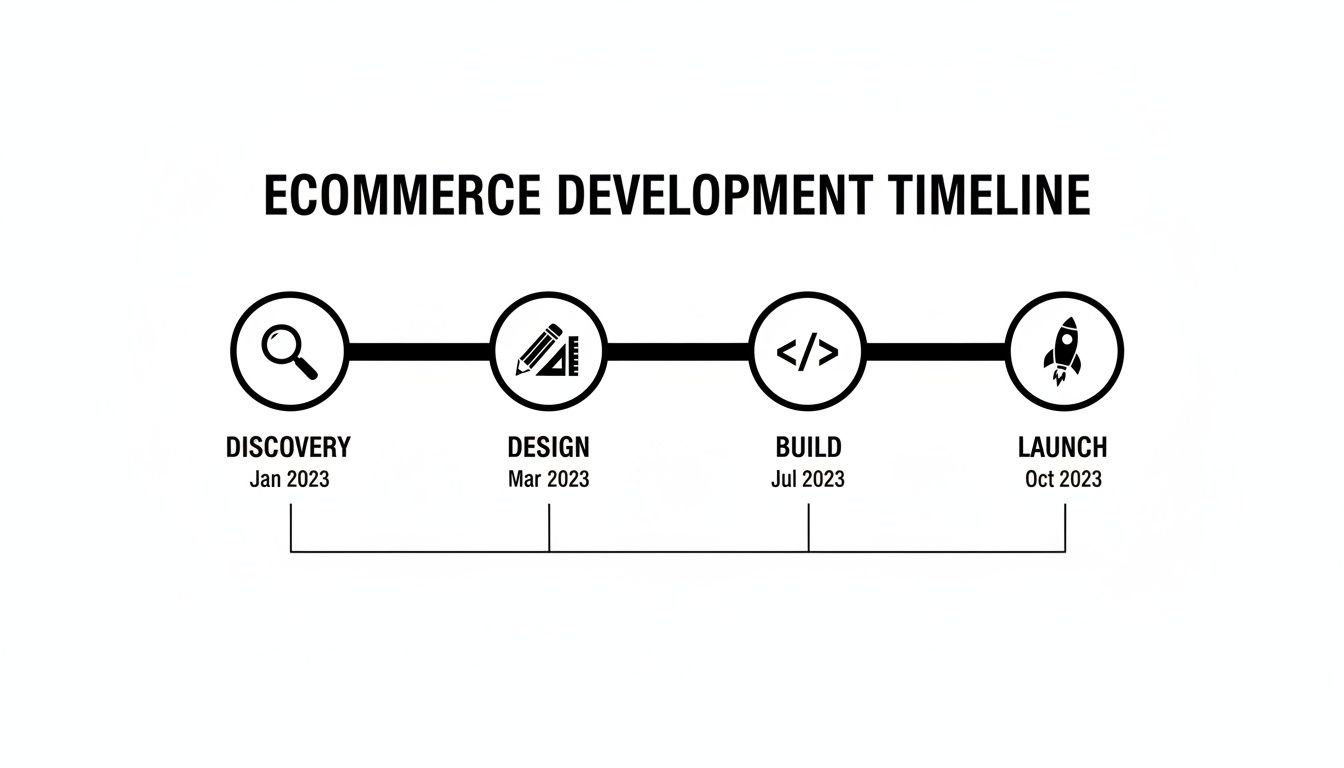
As you can see, it’s a logical progression. We don’t start building the walls until the foundation is solid.
To give you a clearer idea, here's a breakdown of what to expect for a standard ecommerce project.
Typical Ecommerce Project Timeline
This table gives a rough estimate, but remember that the complexity of your site will ultimately determine the final timeline. A store with a handful of products is a different beast to one with thousands of SKUs and custom features.
| Phase | Typical Duration | Key Activities |
|---|---|---|
| Discovery & Strategy | 1-2 weeks | Workshops, competitor analysis, goal setting, technical requirements, project planning. |
| Design & UX | 2-4 weeks | Wireframing, creating visual mockups, prototyping the user journey, getting your feedback. |
| Development & Build | 4-8 weeks | Front-end and back-end coding, platform setup, feature implementation, content population. |
| Testing & Revisions | 1-2 weeks | Quality assurance (QA) testing, bug fixing, user acceptance testing (UAT), final tweaks. |
| Launch & Handoff | 1 week | Final deployment, go-live checks, DNS updates, post-launch monitoring, and training. |
All up, you're generally looking at 8-16 weeks from our first chat to your grand opening.
Phase 4: Testing, Launch, and Going Live
Your new store is built, stocked, and almost ready for its big debut. But before we flick the switch, it goes through some serious, no-nonsense testing. We check every link, click every button, and run through the entire checkout process on different browsers, phones, and tablets.
We’re essentially trying to break it so your customers don’t. We run a full gauntlet of tests:
- Functionality Testing: Does the search bar actually find things? Can you add items to the cart and remove them?
- Performance Testing: Is the site snappy and quick to load, even with all those beautiful, high-res product photos?
- Payment Gateway Testing: Do payments go through securely and without a hitch?
Only when the site has passed every single test with flying colours do we schedule the launch. We’ll push the site to its live server, point your domain name to it, and officially open your doors for business. But our job doesn’t stop there. We’ll be watching closely to jump on any unexpected issues and ensure your business gets off to a flying start.
Integrating Payments, Shipping and Australian Taxes
A stunning online store is a fantastic start, but it's the engine room—the behind-the-scenes logistics—where an ecommerce business truly thrives or falters. The real heart of your operation is how you seamlessly take payments, get products to customers, and handle your taxes correctly.
This is a make-or-break part of your ecommerce setup, directly hitting your cash flow, customer happiness, and legal standing. For Aussie businesses, this means getting your head around a few local specifics. Nailing these three pillars from day one will save you a world of headaches and set you up for growth.
Secure and Convenient Payment Gateways
To take money online, you need a payment gateway. The easiest way to think of it is as the digital version of an EFTPOS machine. It securely takes your customer's card details and makes sure the money lands safely in your bank account.
Your goal here is to offer a mix of payment options that make your customers feel secure and confident at checkout. In Australia, a few clear favourites have emerged:
- Stripe and PayPal: These two are the undisputed global heavyweights. They're known for rock-solid security and reliability, and they plug into major ecommerce platforms like Shopify and WooCommerce without any fuss.
- Buy Now, Pay Later (BNPL): Services like Afterpay and Zip are no longer just a nice-to-have; many Australian shoppers now expect them. Adding a BNPL option can seriously lift sales, with studies showing 55% of consumers will spend more if they can pay in instalments.
Choosing the right payment gateway isn't just a technical decision; it's a customer service one. Offering trusted and flexible payment methods tells your customers that you understand their needs and value their business, reducing checkout friction and boosting sales.
For a deeper dive into all the options, our guide on choosing a payment gateway in Australia has some great insights to help you make the right call.
Streamlined Shipping and Fulfilment
How you manage shipping has a huge say in your store's profitability and what customers think of your brand. Unexpectedly high shipping fees are the number one reason people abandon their carts, so a clear, fair strategy is non-negotiable.
As we build your site, we connect your store directly with Australia's biggest carriers. This unlocks powerful features that make life easier for you and your customers.
Key Shipping Integrations and Strategies:
- Australia Post & Sendle: By integrating directly with these couriers, your website can calculate shipping costs in real-time based on a customer's postcode and the order's weight. It’s the best way to ensure you never undercharge or overcharge for postage.
- Flat-Rate Shipping: Sometimes, simple is best. Offering a single, predictable shipping cost can make the buying decision easier and encourage people to place larger orders.
- Free Shipping Thresholds: This is a classic, proven tactic for increasing your average order value. An offer like "Free Shipping on Orders Over $100" gives customers a little nudge to add one more item to their cart.
Simplifying Australian GST Compliance
Last but not least, let's talk tax. For any Australian business, the Goods and Services Tax (GST) is a big one. If your business has a turnover (or is projected to have one) of $75,000 or more per year, you’re required to register for GST. A key step is understanding how to register for GST in Australia.
The good news? Modern ecommerce platforms make handling GST far less painful than it used to be. When we develop your online store, we set it up to manage these calculations automatically.
Your website can be configured to correctly apply the 10% GST on taxable sales and generate proper tax-inclusive invoices for your records and for your customers. This automation gets rid of the risk of human error and saves you countless hours of bookkeeping, keeping your business compliant with the ATO without all the stress.
Driving Traffic and Sales After Launch
So, your brand-new online store is live. Congratulations! While that’s a massive achievement in your ecommerce web development journey, the launch isn’t the finish line—it’s the starting block. Now the real work begins: getting a steady flow of customers to your digital front door and turning those visitors into buyers.
Think of it this way: you’ve just built a beautiful retail shop on a quiet backstreet. Now you need to put up the signs, hand out flyers, and let people know you're open for business. Launching is just step one; genuine growth comes from a smart, consistent marketing effort across a few key channels.
Let's break down the strategies that will bring people in and actually make you money.
Mastering Ecommerce Search Engine Optimisation (SEO)
Search Engine Optimisation (SEO) is the art of getting your website a prime spot on Google's high street. It's all the work you do to make sure your site pops up when people search for the products you sell. When someone in Australia types in "handmade leather boots Sydney," you want your store to be one of the very first things they see.
Good ecommerce SEO is much more than just sprinkling keywords around. It’s a deliberate approach to your site’s entire structure and content.
Key areas to get right include:
- Product Page Optimisation: Every single product page needs a unique, descriptive title, a product description that sells the dream, and great photos with descriptive alt text. This tells Google exactly what you're offering.
- Category Page Optimisation: Don't neglect your category pages (like "Men's Jackets" or "Women's Skincare"). They are goldmines for SEO. They need clear headings and a bit of intro text to guide both your customers and search engines.
- Technical SEO: This is all the behind-the-scenes magic that helps Google easily crawl and understand your site. It covers things like fast page speeds, a design that works flawlessly on mobile, and clean, logical URLs.
Think of SEO as a long-term investment. Unlike paid ads that vanish the second you stop paying, the benefits of good SEO grow over time, bringing you a continuous stream of free, ready-to-buy traffic.
Beyond Search: Paid and Social Channels
While SEO builds that solid, long-term foundation, you can't just sit and wait for it to kick in—that can take months. You’ll want to use other channels to drive traffic right away and start building a community around your brand.
A balanced strategy almost always wins. You use different channels for different jobs, making sure you’re reaching customers whether they're actively searching on Google, scrolling through their Instagram feed, or checking their email.
Paid Advertising for Immediate Visibility
Paid ads, such as Google Ads and social media ads on platforms like Facebook and Instagram, are like turning on a tap for instant traffic. You pay to put your products squarely in front of a very specific audience. You can target people based on their age, what they're interested in, and even their recent shopping behaviour.
This is a fantastic way to test if a new product will sell, push a special offer, or just get your brand name out there quickly. It does require a budget, but the data you get back is priceless for fine-tuning your entire marketing plan.
Email and Social Media for Community Building
Email marketing is still one of the best tools for building relationships and getting repeat business. When you encourage visitors to sign up for your newsletter, you're creating a direct line to your most loyal followers. You can use it to announce new arrivals, send out exclusive discounts, and share your brand's story.
Social media is where you give your brand a personality. It’s less about the hard sell and more about having conversations, sharing photos from happy customers, and building a real community. This is how you build the trust that turns a one-time shopper into a fan for life.
Your Top Ecommerce Questions, Answered
Jumping into ecommerce development for the first time? It's natural to have a few questions swirling around. We get it. To help clear things up, we've put together some straight-shooting answers to the questions we hear most from fellow Aussie business owners.
Think of this as your quick guide to understanding the costs, timelines, and day-to-day management of getting a successful online store off the ground.
How Much Does an Ecommerce Website Cost in Australia?
This is the big one, and the honest answer is: it depends. There’s no simple price tag because every business has different needs. A straightforward shop using a platform like Shopify might start from a few thousand dollars—perfect if you just want to get a neat product catalogue online without fuss.
But if you're dreaming bigger, a custom-built site with unique features, a one-of-a-kind design, and specific software integrations can range anywhere from $15,000 to $50,000+. It really all comes down to the complexity and what you want the site to do for your business.
The best way forward is always to get a detailed quote that’s built around your specific business goals. That way, you know you’re only paying for what you truly need to succeed, with no nasty surprises down the track.
How Long Does It Take to Build an Ecommerce Website?
From our first chat to launch day, a typical ecommerce project usually takes between 8 to 14 weeks. Of course, this timeline can shift a bit depending on a few moving parts.
What makes the clock tick faster or slower?
- The platform: A custom-coded solution will naturally take longer than setting up a store on a pre-built platform.
- Custom features: The more unique functions you need—like special calculators, product personalisers, or booking systems—the more time our developers will need.
- Your input: Getting your feedback and content to us promptly is one of the biggest factors in keeping the project humming along smoothly.
We map out everything with clear milestones from the start, so you’ll always know exactly where we’re at.
Can I Manage My Store Myself After It Is Built?
Yes, one hundred percent! The whole point is to give you the keys to your own business. We build our stores on brilliant, user-friendly platforms like Shopify and WordPress (with WooCommerce) for this very reason.
You’ll be able to add new products, check on orders, write a blog post, and update your homepage without touching a single line of code. We’ll also give you the full tour with proper training and are always here for ongoing support, so you feel totally confident running the show from day one.
Ready to build an online store that actually gets results for your business? The team at Website Builder Australia specialises in creating high-performing ecommerce websites for businesses right across Australia. Get in touch with our friendly Brisbane-based experts today for a free, no-obligation quote!


