

Find Your Ecommerce SEO Company: A Guide for AU Businesses
Your store's live. Products are loaded, shipping is configured, and the ads you tested gave you a few early orders. Then things flatten out. You search your own product names and category terms, and bigger retailers, marketplaces, and comparison pages sit above you.
That's usually the moment an owner starts typing “ecommerce SEO company” into Google and realises the market is full of agencies saying roughly the same thing.
From a Brisbane agency perspective, the gap between a good pitch and good SEO work is wide. A proper ecommerce SEO partner should understand how Australians search, how platform constraints affect rankings, and how to tie search visibility back to sales, not just reports full of ranking screenshots. If you run Shopify or WooCommerce, that matters even more because technical decisions, collection structure, filters, product variants, and mobile UX all shape whether SEO can move revenue.
Why Your Online Store Needs the Right SEO Partner
A lot of Australian ecommerce businesses don't have a product problem. They have a visibility problem.
You can have strong margins, good suppliers, and a decent-looking store, but if your category pages aren't ranking and your product pages aren't being surfaced for buyer-intent searches, growth stays patchy. Paid media can fill the gap for a while, but many small businesses quickly find that relying on ads alone becomes expensive and unstable.
The opportunity is large because Australia is already a highly digital retail market. Australia had 22.2 million internet users in January 2025, equal to 83.3% of the population, which means search visibility affects a very large share of potential buyers before they ever reach a store or product page, according to Reboot's ecommerce SEO statistics overview.
SEO affects discovery before the click
For ecommerce, SEO isn't only about “ranking on Google”. It's about whether your store appears when someone compares brands, checks delivery options, looks for a product near Brisbane, or searches a very specific long-tail phrase that signals buying intent.
That's why the right partner matters. A generic SEO provider may optimise blog posts and call it a day. A real ecommerce SEO company should work on:
- Category-page performance so your highest-value collections can rank
- Product page indexability so Google can discover and understand your catalogue
- Schema and structured data so product information is clearer in search results
- Mobile performance because mobile shoppers won't wait around for slow pages
- Internal linking so authority flows to the pages that make sales
Practical rule: If an agency talks mostly about traffic but barely mentions collections, product templates, faceted navigation, schema, and conversion paths, they're probably not doing serious ecommerce SEO.
The wrong partner creates expensive delays
This is the part many owners only learn after signing. The wrong agency rarely destroys a site overnight. More often, it burns six months.
You get broad keyword reports, vague promises, and content that doesn't match how people shop. Meanwhile, duplicated collection pages, poor canonical handling, bloated Shopify apps, or messy WooCommerce taxonomy keep dragging performance down.
If you want a useful outside view before speaking to agencies, The SEO Agent's insights are worth reading because they frame the early warning signs owners usually notice first, such as low visibility, weak lead flow, and content that isn't pulling its weight.
A good SEO partner should make the work less mysterious. They should be able to explain what's broken, what matters most, and what can wait.
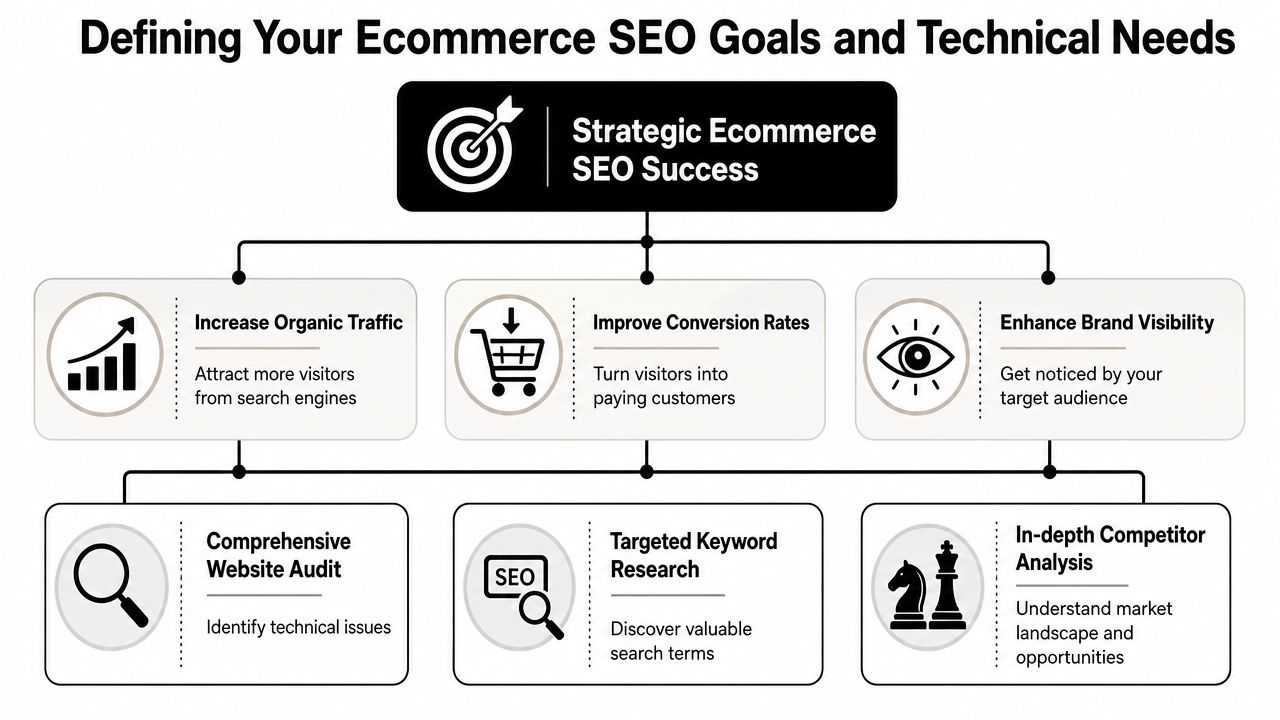
Defining Your SEO Goals and Technical Needs
Before you speak with any agency, get clear on what you're hiring them to solve. “We need more traffic” is too broad to be useful. A decent strategist can help refine that, but you'll get better proposals if you start with sharper business goals.
Australia Post's ecommerce reporting has shown that millions of Australians shop online regularly, and because Google remains the dominant search engine in Australia, ecommerce SEO strategy here needs to be Google-first. That makes category visibility, product discoverability, and local intent searches commercially important across the buyer journey, as noted by First Page Sage's market overview.
Start with business outcomes
Write down the outcomes that would matter to your business over the next year. Not vague marketing wishes. Commercial outcomes.
Examples include:
- More revenue from organic search for a core category
- Better visibility for local terms if you service Brisbane or specific regions
- Improved performance on collection pages that currently rely on ads
- Reduced dependence on marketplaces if you want more direct sales through your own site
A small homewares brand might care most about non-branded category traffic. A local Brisbane retailer with a showroom may need both ecommerce SEO and stronger local search signals. A niche parts supplier may care less about volume and more about being found for precise model-based searches.
If you can't explain what success looks like in plain business language, you'll struggle to judge whether an agency is helping.
Your platform changes the SEO job
Shopify and WooCommerce both support strong SEO, but they create different constraints.
Shopify is usually cleaner operationally. It handles hosting well and makes store management easier for many SMBs. But collection logic, duplicate URL paths, app bloat, variant handling, and limited control in some areas can create SEO friction if the agency doesn't know the platform properly.
WooCommerce gives more flexibility. That's useful when you need custom taxonomy, content architecture, or advanced template control. But flexibility also means more room for technical mistakes. Plugin overlap, thin archive pages, poor speed management, and inconsistent theme development can all get in the way.
If your store build itself needs attention before SEO scales, it helps to understand what sits underneath the marketing layer. This overview of ecommerce web development gives a practical sense of the technical work that often affects search performance later.
Questions to answer before requesting proposals
Use this short brief when speaking to agencies:
| Area | What to define |
|---|---|
| Primary goal | Revenue, category growth, local visibility, or catalogue discoverability |
| Platform | Shopify, WooCommerce, or custom |
| Key pages | Top categories, top products, brand pages, local landing pages |
| Constraints | Dev access, platform limitations, stock turnover, thin content |
| Buying journey | Long research cycle, impulse purchase, repeat purchase, local pickup |
That prep helps you avoid generic proposals. It also forces agencies to respond to your actual business, not a template.
How to Vet Potential Ecommerce SEO Partners
Most bad hires can be avoided here.
A polished proposal doesn't tell you much on its own. What matters is how the agency thinks, what they inspect first, and whether they can explain trade-offs without hiding behind jargon. For an ecommerce SEO company, the strongest methodology is a crawl-to-conversion workflow. That means starting with technical audit work around indexation, page speed, Core Web Vitals, and mobile usability before moving into keyword mapping and content support. In Australia, mobile devices account for roughly 66% of website visits, so mobile-first checks are not optional, according to Uncommon Logic's ecommerce SEO guidance.
A useful visual checklist can help you compare agencies consistently.
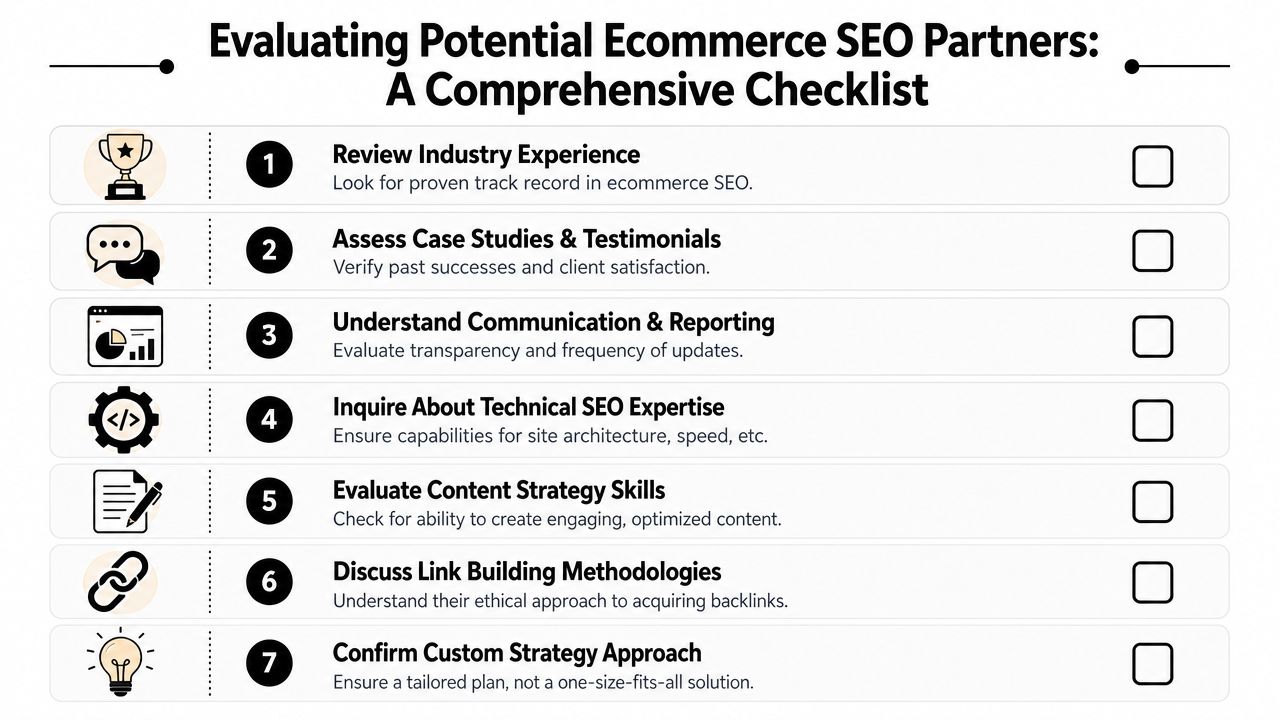
Ask how they audit a store
Don't ask, “Do you do technical SEO?” Every agency says yes.
Ask them what they check first on a Shopify or WooCommerce site. A credible answer should mention several of the following in practical terms:
- Indexation controls including noindex issues, canonical handling, pagination, and duplicate collections or archives
- Site speed and mobile UX including image weight, script bloat, app conflicts, template inefficiencies, and checkout friction
- Category architecture including how categories, tags, filters, and internal links support transactional pages
- Schema coverage for products, categories, availability, and supporting content
- Content mapping so the right search intent lands on the right page type
If they jump straight into blogs and backlinks without first discussing crawlability and page templates, that's a red flag.
Ask who does the work
A lot of SMBs sign with a senior salesperson and are then handed to a junior account manager who can't answer technical questions.
Ask directly:
- Who performs the audit?
- Who decides keyword mapping?
- Who implements technical fixes?
- Will I speak to the strategist, or only to an account manager?
- How do you handle developer collaboration if our platform has custom code?
Those aren't awkward questions. They're basic buying questions.
For a broader agency selection lens beyond SEO, Data Hunters Agency's guide to agency choice is a sensible companion read because it focuses on transparency, fit, and working process rather than glossy promises.
Red flags worth taking seriously
Some warning signs are obvious. Others are subtler.
Guaranteed rankings are a sales tactic, not an SEO strategy.
Watch for these:
- Guaranteed position claims because no one controls Google's results
- Very broad scopes that never define deliverables
- Heavy focus on vanity metrics such as impressions with no commercial context
- No platform-specific detail on Shopify, WooCommerce, or your CMS
- No questions about stock, margins, returns, or fulfilment, which means they're ignoring conversion economics
- No discussion of local intent if your business has a Brisbane footprint or services defined regions
What a solid agency conversation sounds like
A good discovery call usually feels less like a pitch and more like diagnosis.
They'll ask about your product margins, your priority categories, whether you're competing with marketplaces, whether collection pages convert, and whether your developers can implement template changes quickly. They'll want access to Search Console, analytics, and your CMS before speaking too confidently.
This short explainer is useful context if you're deciding whether to keep SEO in-house or hand it off to specialists through outsourced SEO services.
A practical walkthrough also helps if you want to see how agencies describe the process in action:
Questions worth asking on every shortlist call
Use these as your baseline:
- How do you audit category pages versus product pages?
- What Shopify or WooCommerce issues do you see most often?
- How do you prioritise fixes in the first month?
- How do you handle cannibalisation between blogs, collections, and product pages?
- What will reporting include beyond rankings?
- What do you need from our dev team?
- How do you approach local search if we serve Brisbane customers as well as national ecommerce demand?
If they answer clearly, with specifics and trade-offs, keep talking. If every answer sounds rehearsed, move on.
Decoding SEO Proposals and Pricing Models
Once proposals land in your inbox, don't compare them by price first. Compare them by clarity.
The big issue with many SEO proposals isn't that they're expensive. It's that they're vague. A lower monthly fee can still be poor value if the scope is thin, the deliverables are fuzzy, and the agency expects your internal team to do half the implementation.
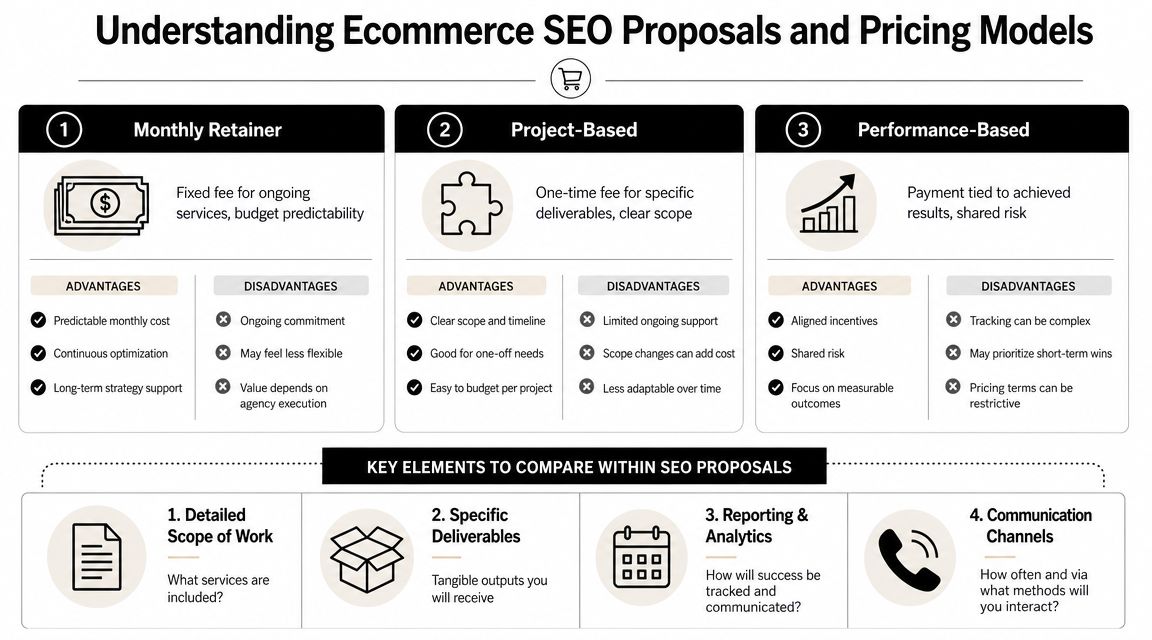
Three common pricing structures
Here's the practical difference.
| Model | Usually suits | Watch-outs |
|---|---|---|
| Monthly retainer | Ongoing SEO for stores that need continuous technical, content, and reporting work | Scope can become vague if deliverables aren't listed |
| Project-based | Audits, migrations, technical cleanup, category restructure | Good for fixed work, less useful for long-term momentum |
| Performance-based | Businesses willing to share risk with strict measurement rules | Attribution disputes can get messy fast |
For most SMB ecommerce sites, a monthly retainer works best if the proposal clearly states what happens each month. Ecommerce SEO is rarely one-and-done. Technical issues get fixed, then category pages need refinement, then internal links, then content support, then measurement and iteration.
A project fee can work well when the job is tightly defined, such as a Shopify migration audit, canonical cleanup, or collection-page overhaul.
I'm generally cautious with performance models for ecommerce SEO. They sound attractive, but they often raise hard questions about attribution, seasonality, stock outages, pricing changes, and work your own team controls.
What a good proposal must include
A proposal should answer basic operational questions without you having to chase them.
Look for:
- Scope of work with actual tasks, not broad labels like “ongoing optimisation”
- Deliverables such as audits, keyword maps, implementation tickets, content briefs, or monthly reporting
- Responsibilities showing what the agency does versus what your internal team or developer does
- Timeline with priority order, especially for the first phase
- Measurement plan tied to commercial outcomes
Contract check: If the proposal doesn't tell you what happens in month one versus month three, you're buying hope, not a process.
Read proposals through a conversion lens
This is the part many owners miss. SEO proposals often spend pages on rankings and very little on the shopping experience after the click.
That's a problem in Australia because speed, trust, delivery clarity, and payment experience affect whether search traffic becomes revenue. Many SEO write-ups mention site speed as a ranking factor but don't connect it to abandonment. A stronger question is whether the agency helps reduce leakage by aligning SEO with local shipping promises, mobile UX, and trust signals, as discussed in Orbit Media's ecommerce optimisation guidance.
If your proposal talks about traffic growth but says nothing about:
- shipping information on landing pages,
- returns language,
- postcode or location relevance,
- mobile friction,
- or trust elements on product and category pages,
then it's incomplete for ecommerce.
A proposal should tell you how the agency plans to help buyers complete a purchase, not just find a page.
Your First 90 Days with a New SEO Agency
The first three months usually tell you whether the relationship will work.
A smooth start doesn't look flashy. It looks organised. The agency asks for access early, gathers context from the people who know the business, and starts with the most impactful issues instead of trying to do everything at once.
Month one usually looks like diagnosis
The kickoff meeting should include the owner or decision-maker, whoever manages the website day to day, and anyone responsible for development, merchandising, or paid traffic. The agency should ask for access to Google Search Console, analytics, your ecommerce platform, and any existing SEO documentation.
Early conversations should cover practical business realities:
- your best-margin products
- seasonal categories
- stock constraints
- whether Brisbane or other local markets matter
- shipping limitations
- which pages already convert well
If the agency skips those details, they're missing context that affects priorities.
Month two should move into implementation
By this point, you should see a prioritised action list. Not a giant spreadsheet dumped on your team with no guidance. A clear order of operations.
That often includes technical fixes first, then keyword mapping to category and product pages, then internal linking, metadata refinement, and content support where it helps commercial pages. For Shopify stores, that may involve collection templates, duplicate path handling, and app cleanup. For WooCommerce, it may involve taxonomy cleanup, archive improvements, and plugin conflict review.
The first sign of a healthy SEO engagement is prioritisation. The second is follow-through.
Month three should produce a working rhythm
By the end of the first 90 days, you should have a clearer picture of how the agency communicates and whether they can turn analysis into action.
A good cadence is usually simple. One monthly strategy call. One concise report. Occasional implementation check-ins when technical work is underway. You shouldn't feel flooded with dashboards, but you also shouldn't be guessing what's happening.
What you want at this stage is momentum. You may not see the full commercial impact yet, but you should see that the right pages are being worked on, technical barriers are being removed, and the agency understands your business well enough to make sound decisions without constant re-explanation.
Measuring SEO Success and Real ROI
Many ecommerce businesses become distracted at this stage.
Rankings matter, but they're not the finish line. A #1 position for a weak term doesn't help much if the landing page doesn't convert, the traffic is low intent, or revenue attribution is missing. Ecommerce SEO should be judged on funnel metrics, not vanity metrics.
The commonly cited benchmark for organic search conversion is about 2–4%, with a global average near 2.95%, and the practical lesson for an Australian ecommerce SEO company is to model impact against conversion and revenue lift rather than rankings alone, as outlined in Anchor Group's ecommerce SEO conversion analysis.
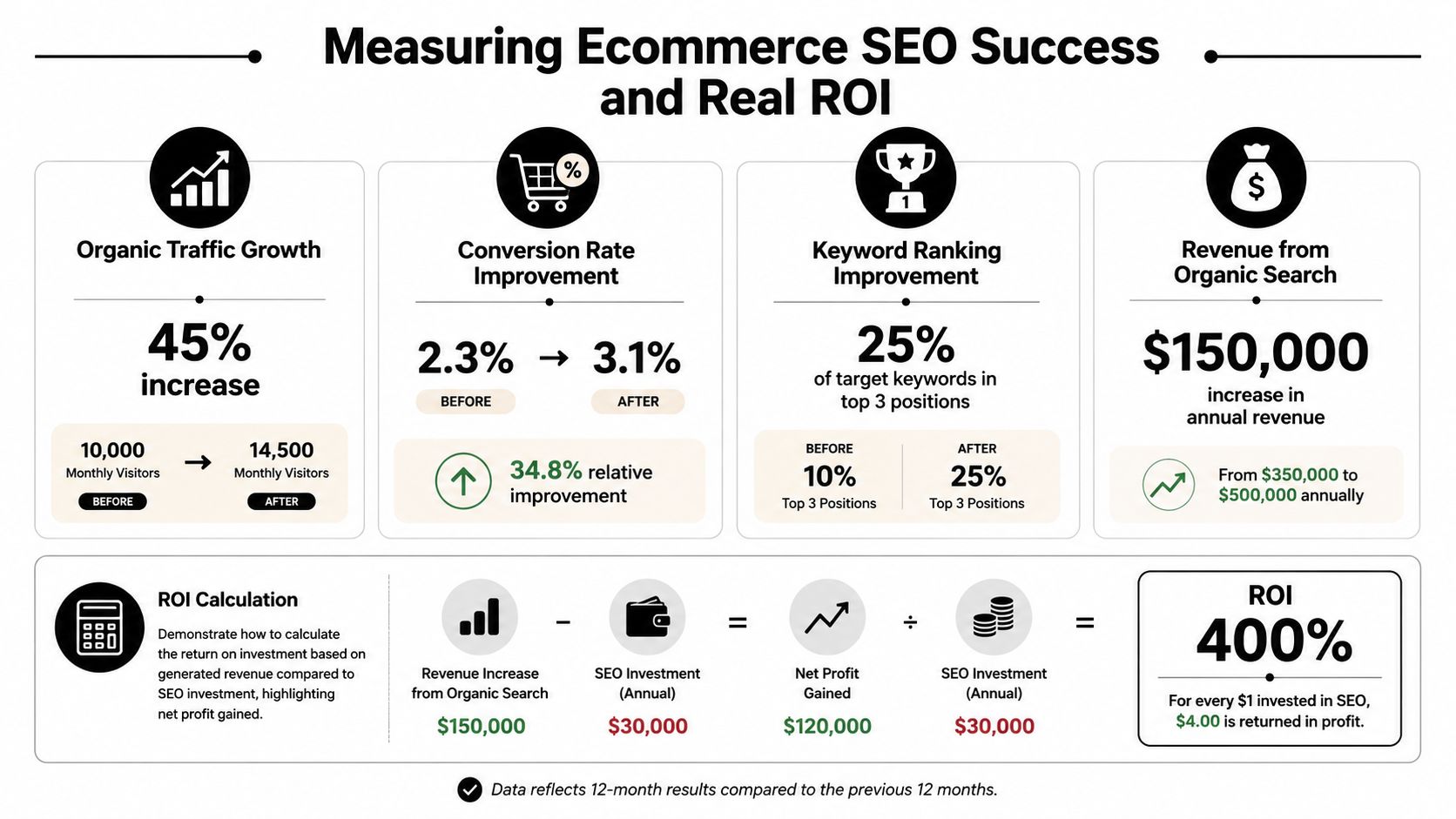
What to track instead of just rankings
A strong monthly report should connect activity to outcomes. At minimum, I'd want to see:
- Organic traffic to commercial pages, not only sitewide traffic
- Visibility for transactional keywords tied to category and product intent
- Organic conversion rate
- Revenue attributed to organic search
- Page-level performance for priority collections and products
- Technical progress on issues that affect crawling, indexing, and UX
Keyword cannibalisation also needs watching. It's common on ecommerce sites where blogs, categories, tags, and product pages all start competing for similar terms. If an agency reports “more rankings” while your key category page loses visibility to a lower-value page, that's not progress.
What real ROI conversations sound like
The best client conversations are often less glamorous than marketing decks.
They sound like this: category A gained stronger visibility, but category B still has template issues. Organic traffic is up on collection pages, but product-page conversion needs work. The agency is improving search visibility, yet revenue attribution still needs cleaner reporting because of cross-channel overlap.
That's real SEO management.
For operators who want a broader view of practical, budget-conscious search strategy, these strategies for eCommerce managers on SEO are a useful companion read because they focus on making search efforts accountable to business outcomes.
What to ask for in monthly reporting
Ask your agency to include these three layers:
| Layer | What it should show |
|---|---|
| Search visibility | Transactional keyword movement and landing-page alignment |
| User behaviour | Organic sessions, bounce signals, conversion paths, page engagement |
| Business impact | Orders, revenue from organic search, and page-level contribution |
If you want support that combines search with the wider commercial picture, including content, site performance, and traffic channels, this overview of ecommerce digital marketing is one example of how those pieces fit together operationally.
A good ecommerce SEO company should help you answer one simple question every month: are we attracting the right searchers, sending them to the right pages, and turning enough of that demand into sales?
If the report can't answer that, it's not good enough.
If you're reviewing your current store, planning a redesign, or trying to choose an ecommerce SEO company with a clearer brief in hand, Website Builder Australia offers Brisbane-based website development, ecommerce builds, and digital marketing support for Australian businesses that want the technical and marketing sides aligned.


