

Mobile App Development Cost: 2026 Australia Guide
A simple app in Australia can start from A$25,000, while more complex apps can easily exceed A$150,000. The final price depends heavily on what the app does, how much backend complexity sits behind it, and whether you're building with a local Australian team, where developer salaries are high.
If you're pricing an app right now, you're probably seeing quotes that seem wildly inconsistent. One provider says your idea is straightforward. Another says it's a six-figure project. Both can be telling the truth.
The reason is simple. App pricing isn't like buying a laptop off the shelf. It's closer to commissioning a custom fit-out for your business. The launch quote matters, but it's only the start. If you want a realistic budget, you need to look at the total cost of ownership, including post-launch maintenance, app store fees, hosting, and the extra work created by integrations, updates, and compliance.
What Really Determines Your Mobile App Development Cost
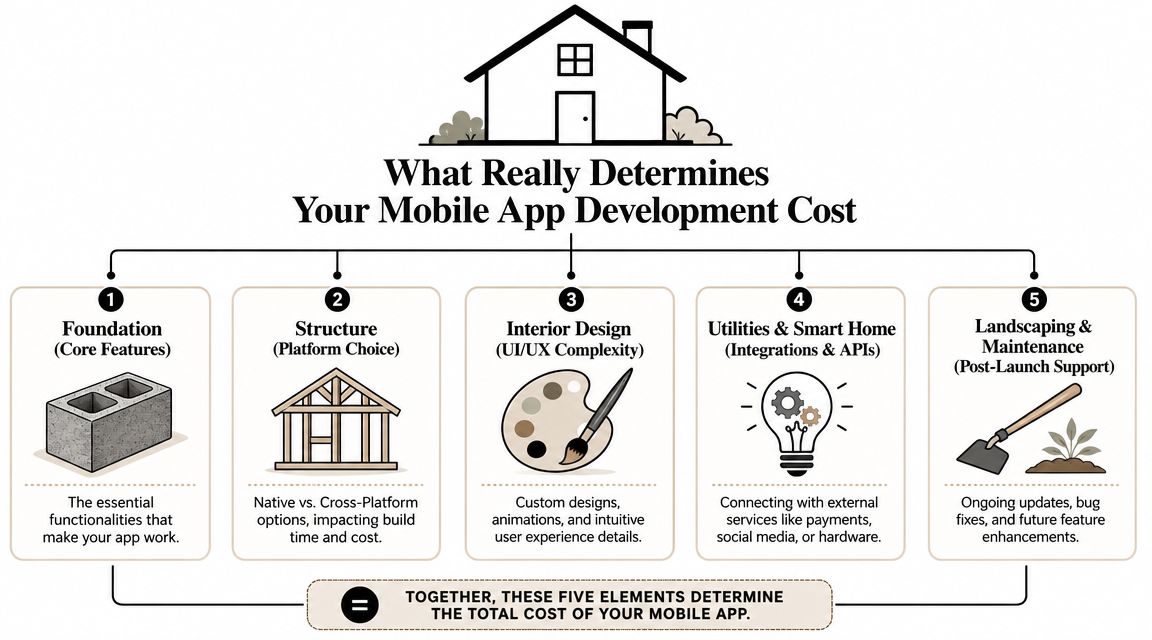
You ask for quotes on what looks like the same app, and one comes back at A$35,000 while another is closer to A$120,000. That gap usually comes down to scope hidden beneath the surface. The screens may look similar on paper, but the cost sits in the behaviour, the systems behind it, and the amount of work needed to keep the app reliable after launch.
A build quote is only one part of the budget. In practice, the strongest cost drivers also shape your total cost of ownership, especially once hosting, third-party services, app store requirements, security updates, and support start to stack up.
Feature Complexity Drives the Effort
Business owners often begin by listing screens. Developers estimate based on workflows, rules, integrations, and failure points.
A simple brochure-style app with static content is relatively straightforward. An app that handles bookings, payments, user roles, live inventory, staff permissions, or customer data across multiple systems takes far more engineering time. Every added function creates more testing, more edge cases, and more ongoing support work once people start using it in the wild.
One practical rule helps here. If your app needs to exchange data with another system, expect both the build cost and the ongoing maintenance cost to rise.
Integrations are a common budget trigger in Australian projects. Payment gateways, CRMs, booking tools, accounting platforms, delivery systems, and custom business software all introduce dependency risk. If the third-party provider changes an API, updates authentication rules, or has downtime, your app may need urgent developer attention later. That cost rarely appears clearly in an early quote, but it still lands on your budget.
Platform choice affects both launch cost and long-term cost
Platform strategy changes more than the initial build. It affects release management, testing effort, future updates, and how expensive the app is to maintain over two or three years.
Native iOS and native Android builds usually give you stronger platform-specific performance and fewer compromises around device features. They also tend to cost more because you are paying for separate engineering streams. Cross-platform development can reduce duplicated work and is often a sensible choice for small businesses that need to get to market efficiently. But if the app relies on complex animations, hardware access, offline behaviour, or highly customised user interactions, cross-platform can become expensive later through workarounds and platform-specific fixes.
That is why the cheapest technical option at kickoff is not always the cheapest ownership model.
Design scope changes effort quickly
Design cost is not just about visual polish. It includes user flows, onboarding, accessibility, empty states, error handling, and the small decisions that stop people getting stuck.
A standard interface built on familiar mobile patterns is faster to design, faster to build, and easier to maintain. A custom interface with unique components, motion design, and lots of conditional behaviour will push up design hours, front-end development, QA, and future iteration costs. I often tell clients to spend money where the user journey needs clarity, not where the interface is trying to look different for its own sake.
Good UX usually saves money later because it reduces rework, support friction, and drop-off caused by avoidable usability problems.
Team composition has a direct effect on price
In Australia, labour cost is a major part of any app budget. Local teams are more expensive than offshore freelancers, but the headline rate is only part of the decision.
A lower quote may exclude proper discovery, QA, technical documentation, deployment support, analytics setup, or post-launch fixes. It may also rely on a very lean team where one developer is covering architecture, coding, testing, and release work. That can work for a very small MVP. It becomes risky once the app handles customer transactions or connects to business-critical systems.
The Australian market also brings extra considerations around privacy, accessibility expectations, local support hours, and coordination with other suppliers such as POS vendors, payment providers, and internal IT teams. Those are delivery costs, but they are also ownership costs, because poor handover and weak support create expensive problems after launch.
Cheap app quotes usually come from one of four places:
- narrower scope than you assumed
- lighter QA and testing
- less senior technical oversight
- limited support once the app is live
That does not mean the highest quote is automatically right. It means you need to check what is included, what is excluded, and what your business will still be paying for six months after release.
Comparing App Development Pricing Models
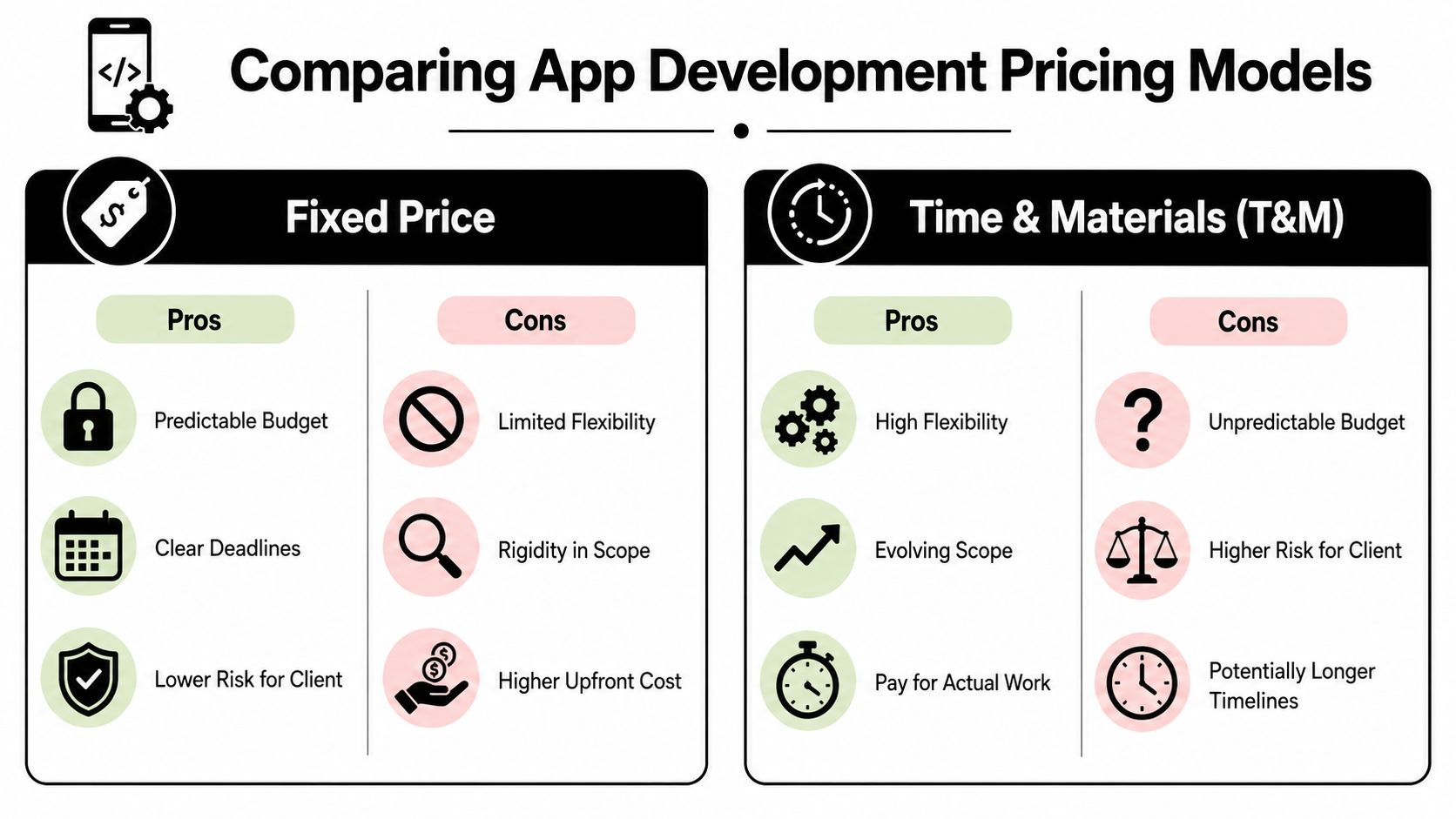
How you're billed matters almost as much as what you're building. In practice, most mobile app projects land in one of two models: fixed price or time and materials.
Neither is universally better. The right choice depends on how clearly the scope is defined and how much change you expect during the project.
Fixed price suits defined projects
A fixed-price contract works best when the app scope is well specified before development starts. The features are clear, the integrations are known, and the design direction is largely settled.
That gives you stronger budget predictability. For a small business, that can be a genuine advantage. You know what you're committing to, and the agency takes more delivery risk.
But there's a catch. Fixed-price quotes often build in contingency because the developer has to protect themselves against uncertainty. That can make the quote look higher on day one. It can also make the process rigid once the build begins.
Good fit for fixed price:
- Clear scope with minimal ambiguity
- Simple workflows that won't change much mid-project
- Tight budgeting where cost certainty matters most
Common downside:
- Change becomes expensive because variations need to be re-scoped
- Discovery is limited if too much was assumed upfront
- You may overpay for contingency that never gets used
Time and materials suits evolving products
Time and materials is more flexible. You pay for the work done, and the team can adapt as requirements become clearer.
This is usually the better model for apps with evolving requirements, uncertain integrations, or a staged MVP approach. It allows a team to prioritise the most valuable work first, then refine the product based on real feedback.
A business owner who wants flexibility needs visibility. Time and materials only works well when the project has tight scope control, regular reporting, and clear decision-making.
Good fit for time and materials:
- MVP builds where you're testing an idea
- Complex projects with unknowns
- Collaborative clients who want to steer priorities as the build progresses
Common downside:
- Budget can move if scope expands
- Weak project management hurts fast
- Small decisions stack up into larger costs if no one is actively controlling them
The trade-off that matters
Fixed price buys more certainty but less agility. Time and materials buys more agility but requires stronger involvement and discipline.
If a provider offers fixed price for a complex, loosely defined app with multiple third-party dependencies, I'd ask hard questions. That kind of quote often turns into tension later. Either the developer starts protecting margin, or the client starts feeling boxed in.
Realistic App Cost Ranges in Australia 2026
The most honest answer to mobile app development cost is that it comes in tiers, not one neat number. A small brochure-style app sits in a different category from a booking platform, and both sit well below an app with payments, real-time data, and custom backend integrations.
Here's a practical way to think about it.
Estimated App Development Costs in Australia 2026
| App Complexity | Estimated Cost (AUD) | Typical Timeline | Example Features |
|---|---|---|---|
| Simple | A$25,000 to A$50,000 | A shorter build timeline | Login, profile, contact forms, content display, simple business workflows, basic admin support |
| Medium | A$50,000 to A$150,000 | A moderate delivery timeline | User accounts, push notifications, booking flows, dashboards, stronger admin tools, API connections, standard business logic |
| Complex | A$150,000+ | A longer multi-stage timeline | Real-time sync, payment gateways, custom APIs, large data handling, advanced permissions, enterprise integrations, more demanding security requirements |
What sits in each band
A simple app usually works when the business process is clear and contained. Think membership information, service requests, basic booking enquiries, or a customer-facing app with a straightforward account area. These projects can stay under control if you avoid custom backend logic and keep integrations to a minimum.
A medium app is where most commercial business apps land. This is the range where the product starts doing real work for the business. It might connect to a CRM, manage bookings, send push notifications, or provide different views for customers and staff. This is also the range where scope discipline matters most, because “just one more feature” starts becoming expensive.
A complex app usually has one or more of the following: real-time behaviour, payments, serious integration requirements, custom back-office systems, or stricter security expectations. Once an app becomes operationally important to the business, delivery standards need to rise with it.
The fastest way to blow the budget is to describe a complex app as “pretty simple” because the front-end looks clean.
Why these ranges move
Two apps can both sit in the medium band, but one may still cost far more than the other because of workflow depth and integration density. That's why I rarely trust comparisons based on industry labels alone.
The better approach is to map the app by function. What does a user do? What happens in the backend? What external systems are involved? If you're weighing a cross-platform approach, this overview of React Native mobile app development is useful for understanding where shared-code builds may fit.
A good estimate should show where the money is going, not just give you a rounded total.
Budgeting for Post-Launch and Ongoing Costs
Launch day isn't the finish line. It's the point where ownership begins.
Many businesses get caught. They budget for design and development, then treat everything after release as minor admin. It isn't. If the app matters to your operations or your customer experience, it needs ongoing care.
Maintenance is not optional
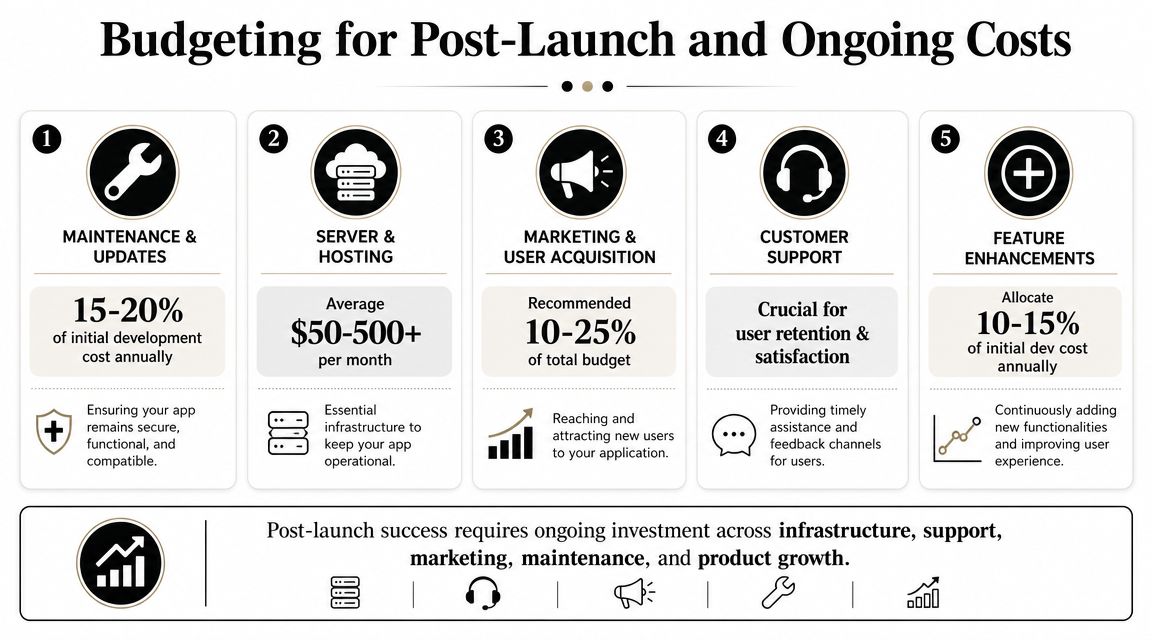
For Australian businesses, maintenance typically adds 15% to 20% per year to the development budget, based on industry research cited by Business of Apps in this breakdown of app maintenance costs. In practical terms, a project priced at A$80,000 may require an extra A$12,000 to A$16,000 every year just to stay current.
That annual spend usually covers bug fixes, operating system updates, device compatibility work, security patches, and routine technical upkeep. It doesn't automatically cover major new features.
If you ignore maintenance, the app doesn't usually fail all at once. It degrades. Forms stop behaving properly after OS changes. Login flows become unreliable. Edge-case bugs start hitting users. App store reviews get worse. Then the “saving” disappears into expensive catch-up work.
The recurring costs businesses forget
A realistic ownership budget should include more than maintenance.
- App store access matters from day one. Apple's Developer Program costs US$99 per year, and Google Play requires a US$25 one-time registration fee, as outlined in this mobile app cost guide.
- Hosting and cloud services keep the app online. The exact amount varies by product and usage, so the right approach is to budget for it as an ongoing operational cost rather than assuming it's included forever.
- Third-party services such as payment gateways, analytics platforms, mapping tools, messaging providers, and verification services can all add recurring fees.
- Support and monitoring become necessary if the app is business-critical. Someone needs to respond when something breaks.
A broader digital support plan also helps if the app sits inside a larger online ecosystem. This guide to website maintenance costs is worth reviewing because many of the same ownership principles apply across web and mobile products.
Budget for growth, not just stability
Keeping the app alive is one thing. Keeping it commercially useful is another. Most businesses will eventually need new features, improved onboarding, analytics changes, or integration updates.
That's also where marketing spend enters the picture. Building the app doesn't guarantee adoption. If you need to improve acquisition efficiency after launch, this resource on how to lower app CPA with AI is a useful read because it focuses on reducing wasted spend rather than solely buying more traffic.
Treat your app like a business asset, not a one-off project file. Assets need upkeep, oversight, and a budget after launch.
Practical Tips to Reduce Development Costs
The smartest way to reduce mobile app development cost isn't to chase the cheapest quote. It's to stop paying for the wrong work.
Most budget blowouts come from avoidable mistakes. Too many features in version one. Weak requirements. Building complex workflows before proving demand. Picking the wrong platform for the business model. Those choices are expensive long before anyone writes bad code.

Start with an MVP that does one job well
A strong minimum viable product doesn't mean a half-finished app. It means the first release is tightly focused on the core problem you're solving.
For a booking product, that may be account creation, availability, booking, and confirmations. For a field service tool, it may be job assignment, status updates, and photo uploads. Everything else can wait until users prove it matters.
What works is shipping the smallest version that creates real business value. What doesn't work is loading version one with every future idea.
Keep in the first release:
- Core transaction flow your users need
- Basic admin visibility so the business can operate the app
- Essential integrations only where manual work would be painful
Push to later phases:
- Nice-to-have automation
- Custom dashboards for every role
- Advanced personalisation or layered edge cases
Choose technology for fit, not fashion
Tech stack decisions should follow product needs. If the app needs broad market reach and a faster initial rollout, cross-platform can be a sensible commercial choice. If it relies on platform-specific behaviour or performance-sensitive interactions, native may save pain later.
The mistake I see often is teams overengineering early. They build for future scale, future features, and future complexity before the business has validated the present need.
A lean app with a clean architecture is cheaper to improve than an oversized app with features no one uses.
There's also a commercial benefit in planning the go-to-market side earlier. If your launch strategy is still vague, this guide for app marketers in 2026 can help you think beyond development and avoid building features that don't support adoption.
After that, review the video below if you want a more visual look at cost-saving decisions during planning and delivery.
Kill scope creep early
Scope creep rarely arrives as one major request. It shows up as ten small “while we're here” decisions. A filter here. A reporting option there. A custom role permission because it might be useful later.
That's why every feature should answer one question: does this improve launch viability, revenue, operations, or customer experience right now? If not, move it to phase two.
A disciplined backlog is one of the biggest cost controls in any app project.
Finding the Right Australian Development Partner
The right partner won't just tell you what the app costs. They'll tell you why. That difference matters.
A good Australian team should be able to break the quote into scope, design, development, integrations, QA, and post-launch support in language a business owner can follow. If a provider can't explain the estimate clearly, that's usually a warning sign.
What to look for in a partner
Start with capability, then check fit.
- Relevant portfolio that shows work with business apps, not just polished screenshots
- Clear commercial communication so you can understand trade-offs before they become budget issues
- A defined process for scoping, design, delivery, testing, and support
- Post-launch thinking because the app has to survive beyond submission to the stores
If you're comparing local and offshore options, this article on choosing the right development partner is useful because it frames the decision around collaboration and delivery risk, not just headline price.
Why local context still matters
A local team usually costs more than the lowest offshore quote, but cost isn't the same as value. If your app needs regular workshops, local compliance awareness, easier communication, and ongoing support in your time zone, that premium can be justified quickly.
The best partner is the one that can turn a business requirement into a maintainable product, then stay accountable after launch. If you want to see what a local service scope typically includes, this overview of mobile application development services in Australia gives a useful baseline.
Frequently Asked Questions About App Costs
Why do two agencies give very different quotes for the same app?
It usually means they are pricing different levels of risk, quality, and ongoing responsibility.
One quote might include workshops, UX work, QA, app store submission, backend setup, and a support period after launch. Another might cover only design and development hours, with change requests, testing, hosting setup, and post-launch fixes billed later. On paper, both can look like a quote for the same app. In practice, they are not the same purchase.
Ask for a line-by-line breakdown. You want to know what is included, what is excluded, what monthly costs start after launch, and how scope changes are handled. That is how you compare total ownership cost, not just the build number.
What usually pushes an app into six figures?
Custom backend work is a common reason. So are third-party integrations, account permissions, payment flows, real-time features, and any requirement that has to work reliably across different devices and edge cases.
The screen count matters less than business logic. A simple-looking app can get expensive fast if it needs bookings, subscriptions, inventory sync, staff dashboards, or links into existing systems like Xero, Shopify, or a custom CRM.
The other cost driver owners miss is operational complexity. If the app needs cloud infrastructure, admin tools, monitoring, security updates, and regular releases, the project cost extends well beyond development.
Is cross-platform always cheaper than native?
Cross-platform is often a sensible way to control initial cost, especially for MVPs, internal tools, and standard customer apps. You are sharing more code, which usually reduces build time.
The long-term answer depends on the product. If the app relies on heavy animation, advanced camera use, Bluetooth, offline sync, or platform-specific behaviour, native can be the cleaner option over time. I have seen businesses save money upfront with cross-platform, then spend part of that saving later on workarounds and performance fixes.
The better question is which approach gives you a maintainable product at a reasonable total cost over the next two to three years.
Should I build everything I want in version one?
No.
A first release should prove that users want the product and that the core workflow solves a real problem. Every extra feature adds design time, development time, testing time, and future maintenance. It also raises App Store and Google Play release risk because there is more to break.
Start with the few actions that matter most. Launch, learn from real usage, then pay for the next features with better information instead of assumptions.
What ongoing costs should I budget for after launch?
Small business budgets often go off track. The build quote is only part of the spend.
Plan for hosting, third-party software fees, app store accounts, bug fixes, OS updates, security patches, analytics tools, push notification services, and ongoing developer support. If your app processes payments, stores customer data, or connects to external systems, those costs usually rise over time, not fall.
For Australian businesses, local support can also be part of the total ownership cost. Paying more for a team that can respond in your time zone and handle production issues quickly can be cheaper than chasing a lower-rate provider when something breaks.
If you're planning an app and want a realistic view of both build cost and long-term ownership, Website Builder Australia is worth contacting. Their Brisbane-based team handles mobile app development, hosting, maintenance, and broader digital delivery, which makes it easier to budget for the whole lifecycle instead of just the launch quote.


