

Web Design for Tradies: The Ultimate 2026 Guide
Your phone rings less than it should. You know the work is out there, but too many local customers are finding someone else first, or landing on your site and leaving without calling. That usually happens for one of two reasons. Your website either looks like a placeholder, or it gives people no clear reason to trust you and take the next step.
Good web design for tradies isn't about fancy animations or winning design awards. It's about getting the right person, in the right suburb, to feel confident enough to tap Call or request a quote. If your site can't do that, it's not helping the business.
Planning Your Website for More Jobs Not Just Looks
Most tradie websites fail before the design starts. They fail at the planning stage because the owner treats the site like a checklist item instead of a lead tool. A decent-looking homepage won't save a weak strategy.
For Australian tradies, that mindset shift matters. A professional website is commonly priced at A$3,000 to A$8,000 in Australia, and that range is tied to custom design, mobile optimisation, and basic SEO setup according to Tradie Link's guide to website design for tradies. That's not brochure-site thinking. That's investment thinking.
Decide what the site must produce
A tradie website should be built around one primary action. Usually that's a phone call or a quote request. Sometimes it's a form for larger jobs, especially if you want higher-value building, renovation, or commercial enquiries.
That decision changes everything on the site:
- Phone-first jobs: Emergency plumbers, locksmiths, sparkies, and roof repair businesses need big clickable phone buttons, a short path to contact, and less friction.
- Quote-led jobs: Builders, garden designers, cabinet makers, and bathroom renovators usually need stronger project galleries, better job qualification, and a form that collects useful details.
- High-trust services: If you're selling premium workmanship, insurance work, or larger contracts, the site needs stronger proof. Reviews, licences, process pages, and examples of completed work matter more than decorative design.
Practical rule: If a visitor can't tell what you do, where you work, and how to contact you within a few seconds, the site is underperforming.
Build around the customer, not your logo
Tradies often start with colours, fonts, and a new logo file. Customers don't start there. They want to know whether you service their suburb, whether you do the exact type of job they need, and whether you look reliable enough to invite to their home or site.
That means your planning should answer a few direct questions:
- What jobs do you want more of?
- Which suburbs or service areas matter most?
- What proof do customers need before they call?
- Do you want more volume, better-quality leads, or larger projects?
A plumber chasing blocked drain jobs needs a different site structure than a custom builder chasing renovation leads. One needs speed and clarity. The other needs trust and evidence.
Stop calling it a website budget
Call it a lead-generation budget instead. That framing forces better decisions. It becomes easier to justify proper service pages, strong copy, photo direction, mobile optimisation, and local SEO when the goal is booked work, not just being online.
If you want a useful benchmark for structure and messaging, reviewing converting trade website examples can help you see what separates a site that looks active from one that actually pushes visitors toward contact.
A tradie website should work like a reliable estimator or office manager. It should answer common objections, pre-sell your credibility, and direct people toward calling you. If it can't do that, it's decoration.
Choosing Your Platform DIY Template or Agency
The platform decision matters because it affects more than launch day. It affects how easy your site is to update, how much control you keep, and whether the site can grow when you add new services or target more suburbs.
There are three common paths. Build it yourself with a tool like Wix or Squarespace. Pay for a cheap template service. Or hire a professional agency. None of those options is automatically right. The best choice depends on your time, standards, and growth plans.
Website Build Options for Tradies Compared
| Factor | DIY Builder (e.g., Wix, Squarespace) | Template Service (e.g., cheap offshore dev) | Professional Agency (e.g., Website Builder Australia) |
|---|---|---|---|
| Upfront cost | Lower | Usually lower to mid-range | Higher |
| Time required from you | High | Medium to high | Lower after briefing |
| Ease of launch | Fast if scope is simple | Often fast at first | Slower but more structured |
| Design quality | Depends on your eye and discipline | Often looks generic | Usually stronger and more tailored |
| Customisation | Limited by the builder and your skill | Limited if built on reused templates | Stronger flexibility |
| SEO setup | Basic to moderate | Often inconsistent | Usually planned properly |
| Scalability | Fine for a simple site | Can get messy as pages grow | Better for long-term growth |
| Lead generation focus | Depends on your setup | Often weak | More likely to be built around conversions |
| Risk | You may waste time and end up with a mediocre result | Cheap now, expensive to fix later | Higher initial spend |
DIY works when your scope is narrow
A DIY builder can work if you need a simple site, you're comfortable writing content, and you only need a small number of pages. It's often the quickest path for a sole trader who wants a basic presence and is willing to keep expectations realistic.
The problem is that tradies usually outgrow DIY sites fast. Once you need separate service pages, suburb pages, a gallery, review integration, quote forms, and proper SEO structure, drag-and-drop builders start feeling restrictive. They can still be useful, but they reward simplicity, not depth.
If you're comparing platforms, this guide on the best website builder for small business is a practical starting point because it frames the choice around business use, not just design features.
Cheap template services usually create expensive problems
This is the middle ground a lot of tradies choose when they want to save money but don't want to build the site themselves. The issue isn't that templates are bad. The issue is that many cheap providers reuse the same layouts, stock copy, and weak page structures across dozens of businesses.
That creates predictable problems:
- Thin service pages: You end up with one generic paragraph trying to cover every job.
- Weak local targeting: The site says “servicing Brisbane” but gives Google nothing useful to work with for specific suburbs or services.
- Poor trust signals: Reviews, licences, memberships, warranties, and before-and-after photos get buried or skipped.
- No strategic follow-up: Once the site is live, support often disappears.
A cheap website is only cheap if you never have to rebuild it.
Agencies cost more but remove more risk
A good agency should give you clearer page planning, stronger messaging, better mobile design, and cleaner conversion paths. More importantly, they should challenge weak decisions. If you ask for a homepage packed with everything, they should push back. If you want one services page for twenty jobs, they should explain why that limits local visibility.
That said, not every agency is worth the spend. Some sell polished mock-ups and weak execution. Ask direct questions. Who writes the structure? Who handles SEO setup? Who uploads the reviews? What happens after launch? If they can't answer clearly, keep looking.
For most established tradies, the actual trade-off isn't DIY versus agency. It's whether you want to spend your own time learning web design, or spend money getting a site built properly while you stay focused on quoting and running jobs.
Essential Pages and Features to Win Customer Trust
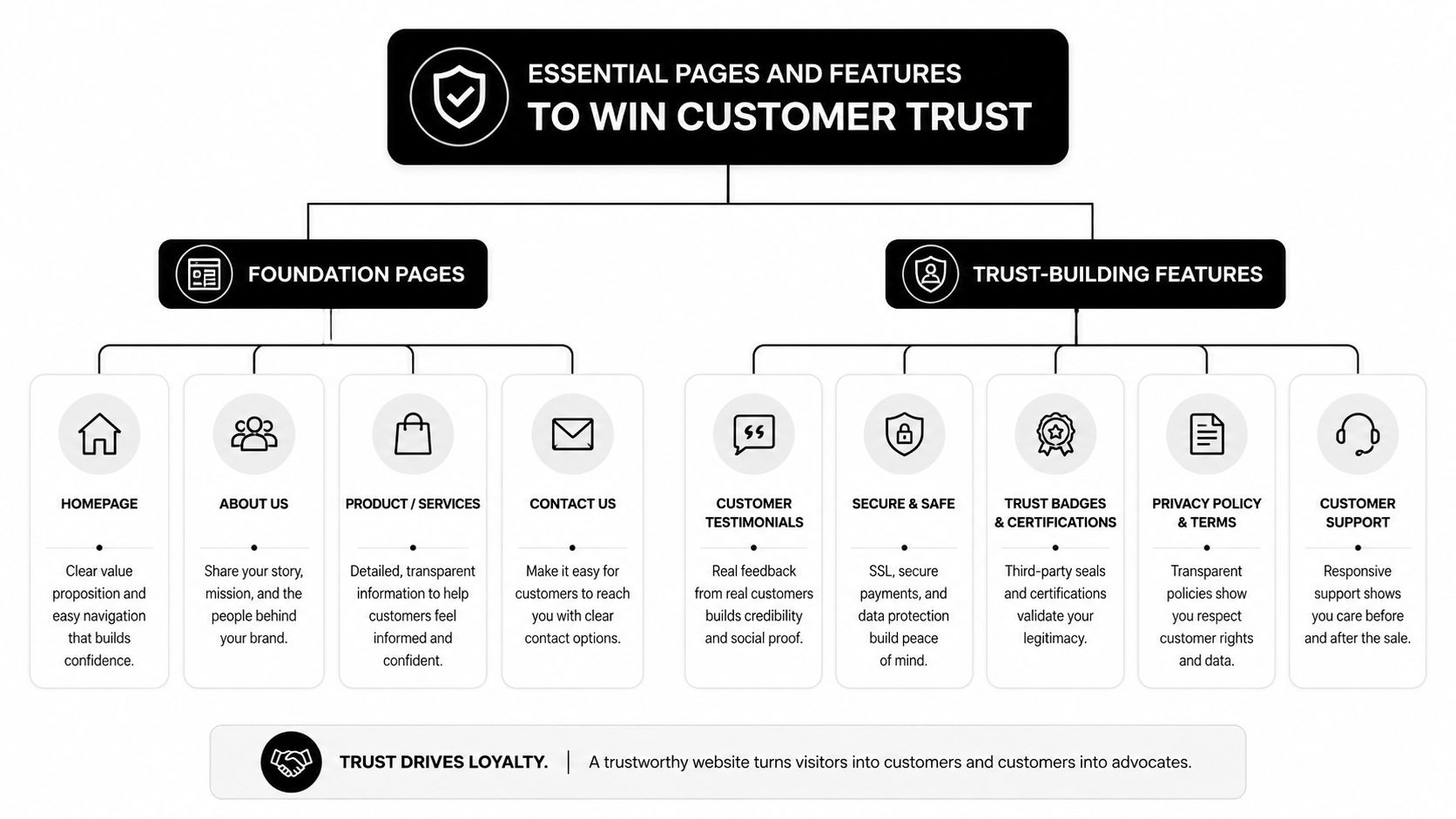
A tradie site doesn't need dozens of pages. It needs the right pages, with the right proof, in the right order. People don't read websites like brochures. They scan for signs that you're legitimate, relevant to their job, and easy to contact.
That's why design quality matters so much in this category. 94% of first impressions are influenced by website design quality, and 75% of users judge credibility based on how a website looks and feels, according to Marketing for Tradies. For a local service business, those first seconds often decide whether someone calls you or goes back to Google.
The homepage should qualify and direct
Your homepage isn't there to say everything. It should do four jobs fast. State what you do, show where you work, prove you're trustworthy, and make contacting you easy.
A strong tradie homepage usually includes:
- A clear headline: Say the trade and service area plainly. Don't hide it behind slogans.
- Primary actions: Click-to-call, quote request, or both.
- Trust proof near the top: Reviews, licences, years in business, certifications, or association badges.
- A short service overview: Enough to guide people to the right page.
- Real project images: Not generic stock shots of tools and hard hats.
If the first screen is vague, cluttered, or all branding, visitors have to work too hard. Most won't.
Service pages do the real selling
The biggest mistake I see in web design for tradies is one generic “Services” page. That setup makes life harder for both customers and search engines. Separate pages for each core service are almost always better.
A good service page should answer practical questions. What's included. Who it's for. What kinds of properties you work on. What problems you solve. What the next step is.
For example, a plumber might split pages into blocked drains, hot water systems, leak detection, burst pipes, and bathroom plumbing. A builder might split by renovations, extensions, decks, carports, and bathroom builds. That structure builds relevance and trust.
If you want more quote requests, give each profitable service its own page and its own reason to exist.
Proof pages matter more than most tradies think
People say they choose on price, but they filter by trust first. That's where these pages do heavy lifting:
- Gallery or project page: Show finished work, not just close-up tool shots. Include context where useful.
- Reviews and testimonials: Put them where people are deciding, not hidden on one lonely page.
- About page: Keep it practical. Who you are, what you specialise in, and why people can trust you.
- Certifications and licences: Especially important for electrical, gas, structural, and regulated work.
If you prepare quotes digitally, it also helps to connect the website to your sales process. For plumbing businesses, tools like Exayard plumbing estimating software can support faster, more organised quoting once a lead comes in.
Calls to action should be impossible to miss
Tradies lose leads when the contact path is awkward. The phone number should be clickable on mobile. Quote forms should be short enough that people will complete them. Buttons should appear on service pages, gallery pages, and key trust sections.
If you're trying to strengthen social proof before launch, this guide on getting more Google reviews is worth reading because review volume and recency often influence whether a visitor contacts you at all.
A trust-building website feels organised, current, and easy to use. It doesn't need to be flashy. It needs to make the customer feel safe choosing you.
Getting Found with Local SEO and Google Business Profile
A good-looking site that nobody finds won't help your business. For tradies, the main battleground is local search. When someone types a trade plus a suburb or nearby area, you want your website and Google Business Profile working together, not acting like separate assets.
WordPress is often the most practical CMS for this because it handles service-page growth, suburb targeting, and plugin-based SEO setup well. According to Four Stripes' tradie website design guide, 87% of consumers use Google to evaluate local businesses, and a conversion rate above 2.35% is a strong target for a lead-focused site. That's why local visibility and trust signals deserve serious attention.
Build pages for services and locations
One of the simplest ways to improve local relevance is to create dedicated pages for each core service, then make sure those pages clearly mention the areas you service where appropriate. Don't stuff suburb names everywhere. Write naturally, but be specific.
A stronger structure looks like this:
- Main service page for the actual job.
- Supporting location relevance in headings, body copy, and service-area references.
- Consistent business details across your site and listings.
- Supporting proof such as reviews, photos, and completed work examples.
For WordPress sites, tools like Yoast can help manage page titles, descriptions, and on-page SEO without making routine updates painful.
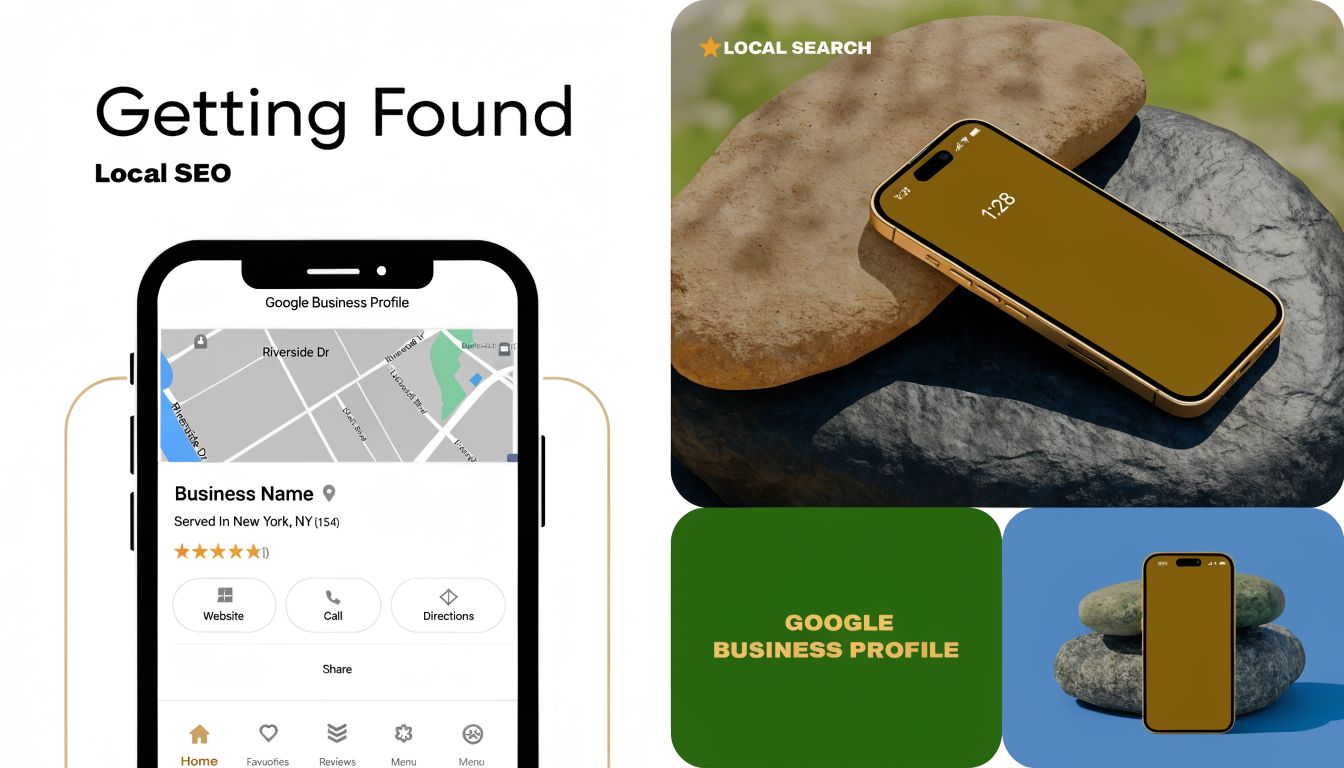
Your Google Business Profile needs active management
A neglected profile sends the wrong signal. Customers use it to check whether you're active, local, and credible. Google uses it as a local trust layer. Your website reinforces that.
Focus on the basics first:
- Choose accurate services: Don't list everything loosely. Match your actual work.
- Upload real photos: Team photos, vans, job types, and finished results all help.
- Keep business details consistent: Service areas, opening hours, and contact details need to match your site.
- Collect reviews steadily: Don't leave review gathering to chance.
- Use posts and updates when relevant: They show activity and can support visibility.
If you need a practical local search primer, this overview of local SEO for businesses explains the moving parts in plain language.
Reviews don't just persuade customers. They also support the credibility of your local search presence.
Reviews, content, and conversions connect
A lot of tradies treat SEO like a technical job. It isn't only technical. It's also about proof and clarity. Local pages rank better when they're useful. Useful pages convert better when they include proof. Reviews help on both fronts because they reinforce trust before contact.
For businesses that want outside help understanding the broader SEO work involved, looking at providers that specialise in digital marketing services for SEO can give you a clearer sense of what ongoing optimisation usually includes.
The best setup is simple. Your Google Business Profile gets you visibility. Your website confirms you're the right choice. Your service pages and trust elements turn that visit into a call or quote request.
Launch Checklist and Keeping Your Site Working for You
A website launch isn't the finish line. It's the point where the site starts proving whether it can do its job. Too many tradies go live, tick the box, and never test anything again.
Before launch, run through the basics properly. Not quickly. Properly.
Pre-launch checks that actually matter
- Test every contact path: Call buttons, forms, email links, and thank-you pages all need checking on mobile and desktop.
- Read every key page aloud: This catches awkward wording, missing suburbs, repeated phrases, and basic errors.
- Check image choices: Use real work where possible. Make sure photos aren't stretched, blurry, or irrelevant.
- Review page order on mobile: Most tradie traffic is mobile-heavy in practice, so what appears first matters.
- Confirm tracking is active: You need to know which pages people visit and which actions they take.
- Look for dead ends: Every major page should point toward a next action.
Keep the site maintained
Even a solid WordPress site needs upkeep. Plugins need updates. Forms need testing. Old content needs review. Review widgets, galleries, and map embeds can break without warning, and broken trust elements cost leads.
A simple maintenance rhythm works well:
- Monthly: Check forms, phone links, plugin updates, and site speed.
- Quarterly: Refresh photos, add new reviews, and tighten any weak service pages.
- After major jobs: Upload fresh project examples while the work is still current.
- When services change: Update the site immediately. Don't leave outdated offers live.
A tradie website should age like an active business, not like an abandoned brochure.
Watch behaviour, then improve small things
You don't need a complicated reporting stack. Start by asking a few useful questions. Which pages get visited most. Which pages trigger calls or form submissions. Where do people drop off. Which service pages attract enquiries, and which ones get traffic but no action.
Then make small changes. Tighten a headline. Move the phone button higher. Shorten a quote form. Swap a weak image. Add stronger proof near a CTA. Good websites improve because someone keeps paying attention.
That's how web design for tradies becomes an asset instead of a one-off project. The businesses that get more from their sites are usually not the ones with the fanciest designs. They're the ones that keep the site accurate, visible, and easy to act on.
If you want a tradie website that's built to generate calls, quote requests, and local visibility, Website Builder Australia can help. Their team builds custom, responsive websites for Australian businesses and supports the full picture, including hosting, maintenance, SEO, and digital marketing, so your site keeps working after launch.


