

Website Design Services for Small Business A Complete Australian Guide
Professional website design services for small business are about more than just a pretty facelift for your site. They’re about creating a strategic asset—a tool designed from the ground up to build credibility, bring in leads, and ultimately, drive revenue.
It's the difference between having a simple online brochure and owning a powerful, automated business tool that works for you 24/7.
Why Your Business Needs More Than a Basic Website
In today's market, just "having a website" isn't going to cut it. Think of your social media profiles as temporary market stalls. They're great for quick chats and catching passing trade, but you’re entirely at the mercy of the market owner's rules. A professionally built website, on the other hand, is your flagship store. It’s the one piece of digital real estate you truly own and control.
This ownership is absolutely critical. While social media is an important part of the mix, you’re essentially just renting space. A sudden algorithm change or a new policy can decimate your reach overnight. Your website is the central hub for all your marketing, anchoring your brand and giving you complete authority over your message and, importantly, your customer data.
From Online Presence to Business Asset
A well-built website transforms your digital footprint from a fleeting impression into a credible, lead-generating machine. Research consistently shows that a massive 75% of consumers judge a company's credibility based purely on its website design. A dated, clunky, or broken site doesn't just look bad; it actively drives potential customers away before they even find out what you do.
By mastering user experience optimisation, you ensure your site doesn't just look the part but actually performs, guiding visitors smoothly from interest to action.
This is where professional website design services for small business prove their worth. A good agency focuses on building a site that is:
- Credible and Trustworthy: A polished, modern design instantly signals professionalism and inspires confidence in your brand.
- A Central Marketing Hub: It’s the anchor that connects all your channels—from SEO and Google Ads to email and social media—into one cohesive strategy.
- A Lead Generation Engine: It uses clear calls-to-action, smart contact forms, and optimised landing pages to actively turn visitors into valuable leads and customers.
The Foundation of Digital Growth
At the end of the day, investing in a quality website isn't just another business expense; it's a foundational step towards sustainable growth. It establishes your brand's authority in your industry, captures leads while you sleep, and provides a stable platform to build all your future marketing campaigns on.
It’s the difference between shouting in a crowded marketplace and inviting customers into your own perfectly organised, welcoming storefront.
Decoding What Website Design Services Include
When you first hear the term “website design services,” it’s easy to feel a bit lost. It sounds like a single thing you can buy off a shelf, but it’s actually more like a multi-course meal with lots of different parts. Getting your head around these components is the key to knowing what you're paying for and, more importantly, what your business genuinely needs to succeed online.
Think of it like building a house. You wouldn't just tell a builder, "build me a house." You'd talk through the architectural blueprints, the construction materials, the plumbing, and the electrical systems. Website design services are exactly the same, covering everything from the initial sketch on a napkin to a fully functional digital storefront ready for customers.
For Australian businesses, this process is more critical than ever. The demand for modern, effective websites has skyrocketed, pushing the local web design services market to an impressive $1.4 billion in 2024. This massive growth is all thanks to small businesses finally realising that a professional online presence is no longer a 'nice-to-have'—it's essential.
Custom Visual Design: The Architectural Blueprint
This is where it all begins—the very first stage where the look and feel of your website are born. It's so much more than just picking a few colours and a nice font. It’s about translating your brand's heart and soul into a visual language that truly connects with your customers. Your designer is like your digital architect, creating the blueprint for your new online home.
This includes:
- Brand Alignment: Making sure the design uses your logo, colour palette, and typography consistently. This builds brand recognition and trust.
- User Interface (UI) Design: Crafting all the visual bits and pieces users interact with—like buttons, menus, and forms—so they're not just beautiful, but also a breeze to use.
- User Experience (UX) Strategy: Mapping out the entire journey a visitor will take. The goal is to make it dead simple for them to find what they need, creating a smooth, frustration-free experience.
A brilliant design doesn't just look pretty; it makes visitors feel understood and guides them effortlessly toward taking action, whether that’s buying a product or sending an enquiry.
A well-designed website acts as your best salesperson, available 24/7. It communicates your value, builds trust, and makes it simple for customers to do business with you, even when you're not there.
Web Development: The Construction Crew
Once the blueprint gets the thumbs-up, the developers step in. Think of them as the construction crew. They take those static visual designs and bring them to life, turning them into a live, functioning website with code and technology.
Web development is generally split into two camps:
- Front-End Development: This is everything your visitors see and interact with. Using languages like HTML, CSS, and JavaScript, developers build the responsive layout, slick animations, and all the interactive elements from the design phase.
- Back-End Development: This is the engine room—the behind-the-scenes magic. It includes the server, database, and application logic that makes everything tick. For most small businesses, this involves setting up a Content Management System (CMS) like WordPress, which lets you update your own content without having to touch a line of code.
This technical foundation is what makes your site fast, secure, and ready to grow with your business.
Integrations and E-commerce: The Utilities
Finally, what good are website design services for small business without the features that turn your site into a real business tool? This final stage is like getting the plumbing and electricity hooked up in your new house. It connects your website to other essential systems and adds powerful functionality.
Beyond the visuals, this can mean connecting your CRM for lead management or even integrating chatbot functionality for instant customer support.
For businesses selling products online, this is where e-commerce capabilities are built. It involves setting up product pages, secure payment gateways, and shipping calculators to create a seamless shopping experience that drives sales and keeps your customers coming back for more.
Understanding Website Design Costs in Australia
It's the first question on every business owner's mind: "So, how much is a new website going to set me back?" And it's a perfectly fair question. The truth is, investing in website design services for small business isn't like buying something off the shelf. It’s more like commissioning a custom-built tool designed specifically for your business.
The price tag can swing from a few thousand dollars for a simple, professional online brochure to tens of thousands for a complex e-commerce machine. Think of it like buying a vehicle. A local tradie might just need a reliable ute to get around and showcase their work (a brochure site), while a national retailer needs a whole fleet of delivery trucks (a sophisticated e-commerce platform). Both are vehicles, but their purpose, complexity, and cost are worlds apart.
Your budget should really just be a reflection of your business goals. A clean, sharp-looking site might be all a Brisbane-based consultant needs to look professional and get the phone ringing. But if you're building an online store, you’ll need a much bigger investment to handle things like secure payments, inventory, and a smooth customer checkout process.
Common Pricing Models Explained
Once you start getting quotes, you'll see a few different ways agencies structure their pricing. Getting your head around these helps you compare apples with apples and understand exactly where your money is going. In Australia, you'll mainly come across three models.
- One-Off Project Fee: This is the most common approach for a brand new website or a major overhaul. You agree on a fixed price for a clearly defined scope of work, which gives you complete certainty over your budget.
- Hourly Rates: This model works best for smaller, one-off jobs, like adding a new feature or fixing a nagging issue. Rates can vary a lot depending on an agency's experience and location.
- Monthly Retainer: This is for ongoing work like website maintenance, security checks, SEO, or content updates. It ensures your site is always looked after and continues to work hard for your business.
A cheap website almost always ends up being the most expensive. You might save a few bucks upfront, but the cost of lost customers, security problems, and needing a complete rebuild down the line can be devastating for a small business.
Why Australian Developers Cost More (And Why It's Worth It)
It's easy to be tempted by cheap quotes from overseas developers and wonder why the local agencies in Brisbane or Sydney seem so much more expensive. The price difference is definitely real, but so is the difference in the value you get. Choosing a local agency isn't just about being patriotic; it's a smart business move.
Local agencies give you:
- Same-Timezone Support: When something breaks, you can just pick up the phone and talk to a real person who can fix it—not wait 24 hours for an email reply from a different time zone.
- Local Market Knowledge: An Australian team gets the local market. They understand your customers, what they expect, and what it takes to stand out from your direct competitors.
- Direct Accountability: Working with a local business means clear communication and real accountability. There are no language barriers or cultural mix-ups to worry about.
At the end of the day, paying a bit more for local expertise usually leads to a much better result and a far smoother process. The peace of mind and long-term return are well worth it. For a more detailed breakdown, you can learn more about website design costs in Australia here.
Sample Website Design Packages for Australian Small Businesses
To give you a clearer picture of how your budget lines up with your business goals, we've put together a few sample packages. This table breaks down what you can generally expect at different investment levels.
| Package Type | Ideal For | Key Features Included | Estimated Price Range (AUD) |
|---|---|---|---|
| Starter/Brochure Site | Local service businesses, tradies, consultants | 5-7 pages, mobile responsive, contact form, basic SEO setup. | $3,000 – $7,000 |
| Business Growth Site | SMBs wanting to generate leads online | Custom design, CMS like WordPress, blog, advanced SEO, integrations. | $7,000 – $15,000 |
| E-commerce Store | Retailers selling products online | Secure payments, product/inventory management, shipping integration. | $10,000 – $25,000+ |
| Custom Web Application | Businesses with unique functional needs | Bespoke features, complex integrations, user accounts, specific workflows. | $25,000+ |
Think of these as a starting point. The final cost will always depend on your specific needs, but this guide should help you budget realistically and find a package that matches your ambitions.
The Website Design Journey From Concept To Launch
Kicking off a new website project can feel a bit daunting. It often seems like a long, winding road filled with technical jargon and murky steps. But when you partner with the right team for website design services for small business, that journey becomes a clear, collaborative, and genuinely exciting process.
Think of it less like a solo trek through the bush and more like a guided expedition. A good agency is your guide, breaking the whole thing down into manageable stages. From the first brainstorming session to the final, thrilling launch day, you’ll always know what’s happening, what’s needed from you, and what’s coming up next.
This flowchart gives you a bird's-eye view of how a well-run project flows from one logical step to the next.
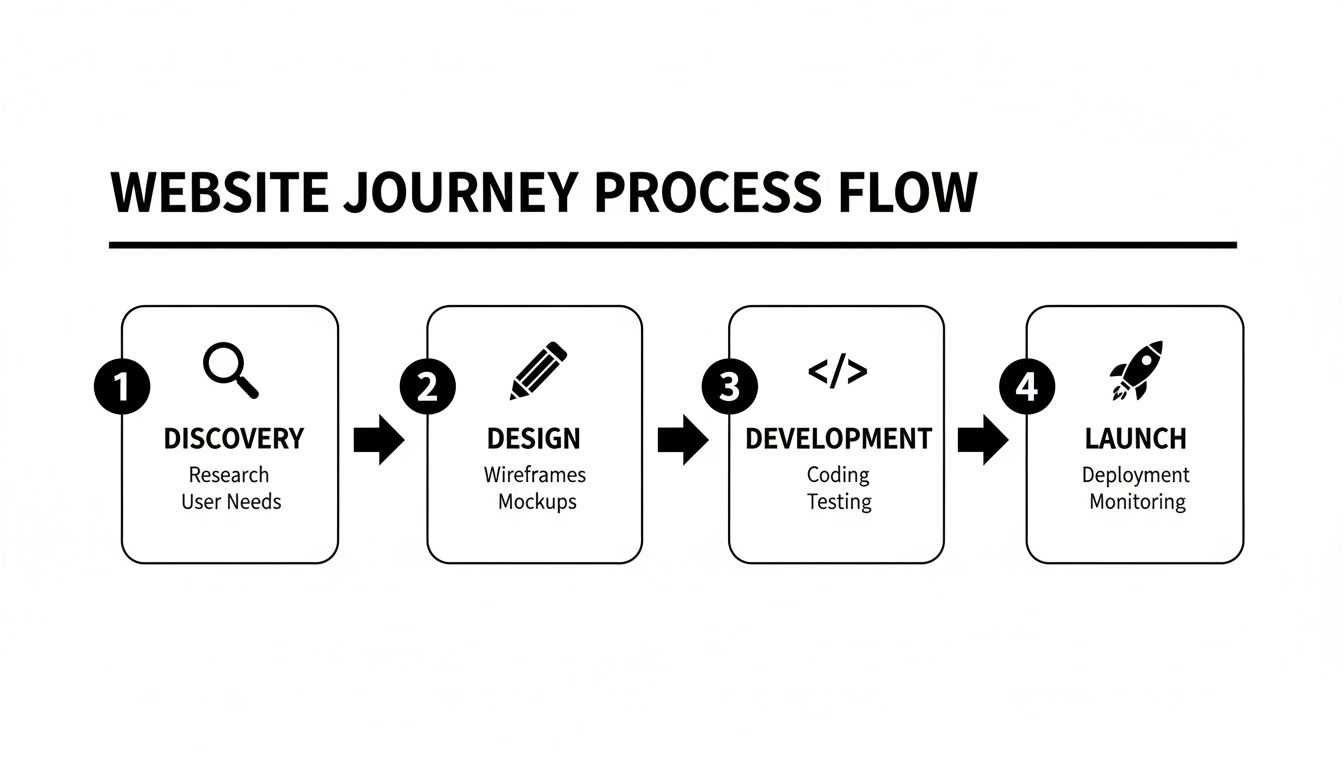
As you can see, a successful build isn't a chaotic scramble. It's a clear, four-stage journey that takes us from understanding your vision to celebrating your brand-new digital home. Let's walk through what each of these stages really looks like.
Phase 1: The Discovery and Strategy Session
Every great website starts with Discovery. Honestly, this is the most critical phase because it lays the foundation for everything that follows. It's much more than a casual chat; it's a deep dive into the heart of your business.
We'll work together to get crystal clear on:
- Your Business Goals: What does this website need to do? Are we chasing more leads, driving direct sales, or building up your brand's reputation?
- Your Target Audience: Who are we talking to? What makes them tick, what problems are they trying to solve, and what are they looking for online?
- Your Competitors: What are the other players in your space doing well, and where are the gaps we can exploit to make you stand out?
This phase wraps up with a detailed plan and a sitemap, which is essentially the blueprint for your new website. To get a better handle on this, have a look at our guide on crafting a comprehensive design brief.
Phase 2: The Design and Prototyping Stage
With a solid strategy locked in, we move into the fun part: the Design phase. This is where your brand’s personality starts to take visual form. Our designers will create mockups, which are static pictures of what your future website will look like.
But this isn't just about making things pretty. It’s all about creating an intuitive user experience (UX) that guides your visitors exactly where you want them to go. We focus on dead-simple navigation, powerful calls-to-action, and a visual style that immediately builds trust. You'll get plenty of chances to review the designs and give feedback before a single line of code gets written.
Phase 3: The Development and Content Integration
Once you’ve given the designs the green light, our developers roll up their sleeves. They take those static mockups and breathe life into them, turning them into a fully functional, interactive website. This is where all the coding happens to make sure your site is fast, secure, and looks schmick on every device, from a big desktop monitor to a smartphone.
During this stage, we also plug in all your content—the text, images, and videos that tell your story. Having your content ready to go is a huge help in keeping the project moving along on schedule.
Phase 4: Testing and The Exciting Launch
Before your website goes live to the world, it goes through a rigorous testing phase. We’re like digital detectives, checking every link, every form, and every button on different browsers and devices to hunt down and squash any pesky bugs.
Once everything is pixel-perfect and working flawlessly, it’s launch time. We handle all the technical bits and pieces of deploying the site to your domain and flicking the switch. This final step isn't the end, but the beginning of your new and improved online presence, ready to attract customers and grow your business.
Right, let's talk about picking the team that's going to build your new website. This is a big decision. It’s not like hiring a sparky for a one-off job; you're choosing a digital partner who will be a massive part of your business's growth journey.
The right agency won't just feel like a supplier—they'll feel like an extension of your own team. It's about finding people you click with, who have the technical skill to back it up, and who will stick around to help you long after the site goes live.
Making the right choice means you have to look past the shiny homepages and really dig into what makes an agency tick. You need a team that gets your vision, can build it right, and is there to support you down the track.
Look Beyond The Pretty Portfolio Homepage
Every agency is going to show off its best work, right? Their portfolio will be full of their most visually impressive projects. And while a good-looking portfolio is a great start, you need to go a bit deeper. Don't let the pretty pictures distract you from what really matters: results.
As you're browsing through their work, start asking some hard questions:
- Is this relevant to me? It's great if they've built a heap of slick websites for trendy cafes, but if you're selling industrial machinery, is their experience a good fit for your business?
- Do these sites actually work well? Don't just look at the screenshots. Click the links. Visit the actual websites. Are they quick to load? Is the navigation intuitive? Critically, how do they look and feel on your phone?
- What was the outcome? A beautiful website is one thing. A website that doubled a client's online leads is another thing entirely. Look for case studies that spell out the real-world business impact of their work.
A strong portfolio isn't just about design flair; it's proof they know how to build websites that solve genuine business problems.
Read Between The Lines Of Testimonials
Testimonials and online reviews are your secret weapon. They're a direct window into what it's really like to work with an agency. I always recommend checking out reviews on third-party sites like Google, as they tend to be more candid than the glowing quotes an agency hand-picks for their own website.
Pay close attention to what past clients are saying about the day-to-day stuff:
- Communication: Did the agency keep them in the loop? Were they easy to get a hold of when questions came up?
- Problem-Solving: Let's be real—hiccups happen. When they did, how did the team respond? Did they own it and fix it, or did they go quiet?
- Aftercare: What happened once the site was launched? Was there support for training, bug fixes, and those little tweaks you always think of later?
A testimonial that says, "They were fantastic to work with and always replied to my emails within an hour," tells you so much more about the actual experience than a generic "We love our new site."
Understand Their Tech and Support
The technology an agency uses—their tech stack—is more important than you might think. For most Aussie small businesses, you'll want a website built on a widely used Content Management System (CMS) like WordPress. Why? Because it means you're never locked in. You're not tied to a weird, proprietary system that only one developer in the world knows how to use.
Just as crucial are the Support Level Agreements (SLAs). This isn't just jargon; it’s a formal document that lays out exactly what level of support you can expect. It should clearly state things like response times for urgent issues, how software updates are handled, and what's covered in your maintenance plan.
This is where choosing a local team, like a website design agency in Brisbane, can be a game-changer. There's a huge peace of mind that comes with having a partner in your own timezone who gets the local market. When things go pear-shaped and you need help fast, you want to be able to pick up the phone and talk to a real person—not submit a ticket to a faceless helpdesk on the other side of the planet. A local partner brings accountability and a level of service that’s hard to beat.
Growing Your Business After The Website Launch
So, your new website is live. Congratulations! That’s a huge milestone, but it’s crucial to see this as the starting line, not the finish. A great website is a powerful launchpad, and now it’s time to fuel the engine and turn that potential into real, measurable business growth.
Simply letting your new site sit there is like buying a brand-new delivery truck and leaving it parked in the garage. To see a genuine return on your investment, you need an ongoing strategy to bring customers to your digital doorstep and keep them coming back. This is where post-launch services come into their own.
The Foundation: Web Hosting and Maintenance
Before you even think about marketing, you need to make sure your website's foundation is rock-solid. This all starts with two critical, non-negotiable services: web hosting and maintenance.
- Web Hosting: Think of this as the plot of land your website is built on. Quality hosting ensures your site loads quickly and is available 24/7. A slow-loading site frustrates users and gets penalised by search engines, making this an essential first step.
- Website Maintenance: This is your ongoing security and upkeep. It involves regular software updates, security scans, and backups. Neglecting maintenance leaves your site vulnerable to hackers and performance problems, which can quickly destroy customer trust.
These two services work hand-in-hand to keep your digital asset secure, fast, and reliable—the bedrock for all your future marketing efforts.
Driving Traffic and Building a Community
With a secure and stable website, you can confidently start bringing in traffic. This is where strategic marketing services turn your site from a static brochure into a lead-generation machine. While there are plenty of options, a few core strategies deliver the biggest punch for small businesses.
This is especially true in Australia, where there's a surprising gap in the market. A staggering 41% of small businesses still don't have a website, often due to cost concerns or a lack of technical know-how. Yet, with two-thirds of consumers admitting they won't even consider a business they can't find online, having a site and actively marketing it gives you a massive advantage. You can discover more about these web design statistics and what they mean for your business here.
A website without a marketing plan is like a shop with no signs, no advertising, and no front door. It might exist, but nobody will ever find it. Sustainable growth comes from actively guiding customers to your digital front door.
Key growth services to consider include:
- Search Engine Optimisation (SEO): This is the long-term play for attracting "free" organic traffic from search engines like Google. By optimising your site's content and structure, you slowly but surely climb the rankings for the keywords your customers are searching for.
- Pay-Per-Click (PPC) Advertising: Services like Google Ads offer immediate visibility. You pay for ads that appear right at the top of search results, driving targeted traffic to your site straight away—perfect for promotions or generating leads quickly.
- Social Media Management: This is all about creating a community around your brand on platforms like Facebook and Instagram. It builds loyalty and drives traffic back to your website, where you can convert followers into customers.
Ultimately, the best website design services for a small business are those that provide a clear path for growth after launch, ensuring your investment continues to pay dividends for years to come.
Frequently Asked Questions
When you're looking into website design services for a small business, a few questions always seem to pop up. It's totally normal. Getting clear, straight answers is the best way to feel confident about where you're putting your money. Let's tackle some of the most common queries we get from Aussie business owners just like you.
How Long Does It Take to Build a Small Business Website?
Honestly, it varies, a bit like building a house. For a straightforward, elegant "brochure" style website with about 5-7 pages, we can often get you from design and development to launch within 4 to 6 weeks. That's assuming you’ve got your text and images ready to roll.
On the other hand, if you're dreaming bigger—say, an e-commerce store with hundreds of products and all the custom bells and whistles—it’s a more involved project. These larger builds usually take anywhere from 8 to 16 weeks, sometimes more. There's just more complexity with things like payment gateways, stock management, and shipping rules. The biggest thing that keeps a project on track? Your timely feedback and getting content to us when we need it.
Can I Update the Website Myself After It Is Built?
Absolutely! Making sure you can manage your own site is a huge part of what we do. The vast majority of websites we build use a Content Management System (CMS), and our go-to is WordPress. A CMS is just a fancy term for a user-friendly backend that lets you log in and make changes without touching a single line of code.
Think of it like editing a document in Microsoft Word. You’ll be able to easily:
- Post new blog articles or company news.
- Tweak the text on your 'About Us' or services pages.
- Upload new photos to a gallery.
- Update your contact details or opening hours.
We always include training so you feel completely comfortable and empowered to take the reins.
Do I Need Ongoing Maintenance for My Website?
Yes, and this one’s non-negotiable. A website isn't a 'set-and-forget' purchase; it's a living, breathing piece of software that needs regular TLC to stay secure and run properly. Without it, your site becomes a sitting duck for hackers, slow-downs, and broken features.
Think of it this way: you wouldn't buy a brand new car and then never get it serviced. It might run perfectly for a while, but sooner or later, problems will pop up. Website maintenance is your digital tune-up, keeping your investment safe and humming along nicely.
A good maintenance plan covers all the essentials: software updates, security scans, performance checks, and regular backups. It’s the peace of mind that comes from knowing your site is fast, safe, and always open for business.
What Is the Difference Between a Custom Website and a Template?
The biggest difference comes down to strategy and originality. A template-based website is built using a pre-made design. We drop your content into the existing layout. It's a quicker and more budget-friendly route, but the trade-off is that you're stuck with the template's limitations, and your site might end up looking a lot like others out there.
A custom website, however, is designed and built from the ground up, just for you. Every single part of it—the strategy, the user journey, the look and feel—is crafted around your specific brand, your customers, and your business goals. It’s a bigger investment upfront, but a custom site gives you a powerful competitive edge because it's built to solve your unique problems.
Ready to get a website that not only looks the part but actually drives real growth for your business? The team at Website Builder Australia is here to help. We offer a full range of website design, development, and marketing services to help your Brisbane or Australian business really shine online.


