

NDIS Digital Marketing: Your 2026 Growth Playbook
You've set up the business, registered the basics, sorted your service offering, and maybe even hired good staff. But the calendar still has gaps. That's the point where most new providers realise the problem isn't service quality. It's visibility, trust, and how clearly the business shows up online.
That's where NDIS digital marketing either becomes a growth engine or a money pit.
A lot of providers get pushed into the usual checklist. Build a website. Run some Google Ads. Post on Facebook. Try SEO. The problem is that generic advice doesn't account for how people choose NDIS services in Australia. Participants, carers, families, and support coordinators don't respond to slick marketing. They respond to clear information, local relevance, accessibility, and confidence that you understand the rules.
The providers who grow steadily tend to do a few things well. They validate demand before choosing where to market. They build a site that people can use. They create local search visibility instead of chasing broad keywords. And they don't ignore referrals, which remain one of the strongest trust channels in this sector.
The Digital Shift in NDIS Participant Engagement
If you're still treating digital as a side task, you're competing with one hand tied behind your back. The Australian online advertising industry is projected to reach $19.2 billion in 2026, with 4.7% CAGR between 2021 and 2026, and revenue climbing at an annualised 6.5% over the past five years, according to IBISWorld's Australian online advertising industry data. That matters because it confirms where attention and budget are already flowing. NDIS providers aren't operating outside that environment. They're inside it.
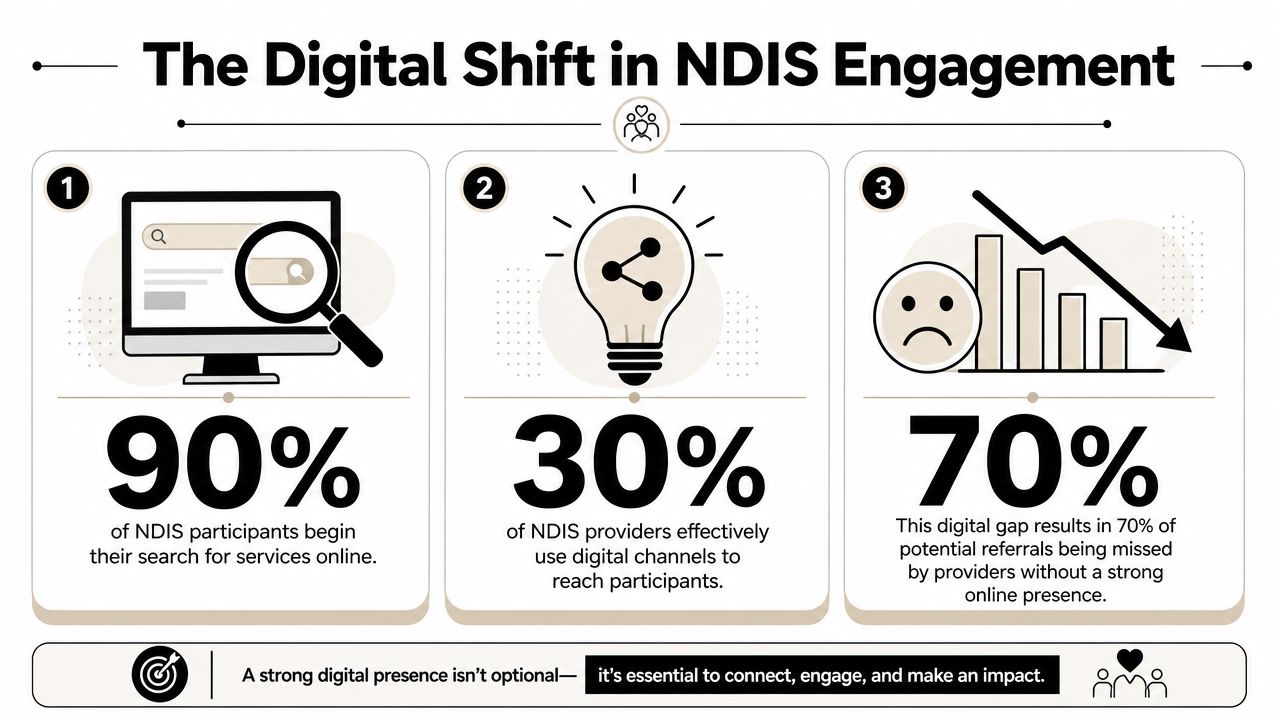
What digital shift actually means for a provider
In practice, this means your website, Google presence, reviews, service pages, and social content are often your first interaction with a participant or referrer. Before anyone picks up the phone, they're trying to answer basic questions:
- Can this provider help with my needs
- Do they service my area
- Do they explain things clearly
- Do they look trustworthy and organised
- Can I contact them without friction
If those answers aren't obvious, people keep searching.
That's why NDIS digital marketing isn't just promotion. It's operational clarity made visible. A strong digital presence tells people what you do, who you support, where you operate, and what happens next if they enquire. A weak one creates uncertainty. In this sector, uncertainty kills enquiries quickly.
Why a scattergun approach fails
Many providers waste budget because they start with tactics instead of decisions. They pay for clicks before checking local demand. They target statewide phrases when their actual service radius is narrow. They publish polished but vague copy that never answers participant concerns.
Practical rule: Don't market everywhere. Market where you can deliver, where demand exists, and where your message can be specific.
There's also a compliance layer that makes careless marketing more risky here than in many other industries. Overclaiming, using unclear language, or pushing people into contact too aggressively can damage trust fast. NDIS marketing has to work commercially without sounding like a hard sell.
The better approach is straightforward. Build on real demand, local relevance, accessible design, and messages that respect how decisions get made in disability services. That gives you a foundation that's far more stable than chasing random traffic or vanity metrics.
Building Your Foundation on Audience and Compliance
Before you touch ads, SEO tools, or content calendars, get clear on who you're speaking to. In most NDIS businesses, there are three distinct audiences, and each one reads your website differently.
Australia is projected to have 21.3 million active social media users in 2026, representing 82% of the population, which is why platforms such as Facebook remain important touchpoints for participants and families, according to Australian digital marketing benchmarks compiled by Odin Digital. That doesn't mean every audience behaves the same way on those platforms. They don't.
The three audiences you need to address
Participants usually want plain English, service fit, and ease of contact. They need to know what support looks like in day-to-day terms, not industry jargon.
Families and carers often look for reassurance. They're checking whether your team seems reliable, responsive, and respectful. They also tend to compare providers more carefully because they're helping manage risk.
Support coordinators are different again. They want clarity, fast qualification, current capacity, service areas, and confidence that your intake process won't create extra work for them.
A homepage that tries to speak to all three at once often ends up saying very little. Your messaging needs to separate these needs cleanly across pages, FAQs, and calls to action.
A practical way to do that is to structure your site around service pages, location pages, intake information, and referral-friendly content. If you're reviewing your site architecture, a specialised reference point like this guide to NDIS web design is useful because it keeps the focus on accessibility, clarity, and enquiry flow rather than generic design trends.
What compliant marketing sounds like
Compliance in NDIS marketing isn't only about what you publish in ads. It also affects testimonials, sponsored content, landing pages, and social posts. If something reads like editorial content but is promotional, it needs to be disclosed properly. That's why it's worth understanding broader disclosure principles through a practical resource such as Understanding advertorial disclosure rules.
Compliance warning: Don't imply outcomes you can't guarantee. Don't use language that overpromises access, results, approval, or participant benefit.
Here's the trade-off. Soft, vague copy feels safe, but it often performs badly. Overconfident copy may attract attention, but it creates compliance and trust problems. The middle ground is better. Be specific about services, locations, process, and suitability.
Better wording choices
| Risky wording | Safer wording |
|---|---|
| We guarantee the best support | We provide tailored support based on individual needs |
| We can help everyone on the NDIS | We support participants within our listed service areas and service scope |
| Get approved fast | We can explain our intake process and how to get started |
| We're the top choice for participants | We focus on clear communication, reliable service delivery, and accessible support |
If your marketing copy sounds like it belongs in a high-pressure sales funnel, it's probably wrong for this space.
The providers who build strong reputations usually sound calm, capable, and transparent. That tone doesn't weaken your marketing. It makes it believable.
Find Your Participants with Data-Driven Local SEO
Local SEO for NDIS providers should start with market validation, not keyword brainstorming. Too many businesses choose a suburb because it feels promising, then spend months trying to rank in an area that doesn't fit their operations or demand profile.
The smarter move is to validate demand first. A practical method used in Australian NDIS marketing is to access the Participant Data module at data.ndis.gov.au, calculate participant volume by geography, and assess suburbs within a 30-minute operational hub so you can confirm there's enough “market juice” before you spend money or time on promotion, as outlined in this NDIS marketing methodology discussion.

Start with service radius, not ambition
Your ideal map isn't the largest one. It's the one you can service consistently.
Begin by defining your operational centre. That might be an office, a therapy clinic, or a practical travel base for mobile support. From there, map the suburbs you can realistically serve without stretching staff, travel time, or participant experience.
Then compare those areas against participant volume and service fit. If you're a small provider, this step matters even more. A narrower area with strong demand and easier logistics usually beats a broad footprint with inconsistent delivery.
Turn data into a keyword plan
Once you've validated the locations, build your keyword list around actual service and suburb combinations. That means phrases like service type plus location, not generic statewide language.
Use a simple working structure:
Core service pages
Create pages for each real service you deliver, such as support coordination, occupational therapy, community access, or plan management.Location-specific pages
Build pages for the suburbs or local areas you've already validated, but only if you are capable of servicing them.Intent-based wording
Write headings and copy around what people search for, such as “NDIS occupational therapy in [location]” or “support coordinator [location]”.Referral-friendly content
Include information that helps support coordinators assess fit quickly, such as referral process, intake criteria, and contact pathways.
If you want help refining keyword sets and page structure without defaulting to generic AI copy, a tool like SEO Agent can help organise local search intent and content planning.
Google Business Profile matters more than most providers think
Your Google Business Profile is often the difference between being considered and being skipped. It needs to match your site, your service area, and your actual business details.
Focus on the basics:
- Business categories: Choose the closest fit to your real services.
- Service areas: Keep these aligned with the locations you can support.
- Photos and updates: Use real imagery and current information.
- Reviews: Build them steadily and ethically.
- Website connection: Link to the most relevant landing page, not always just the homepage.
For local search, this kind of setup often does more than broad blog content alone. If you want a practical reference for the moving parts involved, this resource on local SEO for businesses is a good companion.
Local SEO works best when your geography, staffing, website pages, and Google listing all say the same thing.
That consistency is what Google reads, but it's also what participants and referrers trust.
Build Trust with Content and Referral Strategies
Ranking is only half the job. After someone finds you, they still need a reason to choose you.
For NDIS providers, content isn't about gaming the algorithm with endless blog posts. It's about reducing uncertainty. Families want to know how services work. Participants want straightforward explanations. Support coordinators want enough detail to decide whether a referral makes sense. Good content does all three without sounding clinical or sales-heavy.
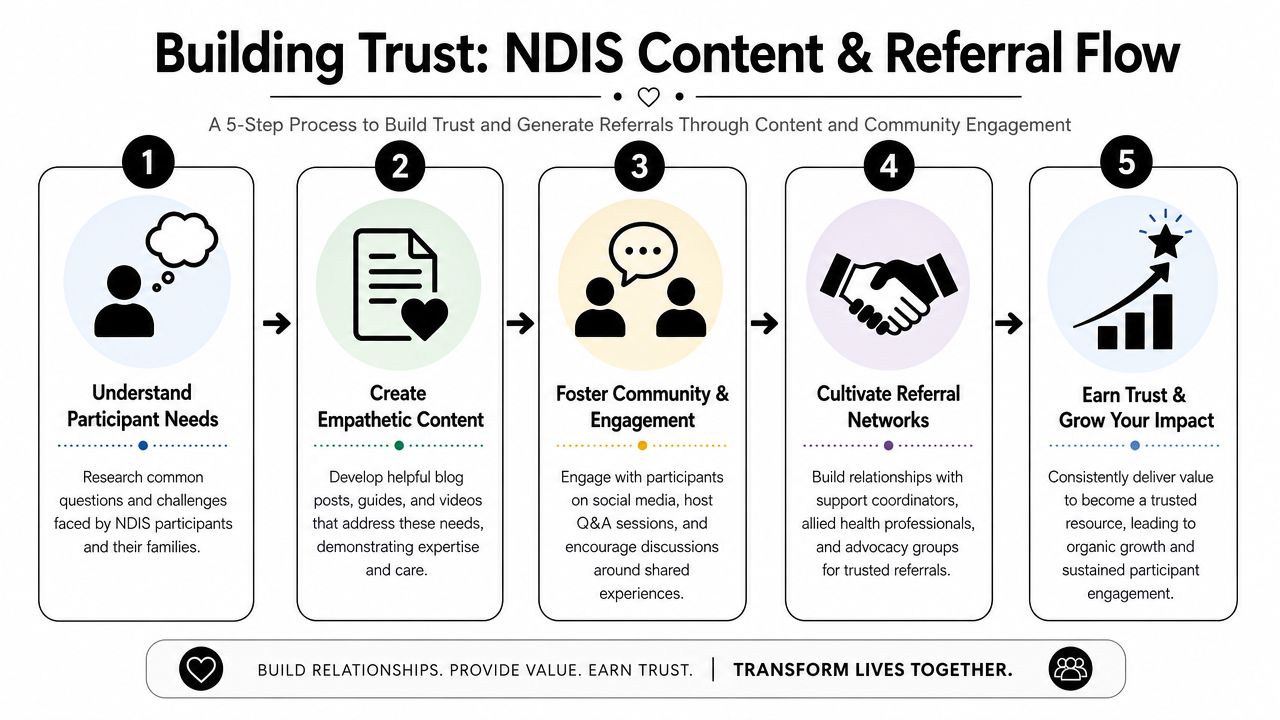
Content that helps people say yes
The strongest content usually answers practical questions that come up before first contact. Think less “why we're amazing” and more “what you need to know if you're considering this service”.
Useful topics often include:
- Service explainers: What the service is, who it suits, and what support may look like.
- Intake guidance: What happens after an enquiry, what information is needed, and how referrals are handled.
- Location clarity: Which suburbs or regions you support.
- Funding context: Plain-language guidance around using NDIS funding within your service scope.
- Team introductions: Real people, real qualifications, real communication style.
You can also use short videos, FAQs, and page-level explanations to reduce friction. This kind of media works well when it feels calm and practical rather than polished for the sake of it.
Here's a useful example format for video placement:
Referral systems deserve more attention
This is where many providers leave growth on the table. Referrals are often treated as something that “just happens” if you do good work. Good work helps, but referrals usually grow faster when you make the process easier and more intentional.
Small NDIS plan management providers have described referrals as “highly valuable” for participant acquisition in this discussion among NDIS providers. That lines up with what many practitioners see on the ground. Trust-based industries don't only grow through ads. They grow through relationships that lower perceived risk.
A simple referral framework
Make it easy to refer
Create one clear referral page with who you help, where you operate, and the best contact method.
Ask at the right time
The best time to invite referrals is after a positive service interaction, not as part of a generic marketing blast.
Support the referrer
Give support coordinators and allied health partners material they can use, such as concise service summaries and intake instructions.
Build reviews alongside referrals
Reviews and referrals reinforce each other. If you need a practical framework for requesting them appropriately, this guide on how to get Google reviews is useful, and so is this local guide on how to get more Google reviews.
Good referral marketing isn't pushy. It removes friction for people who already want to recommend you.
The providers who do this well aren't the loudest online. They're the easiest to understand, the easiest to refer to, and the easiest to trust.
Accelerate Growth with Paid Ads and Website Conversion
Paid ads can work well for NDIS providers, but only when the fundamentals are already sound. If your service scope is unclear, your site is hard to use, or your location targeting is loose, ads will help more people bounce faster.
That's the inherent trade-off with paid media. It gives speed, but it also exposes weaknesses immediately. Organic channels can hide problems for a while. Google Ads won't.
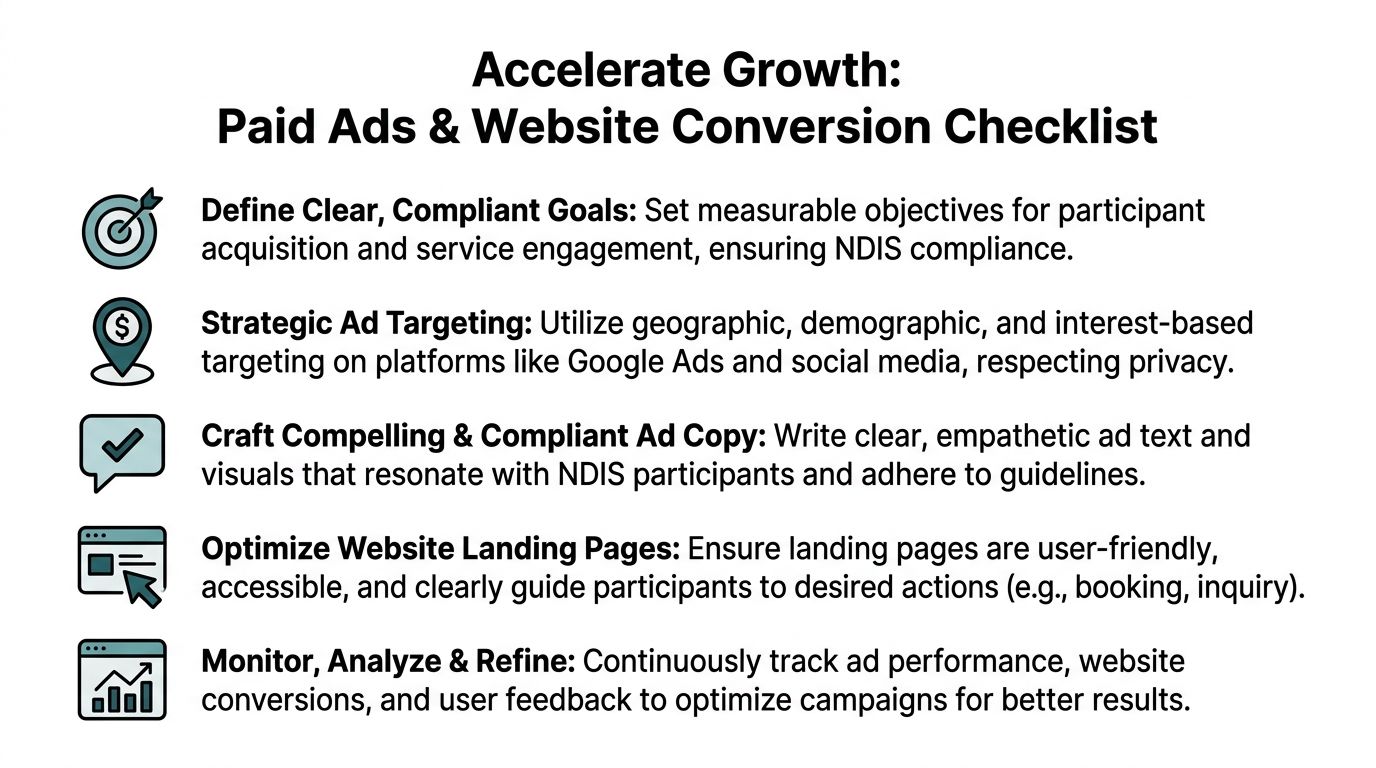
Where paid ads fit
Google Ads is usually the first paid channel I'd consider for a provider with a clear service offer and defined geography. Search traffic has intent. Someone typing a specific service and location query is often further along than someone casually scrolling social media.
Social ads can still help, especially for awareness, community visibility, and remarketing. But they tend to work better when your targeting, creative, and follow-up process are already organised.
Keep the ad approach restrained:
- Use specific locations rather than broad coverage.
- Match ad copy to landing pages so users land where they expect.
- Avoid inflated claims or emotionally manipulative wording.
- Filter irrelevant traffic by being clear about service type and area.
Conversion starts with accessibility
A major barrier in NDIS marketing is poor website accessibility. Providers need WCAG 2.1 compliance, and failures here can cause up to 40% of campaigns to underperform by excluding key participant groups, according to FlowLogic's NDIS marketing guidance.
That's not a design preference. It's a conversion issue and a service issue.
If a participant or carer can't read your text easily, move through with a keyboard, understand your forms, or find contact information without effort, your campaign doesn't just convert badly. It excludes the very audience you're trying to support.
Accessibility isn't a finishing touch. It's part of whether your marketing works at all.
Website fixes that usually matter most
| Area | What to check |
|---|---|
| Navigation | Clear menu labels, logical page structure, easy access to service and contact pages |
| Readability | Plain English, strong contrast, readable font sizes, short paragraphs |
| Forms | Fewer fields, clear labels, visible error messages, easy submission flow |
| Calls to action | Simple options such as call, email, refer, or book an enquiry |
| Mobile usability | Buttons that are easy to tap, fast loading, content that doesn't break on smaller screens |
A strong landing page for NDIS digital marketing should answer five things quickly: what you do, who you help, where you operate, how to enquire, and what happens next. If those aren't obvious above the fold and reinforced further down, fix that before increasing spend.
Measure and Optimise Your Marketing Engine
Most providers don't need more data. They need cleaner decisions.
The biggest reporting mistake in NDIS digital marketing is focusing on activity instead of outcomes. Social likes, impressions, and page views may tell you something, but they don't tell you whether the business is attracting suitable participants or useful referral pathways.
Track what matters to operations
A lean measurement system should focus on indicators your team can act on:
- New enquiries: Count qualified enquiries, not just all form fills.
- Referral source: Record whether the lead came from Google, social media, direct referral, support coordinator, or another channel.
- Service fit: Note whether the enquiry matched your actual service scope.
- Location fit: Track whether the person was in your active service area.
- Time to response: Slow response can waste good marketing.
If you use Google Analytics 4, pair it with form tracking, call tracking, and a simple CRM or spreadsheet discipline. The important part isn't having a complicated dashboard. It's tying each enquiry back to a source and a service outcome.
A practical review rhythm
Don't treat marketing like a campaign that ends. Treat it like a monthly operating system.
One useful routine is:
- Review enquiries by source
- Check which pages generated contact
- Assess quality, not just volume
- Remove spend from weak-fit channels
- Improve pages that attract interest but don't convert
That loop tends to reveal the truth quickly. Sometimes a page ranks but attracts the wrong audience. Sometimes a referral source sends fewer leads but better ones. Sometimes paid ads are fine and the actual issue is a confusing form or poor phone handling.
The best-performing providers don't “set and forget” marketing. They tighten it month by month.
The long-term win is consistency. Validate demand before entering a market. Build for accessibility. Create local relevance. Earn trust with useful content. Support referrals properly. Then measure what turns into real conversations and real participants. That's how NDIS digital marketing becomes dependable instead of frustrating.
If you need help turning these ideas into a practical website and marketing setup, Website Builder Australia can help with NDIS-focused websites, local SEO, paid advertising support, and the technical foundations that make digital marketing easier to manage.


