

Health Care SEO: An AU Guide for Medical Practices in 2026
78% of Australians search online before choosing a healthcare provider, yet only 34% of medical practices effectively optimise their websites for SEO, according to Balmer Agency's 2025 guide for Australian medical practices.
That gap changes how you should think about marketing your clinic. Health care SEO isn't a nice extra for a modern practice. It's the work that helps patients find you, understand what you do, and trust you enough to book.
For a busy clinic owner, the term can sound technical and time-consuming. It doesn't need to be. At its core, health care SEO is about making your website easier for patients to find and easier for Google to understand, while staying accurate, compliant, and helpful.
The Digital Front Door to Your Practice
Your website now does part of the job that your reception desk, signage, and waiting room used to do on their own. It gives a first impression. It answers basic questions. It helps people decide whether your practice feels credible, organised, and right for their needs.
That's why many health systems now talk about the website as the practice's digital front door. If you want a broader view of that concept, these digital front door solutions show how online access, search visibility, and patient experience all connect.
What health care SEO actually means
In plain language, health care SEO is the process of improving your clinic's visibility in search results when people look for symptoms, conditions, treatments, doctors, or local medical services.
That includes work such as:
- Improving your pages: So Google can tell what each page is about
- Organising your website clearly: So patients can move from question to answer without getting lost
- Writing useful content: So your site helps real people, not just search engines
- Strengthening local signals: So your clinic appears for nearby searches
- Building trust signals: So your credentials, policies, and professional standards are easy to verify
A patient rarely thinks, “I'm now engaging with a clinic's SEO strategy.” They just search for something like “knee pain when walking Brisbane” or “GP near me open Saturday”. Your SEO determines whether they find your clinic or a competitor.
Why this matters to small and medium practices
Large hospital groups often have dedicated teams. Smaller clinics usually don't. That can make SEO feel out of reach, but smaller practices often have an advantage. They know their local community, their patients' common concerns, and the questions people ask on the phone every day.
Practical rule: If your reception team hears the same question repeatedly, that topic probably belongs on your website.
A clean, well-built site also matters here. If your practice website is hard to update, SEO becomes a chore. Clinics that invest in a flexible platform through a service such as WordPress web design for Australian businesses usually find it much easier to publish pages, update doctor profiles, and keep information current.
Think of SEO as patient access, not just marketing. A parent looking for care after work hours, an older patient searching from a mobile phone, or a new resident trying to find a trusted GP all depend on what shows up online first.
Why Health Care SEO Is a Different Beast
A plumber can rank with a decent location page, a few reviews, and a service list. A medical practice operates in a different category altogether. Google treats health information with far more caution because poor information can affect a person's wellbeing.
In practical terms, that means your website isn't judged only on keywords. It's judged on trust.
Why trust carries more weight in medical search
Google groups health topics into a higher-risk category often discussed as YMYL, short for “Your Money or Your Life”. You don't need to memorise the label. The important point is simple. If your content could influence someone's health decision, Google expects stronger evidence of expertise and reliability.
A useful analogy is a peer-reviewed medical journal. An article isn't taken seriously because it exists. People look at the author, qualifications, references, editorial oversight, and whether the claims are responsibly presented. Your website needs to send the same sort of signals.
That's where E-E-A-T comes in: experience, expertise, authoritativeness, and trust. On a clinic website, those signals show up through things like clinician bios, clear qualifications, accurate condition information, contact details, and a professional tone that avoids hype.
The Australian context changes the strategy
Australian clinics also need to think about AHPRA advertising expectations. Generic SEO advice often tells businesses to make bold claims, use aggressive testimonials, or promise outcomes. That approach can create problems in health care.
A safer and smarter strategy is to focus on education. Explain symptoms. Outline treatment pathways carefully. Clarify what an appointment involves. Help people understand when they should seek professional advice.
That approach aligns much better with how patients search and how medical practices need to communicate.
If a sentence sounds more like a sales brochure than a clinician speaking responsibly, rewrite it.
The broader market has already shifted online. In the Australian healthcare sector, online purchases for discount health stores and pharmacies saw 240% year-over-year growth nationally in August 2020, as reported in Vine Digital's industry state report citing Australia Post data. The exact channel may differ between a pharmacy, allied health clinic, and specialist practice, but the takeaway is the same. Patients are comfortable using digital channels for health-related decisions.
What general SEO often gets wrong for clinics
A lot of standard advice misses the realities of health care. It tends to overvalue broad traffic and undervalue credibility.
Here's the difference:
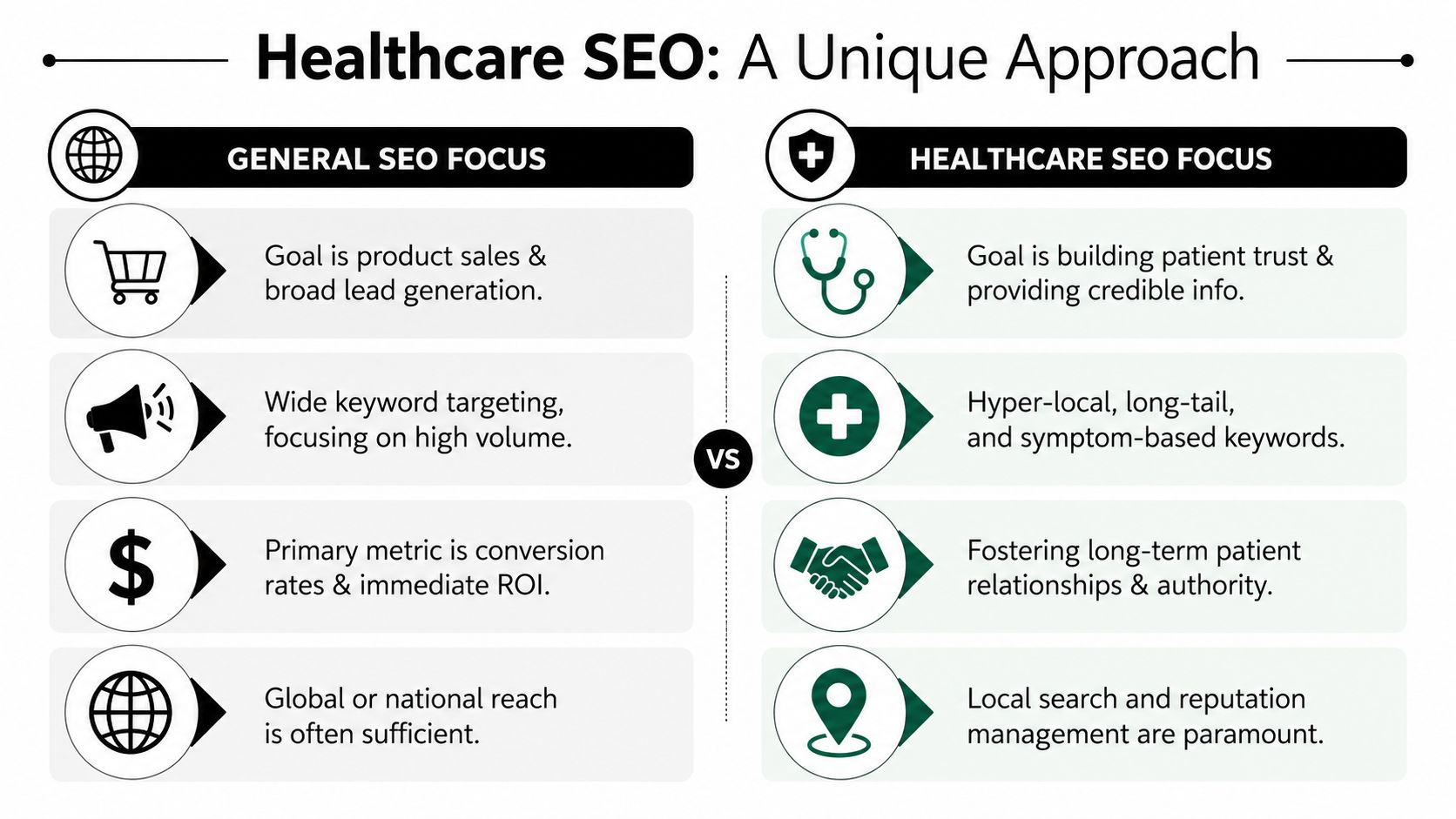
| General SEO focus | Health care SEO focus |
|---|---|
| Broad keyword reach | Relevant patient intent |
| Fast conversions | Informed bookings and trust |
| Promotional messaging | Accurate, compliant education |
| Generic authority signals | Clinician expertise and local credibility |
For clinics serving disability, community, or support sectors, the same higher-trust rules apply. That's one reason healthcare-adjacent organisations often need a more careful strategy than ordinary local businesses. This is especially true in regulated sectors such as NDIS digital marketing, where trust, compliance, and clarity matter just as much as visibility.
Building on a Solid Technical Foundation
A clinic website works a lot like a physical practice. Before you worry about decor, you need a sound building, clear signage, and rooms arranged in a way that makes sense. Technical SEO is that foundation.
If the structure is messy, patients struggle to find information. Search engines do too.
Start with site structure
Most clinics build websites around internal thinking. They create a menu based on departments, provider names, or service categories only. Patients don't always think that way.
A stronger structure usually connects three layers:
- Core service pages such as GP care, physiotherapy, podiatry, or skin checks
- Condition or symptom pages that reflect what people search
- Location and clinician pages that support local discovery and trust
For example, a physiotherapy clinic might have a service page for physiotherapy, but also pages for lower back pain, postural pain at desk work, sports injury recovery, and neck stiffness. Those pages should link logically to booking information and the right practitioner.
Mobile experience isn't optional
Many prospective patients search while commuting, waiting at school pick-up, or dealing with a problem in the moment. If your website is awkward on a phone, they'll often leave before reading a word.
That means your site should make the basics easy to do on mobile:
- Tap to call: Phone numbers should work without friction
- Tap to book: Appointment links need to be obvious
- Read comfortably: Text should be clear without zooming
- Find locations fast: Maps, parking, and opening hours should be simple to access
Google also uses the mobile version of a site for ranking, so mobile usability affects visibility as well as user experience.
Speed affects both rankings and patience
Slow pages frustrate people, especially when they're trying to solve a health problem quickly. They also create technical drag for SEO.
The healthcare SEO guidance from DexCare notes that page speed is tied to Google's Core Web Vitals, and that mobile optimisation is vital. The same resource also points to server-side rendering as a useful fix for mobile performance problems on more complex sites, particularly where frameworks or heavy scripts slow things down. If speed issues are part of your setup, a plain-English explainer on what a CDN does for website performance can help you understand one piece of the puzzle.
A patient won't describe the problem as “poor technical SEO”. They'll just think your clinic website feels old, clunky, or hard to use.
A simple technical checklist for clinic owners
You don't need to become a developer to spot obvious issues. Review your site with these questions:
- Can a new patient reach the right page quickly? If common issues are buried, your structure needs work.
- Does every important page load cleanly on mobile? Check booking, contact, doctor profile, and service pages first.
- Are there duplicate or thin pages? Multiple weak pages on nearly the same topic can confuse Google.
- Can staff update content easily? If updates are difficult, information goes stale.
- Do internal links guide users forward? A symptom page should lead naturally to a clinician, service, or booking action.
Technical SEO sounds intimidating because people often explain it in code-first language. For most practices, the goal is simple: build a website that's fast, organised, and easy for patients to use.
Creating Content That Heals and Ranks
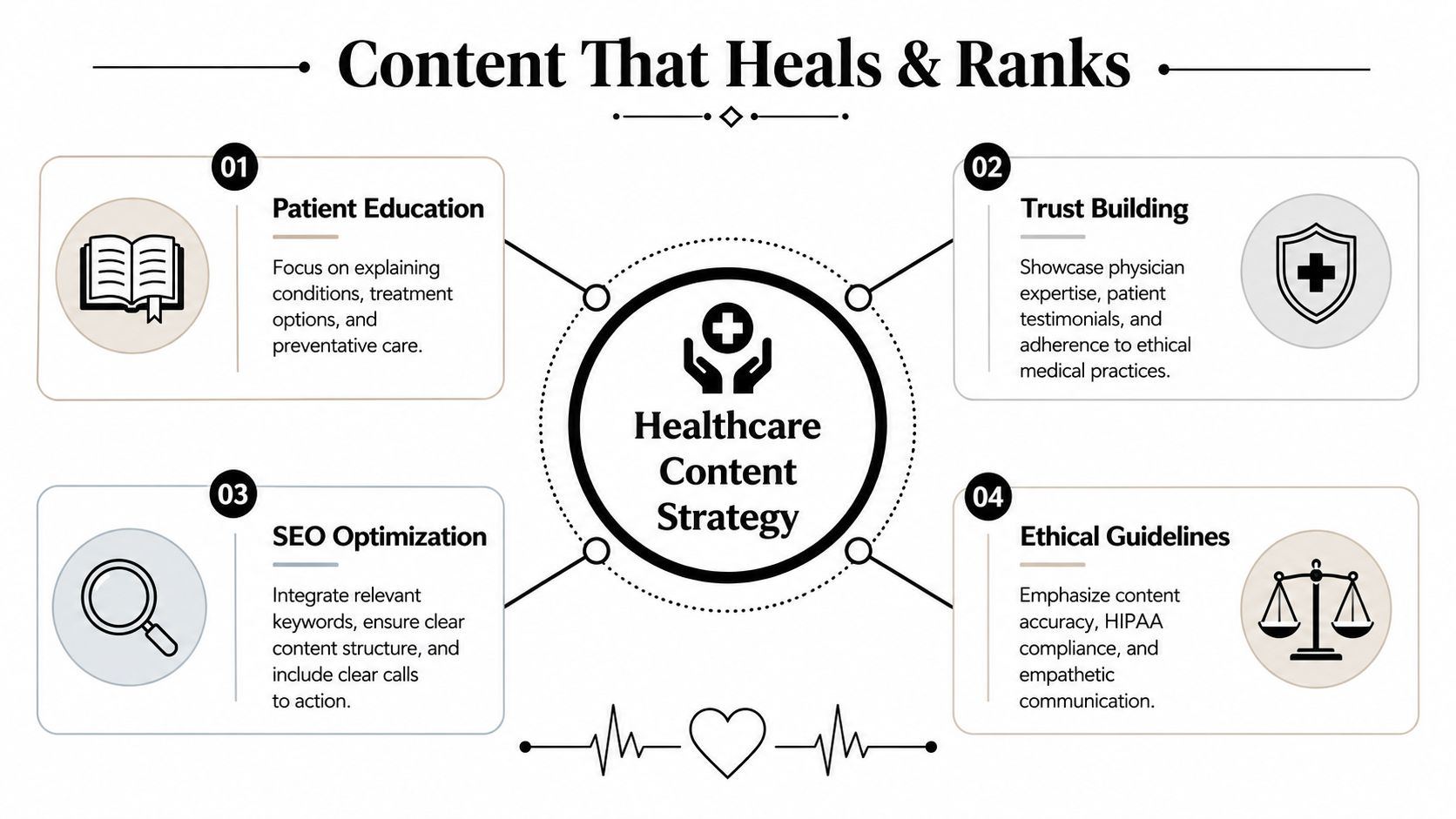
Most clinics build content around services because that's how they organise the business. The problem is that patients usually start somewhere else. They start with discomfort, uncertainty, or a symptom they can't quite name.
That gap is where many health care SEO strategies fall short.
Patients search for problems first
In Australian healthcare search, symptom-driven search architecture accounts for approximately 68% of initial patient queries, and symptom-focused pages outperform service pages by 3–5x in organic traffic, according to Dux Digital's healthcare SEO analysis.
That finding matches what most reception teams already know. People rarely ring up saying, “I'd like your musculoskeletal physiotherapy service.” They say, “I've had lower back pain for two weeks and it's getting worse.”
Service pages still matter, but they shouldn't do all the work
A service page explains what you offer. That's important. But it usually won't capture the full patient journey.
Take a podiatry clinic. A service page called “Podiatry” is useful once someone already knows they need a podiatrist. It's less useful for someone searching:
- heel pain when walking
- sore feet after standing all day
- ingrown toenail treatment
- foot pain in runners
Those people need educational pages that match their question, reassure them with clear information, and guide them towards the right next step.
A better model for clinic content
A practical way to think about content is a topic cluster. One broad topic sits at the centre, supported by closely related pages.
For a physiotherapy clinic, a lower back pain cluster might look like this:
| Page type | Example topic | Purpose |
|---|---|---|
| Main symptom page | Lower back pain | Captures broad symptom intent |
| Supporting article | Lower back pain after sitting all day | Matches a specific search scenario |
| Supporting article | When back pain needs assessment | Helps patients judge urgency |
| Supporting article | What to expect at a physio appointment for back pain | Reduces booking hesitation |
| Service page | Physiotherapy for musculoskeletal pain | Connects education to treatment |
This structure helps in two ways. Patients get clearer answers, and Google sees depth around the topic.
How to stay useful and compliant
Symptom-led content works especially well in Australia because it lets clinics educate without making inflated claims. That matters under AHPRA expectations.
Your content should aim to inform, not diagnose online. It should explain possibilities, set expectations, and encourage appropriate professional assessment where needed.
A strong symptom page often includes:
- Plain-language descriptions: Explain what people may be experiencing
- Common contributing factors: Keep wording careful and balanced
- When to seek care: Give sensible guidance without alarmism
- What assessment may involve: Reduce uncertainty before booking
- Relevant next steps: Link to the correct service or clinician page
Clinical content rule: Write as if a cautious, experienced practitioner will read every sentence before it goes live.
Make authorship visible
Healthcare content needs a visible human behind it. Readers should be able to see who reviewed or wrote the page, what their credentials are, and how the content connects to real clinical expertise.
That doesn't mean every article must sound academic. It means the page should be clearly accountable. A named clinician, an up-to-date bio, and accurate editorial review signals help both users and search engines trust what they're reading.
One practical example
Let's say you run a Brisbane psychology clinic. A generic services page for “Anxiety Treatment” is useful, but it won't address all the ways people search. They might look for “can't sleep because of anxious thoughts”, “panic attacks at work”, or “how to know if stress is becoming anxiety”.
A symptom-driven content approach would answer those questions directly, with careful language, local relevance, and clear pathways to seek support. That's more helpful to patients, and it gives your site far more opportunities to appear in search.
Mastering Local SEO and Online Reputation
For most clinics, local visibility is where SEO becomes tangible. You're not trying to attract everyone. You're trying to be easy to find for the right people in the areas you serve.
Your Google Business Profile often shapes that first impression before a patient even visits your website.

Treat your profile like a digital shopfront
A neglected profile sends the wrong signal. Missing hours, weak descriptions, outdated phone numbers, or no appointment link all create friction.
A well-managed profile should include:
- Accurate core details: Practice name, address, phone number, and hours must match your website
- Service information: Add your key services in language patients understand
- Booking access: Use a clear appointment link where appropriate
- Real photos: Exterior, reception, treatment rooms, and team images help patients feel oriented
- Questions and answers: Address common concerns before people need to call
Location consistency matters. If your website says “Suite 2” and another directory says “Level 1”, those mismatches can weaken trust and create confusion.
Build location relevance beyond Google Business Profile
Your local SEO doesn't stop with one profile. Your website should reinforce where you practise and who you serve.
That usually means having strong location pages with information such as:
- nearby suburbs served
- access and parking details
- public transport guidance
- services available at that location
- clinicians who consult there
This is especially important for multi-location clinics. Each location needs its own clear presence online, not just a single generic contact page.
Reviews are part of patient care online
Reviews make many clinic owners nervous, and that's understandable. Health care is personal. Not every patient experience is straightforward. Still, reviews are one of the clearest trust signals available in local search.
The right mindset is to treat reputation management as an extension of communication and care.
Here's a practical framework:
| Situation | Better response approach |
|---|---|
| Positive review | Thank the reviewer warmly without discussing clinical details |
| Negative review | Stay calm, avoid confirming treatment details, invite offline contact |
| No reviews coming in | Create a simple, repeatable request process after appropriate appointments |
| Old reviews only | Keep the profile active with fresh service and practice updates |
If you want a broader framework for handling this carefully, this Online Reputation Management Guide offers useful principles for monitoring, responding, and improving digital reputation over time.
Patients read your responses to other people's reviews to judge how you'll treat them.
How to ask for reviews without sounding awkward
Many clinics skip review generation because staff feel uncomfortable asking. The easiest fix is to turn it into a process rather than leaving it to chance.
Try something simple:
- Choose the right moment after a positive, completed interaction
- Use a standard script so staff aren't improvising
- Send a direct link by SMS or email where appropriate
- Keep the wording neutral and never pressure patients
- Review your responses weekly so nothing sits unattended
A short visual overview can help if your team needs a refresher on local search basics and profile management:
What many clinics miss
A clinic can have excellent practitioners and still lose local search visibility because the basics are patchy. An incomplete profile, inconsistent details, weak location pages, and no review process can reduce enquiries.
Local SEO isn't separate from patient experience. It's the online version of being easy to find, easy to contact, and professional from the first interaction.
Advanced Signals Schema and Compliance
Once your website structure and content are in shape, there's another layer that helps search engines interpret your clinic correctly. That layer is schema markup.
You don't need to write the code yourself to understand why it matters. Think of schema as a translator. It tells Google, in a structured format, what a page is about and which details carry weight.
What schema does for a medical practice
On a normal page, Google has to infer meaning from headings, body copy, and links. Schema makes key details more explicit.
According to DexCare's healthcare SEO guidance, implementing medical schema in JSON-LD format is a critical technical requirement. Physician schema with credentials and affiliations generates knowledge panels, while MedicalClinic schema on location pages builds local pack visibility.
That matters because it can support clearer search presentation for things like:
- doctor credentials
- specialty information
- hospital affiliations
- clinic location details
- geo-signals tied to local relevance
Where clinics should use it first
If resources are limited, start where schema has the clearest practical value.
A sensible priority order looks like this:
- Clinician pages: Add Physician schema with qualifications and affiliations
- Location pages: Use MedicalClinic or related medical business schema
- Contact and organisation details: Make business identity consistent
- Key service pages: Clarify the relationship between services, providers, and locations
You don't need to mark up every possible element at once. It's better to apply schema accurately on core pages than badly across the whole site.
Compliance still sits over everything
Technical enhancements never replace professional responsibility. If a page is misleading, outdated, or too promotional, schema won't save it.
For Australian practices, that means every SEO improvement still needs to respect AHPRA expectations, patient privacy, and careful wording around outcomes. Keep disclaimers appropriate. Avoid exaggerated treatment promises. Make sure clinician details are current. If your site includes forms, privacy information should be easy to find and understand.
Accessibility is part of this trust layer too. Search visibility and usability often support each other. For clinics improving both at once, this article on WCAG compliance and SEO is a helpful primer on how accessible design choices can also strengthen organic performance.
Better technical signals work best when they sit on top of accurate content, clear authorship, and a site patients can actually use.
The real payoff
Schema sounds advanced, but the reason to care is straightforward. It helps search engines connect your expertise, your people, and your locations more confidently.
That's valuable in health care, where trust signals carry more weight and ambiguity works against you.
Measuring Success and Your 90-Day Roadmap
Many clinics either track too much or almost nothing. They watch rankings daily, react to every fluctuation, and still don't know whether the website is improving. A better approach is to use a small set of meaningful indicators and review them consistently.
For health care SEO, success should look like stronger engagement, better local visibility, and more qualified patient actions.
The website health check that matters
The benchmark data from 9 Clouds' healthcare SEO performance guide gives clinic owners a useful reference point. Achieving 1.9 sessions per user ranks a website in the top 10% nationally, while the bounce rate goal should stay under or around 60%.
Those metrics don't tell the full story on their own, but they help you ask smart questions.
What to review each month
A practical monthly review might include:
| Metric | What it tells you |
|---|---|
| Sessions per user | Whether people explore beyond one page |
| Bounce rate | Whether pages match intent and hold attention |
| Top landing pages | Which topics attract organic visits |
| Calls or booking clicks | Whether traffic is relevant, not just present |
| Google Business Profile activity | Whether local search visibility is improving |
Look at trends monthly rather than obsessing over daily movement. Healthcare search can fluctuate, and day-to-day checks often create noise rather than insight.
A realistic 90-day plan for a busy clinic
If your team is small, the goal isn't to do everything at once. It's to sequence the work properly.
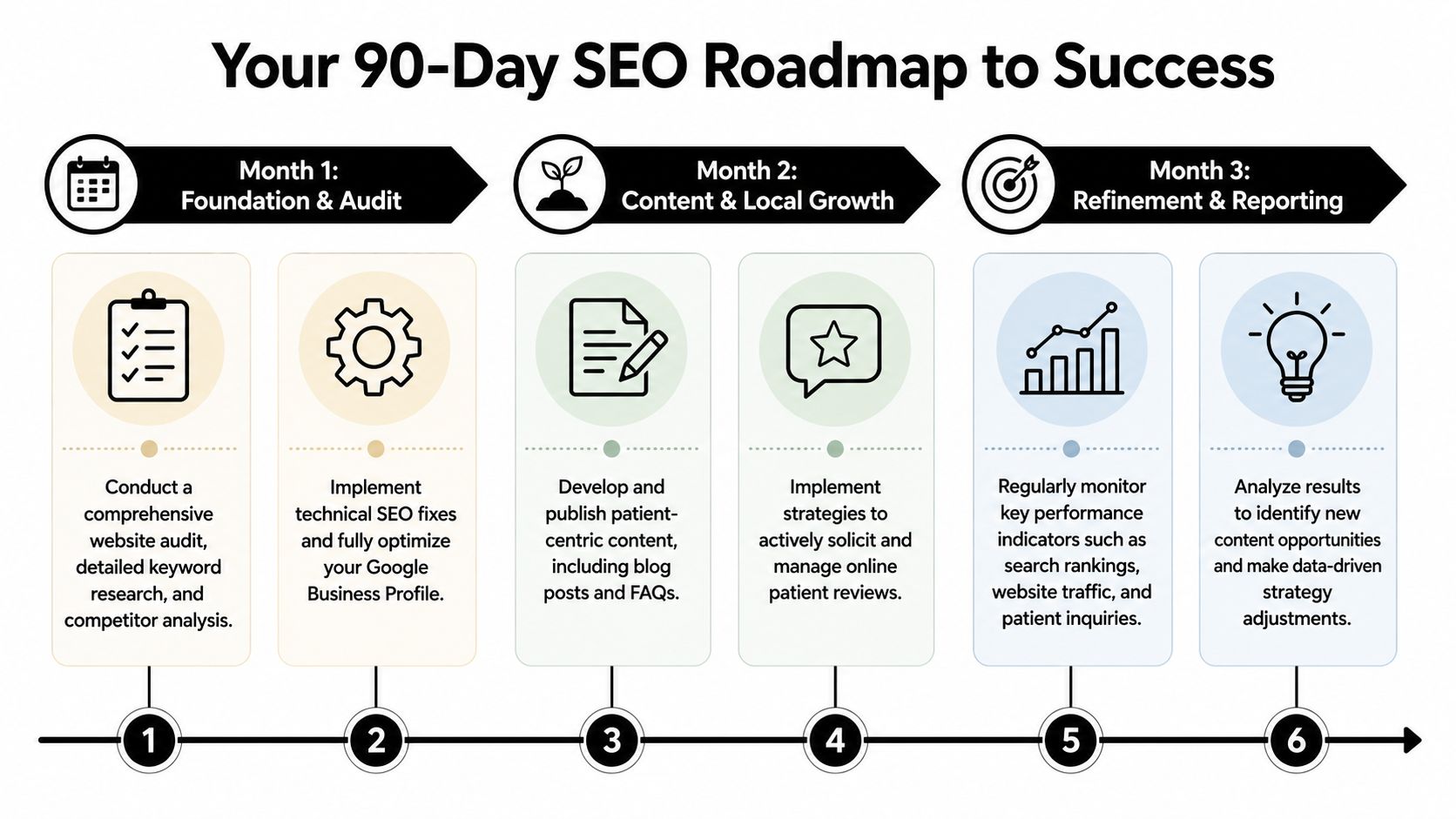
Month one
Focus on the foundation.
- Audit your website: Check mobile usability, page speed, navigation, outdated content, and thin pages.
- Review your Google Business Profile: Update hours, services, images, booking links, and contact details.
- Tighten core trust pages: Make sure clinician bios, privacy information, and location details are complete.
Month two
Build one meaningful content cluster.
- Choose one common patient problem: Pick a symptom or condition you see regularly.
- Create the main page first: Write a clear educational page that answers the core question.
- Add supporting pages: Publish a few related articles based on real patient concerns.
Month three
Strengthen local proof and measurement.
- Set up a review request process: Keep it simple and consistent.
- Refine internal linking: Make sure symptom pages lead to service, clinician, and booking pages.
- Review results monthly: Look for engagement improvements and which pages deserve further expansion.
Start with one service line or one symptom cluster. Clinics often stall because they try to rebuild the whole site at once.
What good progress looks like
After the first three months, you should have more than a prettier website. You should have a clearer structure, a stronger local presence, better educational content, and a way to measure whether patients are engaging.
Health care SEO works best when it stops being a side project and becomes part of how your practice communicates online. The clinics that do this well usually aren't publishing the most content. They're publishing the clearest, most useful, most trustworthy content on a site that's easy to use.
If your clinic needs a site that's easier to update, faster on mobile, and built to support long-term SEO growth, Website Builder Australia can help with website design, development, and digital support designed for Australian businesses.


