

Expert PPC Management Australia: Your 2026 Strategy Guide
You search for your own service on Google and see three competitors above you. One has a sharp offer, one has review extensions, and one is running the same message across Search, Instagram, and Facebook. Meanwhile, your own enquiries feel patchy. Some weeks are solid. Others are quiet for no obvious reason.
That's usually the moment PPC stops feeling like a “marketing extra” and starts looking like a business system.
For Australian SMEs, PPC management Australia isn't really about buying clicks. It's about buying qualified attention from people who are already close to acting, then making sure the numbers still work after ad costs, sales follow-up, labour, and margin. If the campaign generates traffic but the leads are poor, it isn't working. If it produces enquiries but they don't turn into profitable jobs or sales, it isn't working either.
The businesses that get value from PPC treat it like controlled commercial testing. They use it to find demand, validate offers, fill pipeline gaps, and scale the parts of the funnel that make money.
What Is PPC and Why Does It Matter for Your Business
PPC stands for pay-per-click. In simple terms, you pay to appear in front of people on platforms like Google, Microsoft, or Meta, and you're charged when someone clicks.
The easiest way to think about it is this. SEO is like building a strong shopfront on a busy street over time. PPC is like renting the best position on that street today. You don't own it forever, but you can get visibility immediately.
That matters when your business needs leads now, not six months from now.
Why business owners turn to PPC
For a local electrician, accountant, physiotherapist, online retailer, or builder, search ads can put your business in front of someone at the exact moment they're looking for a solution. This timing provides a distinct advantage. You're not interrupting someone for the sake of awareness. You're meeting intent while it's active.
PPC also gives you control that many other channels don't.
- Budget control: You can cap spend, adjust bids, and prioritise your best services.
- Targeting control: You can focus on suburbs, cities, devices, times of day, and audience segments.
- Message control: You can test offers, headlines, and landing pages quickly.
- Measurement control: You can track calls, form fills, purchases, and other actions that matter.
Practical rule: If you can't explain what a lead is worth to your business, your PPC account will drift toward vanity metrics.
PPC is fast, but that doesn't make it simple
A lot of Australian businesses start with the wrong expectation. They assume PPC is just a switch you turn on. In reality, the platform is fast, but profitable management takes discipline. Someone has to choose the right keywords, write ads that match real buying intent, build landing pages that convert, and keep trimming waste week after week.
That's why PPC matters. It gives you speed and precision. But it only becomes a growth channel when it's managed around lead quality, sales quality, and margin, not just traffic.
Choosing Your Advertising Playground in Australia
Different platforms do different jobs. Treating them as interchangeable is one of the most common mistakes in PPC management Australia.
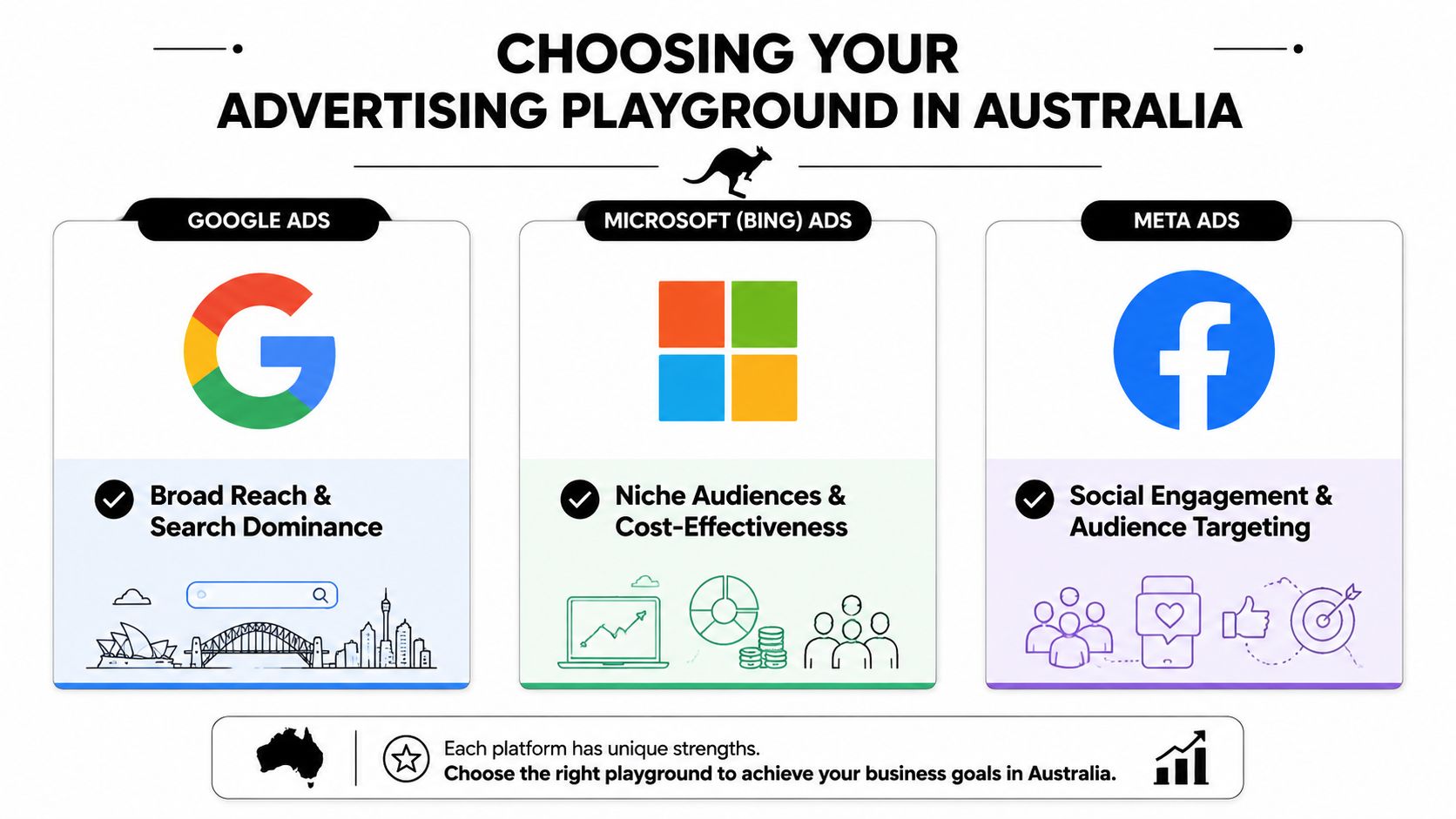
If Google Ads is a ute, Meta is more like a branded van, and Microsoft Ads is the practical workhorse that often gets ignored. Each can be useful. The right mix depends on how your customers buy.
Google Ads for active intent
Google Ads is usually the first stop for service businesses and many ecommerce brands because it captures people who are already searching. Someone types what they need, sees your ad, and clicks if your offer looks relevant.
High-intent demand thrives. It suits businesses that win when timing matters, such as emergency trades, local services, B2B providers, clinics, and retailers with clear product demand.
Australian PPC guidance also keeps returning to Google, Microsoft, and Performance Max orchestration, with reporting centred on click-through rate, conversion rate, and return on ad spend, while stronger agencies frame campaign management as a pipeline-quality issue rather than a raw-click issue, as outlined by Click Trends on PPC management services.
Microsoft Ads for overlooked value
Microsoft Ads usually gets less attention, but that can be a mistake. In many accounts, it works well as a second search channel once Google is structured properly.
It often suits businesses that want:
- Additional search reach: You can extend beyond Google without rebuilding your whole strategy.
- Incremental lead flow: It can add volume from users who still search through Microsoft's ecosystem.
- Testing room: It's useful for comparing search behaviour and bidding efficiency across platforms.
This isn't a replacement for Google in most cases. It's a complement.
Meta Ads for demand creation and remarketing
Meta is different because many users aren't actively searching when they see your ad. You're targeting based on audience signals, interests, behaviours, and past engagement rather than explicit search intent.
That makes it valuable for:
| Platform | Best use | Typical fit |
|---|---|---|
| Google Ads | Capture active demand | Local services, ecommerce, B2B lead gen |
| Microsoft Ads | Expand paid search coverage | Mature search campaigns seeking more reach |
| Meta Ads | Build awareness and retarget interest | Visual brands, offers, promotions, remarketing |
For businesses selling visual, lifestyle, or impulse-friendly products, Meta can play a strong acquisition role. For many service businesses, it performs better as a support channel for remarketing and brand familiarity. If you're weighing that side of the mix, this guide to Instagram advertising in Australia is a useful companion.
Better platform selection starts with one question: are you trying to capture demand that already exists, or create demand that needs nurturing first?
Crafting a Winning Local PPC Strategy
A good campaign in Australia doesn't come from broad targeting and generic copy. It comes from relevance. The more closely your keywords, ads, landing pages, geography, and sales process line up, the easier it is to control cost and improve lead quality.

Start with geography and timing
If you service Brisbane's northside, there's no point paying for clicks from the Gold Coast. If your office team only answers calls during business hours, your ad schedule should reflect that unless you have a proper after-hours process.
Local PPC strategy usually gets stronger when you tighten the account around operational reality.
- Service area targeting: Focus on the suburbs, cities, or regions you want.
- Ad scheduling: Match visibility to your team's ability to answer calls or respond to forms.
- Mobile intent: Many local searches happen on phones, so mobile landing page speed and call usability matter.
- Local language: Australian wording, clear service descriptions, and realistic offers usually outperform generic copy.
Search-term hygiene is where accounts get cleaner
The most impactful technical control in Australian PPC management is search-term hygiene. By building tightly themed keyword groups and using negative keywords aggressively to filter out irrelevant searches, businesses can protect Quality Score and reduce wasted ad spend, as explained in Elsner's Australian PPC strategy guide.
That sounds technical, but the practical version is simple. Don't let the platform guess too much.
If you run a plumbing business, you don't want budget leaking into irrelevant searches, research terms, DIY intent, or jobs seekers. If you sell premium products, you don't want to pay for bargain-hunter traffic that never converts. Search-term review and negative keyword work isn't glamorous, but it's often where profitability starts.
A messy search term report can quietly burn more budget than a weak ad headline.
Match the ad to the page
One of the fastest ways to waste money is sending every click to the homepage. Searchers click because they believe the page will solve the problem implied by the ad. If the message shifts, confidence drops.
A tighter setup looks like this:
- Keyword intent: “Emergency electrician Brisbane”.
- Ad promise: Fast call-out, local service, clear next step.
- Landing page: Emergency electrician page, not a general services page.
- Conversion path: Tap-to-call, short form, visible service area, trust signals.
What works and what usually doesn't
What tends to work
- Narrower keyword themes
- Strong negative keyword discipline
- Local offers tied to real services
- Landing pages built for one action
- Ongoing A/B testing of copy and forms
What usually doesn't
- Broad campaigns with mixed services in one ad group
- Sending all traffic to the homepage
- Optimising only for cheap clicks
- Running ads without proper conversion tracking
- Leaving automated campaigns unsupervised
Decoding PPC Management Costs in Australia
Cost is the question most business owners ask first, but the better question is what you're paying for and whether the structure suits your stage of growth.
In Australia, PPC management is commonly priced as a monthly retainer in the low-to-mid thousands. A 2024 survey cited by Reboot Online found that 21.2% of marketers paid $1,001 to $3,000 per month for external PPC support, while 15.2% paid $501 to $1,000, and another 15.2% paid $5,001 to $8,000 per month. The same source also says the average monthly PPC management cost can be around $10,000, which shows how widely pricing can vary by campaign size and complexity, according to Reboot Online's PPC statistics roundup.
That spread tells you something important. There isn't one standard “Australian PPC management fee”. Pricing changes with channel mix, reporting depth, tracking setup, landing page involvement, and how much strategic work the agency is doing.
The main pricing models
| Model Type | How It Works | Best For |
|---|---|---|
| Monthly retainer | Fixed management fee each month | Businesses wanting predictable costs and steady support |
| Percentage of ad spend | Fee rises or falls with media spend | Accounts where spend changes often and management scales with it |
| Hybrid model | Base retainer plus spend-based component or project work | Businesses needing both strategic oversight and flexible growth support |
What each model gets right and wrong
A retainer is usually easiest for budgeting. You know the fee upfront, and it can suit SMBs that want stable support without wondering whether every increase in ad spend will immediately lift management costs too.
A percentage-of-spend model can make sense on larger or more dynamic accounts, but it creates a trade-off. If the fee rises as spend rises, the business owner should ask how the agency stays aligned with efficiency, not just budget growth.
A hybrid setup often works when an account needs more than campaign tweaks. Think tracking cleanup, landing page testing, feed work, or multi-platform management. If you want a broader understanding of likely spend and setup choices, this overview of how much Google PPC costs gives helpful context.
Don't judge cost in isolation. Judge whether the management model rewards better outcomes or just bigger media bills.
How Australian Agencies Run Your Campaigns
You usually feel PPC management at two points. When the phone starts ringing with the right enquiries, or when spend climbs and sales still ask why lead quality is poor. The difference is rarely the ad platform itself. It comes from how the account is run week to week, and whether the agency is managing for profit instead of surface metrics.
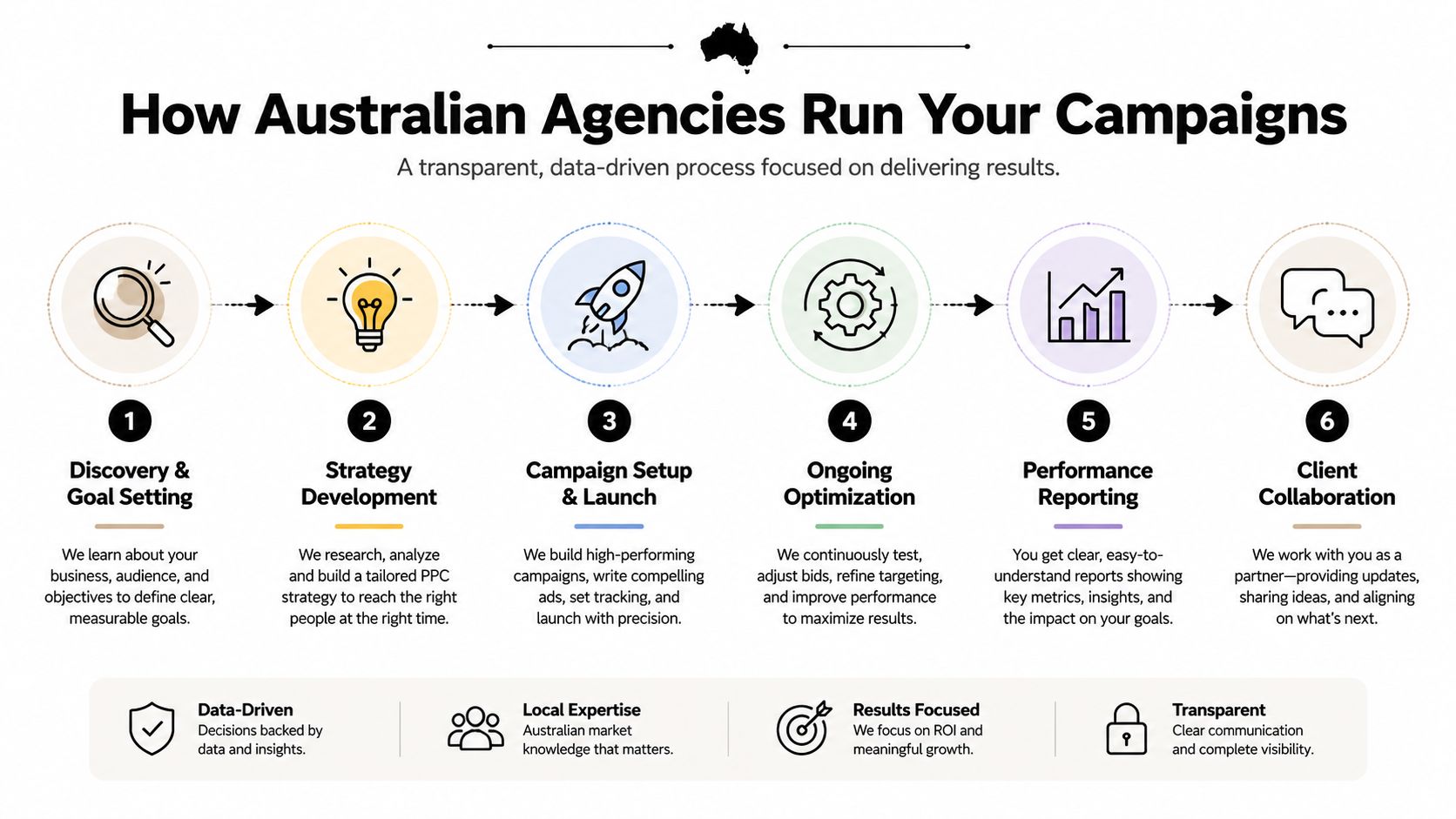
Good agencies follow a clear operating process. The strong ones also connect that process to sales outcomes, margin, and cost per acquired customer, especially in competitive Australian categories where a cheaper click can still produce an unprofitable lead.
From audit to launch
The first job is to inspect the foundations. That means checking conversion tracking, reviewing search terms, looking at campaign structure, understanding your sales cycle, and spotting where budget is leaking. If the account is new, the agency has to build that picture from your offer, margins, service areas, and the kind of customer you want.
Then they build for control. Campaign structure, keyword groupings, audience signals, ad copy, extensions, bidding rules, and landing page alignment all affect how much room there is to improve later. A messy setup makes optimisation slower and more expensive.
If you want a sense of what specialist support usually covers, this breakdown of a Google Ads specialist in Australia is a useful reference point.
The real work starts after launch
Launch day matters less than the next 30 to 60 days. That period shows what traffic the account is really attracting, which leads are worth chasing, and where Google or Meta is learning from the wrong signals.
A capable PPC team keeps adjusting the parts that affect commercial performance:
- Search terms: Remove waste, add negatives, and identify high-intent queries that lead to real enquiries
- Bids: Shift spend toward locations, devices, times, and audiences that convert profitably
- Ads: Test offers, headlines, and calls to action that attract better-fit prospects
- Landing pages: Improve form completion, call quality, trust signals, and page clarity
- Conversion signals: Make sure the platform is optimising toward meaningful actions, not just low-value form fills or accidental calls
Many campaigns commonly drift. An agency can report lower cost per click while the sales team deals with poor-fit leads, missed calls, or enquiries from areas you do not service. For an SME, that is not a reporting issue. It is a margin issue.
Good management depends on client input
The best-performing accounts usually have strong feedback from the business. The owner or sales team knows which suburbs close better, which jobs have stronger margins, which services create repeat business, and which leads waste time. Without that input, the agency is still optimising, but often against an incomplete definition of success.
Reporting should reflect that reality. It should answer practical questions your team can act on:
- Which campaigns created qualified opportunities, not just conversions?
- Which keywords or audiences produced poor-fit leads?
- Where did cost rise without improving sales outcomes?
- What changed in the account this month, and what happened after the change?
The best PPC manager improves more than the ad account. They use sales feedback, call outcomes, and lead quality patterns to keep spend tied to profit.
How to Choose the Right Local PPC Partner
Choosing a PPC agency in Australia isn't hard because there are too few options. It's hard because there are so many. The market is mature, with 108 PPC agencies in Australia listed by Clutch in a 2026 ranking, and Premier Partner positioning is a common credential. One Australian agency states that Google Premier Partner status places it in the top 3% of Google Ads agencies in Australia, a useful sign that buyers are comparing providers in a crowded field, as noted in Semrush's Australian PPC agency listing page.
That means the decision usually comes down to fit, transparency, and commercial thinking.
Questions worth asking before you sign
Don't start with “How cheap are you?” Start with “How do you think?”
Ask questions like these:
- How do you define a good lead for a business like ours?
- What do you optimise for when lead quality and lead volume conflict?
- How often do you review search terms and negatives?
- What happens if tracking is incomplete or unreliable?
- Who works on the account day to day?
- How do you report on performance in plain English?
- What do you need from our team to improve results?
A solid agency should answer clearly. If they hide behind jargon, they'll probably hide behind dashboards too.
Signs you're looking at the wrong partner
Some warning signs show up early.
| Green flag | Red flag |
|---|---|
| Talks about margin, lead quality, and sales feedback | Talks only about clicks and impressions |
| Explains trade-offs clearly | Promises easy wins with no nuance |
| Wants proper access to conversion data | Is happy to run on weak tracking |
| Encourages transparency in reporting | Keeps account visibility vague |
If you're comparing options and want specialist support rather than a generalist add-on service, reviewing what a dedicated Google Ads specialist should handle can sharpen your shortlist.
A good local PPC partner should feel like an extension of your commercial team. They don't need to know your business better than you do. They do need to ask the kind of questions that help them manage spend like it's their own.
Measuring Success and Avoiding Costly Mistakes
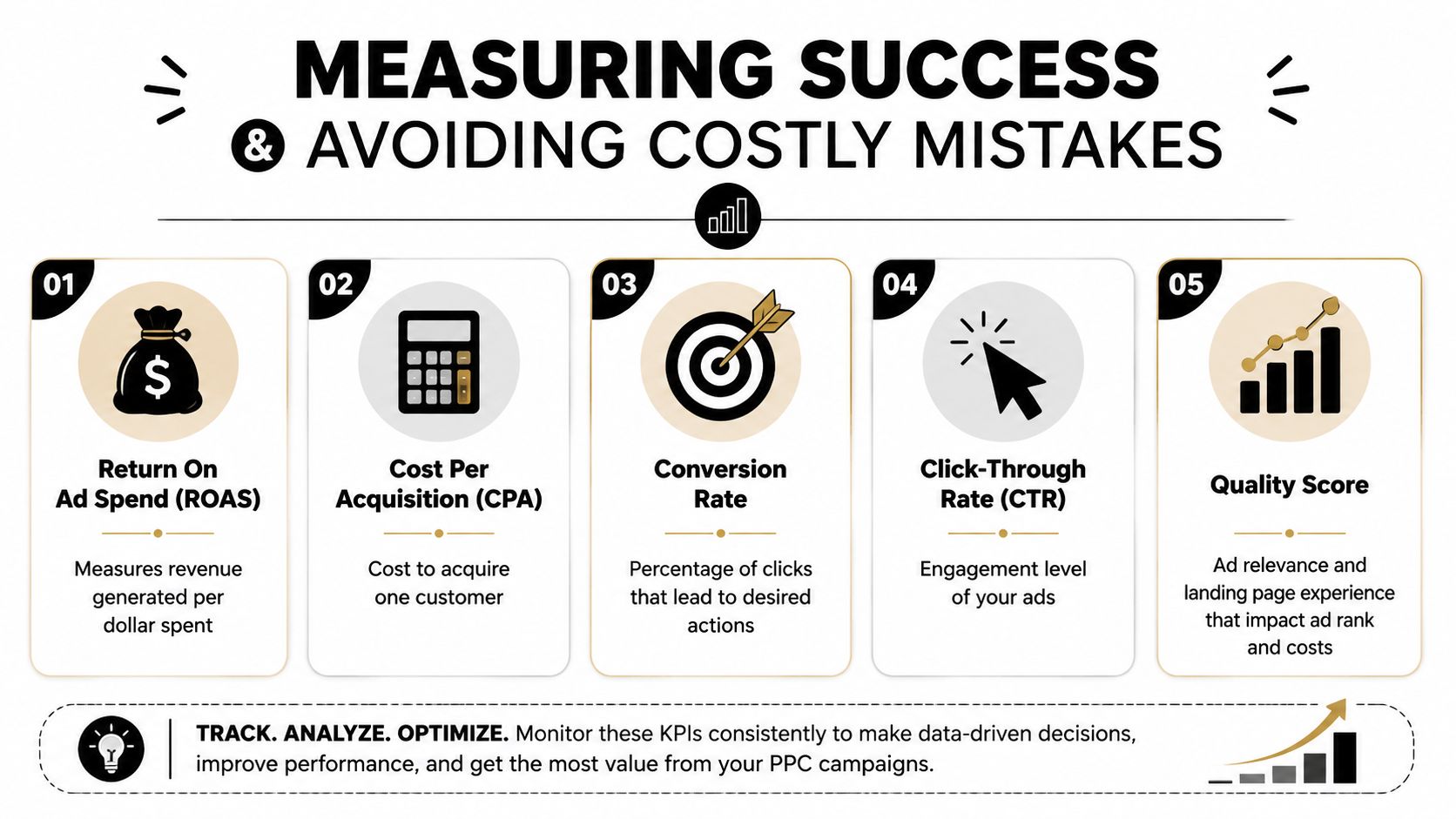
A PPC account can look healthy inside the platform and still underperform in the business. That's why success has to be measured at two levels. First, the ad metrics. Second, the commercial outcome.
The KPIs that matter
At campaign level, the core measures are straightforward:
- CTR: Are people responding to the ad?
- Conversion rate: Do clicks turn into enquiries or sales?
- CPA: What does it cost to acquire one lead or customer?
- ROAS: How much revenue comes back relative to ad spend?
Those metrics matter, but they don't tell the whole story. A cheap lead isn't always a good lead. A strong ROAS number can still mask refund issues, bad-fit customers, or low-margin jobs.
The mistake many SMEs make with automation
One of the most under-served issues in Australian PPC is the tension between AI-driven campaigns and measurement. Stronger management starts by upgrading measurement architecture so platform automation optimises for profitable conversions, not just reported ones, as discussed in Marketing Angle's PPC management analysis.
That trade-off matters because modern campaign types can scale quickly while hiding waste if your tracking is weak. If the platform gets fed poor conversion signals, it will optimise toward the wrong users with great efficiency.
Common mistakes include:
- Trusting platform reporting blindly
- Ignoring offline sales quality
- Sending traffic to weak mobile pages
- Letting automation run without guardrails
The better question isn't “How do we lower CPC?” It's “Are we acquiring profitable customers at a sensible cost?”
If you want PPC managed with that level of commercial discipline, Website Builder Australia is a strong local option. Their Brisbane-based team supports Australian businesses with Google Ads, websites, landing pages, tracking, and broader digital strategy, which is exactly what most SMEs need when paid campaigns have to produce leads, sales, and clear return on investment rather than just activity in a dashboard.


