

How to Open Ecommerce Business: A Practical Guide to Launching Online Stores
So, you're ready to jump into the world of Australian e-commerce? It's a massive opportunity, but it can feel like a huge mountain to climb. The whole process really boils down to three key phases: validating your idea, actually building your digital shopfront, and then, finally, launching it into the wild.
This guide is your roadmap. We're going to break down the entire journey, from researching a niche that actually makes money and sorting out the legal stuff like your ABN, right through to picking the best e-commerce platform and getting your marketing channels humming.
Your Roadmap to Entering Australian Ecommerce
Let's be honest, starting an online business feels daunting. But the timing has never been better to get stuck in. This guide is designed to be your complete playbook, breaking everything down into clear, manageable chunks.
We’ll start with the crucial first step: validating your killer idea. From there, we'll walk through the necessary paperwork, compare the pros and cons of different digital platforms, and map out a marketing strategy that gets you noticed. Forget the generic advice you’ve read elsewhere; we're diving deep into real-world scenarios that matter right here in Australia. By the end, you'll have a practical framework to not just launch, but to scale a successful online business.
The Booming Australian Market
There's seriously no better time to open an e-commerce business in Australia. The market has absolutely exploded, hitting a massive $63.6 billion in total online spending. And that growth is only getting faster.
Just recently, online retail turnover hit $4.143 billion in a single month—that's a jump of $495 million from the year before. Why? Aussies are flocking online for better value and sheer convenience. The data shows that 9.8 million households are now shopping online, a huge leap from 8.2 million previously.
To grab a piece of this pie, your strategy must include a mobile-friendly site. With 5G now covering 85% of Australians, shopping on the go is the norm. You can discover more insights about Australian ecommerce trends to help position your business for success.
This flow chart nails the process perfectly: first, you validate, then you build, and only then do you launch.
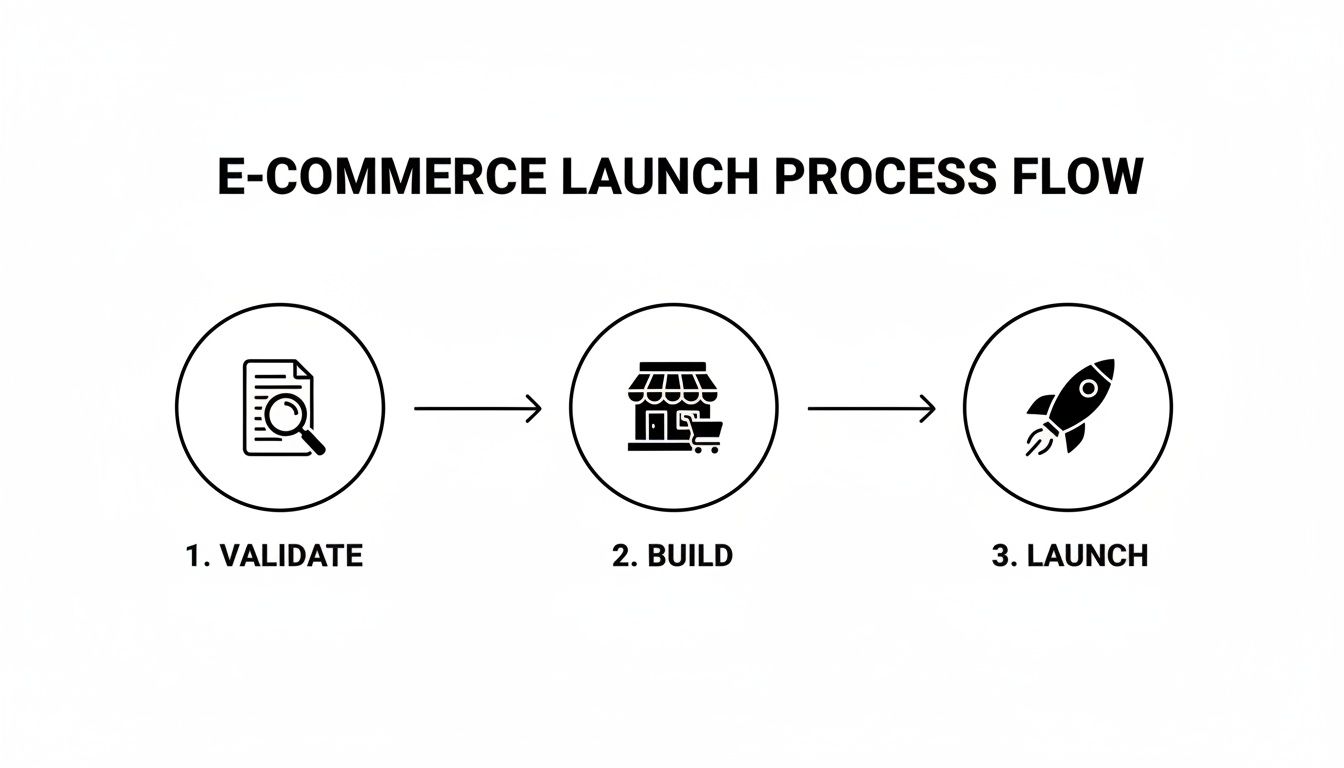
The key takeaway here is that launching is the final piece of the puzzle, not the starting point. A successful store is always built on a solid foundation of research and careful planning.
Why This Guide Is Different
Plenty of guides out there give you vague, fluffy advice. We’re not about that. This is a practical, Australia-first approach, focusing on the specifics that trip up local entrepreneurs.
We'll cover things like:
- Legal Essentials: Getting your head around ABN and GST registration without all the confusing government jargon.
- Platform Choices: A real comparison of platforms like Shopify and WooCommerce, looking at how they stack up with Australian payment gateways and shipping partners.
- Local Marketing: How to build SEO and paid ad strategies that actually connect with Aussie shoppers, from Sydney to Perth.
Success in e-commerce isn’t just about having a great product; it’s about executing a series of well-planned steps. This guide provides the structure, but your unique brand vision and dedication will bring it to life.
Validating Your Niche and Crafting Your Business Plan
A great idea is the spark, but let’s be honest—validation is the fuel that will actually get your ecommerce business off the ground. Before you get lost in the fun of choosing website themes or payment gateways, you need to be dead certain that people want to buy what you plan to sell. This is the crucial step that separates a thriving online store from a very expensive hobby.
Trying to jump into a huge category like "women's fashion" or "homewares" is a fast track to being drowned out by the competition. The real trick is to find your niche. Don't just sell fashion; sell "sustainably made linen clothing for professional women in their 30s." Starting specific is how you stand out.
Finding Your Sweet Spot in the Australian Market
First up, you need to put on your detective hat. Dig into what Australian consumers are actually searching for online. Tools like Google Trends are your best friend here. You can filter by location and see if "bamboo baby clothes" is a growing trend in New South Wales or if "custom dog collars" is a popular search across Queensland.
Look for trends that show a steady climb, not just a flash-in-the-pan spike. That's a sign of real, sustained interest. Next, it's time to do a bit of competitor analysis. Find a few Aussie businesses already playing in your potential niche and take a good look at what they're up to.
- What are they doing well? Check out their branding, product photos, and what customers are saying in reviews.
- Where are the gaps? Maybe their shipping is notoriously slow, their product range is tiny, or their customer service gets terrible feedback. These weaknesses are your opportunities.
- How are they priced? Get a feel for the market rate for similar products. This is vital info for when you work out your own pricing.
A lot of people see competitors and run for the hills. That's a mistake. Having competition is usually a great sign—it proves there's a market for what you want to sell. Your goal isn't to be the only one, but to be a better, more targeted option for a specific type of customer.
Once you’ve found a promising niche, it’s time to get crystal clear on who you're actually talking to.
Creating Your Ideal Australian Customer Persona
You need to know your customer like they’re your best mate. A customer persona is a detailed profile of your perfect buyer, and it’s much more than just a vague demographic. It’s a character with a backstory. So, instead of targeting "millennials in cities," you create "Chloe, the 32-year-old marketing manager from Melbourne."
Get into the nitty-gritty with details like:
- Demographics: Age, location (is she inner-city Sydney or regional WA?), income, and job.
- Pain Points: What problems is she facing that your product can solve?
- Shopping Habits: Where does she shop now? Is she swayed by Instagram influencers or does she live and die by product reviews? Is she hunting for a bargain or happy to pay a premium for quality?
- Values: Does she care about sustainability, supporting local Aussie businesses, or just pure convenience?
This persona will become your North Star, guiding every decision you make from your website's tone of voice to your ad campaigns.
Translating Research into a Simple Business Plan
Look, a business plan doesn't need to be a 100-page monster that gathers dust. For a new ecommerce store, a lean, practical plan is way more useful. Think of it as your roadmap for the first 6-12 months to keep you on track.
Make sure your plan covers these key areas:
- Product Sourcing: How are you getting your products? Will you be making them yourself, partnering with a local manufacturer, or using a dropshipping supplier? Each option has completely different startup costs and profit margins.
- Pricing Strategy: It’s time to crunch the numbers. You need to calculate all your costs—the product itself, shipping, packaging, and any platform fees. And don't forget to factor in GST if you think your annual turnover will hit the $75,000 threshold. Your final price has to cover everything and still leave you with a healthy profit.
- Financial Projections: Whip up a simple spreadsheet. List your estimated startup costs (website, inventory, marketing) and then project your monthly sales for the first year. Be realistic here; it takes time to build momentum. This forecast will help you manage your cash flow and set goals you can actually hit.
Once you've validated your niche and sketched out a solid business plan, a practical guide on how to start an online clothing store can offer some fantastic, specific advice. This groundwork is without a doubt the most important part of the whole process. It ensures you're building your business on a solid foundation, ready for everything that comes next.
Right, you've got a killer product idea and you know people want it. Now for the less glamorous, but absolutely critical part: getting your business set up legally in Australia.
This is the stuff that makes your business real. It's the foundation that builds trust, keeps you on the right side of the ATO, and honestly, saves you from massive headaches later on. Let's break down exactly what you need to do, step by step.
Choosing Your Business Structure
First up, you need to decide what kind of business you're going to be. For most people starting out in ecommerce down under, it really boils down to two main options.
Sole Trader: This is the go-to for most startups. It’s simple, cheap, and fast to set up. You and the business are legally the same entity, which means all the profits (and the risks) are yours personally. It's the perfect way to get started and test the waters without getting bogged down in paperwork.
Proprietary Limited Company (Pty Ltd): Think of this as the next level up. Setting up a company creates a separate legal entity. This is a game-changer because it protects your personal assets (like your house) if the business runs into trouble. It's more complex and costs a bit more to run, but it gives you credibility and is built for growth.
Most founders I know start as a sole trader. You can always switch over to a company structure once the cash starts flowing and things get more serious.
Getting Your ABN and Business Name Sorted
No matter which path you take, you absolutely need an Australian Business Number (ABN). This is your unique 11-digit identifier for everything business-related in Australia. You'll need it for invoicing suppliers, avoiding having tax withheld from your payments, and just looking like a legitimate operation.
You can apply for an ABN for free directly through the Australian Business Register (ABR). It's a pretty straightforward process.
Once the ABN is sorted, you need to register your business name. This is what your customers will actually call you. A quick tip: check if the domain name you want is available at the same time you're checking the business name. You want them to match perfectly for brand consistency.
Don't underestimate the importance of your ABN. It's more than just a number; it's your ticket to play in the professional leagues. Without one, any business paying you has to withhold tax at the highest possible rate, which can absolutely cripple your cash flow from day one.
Understanding GST and Your Money Matters
Ah, the Goods and Services Tax (GST). This is a big one. You are legally required to register for GST once your annual business turnover is expected to hit $75,000.
If you're starting small, you don't have to register straight away. However, you can choose to register voluntarily before you hit that $75,000 threshold. Why would you? The big plus is being able to claim GST credits on things you buy for the business. The downside is the extra admin of lodging Business Activity Statements (BAS) with the tax office.
Finally, and I can't stress this enough, open a separate bank account for your business the moment you get your ABN. Trying to run a business from your personal everyday account is a recipe for disaster. It turns tax time into a nightmare and makes it impossible to see if you're actually making a profit. It’s a simple, professional habit that sets you up for success.
While you're sorting out your banking, it's a good idea to get familiar with how payment gateways operate. For example, you can learn more about PayPal transaction fees in our detailed guide. Getting these financial basics right from the start is what separates the businesses that last from those that don't.
Building Your Digital Storefront and Choosing a Platform
Okay, you've got your business plan sorted and the legal ducks are in a row. Now for the fun bit – actually building your online store.
Think of your website as more than just a place to list products. It’s your 24/7 salesperson, your brand ambassador, and the main way you’ll connect with your customers. The platform you build it on is one of the most important decisions you'll make, dictating everything from how you manage inventory to how easy it is for a customer to hit 'buy'.
All-in-One vs Customisable Builds
First up, you need to decide between an all-in-one, hosted platform or a more hands-on, self-hosted solution. Each path has its pros and cons, really depending on your technical confidence, budget, and where you see the business going long-term.
Hosted Platforms (like Shopify and BigCommerce): These are fantastic for most people starting out. They take care of all the technical heavy lifting – hosting, security, updates – all for a monthly fee. It’s like renting a fully fitted-out retail space; you just need to focus on stocking the shelves and making sales.
Self-Hosted Platforms (like WooCommerce): This route gives you ultimate control. You download the software (WooCommerce is essentially a powerful plugin for WordPress) and install it on your own hosting account. This is like owning the building; you have total freedom to customise, but you’re also on the hook for all the maintenance and security.
There's no single "best" choice here, just the one that fits your business needs right now.
A simple way to look at it: an all-in-one platform gets you up and trading faster with fewer headaches, while a custom build gives you unlimited potential for unique features down the track.
Comparing the Top Ecommerce Platforms
For Aussie businesses, the choice usually boils down to three main players. All of them have a strong local presence and play nicely with Australian payment gateways and shipping carriers. It's a great idea to check out our guide on Australian payment gateways to get a sense of which integrations are must-haves for your store.
Before we dive into the details, here's a quick comparison to help you see how they stack up for an Australian business.
Ecommerce Platform Comparison for Australian Businesses
| Platform | Best For | Monthly Price (AUD) | Transaction Fees | AU Payment and Shipping Integrations |
|---|---|---|---|---|
| Shopify | Beginners and businesses focused on ease of use and rapid launch. | Starts at ~$44/mo | 0.5% – 2% (unless using Shopify Payments) | Excellent (Afterpay, Zip, AusPost, Sendle) |
| WooCommerce | Businesses wanting full customisation, content-heavy sites, and no platform fees. | Free software (hosting/domain costs ~$15-50/mo) | 0% (only processor fees) | Extensive (via plugins for all major providers) |
| BigCommerce | Growing businesses and those with large, complex product catalogues. | Starts at ~$49/mo | 0% on all plans | Strong (PayPal AU, Stripe, eWay, AusPost) |
As you can see, the right choice really depends on your priorities—whether that's simplicity, control, or built-in power.
Shopify is often crowned the king of ease of use. Its dashboard is clean and intuitive, which means you can get a store up and running incredibly fast. It also has a massive app store for adding extra features and boasts brilliant support for local favourites like Afterpay and Australia Post.
WooCommerce, which is built on WordPress, is the world's most popular ecommerce solution for a reason: unparalleled customisation. The core software is free, but you'll need to factor in costs for hosting, a domain name, and potentially premium themes or plugins to get all the functionality you want. It's the perfect choice for anyone who wants to build a truly unique brand experience.
BigCommerce is a powerful competitor that finds a sweet spot in the middle. Like Shopify, it’s a hosted platform, but it packs in more features right out of the box, which can save you a fair bit on app subscriptions. It's particularly strong for businesses managing large or complex product catalogues.
Securing Your Technical Foundations
No matter which platform you go with, there are a few technical basics that are absolutely non-negotiable for building trust and giving your customers a good experience.
First, you need a domain name. This is your address on the web (e.g., yourbrand.com.au). You want something short, memorable, and closely tied to your business name. Grabbing a .com.au domain is a smart move as it instantly signals to shoppers that you're a local Aussie business.
Next up is an SSL certificate. This is what encrypts the data moving between your customer's browser and your website, keeping sensitive info like credit card details safe. Modern browsers will slap a "Not Secure" warning on any site without one, which is a guaranteed way to lose a sale. The good news is that most quality hosting providers and all major ecommerce platforms include a free SSL certificate.
Finally, think about your web hosting. If you're using Shopify or BigCommerce, this is already included in your plan. For WooCommerce users, you'll need to pick a hosting provider. My advice? Choose a host with servers located right here in Australia. This makes a huge difference to your website's loading speed for local customers, which is a massive factor for both user experience and your SEO rankings.
The Australian online shopping market is worth over $40 billion, and it's not slowing down. To get your slice of the pie, you need to invest in a solid technical foundation that actually converts browsers into buyers.
Preparing for Launch with Marketing and Operations

Having a beautifully designed store is a fantastic start, but it's only half the battle. If potential customers can't find you, all that hard work setting up your digital storefront goes to waste. This is where we get serious about building the marketing and operational foundations that ensure your launch day isn’t met with crickets.
Think of it this way: you've built the shop, and now you need to build the roads that lead people to it. At the same time, you need to make sure the in-store experience is seamless. It’s time to shift your focus from building the store to bringing people to it.
Laying the Groundwork with SEO
Search Engine Optimisation (SEO) is your long game. It's the art and science of getting your store to show up on Google for free when people are actively searching for what you sell. This isn't about quick wins; it's about building a sustainable source of high-quality traffic.
It all starts with solid keyword research. You need to get inside your ideal customer's head and figure out the exact words and phrases they're typing into the search bar. Tools like Ahrefs or even the free Google Keyword Planner are your best friends here. Look for "long-tail keywords"—those longer, more specific phrases. They usually have lower competition and signal someone is much closer to making a purchase. For example, instead of just "boots," a much better target might be "waterproof leather boots for hiking in Tasmania."
Once you've got a list of target keywords, you need to weave them naturally into the fabric of your website. Key spots include:
- Product Titles: Make them descriptive and clear, including the main keyword.
- Product Descriptions: Write unique, compelling copy that sells the dream and includes your keywords strategically.
- Category Pages: These are perfect for targeting broader terms that describe a whole group of products.
Don’t just stuff keywords everywhere. Your primary goal is to write for humans first, search engines second. A helpful, persuasive product description that actually answers a customer's questions will always outperform robotic, keyword-crammed text.
Setting Up Essential Tracking Tools
Before your very first visitor lands on your site, you absolutely must have analytics in place. You can't improve what you don't measure, and for any serious ecommerce business, Google Analytics is non-negotiable.
Setting up Google Analytics is free and pretty straightforward. It’s the only way to get real data on how many people are visiting your store, where they’re coming from (e.g., Google search, Instagram), and which pages they're looking at. Most importantly, you can set up ecommerce tracking to see exactly which marketing efforts are actually driving sales.
Building Pre-Launch Buzz on Social Media
While SEO is a marathon, social media is your sprint to generate immediate excitement. A few weeks before you officially launch, start making some noise on the platforms where your target audience hangs out. Whether that's Instagram for highly visual products or Facebook for building a community, the key is a consistent content plan.
Start teasing your products with high-quality photos and behind-the-scenes videos. You could run a giveaway or offer a special pre-launch discount for anyone who signs up for your email list. The goal is to build an engaged audience before you even have something to sell. That way, you have a crowd of eager customers ready to hit "buy" the moment your store goes live. We also recommend exploring our insights on how a https://websitebuilderaustralia.com.au/website-builder-australia-your-brisbane-partner-for-social-media-marketing-success/ can make a significant difference.
Finalising Your Operations
Smooth operations are the secret ingredient to happy, loyal customers. Getting your shipping and customer service sorted before you launch will save you from a world of pain later.
For an Aussie business, this means getting your shipping rates right for both your customers and your bottom line. You might want to consider:
- Flat-rate shipping for its simplicity.
- Weight-based rates if your products vary a lot in size.
- Free shipping over a certain dollar amount (e.g., $100) to encourage bigger orders.
Thankfully, most ecommerce platforms integrate directly with carriers like Australia Post or Sendle, which simplifies this process immensely.
Customer service is the other critical piece of this puzzle. Set up a dedicated business email and create some template responses for common questions like "Where's my order?" or "What's your return policy?". A prompt, helpful, and human response can turn a slightly annoyed shopper into a lifelong advocate for your brand. To truly thrive, focus on integrating top-tier ecommerce and customer service from day one. This proactive approach ensures you're ready to deliver an exceptional experience that keeps people coming back.
Your Top Questions About Starting an Ecommerce Business
Kicking off your first online store is exciting, but it’s completely normal to have a million questions swirling around. It can feel a bit overwhelming, to be honest. To help you cut through the noise and move forward with confidence, we’ve tackled some of the most common queries we hear from new Aussie entrepreneurs.
How Much Does It Really Cost to Start an Ecommerce Business in Australia?
This is the big one, isn't it? Thankfully, you don't need a million dollars to get started. The real answer is: it depends. Your startup costs can vary wildly based on the path you choose.
If you’re running a lean operation, you could launch with a platform like Shopify for just a few hundred dollars to cover your initial subscription and a theme. On the flip side, a completely custom-built website can easily run from a few thousand up to $10,000 or more.
The key is to budget for the non-negotiables:
- Business Registration: This will usually set you back somewhere between $100 to $500, depending on your business structure.
- Platform Fees: Expect to pay anywhere from $40 to $400 per month.
- Initial Inventory: This is the biggest variable and depends entirely on your product.
- Starting Marketing Budget: You need to get the word out. A realistic starting point is $500 to $1,000 per month to gain some early traction.
- Payment Processing Fees: Factor in roughly 1.75% + 30c for every transaction.
All up, a sensible minimum budget to get you through the first few months would be in the $2,000 to $5,000 range.
Do I Need to Register for GST Immediately?
Short answer: no, you don't. In Australia, it's only compulsory to register for the Goods and Services Tax (GST) once your business turnover hits (or is likely to hit) $75,000 in a 12-month period. Plenty of small businesses start trading without being registered.
You can choose to register voluntarily before hitting that threshold. The main perk is being able to claim GST credits on your business expenses. However, it also means adding GST to your prices and lodging regular Business Activity Statements (BAS) with the ATO, which adds a layer of admin you might not want right away.
What Are the Best Shipping Options for a New Australian Store?
When you’re just starting, keep it simple. Australia Post’s MyPost Business is a fantastic place to begin. It's reliable, and you don't need to commit to huge shipping volumes to get decent rates.
Services like Sendle and Shippit are also excellent choices. They integrate smoothly with most ecommerce platforms and can often offer really competitive pricing by pooling volume from many small sellers. From day one, it's a smart move to give customers a choice between standard and express postage.
Our Tip: Start with a simple flat-rate shipping fee across Australia. It’s the easiest way to manage logistics without getting bogged down in complex calculations. As you grow, you can introduce more advanced, location-based shipping rules. And for local customers, a free "click and collect" option can be a brilliant incentive.
How Can I Compete with Major Retailers like Amazon and The Iconic?
Here's the truth: trying to beat the giants on price or delivery speed is a game you'll probably lose. Don't play it. Your real power lies in doing all the things they simply can't. You need to lean into what makes you unique.
First, go niche. Instead of trying to sell a bit of everything, become the absolute go-to expert for a specific, curated range of products. This builds authority and attracts a loyal, dedicated audience that isn't just looking for the cheapest option.
Next, tell a compelling story. Build a real brand and a community around what you do. Use your content and social media to share your passion, your values, and the story behind why your products exist. People connect with people, not corporations.
Finally, deliver knockout, personalised customer service. When someone emails your business, they're talking to you—the founder. That personal touch is something a massive retailer can never replicate, and it's often the very reason a shopper will choose to support a local Australian business. Focus on what makes you different, not just cheaper.
Ready to build a digital storefront that stands out and turns visitors into loyal customers? The team at Website Builder Australia specialises in creating powerful, custom ecommerce solutions for businesses just like yours. Get in touch with us today to chat about your project and see how we can help you launch and grow your online business.


