

Local SEO for Plumbers Your Guide to Dominating Local Search
Let's be real—when a pipe bursts, nobody’s dusting off the Yellow Pages. They're grabbing their phone and searching for an 'emergency plumber near me'. Getting your head around local SEO is probably the single most important marketing move you can make for your plumbing business. It's what turns those frantic online searches into a ringing phone and a packed-out schedule.
Why Local SEO Isn't Optional for Plumbers Anymore

The game has completely changed for tradies. Your potential customers are living online, and their journey to hiring a plumber almost always starts and ends with a quick Google search. This simple fact makes your visibility in local search results the make-or-break difference between a thriving business and one that’s always scrambling for the next job.
Picture this: It's 9 PM on a Saturday in Brisbane. A homeowner spots a nasty water stain spreading across their ceiling from a leaky pipe. Their first move isn't to flick through old flyers or even ask a neighbour. It's to pull out their phone and type "emergency plumber Brisbane southside" into Google. The businesses that pop up in that local map pack? They're the ones getting the call.
That's the power of a focused local SEO strategy right there. It’s that direct.
The Hyperlocal Edge for Plumbers
It's so important to understand the difference between broad, general SEO and the hyperlocal tactics that actually get your phone ringing. A national campaign trying to rank for "best plumber" is completely useless for a business that only serves the northern suburbs of Sydney.
Your entire focus should be on winning the searches that have local intent. These are the queries where the person is either directly or indirectly telling Google they need someone nearby, right now.
Think about searches like:
- "hot water system repair Bondi"
- "24/7 plumber Parramatta"
- "blocked drain specialist near me"
- "gas fitter Chermside"
These aren't just idle queries. They're urgent calls for help from people in your service area who are ready to book a job.
At its core, local SEO is all about making your business the most relevant, trustworthy, and visible solution for a customer's problem within a specific geographic area. It’s about being the best answer when and where it truly counts.
The Data Doesn't Lie
This isn't just a gut feeling; it’s backed by solid user behaviour. Local search has become a massive force, with data showing that 46% of all searches on Google have a local intent. For an urgent, needs-based service like plumbing, that figure is everything. Someone searching for leak repairs needs a local fix, not a list of plumbers three states away.
To really get a handle on this critical strategy, you can dive deeper into the fundamentals of local SEO. This hyperlocal focus is what connects you directly with customers in crisis, positioning your business as the obvious solution in their moment of need. For a wider view, check out our guide on how local SEO for businesses can be a game-changer for any local company.
Right, let's talk about the single most important tool for getting local plumbing jobs: your Google Business Profile.
Mastering Your Google Business Profile
Think of your Google Business Profile (or GBP) as your digital shopfront. For a local plumber, it’s often the very first thing a potential customer sees when they’re frantically searching for someone to fix a burst pipe. A properly optimised profile is the absolute heart of local SEO, driving phone calls and website visits straight from Google Search and Maps.
Too many tradies set it up once and then forget about it. That's a massive mistake. Your GBP isn't static; it's a living profile that needs regular attention to stay at the top. If you ignore it, you’re basically invisible to the very customers who need you the most.
Nailing the Setup from Day One
Getting the initial setup right is where so many businesses stumble. Do this correctly from the start, and you'll save yourself a world of headaches and set the stage for ranking high in that coveted local "map pack."
First things first, head to google.com/business to claim your profile. The single most critical choice you'll make is your primary category. It has to be ‘Plumber’. You can add secondary categories later, like ‘Drain Cleaning Service’ or ‘Gas Fitter’, but that primary one carries the most weight for telling Google exactly what you do.
This dashboard is your new command centre for everything Google-related.
From here, you’ll upload photos, answer customer questions, and keep your details up-to-date. An active, well-managed profile is a powerful signal to Google that you're a legitimate, trusted local business worth showing to searchers.
Writing a Business Description That Actually Converts
You've got 750 characters for your business description. Don't waste a single one on fluff. Write for your customer, but keep your important keywords in mind. Tell them who you are, what sets you apart, and the suburbs you service.
Instead of something generic, get specific.
"Your trusted, family-owned North Sydney plumber for over 20 years. We offer 24/7 emergency services for burst pipes, blocked drains, and hot water repairs. Our licensed and insured team provides upfront pricing, ensuring no surprises for residential and commercial clients across the Northern Beaches."
See what that does? It packs in:
- Key Services: Burst pipes, blocked drains, hot water repairs
- Location: North Sydney, Northern Beaches
- Trust Signals: Family-owned, 20 years, licensed, insured, upfront pricing
- Keywords: ‘plumber’, ‘emergency services’
This level of detail helps both customers and Google understand your business instantly. The same logic applies to other trades, which we cover in our guide on local SEO for electricians.
Going Beyond the Basics to Drive Engagement
A name and number isn't enough. To turn your profile into a real lead-generating machine, you need to use all the features Google gives you.
To make this easier, we've put together a checklist. Run through this to make sure you haven't missed anything crucial.
Google Business Profile Optimization Checklist
Here's a handy checklist to ensure your Google Business Profile is fully dialled in for maximum local visibility.
| Optimization Element | Status (To-Do / Complete) | Why It Matters |
|---|---|---|
| Services List | Don't just list 'plumbing'. Add every specific service like 'Hydro Jetting', 'Leak Detection', and 'Tap Repair'. Each one is another chance to rank. | |
| Photos & Videos | Upload high-quality, geotagged photos of your team, vans, and job sites (before-and-afters are gold). Visuals build trust instantly. | |
| Google Posts | Use Posts to share specials, tips, or company news. Aim for a new post weekly to show Google and customers that you're active. | |
| Q&A Section | Proactively ask and answer common questions. "Do you offer free quotes?" or "What's your emergency call-out fee?" This saves you time and helps customers. |
This kind of active management is what separates the top-ranking plumbers from everyone else.
It's shocking, but a recent analysis by Rankmax.com.au found that 58% of all Australian businesses haven't optimised their online presence for local search, and only 30% even have a dedicated plan. For a savvy plumber, this is a massive opportunity. Just by getting your GBP right, you're already miles ahead of the competition.
Optimising Your Website to Attract Local Customers
Think of your Google Business Profile as the sign on your shopfront—it gets people to stop and look. But it’s your website where the real magic happens. This is your digital workshop, the place where a casual searcher becomes a paying customer. To make sure those frantic local searches actually lead to a ringing phone, you need to get your website optimisation spot on.
Your website has to be built to answer the exact questions your potential customers are asking. This isn't about having a generic "services" page. You've got to get inside the head of a homeowner with a burst pipe. They're not searching for "plumbing services"; they're desperately typing "hot water system repair Bondi" or "24/7 emergency plumber Parramatta" into their phone.
This diagram shows how your Google Business Profile—the first touchpoint—should be set up before anyone even lands on your site.
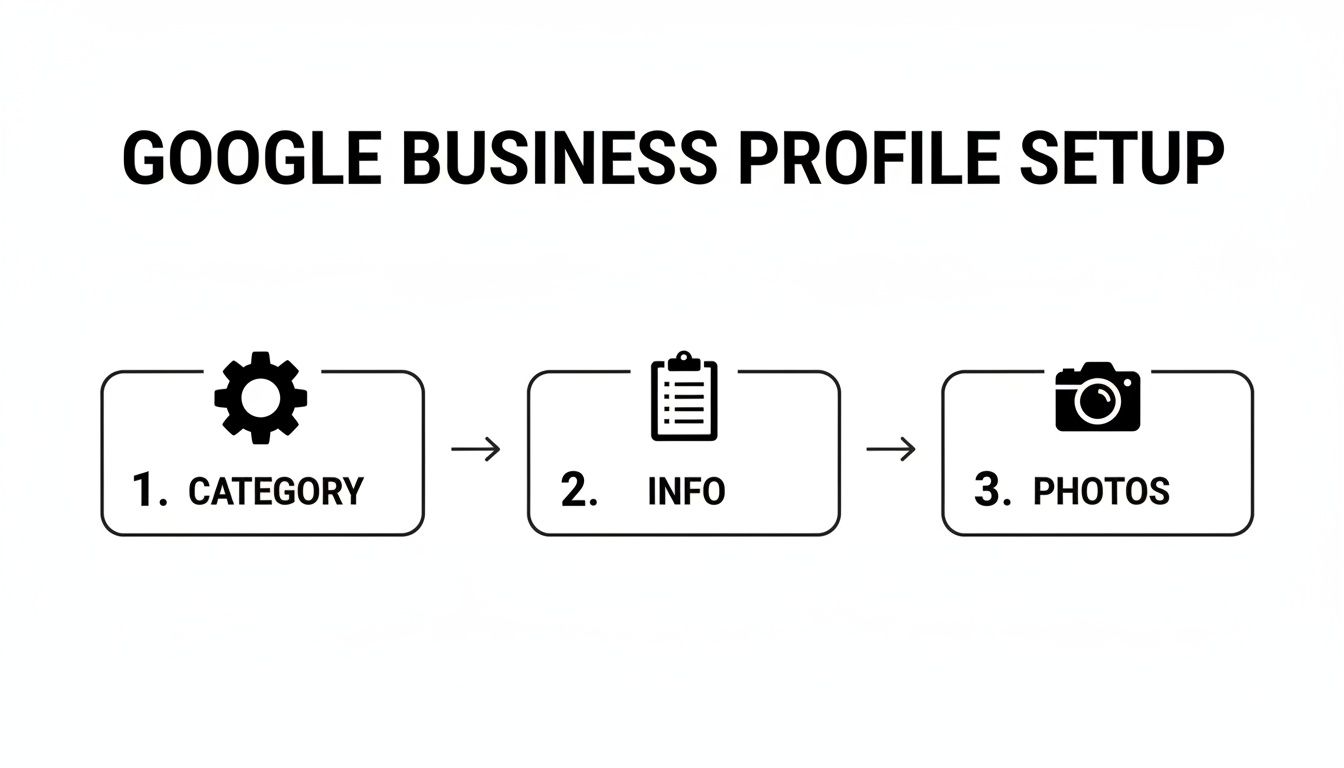
Once you've got those Google basics sorted, your website is the next, crucial piece of the puzzle. It’s what turns a search into a scheduled job.
Building Pages for Services and Suburbs
The best plumbing websites I’ve seen are all structured around two simple ideas: what you do and where you do it. This means you need dedicated pages for each of your main services and for every key suburb you operate in.
Forget about lumping everything onto one page. You need individual, detailed pages for things like:
- Blocked Drains
- Hot Water System Repairs & Installation
- Gas Fitting Services
- Leak Detection
- Emergency Plumbing
Each of these pages should be a proper deep dive. Explain the common problems you solve for that specific service, walk them through your process, and tell them why you’re the right choice. This approach lets you target super-specific keywords like "gas fitter North Sydney" directly on the relevant page, which is way more effective than a generic services list.
The same logic applies to your service areas. If you cover multiple suburbs, create pages for them. A page titled "Plumber in Chatswood" that speaks directly to the locals—maybe even mentioning a local landmark or common plumbing issues in old Chatswood homes—is going to work a lot harder for you than just listing "Chatswood" on your homepage.
The goal is simple: create a specific, highly relevant landing page for every valuable search combination you can think of. When someone searches for 'leak detection in Manly,' you want Google to see you have a page dedicated to exactly that.
This isn't just theory; it delivers real results. Just look at the case study for Sydney Plumbing Hot Water & Gas, an Australian plumbing business that went all-in on this strategy. By creating specific service and location pages across Sydney, they saw a massive 93.57% increase in organic traffic in only four months. You can check out the full results of their strategic approach to see how targeted content turns into genuine business growth.
Speaking Directly to Local Customers
The words on your website need to do more than just list what you do. They need to build instant trust and get people to act. Use a clear, direct tone that speaks to someone who’s stressed out and needs help now.
Ditch the corporate jargon. A phrase like, "Dealing with a stubborn blocked drain that's brought your household to a grinding halt?" connects far better than, "We offer professional drain cleaning services."
On every single service and location page, make sure you include these three things:
- An embedded Google Map: This visually confirms you service their area.
- Your NAP: Your business Name, Address, and Phone number should be impossible to miss and match your GBP listing perfectly.
- Strong Calls-to-Action: Use big, obvious buttons and clickable phone numbers. Think "Call Now for Emergency Service" or "Request a Free Quote."
When you build a website that's meticulously structured for your local audience, it stops being a simple online brochure. It becomes your most powerful tool for winning new customers.
Building Local Trust Through Reviews and Citations

Once you've got your website and Google profile sorted, it's time to look at the bigger picture. Your reputation online is built one mention at a time, all across the web. This is where two absolute game-changers for local SEO come in: citations and reviews. Get these right, and you'll build serious trust with both Google and your future customers.
Think of it from Google's perspective. When its bots crawl the web and see your business mentioned consistently across dozens of reputable sites, it starts to see you as a legit, established local player. Each mention is like a vote of confidence.
This digital footprint is built on a foundation of citations and then reinforced by genuine customer feedback.
The Foundation of Trust: NAP Consistency
A citation is just a fancy word for any online mention of your business’s key info: your Name, Address, and Phone number (NAP). It sounds simple, but getting this wrong is a common and costly mistake.
For local SEO to work, your NAP details must be absolutely identical everywhere. No exceptions.
Inconsistencies are a red flag for search engines. If one directory lists you as "Mick's Plumbing" and another has "Mick's Plumbing & Draining," Google gets confused. It can't be sure it's the same business. This hesitation erodes trust and torpedoes your ranking power, making it that much harder to crack the local map pack.
Your first job is to establish one single, official NAP and stick to it. Decide on one format for your address ("Street" vs. "St."), your business name, and your phone number, and use it religiously.
Once you have that sorted, it’s time to start building your citation profile on the most valuable Australian directories. This sends a powerful signal to Google that you are exactly who and where you say you are.
Top Australian Citation Sources for Plumbers
To get you started, here is a hand-picked list of high-value Australian directories. Getting your business listed here with a perfectly consistent NAP is a fantastic first step in building authority.
Top Australian Citation Sources for Plumbers
| Directory Name | Directory Type | Key Benefit |
|---|---|---|
| Yellow Pages Australia | General Business | A foundational, highly trusted directory that has been a staple for Australian businesses for decades. |
| TrueLocal | General Business | One of Australia's largest online business directories, excellent for customer reviews and local visibility. |
| Yelp Australia | Review Focused | A major player in the review space that heavily influences customer decisions and local search rankings. |
| HiPages | Trades & Services | A must-have for any tradie. Connects homeowners directly with service providers like plumbers. |
| ServiceSeeking.com.au | Trades & Services | Another critical platform specifically for Australian trades, helping you get discovered for specific jobs. |
| Local Search | General Business | A robust directory that provides another strong signal of your business's location and services. |
Building out these profiles takes time, but it’s a crucial part of creating a strong and trustworthy online presence that Google will reward.
Driving Growth With a Proactive Review Strategy
Just hoping for good reviews to roll in isn't a strategy. In a trust-based industry like plumbing, you need a system to actively generate a steady stream of positive feedback. Consider this: a staggering 87% of consumers read online reviews for local businesses. It's often the final piece of the puzzle before they pick up the phone.
Your online reviews are the single most powerful form of social proof. A potential customer reading about how you quickly fixed a burst pipe for another local homeowner is far more persuasive than any marketing copy you could write.
The perfect time to ask for a review is right after you’ve finished the job. The customer is happy, their problem is solved, and they're feeling relieved.
Don't overcomplicate the ask. A simple SMS or email follow-up with a direct link to your Google review page works wonders.
For example, a quick SMS like this is personal and effective: "Hi [Customer Name], it's [Your Name] from [Your Business]. Glad we could sort out your [plumbing issue] today. If you have a moment, a quick review would really help us out: [Direct Google Review Link]." It’s low-pressure and makes it incredibly easy for them to say yes.
Finally, and I can’t stress this enough, you need to respond to every review—the good and the bad. Thanking a happy customer shows you appreciate them. Professionally addressing a negative review shows everyone else that you take responsibility and are committed to good service. You can often turn a public complaint into a public display of excellent customer care.
Gaining an Unfair Advantage with Local Link Building
Right, let's talk about the bit where you can really pull ahead of the competition. While other plumbers are just ticking the boxes—setting up their Google profile and chucking some content on their website—this is where you can leave them for dead. Building a strong local link profile is the secret sauce in your local SEO for plumbers strategy.
Think of these links from other local websites as powerful votes of confidence. They’re a huge signal to Google that your business is a legitimate, trusted part of the local community.
Every quality link you get is basically a digital referral. This isn't about getting hundreds of dodgy, spammy links from overseas. It’s about earning a handful of genuinely relevant, local links that prove you're the real deal. This is what separates the plumbers at the top of Google from everyone else.
Think Beyond Your Own Website
The best link building doesn't even feel like marketing. It’s more like old-school community networking, just done online. The aim is to get your business name and website link featured on other reputable websites in your area. Have a think about all the other businesses and local organisations your customers already know and trust.
A single link from one of them can be worth its weight in gold. It sends referral traffic your way and, more importantly, screams to Google that you're a respected local player.
So, where do you get these cracking links? Here are a few practical ideas you can start on straight away.
- Sponsor a Local Junior Footy Team: This is a classic for a good reason. Almost every local sports club has a "Sponsors" page on their website where they thank and link to the businesses that chip in. It’s an incredibly authentic and powerful local link to get.
- Partner with Complementary Trades: You're on job sites with sparkies, builders, and tilers every single day. Why not make it official? Create genuine referral partnerships and feature each other on a "Trusted Partners" page on your websites. It's a win-win link exchange.
- Connect with Real Estate Agents: Property managers and real estate agents are always desperate for reliable tradies. Offer to be their go-to plumber for rental maintenance or pre-sale inspections. In exchange, ask for a spot on their "Recommended Contractors" page.
A single link from a well-known local real estate agency's website can be more powerful for your local SEO than dozens of generic directory listings. It’s a direct signal of trust within your specific service area.
This kind of strategic outreach is what will set your plumbing business apart. If you want to see what your rivals are up to in this area, it's worth learning how to conduct a detailed competitor analysis to uncover where they're getting their own links from.
Create Content Worth Linking To
Here’s another powerful strategy: create genuinely useful content on your blog that local organisations would actually want to share. This takes you from just "selling your services" to being a true local expert. The trick is to think about timely, location-specific topics.
For example, imagine writing a blog post titled, "A Plumber's Guide to Water Conservation During a Brisbane Drought." That’s the kind of helpful resource that local news sites, community Facebook groups, and maybe even the local council would be happy to link to.
Have a think about content ideas like these:
- A guide to common plumbing issues in older heritage homes in a specific suburb (e.g., "Fixing Plumbing in Newtown's Terrace Houses").
- A seasonal checklist (e.g., "How to Prep Your Melbourne Home's Pipes for Winter").
- An article explaining local council water restrictions and what they actually mean for households.
When you create something that’s genuinely useful for your community, other local websites will naturally want to reference it. This approach not only earns you fantastic backlinks but also builds your brand and cements your reputation as the go-to plumbing authority in your area.
Your Top Local SEO Questions, Answered
Getting your head around local SEO can feel a bit like staring into a tangled mess of pipes under a sink. You know it’s the key to getting more calls, but where do you even start? It’s easy to feel a bit swamped.
Let's cut through the noise. Here are the straight answers to the questions we hear most often from plumbers, designed to get you moving in the right direction and steer clear of common pitfalls.
How Long Does It Take to See Results from Local SEO?
This is the million-dollar question, and the honest-to-goodness answer is it’s a long game, not a quick fix. You might see a few early wins after giving your Google Business Profile a solid tune-up, but a proper strategy needs time to really kick in.
Generally, you should start seeing a real difference in your local rankings—and more importantly, in your phone ringing—within 3 to 6 months. This gives Google enough time to see the consistent, positive signals you're sending and start trusting your business.
Think of it like earning a reputation in a new neighbourhood. It doesn't happen the day you move in. It's built job by job, day by day. SEO is just the digital version of that. Your website's authority and your collection of great reviews build up over time.
The first thing you’ll likely notice is ranking better for your own business name and for less-fought-over keywords, like "tap repair in [your suburb]." Going after the big fish like "emergency plumber [your city]" takes more sustained effort. Consistency is what turns this from an expense into a reliable source of leads.
Do I Need a Physical Address to Rank in a Specific Suburb?
This one trips up a lot of tradies, especially if you work from a home base and cover a wide patch. The short answer? No, you don’t need a physical shopfront in every single suburb you service.
Google gets that businesses like yours are service-area businesses (SABs). When you set up your Google Business Profile, you can hide your home address and instead outline a service area by listing the suburbs or postcodes you cover. This tells Google exactly where you're willing to travel without needing a commercial address.
But that's only half the story. To really prove you belong in those suburbs, your website needs to back it up. That's where location pages come into play.
- Build a dedicated page on your site for each main suburb you target (e.g., "Plumber in Parramatta").
- On each page, talk specifically about your services within that local context.
- You could even mention local landmarks or common plumbing problems specific to the types of homes in that area.
When you combine a correctly set up Google profile with these targeted website pages, you’re sending a powerful signal to Google that you’re a genuine local player, even without a physical address there.
Reviews or Website Links: Which Is Better?
That’s like asking a plumber if they need a wrench or a pipe cutter. You need both, but they do different jobs.
For a local business like a plumbing service, a steady flow of positive reviews will almost always give you a faster return. Good reviews build immediate trust and are a huge factor in your ranking on the local map pack—which is prime real estate for customers who need help now. Seeing five recent 5-star reviews is a massive green light for a potential customer.
Local link building, on the other hand, is your long-term power play. Getting links from other respected local sites (think local business directories, community groups, or suppliers) builds your website’s authority. This is what helps you climb the ranks for those really competitive search terms over time.
A balanced approach works best:
- First, get a rock-solid process for getting reviews. Make it ridiculously easy for every happy customer to leave one.
- Then, start building local links by partnering with other businesses or getting involved in the local community online.
Focus on reviews to get the phone ringing quickly, then build links to cement your position at the top for years to come.
What Is the Biggest Local SEO Mistake Plumbers Make?
Easy. The single biggest mistake we see, and the one that causes the most damage, is inconsistency with your Name, Address, and Phone number (NAP).
When Google finds different versions of your business name ("Mick's Plumbing" on one site, "Mick's Plumbing & Draining" on another), an old address, or a disconnected phone number floating around online, it gets confused. That confusion erodes trust and torpedoes your ability to rank.
A close second is simply setting up a Google Business Profile and then forgetting about it. If you don't respond to reviews, answer customer questions, or add fresh photos of your work, your profile looks neglected. Your competitors who are keeping their profiles active will sail right past you.
Ready to stop wrestling with SEO and get back to what you do best? The team at Website Builder Australia are experts in building digital marketing plans that get the phone ringing for tradies. Talk to us today to see how we can put a local SEO strategy to work for your plumbing business.


