

Social Media Advertising for Small Businesses: Your 2026
You've probably boosted a post once, watched a few likes roll in, and then asked the obvious question: did any of that bring in business?
That's where most small business owners in Australia get stuck. They can see competitors showing up in Facebook feeds, Instagram Stories, and local search journeys inside social platforms, but paid social still feels vague. Too many options. Too much jargon. Too much room to waste money.
The good news is that social media advertising for small businesses doesn't need a big-brand budget or a full in-house marketing team. It needs a clear offer, sensible targeting, strong creative, and a way to tell whether the campaign produced enquiries, bookings, or sales. If you get those four pieces right, social ads become one of the most practical ways to generate demand locally.
Why Social Ads Are a Game-Changer for Aussie SMBs
A lot of Aussie operators still treat social ads like an optional extra. They focus on word of mouth, a few organic posts, maybe a seasonal flyer drop, and hope that's enough. Sometimes it is. Often it isn't, especially when a competitor is appearing in the exact feed your customer scrolls during lunch or after work.
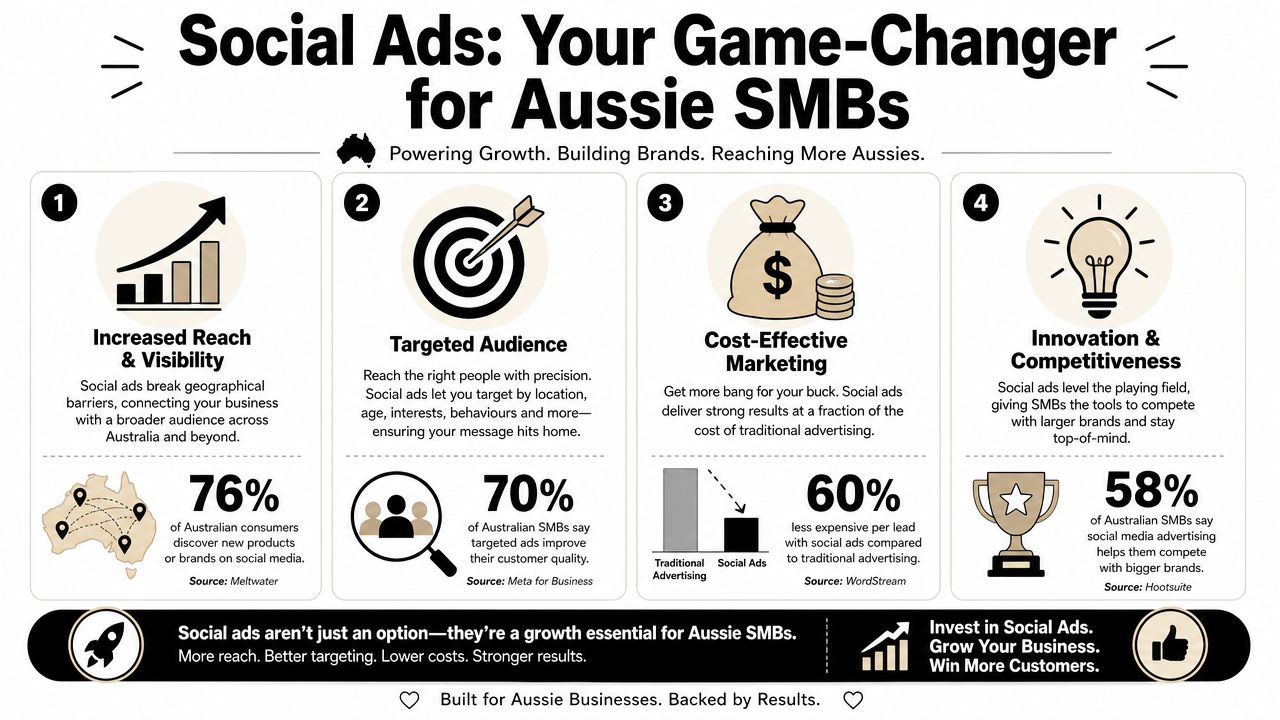
The opportunity is hard to ignore. Social media advertising in Australia accounted for AU$6.7 billion in 2025, and 33.8% of Australians use social networks specifically to look for information about products and brands, according to Sprout Social's Australia statistics summary. That matters for any small business owner because it means people aren't just on social platforms to be entertained. They're actively researching what to buy and who to trust.
What social ads do better than many local channels
A letterbox flyer can hit the wrong suburb. A billboard can't answer a question. A radio spot reaches lots of people who were never going to buy.
Social ads work differently because you can narrow your audience by location, interests, behaviour, and intent. That's valuable when you're a Brisbane cafe, a Sunshine Coast tradie, or a suburban clinic that only needs the right local customer, not everyone.
Three things make paid social especially useful for smaller operators:
- It starts where buyers already spend time. You're not dragging people onto a platform they don't use.
- It gives you control. You can switch creatives, pause weak ads, and redirect budget quickly.
- It lets small brands look present and active. Even a modest campaign can keep your business visible while larger competitors spread their spend across too many channels.
Practical rule: If your customers check social before they visit your website, your ads aren't just promotion. They're part of your sales process.
Small businesses can compete without looking like big businesses
Trying to out-polish major brands is usually a mistake. Small businesses win by being closer to the customer. You know the suburb, the season, the common objections, and the questions people ask before they buy. That local detail makes your ads feel relevant in a way generic national creative rarely does.
For example, a restaurant owner doesn't need abstract “brand awareness” language. They need bookings on quieter nights, stronger takeaway demand, or more attention on a new menu item. If that's your world, these social media strategies for restaurants are a useful companion because they connect social activity to real hospitality outcomes rather than vanity engagement.
The real shift
The biggest mindset change is this. Paid social isn't just for “marketing brands”. It's for ordinary Australian businesses that need more leads, more bookings, more foot traffic, or more online orders without blowing the budget. When handled properly, social media advertising for small businesses is less about broadcasting and more about putting the right offer in front of the right local person at the right time.
Building Your Campaign Foundation
Most weak campaigns fail before the first ad goes live. Not because the platform is bad, but because the business never decided what success looks like.
If you're spending money, your campaign needs a job. One job. A florist in Melbourne might want Mother's Day orders. A Brisbane electrician might want quote requests from homeowners in a defined service area. A B2B consultant might want qualified discovery calls. Those are very different outcomes, and each one needs different messaging, targeting, and landing pages.
Start with one commercial objective
Pick the result that matters most over the next few weeks. Keep it tight.
- Direct sales work when you have a clear offer, simple checkout path, and low-friction buying decision.
- Lead generation fits services where customers need a quote, inspection, consult, or callback.
- Awareness makes sense when you're opening, launching, or entering a new area, but it still needs a practical next step.
A common mistake is trying to chase everything at once. Reach, followers, enquiries, online sales, walk-ins. That usually spreads the budget too thin and makes reporting messy.
If you can't explain your ad objective in one sentence, it's too broad.
Build an audience that matches the sale
Good targeting starts with real customer patterns, not platform guesswork. Think about who buys, why they buy, and what usually tips them over the line.
For a local florist, that might include people within delivery range, buyers shopping around key occasions, and repeat purchasers who respond well to reminders. For a tradie, it might be homeowners in selected postcodes, not renters outside the service zone. For a boutique gym, it could be nearby professionals who care about convenience more than price.
Use details you already know:
- Location matters first for local businesses.
- Offer fit matters next. Match the ad to the customer's likely need.
- Timing matters more than many owners realise. Some services are urgent. Others are seasonal or event-driven.
If your business is still working out its core positioning, these effective social media strategies for startups are worth reading because they're grounded in early-stage decision-making rather than enterprise marketing language.
Choose the platform that suits the business
In Australia, Facebook remains the dominant platform for SMB advertising at 83% usage, ahead of Instagram at 22% and LinkedIn at 16%. The average annual SMB spend on social media advertising is $7,586, according to the Yellow Social Media Report. That tells you two things. First, Facebook is still a practical starting point for many SMBs. Second, the average spend isn't tiny, so every campaign needs discipline.
Here's a simple way to choose.
Choosing Your Social Ad Platform in Australia
| Platform | Best For | Typical Audience (AU) | Ad Strength |
|---|---|---|---|
| Local services, community businesses, retail offers, events | Broad consumer audience across age groups | Strong local targeting, flexible ad formats, practical for first campaigns | |
| Visual brands, hospitality, beauty, fashion, lifestyle products | Mobile-first users who respond to strong creative | Good for visual storytelling, Reels, product discovery | |
| B2B services, consulting, recruitment, professional offers | Business owners, managers, professionals | Better for lead quality in professional categories than broad consumer reach |
Get your tools sorted before launch
Don't leave admin until the day you want to run ads. Set up your Meta Business assets properly, make sure the correct page is attached, confirm who has access, and organise your creative files before the budget starts ticking.
For day-to-day publishing, approvals, and scheduling, a stack of social media management tools can save time and reduce the usual back-and-forth between business owner, staff member, and freelancer. That doesn't replace strategy, but it does make execution cleaner.
Crafting Ads That Actually Convert
The best-performing small business ads rarely look like they came from a boardroom. They look clear, local, and believable.
A Brisbane coffee shop has an edge over a national chain when it shows the actual barista pouring the flat white, the corner table near the window, and the morning special people can get before work. A Sydney-based tradie has an edge when the ad sounds like a real person explaining what's included, where they service, and how quickly they can quote. That's the kind of creative people trust.

Lead with a visual that stops the scroll
Most users will see your ad on a phone. If the image is cluttered, the text is tiny, or the video takes too long to get to the point, you lose them fast.
Good creative for small business ads usually has these traits:
- A clear focal point. One product, one service, one person, one offer.
- Local context. A recognisable shopfront, suburb mention, work vehicle, or team member.
- Fast comprehension. The viewer should understand the ad within a second or two.
If you're building image ads for Meta, getting the format right matters as much as the message. This guide to Facebook ad size is handy when you want your creative to look sharp across feed, Stories, and other placements without awkward cropping.
Write copy like a business owner, not a brochure
Weak ad copy usually tries to sound “professional” and ends up sounding vague. Strong copy is specific. It names the problem, the offer, the location, and the next step.
Compare these two approaches.
- Weak: “Premium plumbing solutions suited to your needs.”
- Stronger: “Need a plumber in Inner West Sydney? Book a same-day callout for blocked drains, leaks, and hot water issues.”
The second one works because it answers practical questions immediately. Who is it for? Where? What problem? What action should they take?
Compete with relevance, not reach
For small businesses, engagement rate and CTR matter more than audience size, and micro-influencer partnerships plus hyper-local geo-targeting can help maximise CTR with minimal spend, as noted by Shift4 AU. That's one of the most useful realities in paid social. You don't need the biggest audience. You need the right people to pay attention and act.
That changes how you should think about “competing”:
- Use real customers and staff instead of generic stock photos where possible.
- Talk to one suburb or service area rather than trying to cover half the state.
- Work with local creators carefully if they already have credibility in your niche or neighbourhood.
- Highlight proof such as customer outcomes, before-and-after visuals, or a simple explanation of your process.
Authentic creative usually beats polished-but-generic creative for local campaigns.
A short explainer can also help if you're training staff or reviewing creative internally before launch.
Calls to action need to be obvious
Every ad should answer one question clearly: what should the customer do next?
For ecommerce, that might be “Shop now”. For a service business, it could be “Request a quote” or “Book a call”. For hospitality, maybe “Reserve your table” or “Order takeaway”.
Don't make people decode your intent. If the ad is about a lunch special, send them to the menu or booking page. If it's about a quote, send them to a focused lead form. The smoother the path, the better the chance of conversion.
Launching and Managing Your Budget
Launching your first campaign is usually less complicated than it looks. The platform interface can feel busy, but the core decisions are simple. Choose the objective, pick the audience, load the creative, set the budget, define the schedule, and send traffic to the right page.
The part that unsettles most business owners isn't the setup. It's the fear of overspending. That's fair. Paid social gives you control, but only if you use the controls properly.
Daily budget or lifetime budget
A daily budget works like setting a spending cap for each day. It's useful when you want steady delivery and close oversight. Many first-time advertisers prefer it because it's easier to monitor and pause.
A lifetime budget is the total amount allocated across the full campaign period. That can work well for short promotions or time-bound offers when you know the start and end date in advance.
Here's the practical difference:
- Choose daily budget if you want consistency and regular check-ins.
- Choose lifetime budget if you're running a defined campaign window such as a sale, opening event, or seasonal push.
- Avoid changing everything at once after launch. Too many edits make it harder to tell what's working.
Keep the structure clean
Don't cram multiple offers into one campaign. A winter special, a new service launch, and a brand awareness message shouldn't all live in the same setup.
A cleaner structure looks like this:
- One campaign objective
- One audience cluster
- Two or three creative variations
- One landing page or one clear next action
That gives you enough variation to test without making the account chaotic.
Treat bidding like an auction with boundaries
Behind the scenes, you're entering an auction for attention. You don't need to micromanage every bid when you're starting out, but you do need spending boundaries and a clear commercial limit in mind.
A sensible launch approach is to start small, let the campaign gather enough signal to show which ad gets clicks or enquiries, then shift spend toward the stronger variation. If an ad gets attention but no real action on the website, the problem may be the landing page, the offer, or the audience fit rather than the ad itself.
For a clearer sense of how spend behaves on Meta, this breakdown of Facebook advertising cost helps small businesses understand where budget pressure tends to come from and what influences it.
Start with a budget you can afford to observe, not just a budget you can afford to spend.
What to check before you publish
A final pre-launch check saves a lot of wasted spend.
- Offer clarity. Is the deal, service, or message obvious at a glance?
- Audience logic. Are you targeting people who can buy from you?
- Destination match. Does the landing page continue the same promise made in the ad?
- Tracking setup. Can you tell whether the ad produced an enquiry, booking, or sale?
Once the campaign is live, resist the urge to panic over every early movement. Watch the data, not your nerves.
Tracking Success and Optimising for ROI
Most small business ad accounts don't have a traffic problem. They have an attribution problem.
A lot of owners can see clicks, likes, and comments, but they can't confidently connect ad spend to actual revenue. That gap is common. A 2025 Deloitte AU digital survey found that only 28% of small businesses can confidently attribute social ad spend to revenue, according to Yellow's business guidance on choosing social platforms. If you can't connect spend to outcomes, every optimisation decision becomes guesswork.
Separate vanity metrics from business metrics
Likes can be useful as a signal that creative is resonating. They are not a business result on their own.
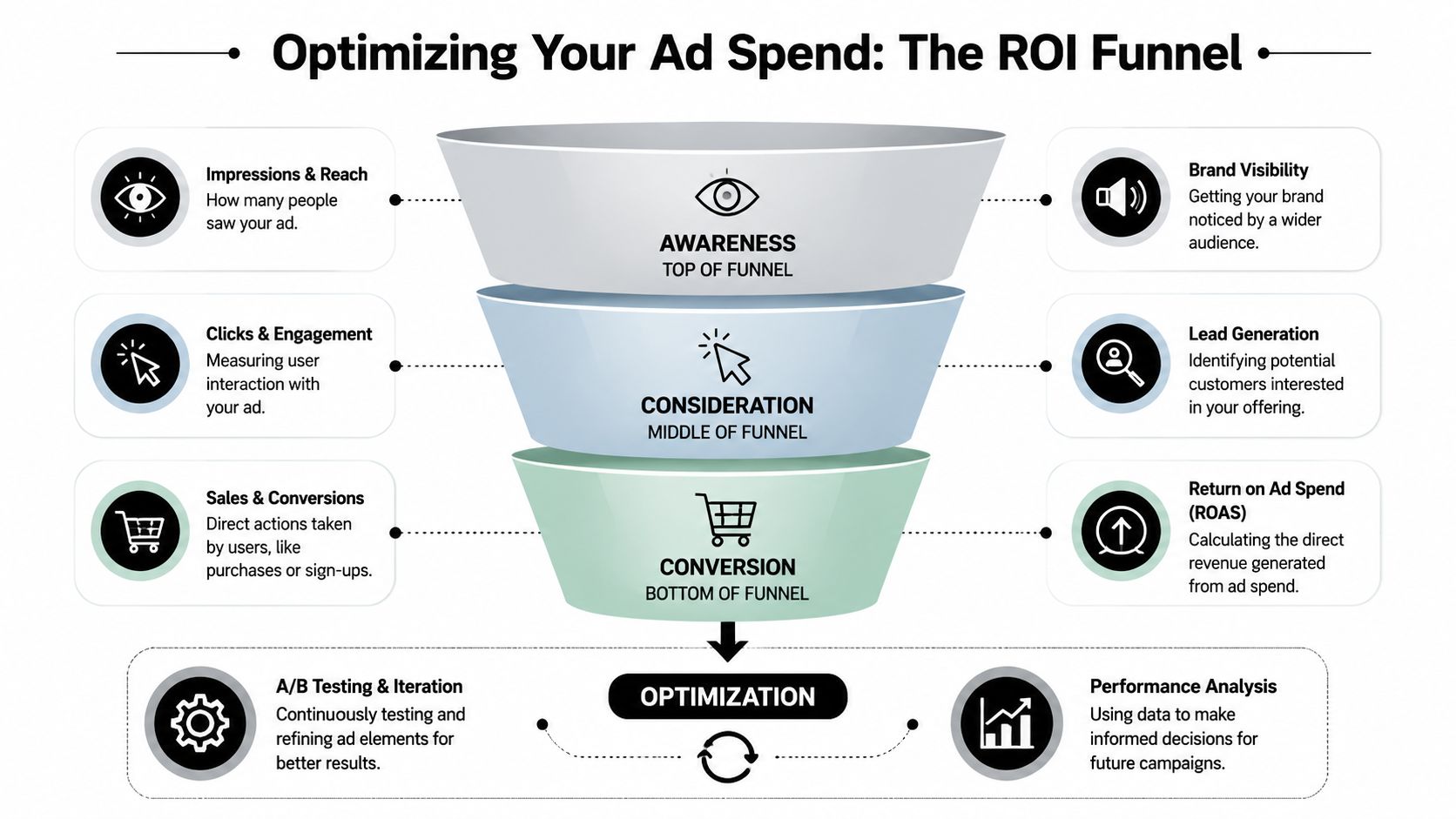
The metrics that matter most are the ones tied to movement down the funnel:
- Clicks tell you whether the message earned interest.
- Leads or enquiries show that interest turned into intent.
- Sales or bookings show that the campaign produced a commercial outcome.
- Return on ad spend helps you judge whether the campaign deserves more budget.
Set up a simple reporting rhythm
You don't need a giant dashboard to manage social media advertising for small businesses. You need a repeatable routine.
A practical weekly review usually includes:
| What to review | What it tells you | What to do next |
|---|---|---|
| Ad creative performance | Which image, video, or message is winning attention | Pause weak creative and keep testing stronger angles |
| Click quality | Whether users are interested enough to visit the site | Rewrite copy or tighten targeting if clicks are poor |
| Conversion actions | Whether traffic is turning into leads or sales | Fix the offer, landing page, or form if people drop off |
| Cost efficiency | Whether the campaign is commercially viable | Reallocate budget toward the ad set producing real outcomes |
Use tracking tools properly
If you run ads without conversion tracking, you're relying on partial signals. For Meta campaigns, that usually means setting up the relevant tracking so you can record key actions like form submissions, purchases, or booking events. Google Analytics 4 can also help you see what users do after they click through.
The important point isn't technical perfection on day one. It's having a clear line between ad spend and the action you care about.
A campaign that generates fewer clicks but more qualified enquiries is usually the better campaign.
How to optimise without wrecking performance
Small businesses often make one of two mistakes. They either never touch the campaign again, or they change five things at once and lose the ability to learn from the data.
A steadier optimisation process works better:
- Pause obvious underperformers rather than trying to rescue every ad.
- Scale proven ads gradually when they're delivering enquiries or sales at an acceptable cost.
- Test one major variable at a time such as headline, image, offer, or audience.
- Look beyond the platform if ad metrics seem fine but revenue is weak. The issue may sit on the website, product page, or enquiry flow.
Disciplined operators consistently outperform impulsive ones. The platform gives feedback quickly, but useful optimisation still depends on patience and clean decision-making.
Common Pitfalls and Your Next Steps
Most disappointing campaigns don't fail because social ads “don't work”. They fail because the setup was fuzzy, the follow-up was slow, or nobody checked whether the campaign was producing actual business value.
One of the biggest traps is delayed response. AU SMBs that actively respond to comments and DMs within 24 hours achieve a 32% higher conversion rate, and 78% of those businesses follow that proactive approach. The same research also notes that 62% of SMBs equate success with sales, while only 32% measure ROI correctly, which creates a serious mismatch between what businesses want and what they track, according to the ETSU research summary.
What to avoid early on
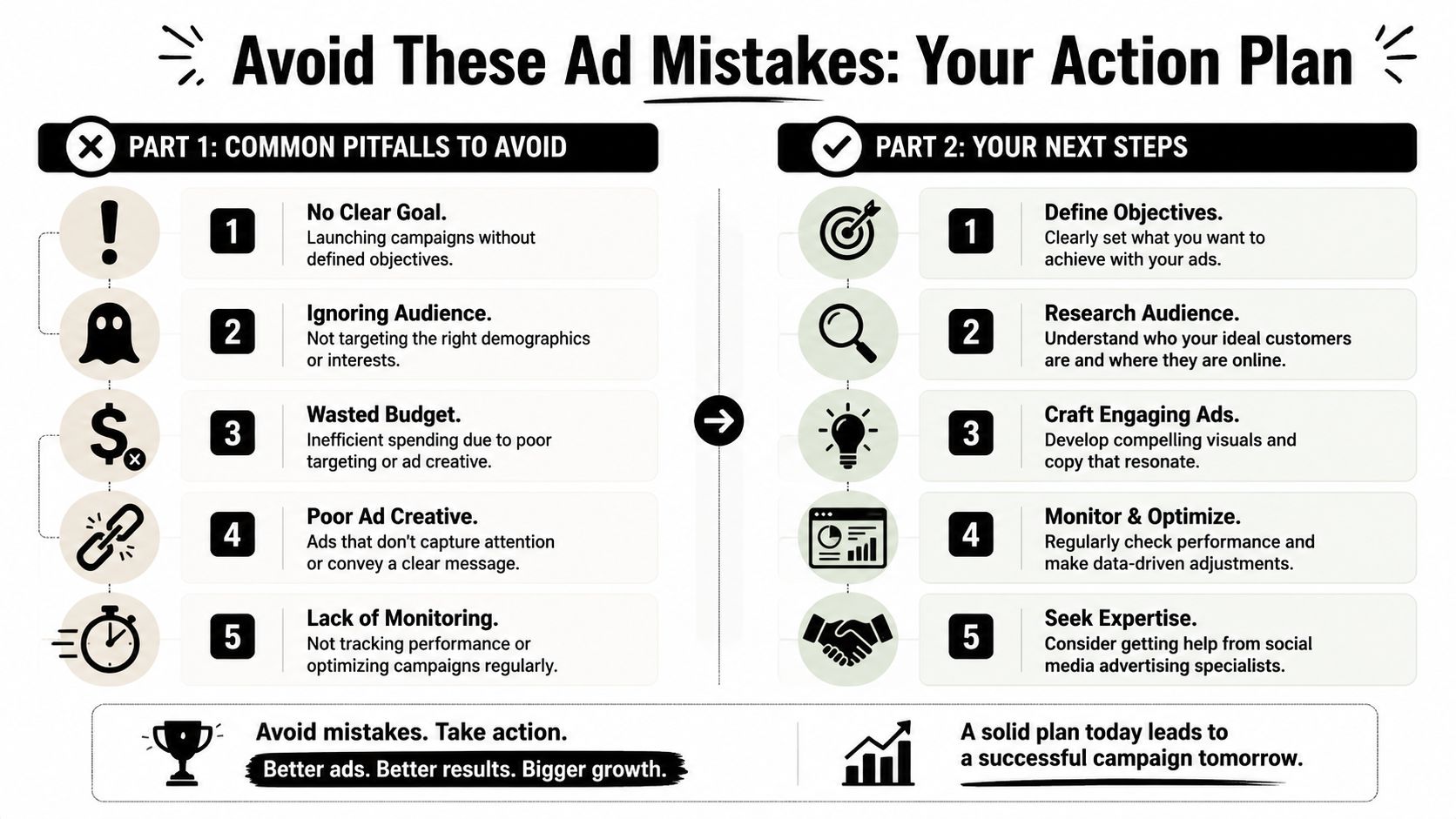
Some mistakes show up again and again in small business accounts:
- No single objective. If one campaign tries to drive followers, sales, and awareness at the same time, the budget gets diluted.
- Weak response habits. An ad can do its job and still fail if comments and DMs sit unanswered.
- Poor landing page continuity. If the ad promises one thing and the page delivers another, people drop off.
- Creative that looks generic. Local businesses lose their edge when ads sound like recycled corporate copy.
- Set-and-forget management. Even a good campaign needs review, exclusions, and occasional refreshes.
When to keep ads in-house
Managing ads internally can work well when your offer is straightforward, someone on the team can respond quickly to leads, and you have the patience to test properly. It also helps when the decision-maker stays close to the account, because the best insights often come from sales calls, front counter conversations, and service enquiries.
In-house management is usually a good fit when:
- Your business is local and focused. One service area, one main offer, one clear conversion path.
- You can produce content consistently. Even simple phone-shot creative can work if it's timely and relevant.
- You're willing to learn the reporting side. Not obsessively, just enough to know what the spend produced.
When outside help makes sense
External support becomes more practical when campaigns feed into a more complex website, multiple offers are running at once, or the business keeps spending without clear attribution. It can also help when the owner is too busy to review performance, answer leads promptly, or coordinate creative and landing pages.
The cheapest campaign isn't the one with the lowest spend. It's the one that turns spend into profitable action.
Frequently Asked Questions
| Question | Answer |
|---|---|
| How much should a small business spend on social ads? | Start with an amount you can monitor comfortably, then increase only after you can see which ad, audience, and offer are producing real business outcomes. |
| Is Facebook still worth it for Australian small businesses? | For many SMBs, yes. It remains a practical platform for local targeting, broad consumer reach, and first-time campaign setup. |
| Should I run ads on Instagram and Facebook together? | Often yes, if the creative suits both placements. But don't assume both platforms will perform equally well for your business. Check the results and adjust. |
| What matters more, likes or enquiries? | Enquiries, bookings, and sales matter more. Likes can be a useful signal, but they don't prove the campaign is profitable. |
| How quickly should I reply to comments and DMs? | As quickly as your team can manage. Fast replies improve the chance of converting attention into action. |
| Can a small business compete with bigger brands on social ads? | Yes, especially by being more relevant locally, using authentic creative, and tightening targeting around real buyers rather than broad audiences. |
If you want expert help turning traffic into leads, bookings, and sales, Website Builder Australia can help with the full digital picture, from websites and landing pages to paid campaigns, tracking, and ongoing optimisation. For Australian businesses that want practical support without enterprise complexity, working with a local team can make the setup cleaner and the results easier to measure.


