

Reduce paypal transaction fees: Practical guide for Australian businesses
Figuring out PayPal's fee structure can feel like a bit of a puzzle at first, but it's much more straightforward than it appears. For businesses in Australia, the standard PayPal transaction fee is a simple combination: 2.60% of the total sale amount, plus a small fixed fee of $0.30 AUD for any sale within the country. This is the bedrock of your costs when you start taking payments online.
Decoding PayPal Transaction Fees in Australia
Think of PayPal fees as a small service charge for the convenience and security they offer. It’s the cost of having a trusted system handle your customer's money safely. This fee isn't just one number; it's split into two core parts that work together on every single sale you make. This combined approach allows PayPal to cover its processing costs for both small and large transactions.
Getting your head around this dual structure is the first step to truly managing your payment processing costs. It doesn't matter if you're selling physical products from an e-commerce store, offering digital downloads, or invoicing a client for services – this model applies. The key is to see these fees not as a penalty, but as a predictable cost of doing business online.
The Two Core Fee Components
Every time a customer in Australia pays you using PayPal, the transaction fee is calculated using these two pieces:
- A Percentage Fee: This is simply a slice of the total transaction amount. It scales up or down with the size of the sale – the bigger the sale, the larger this part of the fee is in dollar terms.
- A Fixed Fee: This is a small, flat amount added to every transaction, no matter how much the customer spends. It helps cover the basic admin cost of processing any payment, whether it's for $10 or $1,000.
Let’s put some numbers to it.
Below is a quick-glance table showing how this works for the most common types of online sales for Australian businesses.
Standard PayPal Fees for Australian Businesses at a Glance
| Transaction Type | Percentage Fee | Fixed Fee (AUD) | Example on a $100 Sale |
|---|---|---|---|
| Standard Domestic Sale | 2.60% | $0.30 | $2.90 ($2.60 + $0.30) |
As you can see, for domestic commercial transactions, PayPal’s standard rate is 2.60% plus a fixed fee of $0.30 AUD per transaction. This structure applies to most sales made through websites, making it highly relevant for agencies like ours that build e-commerce sites with payment integrations. So, if a Brisbane-based retailer makes a $100 AUD sale, they’ll see a fee of $2.90 AUD. You can always check the latest details in their official documentation on merchant fees in Australia.
This basic model for domestic sales is the foundation for understanding everything else. The biggest thing that changes your costs from here is where your customer is located. Selling to someone overseas introduces different rates and extra cross-border fees, which can significantly alter the final amount you pay. We'll explore the nuances of various online payments in Australia in more detail throughout this guide.
Domestic vs International Fees: A Clear Breakdown
Where your customer is physically located is one of the biggest factors that will shape your PayPal transaction fees. It’s the dividing line between a simple, predictable cost and a more complex calculation. For any Australian business, every sale you make will fall into one of two buckets: domestic or international. Getting your head around the difference is absolutely key to managing your bottom line.
A domestic transaction is pretty straightforward. When you sell something to a customer who is also in Australia, you pay the standard commercial rate. It doesn't matter if you're a Brisbane-based consultant invoicing a local client or an online store shipping from Sydney to Perth—the fee structure stays the same. Easy to forecast, easy to manage.
International transactions, on the other hand, throw an extra layer of cost into the mix. When a customer from outside Australia buys from you, PayPal adds a cross-border fee on top of the standard rate. This extra charge is there to cover the complexity of processing payments across different countries and banking systems.
Understanding Domestic Fees
For any sale happening right here within Australia, the cost is simple. PayPal charges its standard percentage plus a small fixed fee. It’s a clean, predictable model that makes local e-commerce a breeze.
This straightforward approach also applies to non-commercial use. When you're just sending or receiving personal payments within Australia, the fee structure is very forgiving. There's no percentage fee at all if currency conversion isn't needed. You'll only see a fixed fee of $0.30 AUD for receiving money in Australian dollars, which is perfect for peer-to-peer transfers or friends splitting costs. You can learn more by checking out PayPal's consumer fee guidelines.
The image below gives you a quick visual breakdown of a standard domestic sale.
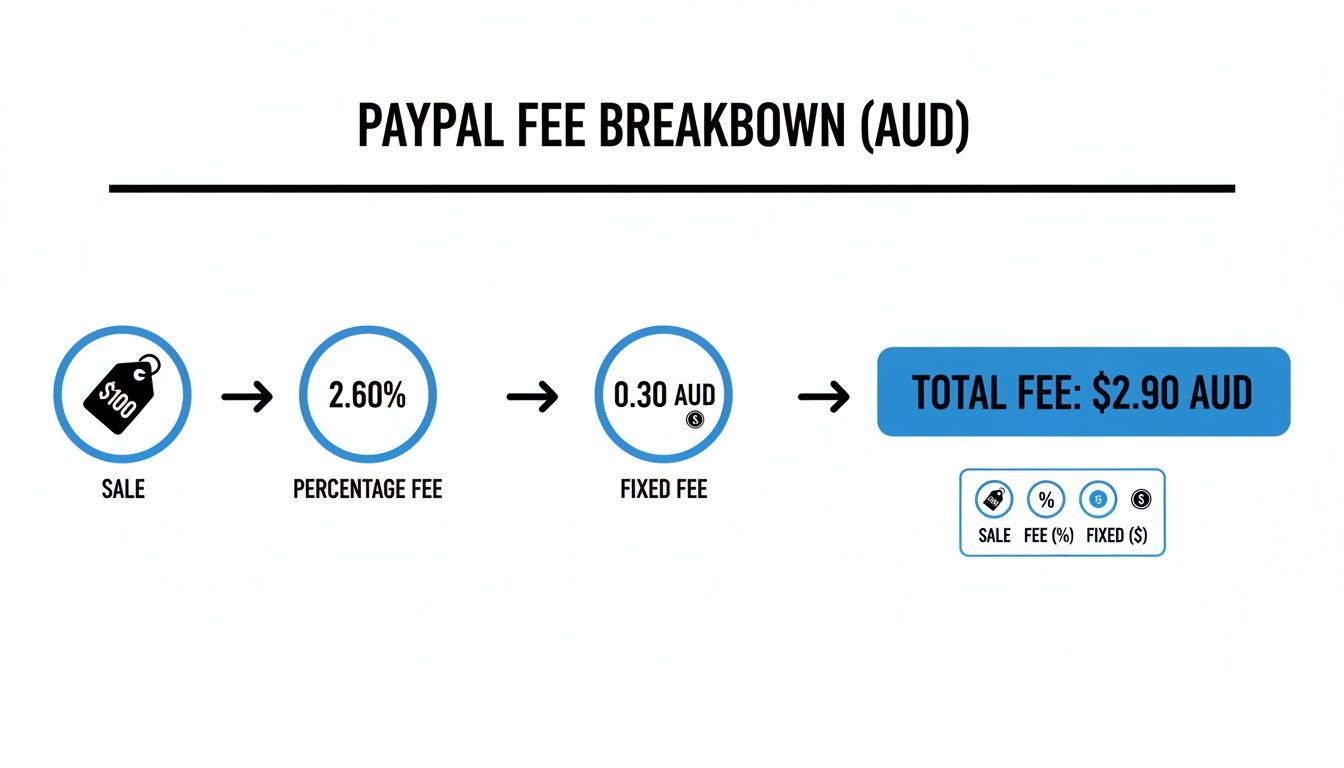
As you can see, the total fee for a typical Aussie sale is made up of the 2.60% rate and the $0.30 fixed fee. Simple as that.
How International Fees Change the Equation
The moment you sell to a customer overseas, the calculation gets a bit more involved. Right now, PayPal tacks on a 1.00% cross-border fee for international commercial transactions. This is charged in addition to the standard domestic rate, which directly bumps up your cost for every international sale.
Let's put this into a real-world scenario.
Scenario Comparison: Domestic vs. International Sale
Let's say you sell a product for $100 AUD.
- Domestic Sale (to a customer in Melbourne): The fee would be $2.90 (2.60% of $100 + $0.30). You pocket $97.10.
- International Sale (to a customer in the USA): The fee would be $3.90 (2.60% + 1.00% of $100 + $0.30). You pocket $96.10.
This example shows a $1.00 difference on a single $100 sale. That might not sound like much, but it really starts to add up when you're dealing with hundreds of international orders. Keep in mind, this doesn't even factor in potential currency conversion fees, which can eat into your profit even more. If you have global ambitions, properly accounting for these extra PayPal fees is non-negotiable for setting sustainable prices and protecting your profit margins.
Uncovering the Hidden Costs of Using PayPal
The standard percentage and fixed fee are just the beginning. A few other charges can quietly pop up and take a bite out of your profit margin. While the base rate is predictable, it’s these extra costs that often catch business owners off guard. Getting a handle on them is crucial for painting an accurate financial picture of your business.
For any Aussie business selling to customers overseas, the biggest of these "hidden" costs is almost always the currency conversion fee. This isn’t just a simple swap from one currency to another; it's all about the rate you actually get.
The Currency Conversion Spread
When PayPal converts a payment—say, from US dollars into your Australian dollar account—it doesn’t use the standard mid-market exchange rate you see on the news. Instead, it applies its own percentage markup on top of a wholesale rate. That markup is pure profit for PayPal and a direct cost to you.
This fee really stings for Australian businesses trading internationally. PayPal adds a standard 4.00% on top of the base wholesale exchange rate when converting to AUD. Think about it: on a $1,000 AUD international sale, you’re already paying the domestic rate, plus a cross-border fee. Add that 4.00% currency markup, and your total fee could easily creep over 7.60%. You can dig into the fine print yourself by checking out the official PayPal merchant fee documentation.
It all means the final amount that actually lands in your account is often a fair bit less than you'd calculated, even after factoring in all the other fees.
Navigating Chargeback Fees
Another sneaky cost is the chargeback fee. This happens when a customer disputes a transaction with their credit card company, claiming it was fraudulent or the item wasn't what they expected. If the bank sides with the customer, the money is taken back.
A chargeback is more than just a refund. It's a forced reversal kicked off by the customer's bank, and PayPal charges a separate admin fee to handle the process—no matter who wins the dispute.
In Australia, this fee can be around $22 AUD per incident. While you can't stop every single dispute, you can definitely protect your business.
To help you keep track, here’s a quick rundown of some of the extra fees that can apply.
Common Additional PayPal Fees to Watch For
| Fee Type | Standard Cost (AUD) | When It Applies |
|---|---|---|
| Chargeback Fee | $22 | A customer disputes a charge with their credit card issuer, and a formal chargeback case is opened. |
| Dispute Fee | $25 | A customer opens a dispute through PayPal's Resolution Centre, and you don't resolve it amicably before it escalates to a claim. |
| Currency Conversion | 4.00% (above base rate) | When you receive a payment in a foreign currency and PayPal converts it to AUD for you. |
| Card Confirmation Fee | ~$1-$2 (refunded) | A small temporary charge to a user's credit/debit card to verify it's a valid, active account. |
Being aware of these costs is the first step. The next is actively working to avoid them.
- Provide Clear Descriptions: Make sure your product listings are painfully accurate and detailed. This is your best defence against "item not as described" claims.
- Use Trackable Shipping: Always, always use shipping that gives you tracking and delivery confirmation. It’s your proof that the item was sent and received.
- Offer Excellent Customer Service: Jump on customer issues quickly and professionally. Resolving a problem early is much cheaper than letting it escalate to a formal chargeback.
Thankfully, PayPal's Seller Protection program can be a lifesaver here. If you meet the eligibility rules—like shipping to the address on the transaction details page and having that all-important proof of delivery—PayPal may cover the loss on claims for unauthorised transactions or "item not received." This can save you from both the lost sale and that pesky chargeback fee. By demystifying these extra costs, you can avoid any nasty surprises on your statements.
Calculating Your Real PayPal Fees with Examples
Alright, knowing the percentages is one thing, but seeing how they actually chip away at your sales is where it all clicks. Let's move from theory to practice and walk through a few common scenarios for Australian businesses. This will show you exactly how PayPal transaction fees stack up in the real world.
Seeing the numbers in action helps you price your products and services smarter and forecast your revenue without any nasty surprises.
Example 1: Domestic Retail Sale
Picture this: your Brisbane-based online store sells a product for $75 AUD to a customer down in Sydney. Because it's a standard commercial sale within Australia, the maths is pretty straightforward.
- Percentage Fee (2.60%): $75 x 0.0260 = $1.95
- Fixed Fee: $0.30
- Total Fee: $1.95 + $0.30 = $2.25
After PayPal takes its cut, your business receives $72.75 from that sale. It's a clean, predictable cost for selling locally.
Example 2: Domestic Service Payment
Now, let's say you're a freelance graphic designer and you've just invoiced a client $500 AUD for a project. The client pays you via PayPal, which treats it as a commercial transaction for services.
- Percentage Fee (2.60%): $500 x 0.0260 = $13.00
- Fixed Fee: $0.30
- Total Fee: $13.00 + $0.30 = $13.30
The final amount landing in your account is $486.70. As you can see, that percentage fee starts to take a much bigger bite out of larger payments.
To keep a sharp eye on these fees and manage your expenses properly, using a good small business accounting software can make a world of difference.
Example 3: International E-commerce Sale
This is where things get a bit more layered. Imagine your e-commerce brand sells a $200 AUD item to a customer in the United States. This is where the cross-border fee comes into play.
- Standard Percentage Fee (2.60%): $200 x 0.0260 = $5.20
- International Fee (1.00%): $200 x 0.0100 = $2.00
- Fixed Fee: $0.30
- Total Fee: $5.20 + $2.00 + $0.30 = $7.50
In this case, your business gets $192.50 from the $200 sale.
Important Note: This international calculation doesn't even factor in the potential currency conversion fee of 4.00%. If the customer paid in USD and you needed to convert it to AUD, that extra charge would be applied to the exchange rate, reducing your final payout even further.
By working through these examples, you can get a much clearer picture of your actual costs, helping you build a financial model for your business that leaves no room for guesswork.
Here are some actionable ways you can start chipping away at your PayPal fees.
While those transaction fees feel like a standard cost of doing business, they aren't always set in stone. With the right game plan, you can minimise how much they cut into your revenue, making sure more of your hard-earned cash stays right where it belongs. It's about being proactive instead of just accepting the default rates.
The key is to understand the options PayPal has on the table and figure out which one fits your business based on your sales volume and how much customers typically spend in one go.
Apply for Merchant Rates
For established businesses, one of the most powerful moves you can make is applying for PayPal's Merchant Rate. Think of it as a volume discount. Once your business is consistently pulling in over a certain amount each month (the starting line is usually around $5,000 AUD), you can become eligible for a lower percentage fee.
This is a tiered system that rewards you as you grow. The more you sell, the higher the bracket you move into, and the lower your percentage fee becomes. Over time, this can add up to some serious savings. Just remember, this isn't automatic—you need to actually go into your PayPal Business account and apply for it.
Taking a few minutes to apply for merchant rates shifts you from being a passive fee-payer to someone who's actively managing their costs. It's a simple step that can directly pump up your profit margins as your business scales.
Consider Micropayment Pricing
What if you sell low-cost items? Think digital downloads, articles, or small in-game goodies. The standard fee structure can be brutal here. A fixed fee of $0.30 on a $2.00 sale is a massive chunk of your revenue. This is exactly where micropayment pricing becomes a lifesaver.
This alternative model is built for transactions under a certain value, typically around $15 AUD. It flips the standard rate on its head: you pay a higher percentage fee but a much, much lower fixed fee. For instance, you might pay 5% + $0.05 AUD instead of the usual 2.60% + $0.30 AUD.
Let's run the numbers:
- Standard Rate on a $2 Sale: $0.052 (2.60%) + $0.30 = $0.35 fee
- Micropayment Rate on a $2 Sale: $0.10 (5%) + $0.05 = $0.15 fee
As you can see, the savings on small-ticket items are huge. Like with Merchant Rates, you have to apply for a micropayments account; it’s a separate pricing model you need to opt into. For a broader look at different payment solutions, check out our guide on choosing a payment gateway in Australia.
At the end of the day, keeping a tight rein on your expenses is just good business. For more ideas, looking into essential tips to cut Australia fees in other areas like shipping can give you more ways to save. These small tweaks across your entire operation can make a big difference to your bottom line.
Optimising Your Website for PayPal Payments
Getting PayPal onto your website involves more than just slapping a ‘Buy Now’ button on your product pages. It's really about crafting a smooth, trustworthy checkout experience from start to finish. A clunky, confusing payment process is one of the biggest reasons people abandon their shopping carts, which is a direct hit to your sales.
How you set up PayPal can make a huge difference to a customer's confidence and your conversion rates.
Think about it: using a direct integration like PayPal Checkout, which keeps customers on your site, almost always works better than redirecting them to the PayPal website. This continuity builds trust and makes paying feel like a natural, seamless part of the shopping journey—not a jarring interruption that makes them second-guess their purchase.
Fine-Tuning Your Checkout Flow
A well-optimised checkout is all about transparency. It clearly lays out all the costs right upfront, including shipping and any other charges. No one likes a last-minute surprise, and hidden fees are a surefire way to scare customers away. This is especially true if you sell internationally, where getting your currency settings right is crucial for building trust with global buyers.
An effective setup should:
- Prioritise a Seamless User Experience: Make sure your payment gateway is fast, works perfectly on mobile, and looks like it belongs on your website.
- Offer Clear Cost Breakdowns: Display every single charge before asking for payment. If you choose to surcharge, be upfront about it.
- Ensure Correct Currency Configuration: If possible, automatically show prices in the customer's local currency or at least provide an easy-to-use converter.
By focusing on these details, you create a checkout process that’s not just user-friendly but also reduces friction. This simple shift helps minimise cart abandonment and ensures your PayPal transaction fees become an investment in successful sales, not just a cost of doing business.
Making your checkout experience as smooth as butter is a massive part of conversion rate optimisation. For more tips on this, you can explore strategies for building a customisable checkout that perfectly matches your brand and what your customers expect.
Common Questions About PayPal Fees
When you're running a business in Australia, getting to grips with PayPal’s fee structure can bring up a few questions. Let's clear up some of the most common ones so you can use PayPal confidently and keep your costs in check.
Does PayPal Charge a Monthly Fee?
Good news here. A standard PayPal Business account in Australia is completely free to set up and you won't be hit with any monthly subscription or maintenance charges.
This makes it a fantastic, low-risk option, especially if your sales numbers tend to go up and down. You only ever pay a fee when you actually get paid for your goods or services.
Can I Pass Fees on to Customers?
Yes, you can. In Australia, passing on payment processing fees to your customers—a practice known as surcharging—is legally allowed.
However, the ACCC keeps a close eye on this. The key rule is that you can't charge the customer more than what it actually costs you to process their payment. You also have to be completely upfront about it, clearly showing the extra fee before they finalise their purchase.
While it's perfectly legal, just be mindful that some customers don't love seeing a surcharge pop up at the checkout. It's a bit of a balancing act between covering your costs and making sure you don't lose a sale over it.
Is Withdrawing Money to My Bank Account Free?
For the most part, yes. When you withdraw your Australian Dollar (AUD) balance from your PayPal account to your linked Aussie bank account, it's generally free of charge.
Where you might see a fee is if the money you're withdrawing is in a foreign currency. In that case, a currency conversion fee will apply to change it into AUD before it lands in your bank. Always give the withdrawal confirmation screen a quick once-over before you hit the button.
At Website Builder Australia, we specialise in building e-commerce sites with smart, cost-effective payment systems designed for how Aussies do business. Let's build your perfect online store.
Powered by Outrank


