

Choosing a payment gateway australia: A Small Business Guide to Faster Payments
Think of a payment gateway as the digital version of the EFTPOS terminal you see at the local shops. It’s the essential bit of tech that securely connects your website, your customer, and your bank account, making sure you get paid safely every time you make a sale online.
What a Payment Gateway Does for Your Business
For any Aussie business selling online, a solid payment gateway isn't just a nice-to-have—it's absolutely non-negotiable. It acts as a secure bridge, letting money travel from your customer's bank to yours. Without one, your online store is basically just a catalogue. With one, it’s a proper business, ready to take orders 24/7.
Here’s how it works in a nutshell. A customer finds something they love on your site, adds it to their cart, and hits "Checkout." In that instant, the payment gateway kicks into gear. It grabs their sensitive credit card details, encrypts them so they're unreadable to fraudsters, and zips them off to the banks to check there are enough funds. Within seconds, it gets the all-clear and tells your website the order is good to go.
The Engine Room of Your Online Store
This whole process does more than just shift money from A to B. It’s also a massive trust-builder. When shoppers see payment options they recognise and feel safe using, they’re far more likely to actually go through with the purchase. This is a huge deal in Australia’s booming online market.
And the scale we're talking about is massive. Australia's digital payment market shot up to USD 257.70 billion in 2024, and payment gateways handle a whopping 55% of that. This is all tied to the explosion of e-commerce here, which topped AUD 60 billion back in 2022, mostly because these tools make buying online so simple and secure.
A payment gateway isn't just another feature; it's the engine of your online revenue. It automates your sales, protects you and your customers, and lets you sell to anyone in the country. It’s easily one of the most critical investments you’ll make.
To break it down even further, a gateway’s job is to handle a few key things that are critical for your business.
Key Functions of a Payment Gateway
Here’s a quick summary of the essential roles a payment gateway plays in every online transaction for your Australian business.
| Function | What It Means for Your Business |
|---|---|
| Data Encryption | Scrambles sensitive credit card information, keeping it safe from hackers and fraudsters. This protects everyone involved. |
| Transaction Authorisation | Checks with the customer's bank in real-time to make sure they have the funds available to make the purchase. |
| Payment Settlement | Once approved, it ensures the money is actually transferred from the customer's account into your business account. |
| Fraud Prevention | Uses tools like AVS (Address Verification Service) and CVV checks to spot and block dodgy-looking transactions. |
| Reporting | Gives you a clear record of all your sales, refunds, and failed transactions, which is a lifesaver for bookkeeping. |
Essentially, the right gateway ticks all the boxes, from security to making your life easier.
To get a better handle on all the different payment solutions out there, resources from dedicated payments experts can be a goldmine of information. At the end of the day, picking the right payment gateway is a fundamental step in building an online business that’s built to last.
How an Online Payment Actually Works in Australia
Ever wondered what really happens in those few seconds after a customer clicks ‘Buy Now’? It feels instant, almost like magic, but it's actually a lightning-fast, highly secure sequence of events. Think of a payment gateway as the silent operator working behind the scenes, making sure every dollar from a sale gets from your customer's bank to yours, safe and sound.
Let's follow the money. Imagine a customer in Perth is buying a new surfboard from your online store based in Sydney. They’ve filled their cart, entered their shipping details, and are now on your checkout page, card in hand. This is where the gateway springs into action.
The Four Key Steps of a Transaction
The whole dance, from that final click to the "Order Confirmed!" message popping up, happens in moments. It’s a rapid-fire digital conversation between your website, the payment gateway, and a few different banks.
Here’s a simple breakdown of that journey:
- Secure Data Capture: Your customer types their credit card details into the payment form on your site. Straight away, your payment gateway encrypts this sensitive information, scrambling it into unreadable code. This is the first line of defence, making it useless to fraudsters from the get-go.
- Secure Transmission: The gateway then securely zaps this encrypted data over to the payment processor, which is like the central post office for the major banking networks.
- Authorisation Request: The processor contacts the customer's bank (known as the issuing bank) with a simple question: "Does this person have enough funds or credit for this purchase?" The bank runs a quick check and fires back a real-time 'approved' or 'declined' message.
- Confirmation and Completion: This yes-or-no answer travels all the way back through the same channels to your website. If it’s a 'yes', the gateway tells your e-commerce platform to finalise the order and show a success message to the customer. Done. The money is then scheduled to be deposited into your business account.
This visual shows that flow, from the moment a customer pays to the bank giving the final thumbs-up.
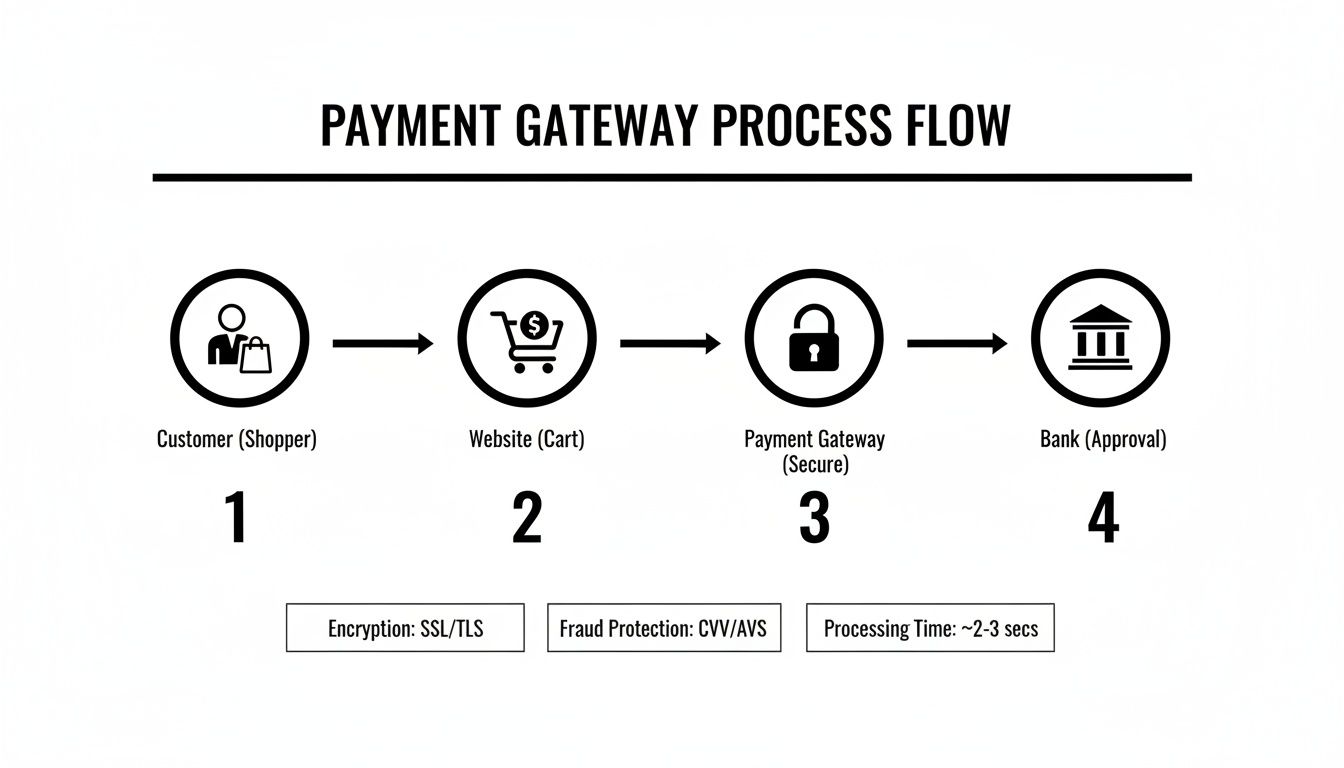
As you can see, the gateway is the central, secure bridge connecting your website to the complex world of banking, handling the entire process automatically.
The Silent Partner in Your Business
All of this happens without you lifting a finger. The payment gateway you choose is your automated cashier, fraud detector, and messenger, all rolled into one tidy package. It handles the nitty-gritty of financial communications so you can focus on what you do best—running your business—confident that every payment is being processed securely and correctly.
The core role of a payment gateway is to provide a secure and reliable channel for money to move from your customer to you. It's the critical piece of technology that turns your online store into a fully functioning business that can accept payments from anywhere, anytime.
This seamless automation is what makes modern e-commerce possible. Getting this system set up right is one of the most important steps for any online business. You can learn more about the technical side of connecting a gateway by exploring guides on payment gateway integration. Once you understand the process, you can really appreciate the value a good gateway brings to the table, ensuring smooth sales and happy customers every single day.
Cracking the Code on Australian Payment Gateway Fees
Let's be honest, trying to figure out the pricing for a payment gateway in Australia can feel a bit like reading your phone bill after a long trip overseas. It's confusing, and nobody likes getting hit with surprise costs. Getting a handle on all the fees is absolutely critical for keeping your profit margins healthy and your financial forecasts on track.
The most common charge you'll come across is the per-transaction fee. This is the bread and butter of how gateways make their money. It's almost always a combination of a percentage of the sale amount plus a tiny fixed fee. For example, a pretty standard rate you’ll see in Australia is 1.75% + A$0.30 for local credit card payments.
This blended model means the fee grows with the size of the order, but there’s always a baseline cost. Let’s look at how this plays out in the real world.
A Real-World Cost Breakdown
Imagine your online shop has an average order value of A$50. Using that 1.75% + A$0.30 fee, the maths for a single sale looks like this:
- (A$50 x 1.75%) + A$0.30 = A$0.875 + A$0.30 = A$1.18
So, for every A$50 sale you make, you're paying A$1.18 in processing fees. It might seem like small change, but it adds up fast. If you pull in 200 sales in a month, your total transaction fees would be A$236. This is a predictable cost you can build right into your pricing strategy and budget.
On top of the standard fee, some providers also have a monthly subscription fee. This is a flat rate you pay each month just to keep the lights on, no matter how many sales you do (or don't) make. Often, these plans will give you a lower per-transaction rate in return, which can make them a smarter choice for businesses with a high volume of sales.
For instance, a gateway might have a A$25 per month plan that drops the rate to 1.5% + A$0.30. You’d need to crunch the numbers to see where your break-even point is compared to a plan with no monthly fee.
The big takeaway here is that there’s no single "best" pricing model. The right fit depends entirely on your business’s sales volume and average order value. A startup with just a few sales will probably want a pay-as-you-go model, whereas a high-volume store could save a bundle with a monthly subscription.
Watching Out for the Sneaky "Hidden" Charges
Unfortunately, the costs don't always end there. You’ve got to keep a sharp eye out for other potential charges that can catch you off guard. Knowing what to look for will help you pick a genuinely transparent payment gateway in Australia.
Here are a few of the usual suspects to ask about:
- Setup Fees: Some gateways, especially those from the big old banks, might sting you with a one-off fee just to get your account set up. Thankfully, most modern players like Stripe and Square have done away with these.
- Chargeback Fees: If a customer disputes a payment and their bank reverses it, the gateway will often slap you with a penalty fee (think A$20-A$35) for the admin hassle. This can happen even if you end up winning the dispute.
- PCI Compliance Fees: Some providers charge an annual or monthly fee to cover their Payment Card Industry (PCI) security compliance costs. With most of the newer gateways, this is built into the main price.
- International Transaction Fees: Selling to customers overseas? Expect to pay a higher percentage, often an extra 1-2%, to process international cards and handle the currency conversion.
Choosing the right payment gateway australia means looking past the big, bold headline rate. Always read the fine print and ask direct questions about every potential cost before you sign anything. A bit of due diligence now will make sure your payment processing costs are a predictable expense, not a constant source of nasty financial surprises.
Must-Have Payment Options for Australian Customers
If you think offering just Visa and Mastercard at your checkout is enough to win over Australian shoppers, it's time for a rethink. Aussie buyers today have come to expect a whole menu of payment choices that fit their personal finances and habits. Not giving them what they want is one of the quickest ways to lose a sale right at the finish line.
Nailing the right mix of payment methods through your payment gateway in Australia is a game-changer for boosting sales. It's a clear signal to customers that you get them, building that instant trust and cutting down the checkout friction that leads to so many abandoned carts. Let’s break down the essential payment types your business needs to be offering to meet local expectations.
Beyond the Standard Credit Card
While credit and debit cards are still the backbone of online payments, they're really just the starting point. Smart Aussie businesses are branching out, adding options for customers who’d rather pay straight from their bank account or handle a purchase like they would any other bill.
Two local heroes you really need to consider are:
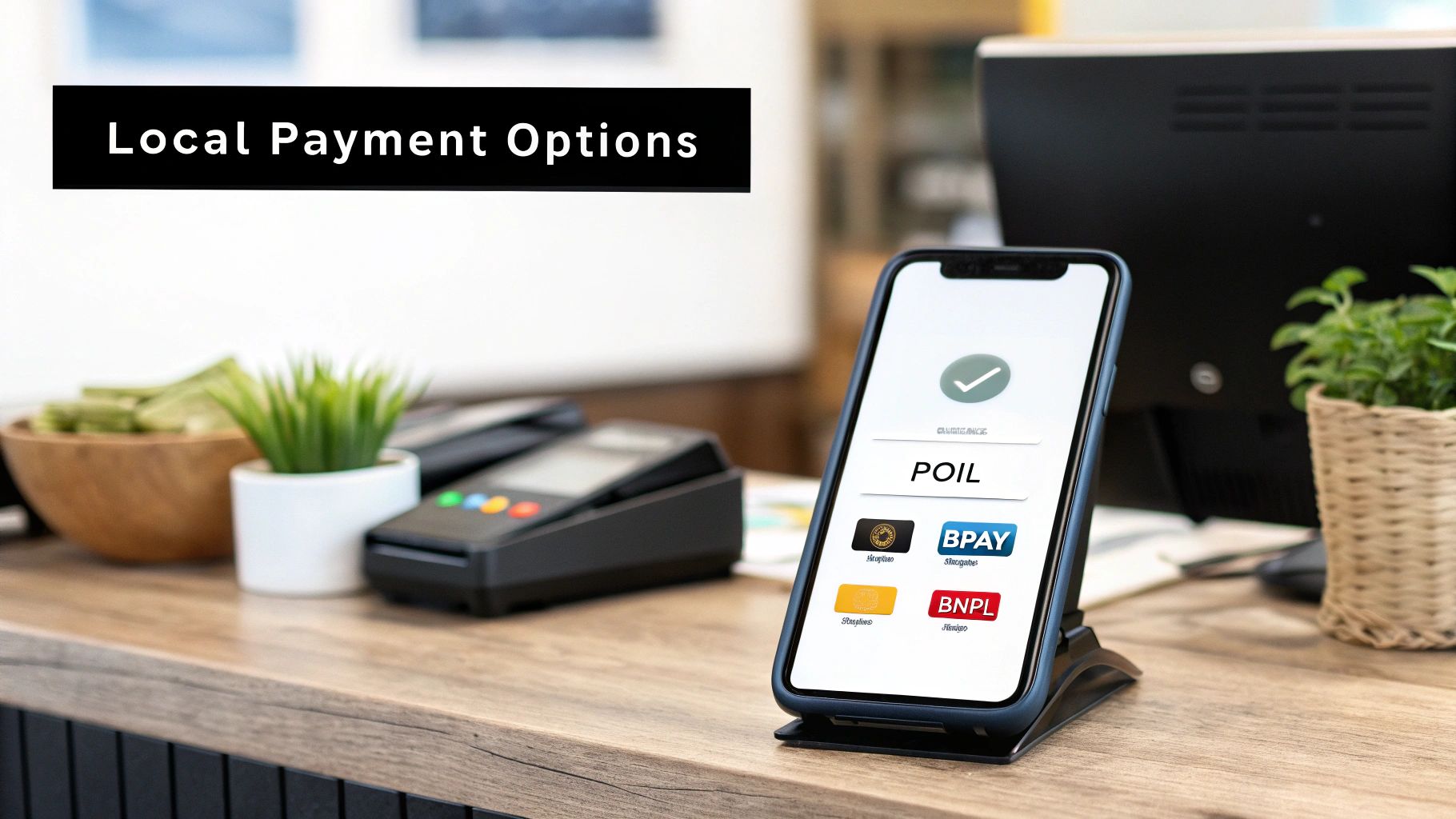
- POLi: This clever service lets customers pay directly from their bank account using their normal online banking login. It's a go-to for shoppers who are a bit hesitant about putting their card details online or simply don’t own a credit card.
- BPAY: A true household name in Australia, BPAY is synonymous with paying bills. Adding it to your checkout can be a fantastic move for businesses that send invoices or sell bigger-ticket items, giving customers a payment method they already know and trust.
The Unstoppable Rise of Buy Now Pay Later
The biggest shake-up in how Australians shop online has been the absolute explosion of Buy Now, Pay Later (BNPL) services. You simply can't ignore platforms like Afterpay and Zip. They’ve gone from a novelty to a standard expectation, especially for younger shoppers and retailers in fashion, electronics, and homewares.
Adding BNPL isn’t just a nice-to-have anymore; it's a critical sales tool. It lets customers break down bigger purchases into smaller, interest-free payments, taking the sting out of the initial cost. For your business, this means a higher average order value and more completed sales, as shoppers feel much more comfortable committing to a purchase they can pay off over a few weeks.
By offering a flexible way to pay, BNPL services directly combat purchase hesitation. A customer might baulk at a $200 upfront cost but will happily commit to four fortnightly payments of $50, making the sale far more likely.
You just can't argue with the numbers. While in-store payments still held 59.55% of Australia's payments market in 2025, online payments are skyrocketing at an incredible 17.62% annual growth rate, making it the fastest-growing channel. BNPL is a massive part of this boom, with Aussies spending over AUD 16 billion in 2023 through services like Afterpay and Zip alone. You can dig into more stats about the Australian payments market on Mordor Intelligence.
Matching Payment Methods to Your Customers
Knowing who uses what helps you build a checkout that actually works. Providing the right options means you won’t accidentally push away a potential buyer, which is a massive consideration when you're working on a customizable checkout.
Below is a simple breakdown of the most popular payment methods available through Australian gateways, helping you understand their ideal use cases and who typically uses them.
Comparing Popular Australian Payment Methods
| Payment Method | How It Works | Best For | Key Consumer Benefit |
|---|---|---|---|
| Credit/Debit Cards | Customers enter card details (Visa, Mastercard, Amex) to pay instantly. | All business types; it's the universal standard. | Convenience, speed, and access to reward points. |
| Digital Wallets | Stored card info (Apple Pay, Google Pay) allows for one-click payment. | Businesses with a high volume of mobile traffic. | Ultra-fast and secure checkout, no manual entry. |
| POLi | Redirects to the customer's online banking portal to authorise payment. | Businesses selling to security-conscious or credit-averse shoppers. | High security; no card details shared with the merchant. |
| BNPL Services | Splits the total cost into several interest-free instalments (e.g., Afterpay, Zip). | Retail, fashion, electronics, and higher-priced items. | Manages cash flow by spreading the cost over time. |
This table shows there’s a perfect payment method for almost every type of customer. The key is to offer a smart mix that covers all your bases.
Ultimately, a modern payment gateway in Australia should make it dead simple to switch these options on and off. Your goal should be to create a seamless, flexible checkout that gives every single customer a reason to click "complete purchase" without giving it a second thought.
How to Choose the Right Gateway for Your Business Model
Picking a payment gateway in Australia isn't a one-size-fits-all decision. The perfect solution for a brand-new online boutique running on Shopify is completely different from what a busy tradie needs for invoicing on the go.
The key to getting this right is matching the gateway’s features to how you actually run your business. It's about creating a smooth payment experience that helps you grow, not holds you back.
The wrong choice can mean you end up paying for features you’ll never use or, worse, missing out on tools that could save you a heap of time and money. It's about finding the perfect fit for where your business is today, and just as importantly, where you want to take it tomorrow.
Let's break down the best options for three common Aussie business types so you can see which providers line up with your daily operations and what your customers expect.
Startups and Small Retailers
If you're just starting your e-commerce journey or running a small retail shop, your priorities are crystal clear. You need a solution that's affordable, incredibly easy to set up, and plays nicely with popular platforms like WooCommerce, Shopify, or BigCommerce.
For this group, the all-in-one providers are the undisputed champions. They bundle the gateway and merchant account into a single, easy-to-manage package with simple, pay-as-you-go pricing.
- Top Recommendations: Stripe and PayPal are the absolute go-to choices here. Both offer robust, one-click integrations with virtually every e-commerce platform out there, have no setup or monthly fees, and give you a user-friendly dashboard to track your sales.
- Why They Fit: Their fee structures (usually a percentage plus a small fixed fee per transaction) are ideal for businesses with fluctuating or lower sales volumes. You only pay when you make a sale, which is perfect for managing cash flow in the early days.
Square is another brilliant option, especially if you also have a physical presence. Its real strength is unifying your online and in-person sales, making it perfect for a local cafe that also sells beans online or a market stall holder with a website.
Service-Based Businesses and Tradies
For consultants, freelancers, tradies, and other service-based professionals, the game is completely different. You aren't just processing one-off sales at a checkout; your world revolves around sending invoices, setting up recurring payments for retainers, and taking deposits before a job starts.
Your ideal payment gateway needs features that support this specific workflow. Just having a ‘Pay Now’ button on your website isn’t enough. You need tools that can automate your billing and make it dead simple for clients to pay you on time.
For service businesses, a payment gateway's value isn't just in processing a transaction. It's in its ability to streamline your entire invoicing and collections process, saving you hours of admin work each month.
- Top Recommendations: Stripe really shines here with its powerful invoicing and subscription tools. You can create and send professional invoices directly from its dashboard, complete with a payment link. Its recurring billing features are also best-in-class for managing ongoing client work.
- Why They Fit: Square also offers excellent invoicing features that are perfect for tradies who need to take payments on-site with a mobile app right after a job is done. PayPal provides solid invoicing capabilities too, with the added benefit of its widespread brand recognition and trust among customers.
High-Volume E-commerce Stores
Once your business scales and you're processing a significant number of transactions each month, your priorities shift again. While ease of use is still important, getting the most competitive transaction rates becomes a massive focus. Even a fraction of a percent saved on fees can add up to thousands of dollars over a year.
High-volume stores also need more advanced tools. We're talking sophisticated fraud detection to minimise chargebacks, the ability to accept a wider range of international currencies, and dedicated support to resolve any issues quickly.
- Top Recommendations: While Stripe remains a strong contender with custom pricing for larger businesses, this is where providers like Adyen and Braintree (a PayPal service) really come into their own. They are built for scale and often provide more favourable interchange-plus pricing models.
- Why They Fit: These platforms offer deeper customisation and more powerful analytics. Adyen, for instance, provides incredibly detailed insights into payment data that can help you optimise your checkout conversion rates. This level of detail is crucial for businesses where tiny improvements can have a huge impact on the bottom line.
Navigating Security and PCI Compliance in Australia
Handling a customer's payment details is a massive responsibility. When someone trusts you with their credit card information, they’re not just buying a product; they’re placing their financial safety in your hands. This is where security and compliance become a critical piece of the puzzle when choosing a payment gateway in Australia.
It's a topic that can sound intimidating, but the core idea is simple: you have to protect your customer's data.
The main rulebook for this is the Payment Card Industry Data Security Standard (PCI DSS). Think of it as the minimum security standard that any business, big or small, must meet if they want to accept card payments. It’s not just a recommendation; it's a mandatory requirement designed to clamp down on fraud and prevent devastating data breaches.

How Modern Gateways Make Compliance Simple
Now for the good news. You don’t need to become a cybersecurity expert overnight to meet these standards. This is honestly one of the biggest perks of using a modern, reputable payment gateway.
When you partner up with a provider like Stripe, PayPal, or Square, you're basically outsourcing the heaviest and most complex parts of PCI compliance. These companies pour millions of dollars into building world-class security infrastructure to keep payment data locked down tight.
The key takeaway is this: by using a hosted payment solution, sensitive card data never actually touches your website's server. Your customers enter their details into a secure form controlled by the gateway, which means the provider shoulders the vast majority of the compliance burden for you.
This approach dramatically reduces your risk and responsibility. Instead of the costly and highly technical nightmare of securing your own servers to PCI DSS standards, you simply need to make sure your business practices are sound and that you've picked a compliant partner. For anyone building their site, this is a huge reason why choosing from a list of secure website builders is so important—they are built to integrate seamlessly with these secure gateways.
To really get your head around the full scope of security responsibilities, understanding PCI DSS compliance is a great next step. It helps you appreciate the immense value your gateway provider is delivering behind the scenes.
Ultimately, your role isn't to build a digital fortress from scratch. It's to choose a trusted partner who has already built one for you. This frees you up to focus on what you do best—running your business—with the confidence that your payment processing is secure, compliant, and protecting both you and your customers.
Got Questions About Australian Payment Gateways?
It's completely normal to have a few more questions rattling around, even after covering the basics. Picking the right payment gateway is a massive decision for your business, and you need clear, straight answers. Let's tackle some of the most common queries we get from Aussie business owners.
What's the Difference Between a Gateway and a Processor?
Think of it like a restaurant. The payment gateway is the waiter who securely takes your card details at the table and pops the order through to the kitchen. The payment processor is the kitchen itself—the behind-the-scenes engine that actually cooks the meal by moving the money between the banks.
Most of the big names you see in Australia, like Stripe and PayPal, now act as both the waiter and the kitchen. They bundle everything into one neat package, so you don't have to worry about managing two separate services.
How Quickly Will I Get My Money?
This is a big one for cash flow, and it’s called the settlement time. In Australia, the standard waiting period to see money from your sales land in your bank account is typically between 1 to 3 business days.
That means cash from a sale you make on Monday might not actually be usable until Tuesday or even Wednesday. Some providers make next-day payouts their standard offer, while others might charge a small fee for faster or even instant access to your funds. Always double-check the settlement schedule before signing on the dotted line.
Settlement time isn't just a technical spec; it's a fundamental part of your business operations. Getting your hands on your funds quicker can make all the difference when it comes to paying suppliers, ordering more stock, and pushing your business forward without delay.
Do I Need a Special Bank Account?
Years ago, you absolutely did. Accepting online payments meant jumping through hoops with your bank to get a special, and often expensive, merchant account. Thankfully, for most small businesses, those days are over.
Modern all-in-one gateways have done away with this requirement. All you need is a standard Australian business bank account. The gateway simply deposits your sales funds directly into your nominated account, making setup a breeze. Just have your BSB and account number handy when you sign up.
Is It Hard to Switch Gateways Later?
Not at all. You are definitely not locked in for life. Swapping your payment gateway is usually quite straightforward, especially if your website is built on a popular platform like Shopify or WooCommerce.
The process generally looks like this:
- Sign up with the new gateway you've chosen.
- Pop the new provider's details into your website's admin area.
- Once you've tested it and know it's working, you can deactivate the old one.
A word of advice, though: before you make the switch, have a quick read of your current provider's terms. You'll want to check for any contract break clauses or cancellation fees to make sure there are no nasty surprises. This flexibility means you can always adapt and pick the best payment gateway Australia has for your business as it evolves.
Ready to build an online store with a secure and reliable payment system? The team at Website Builder Australia specialises in creating e-commerce solutions for Australian businesses, complete with seamless payment gateway integration. Get in touch with us today to start your project.
Enhanced by the Outrank tool


