

7 Essential Marketing Strategies for Small Business Growth in 2026
Navigating the world of marketing can feel overwhelming for a small business owner in Australia. With limited budgets and time, every dollar and minute must count. The challenge isn't just about being seen; it's about connecting with the right audience, building trust, and turning fleeting interest into loyal, paying customers. This requires a focused plan built on proven tactics, not guesswork.
This guide cuts through the noise. We are breaking down several powerful, practical, and proven marketing strategies for small business success. Forget generic advice. Each strategy is tailored for the Australian market, complete with step-by-step actions, budget estimates, and real-world examples to help you build a marketing engine that delivers real, measurable results. These methods are designed to be both effective and adaptable, forming a solid foundation for any growth plan.
For businesses looking to integrate analytics at every step, it's also worth exploring these powerful data-driven marketing strategies for a comprehensive guide on modern approaches. By combining core principles with analytical insights, you can refine your campaigns for maximum impact.
Whether you're a local tradie in Brisbane seeking more leads, an e-commerce startup shipping nationwide, or an established company planning a website redesign, this list provides the foundational tactics that will fuel your growth. We'll cover everything from Search Engine Optimisation (SEO) and Pay-Per-Click (PPC) advertising to content, social media, and email marketing. Consider this your blueprint for achieving sustainable growth in a competitive market.
1. SEO & Local SEO
Search Engine Optimisation (SEO) is the art and science of improving your website's visibility in search engine results pages (SERPs) like Google. It involves a suite of practices designed to convince search engines that your content is the most relevant and authoritative answer to a user's query. This foundational element of digital marketing strategies for small business is about playing the long game to earn sustainable, free organic traffic.
For Australian businesses with a physical location or defined service area, Local SEO is a non-negotiable subset. It adds a geographical layer, optimising your online presence to attract more customers from relevant local searches. When someone in Brisbane searches for "web design near me," Local SEO is what helps your business appear prominently in the map pack and localised organic results. This approach captures high-intent customers actively looking for services in their area.

Why It Works for Small Businesses
Unlike paid ads, which stop delivering results the moment you stop paying, SEO builds a lasting digital asset. Ranking on the first page for keywords like 'WordPress developer Australia' or 'affordable ecommerce website Brisbane' provides a consistent stream of qualified leads at a lower long-term cost per acquisition. It builds brand credibility and trust, as users often perceive organic results as more authentic than sponsored ones.
How to Implement SEO & Local SEO
- Claim and Optimise Your Google Business Profile (GBP): This is your most powerful Local SEO tool. Fill out every section completely: services, hours, photos, business description, and accurate address. Encourage customer reviews and respond to them promptly.
- Conduct Keyword Research: Use tools like Ahrefs or SEMrush to find what your customers are searching for. Target a mix of broad terms (e.g., 'e-commerce solutions') and specific, local long-tail keywords (e.g., 'Shopify website developer in Fortitude Valley').
- On-Page SEO Basics: Ensure every page on your site has a unique title tag and meta description that includes your target keyword. Use clear headings (H1, H2, H3) to structure your content. Critically, your site must be mobile-friendly; you can learn more about why by understanding what responsive web design is and how it impacts user experience and rankings.
- Build Local Citations: Ensure your business Name, Address, and Phone number (NAP) are consistent across the web in major directories like Yelp, TrueLocal, and industry-specific listings.
- Create Location-Specific Content: Develop dedicated landing pages for each service area (e.g., 'Web Design Services Gold Coast'). Write blog posts that answer local questions or highlight local case studies. This signals your local relevance to Google and provides value to your community.
2. Pay-Per-Click (PPC) Advertising
Pay-Per-Click (PPC) advertising is a powerful digital marketing model where advertisers pay a fee each time one of their ads is clicked. Essentially, it's about buying visits to your site rather than "earning" those visits organically through SEO. Platforms like Google Ads and Bing Ads allow you to bid for ad placement in a search engine's sponsored links when someone searches for a keyword that is related to your business offering.
For an Australian small business, this means you can place your website at the very top of Google's results almost instantly. When a potential customer in Sydney searches for 'ecommerce website builder', your ad can appear first, capturing immediate, high-intent traffic. This makes PPC one of the most direct and controllable marketing strategies for small business, perfect for generating leads quickly or promoting time-sensitive offers.
Why It Works for Small Businesses
While SEO is a long-term investment, PPC delivers immediate visibility and traffic. This speed-to-market is invaluable for launching a new product, testing a new service, or filling a sales pipeline quickly. You have granular control over your budget, targeting, and ad copy, allowing you to run highly focused campaigns. For example, a tradesperson can target 'plumber near me' during business hours only, ensuring they spend their budget on the most valuable clicks. This precision and measurability provide a clear return on ad spend (ROAS).
How to Implement PPC Advertising
- Define Your Goals and Budget: Determine what you want to achieve (e.g., 10 form submissions per week) and set a strict daily budget you're comfortable with. Start small, measure, and then scale up what works.
- Conduct Targeted Keyword Research: Use Google's Keyword Planner to find relevant terms. Focus on long-tail keywords with commercial intent, such as 'emergency WordPress support Brisbane', which often have lower competition and higher conversion rates than broader terms like 'web design'.
- Create Compelling Ad Copy: Your ad is your first impression. Write clear, concise headlines and descriptions that highlight your unique selling proposition (USP) and include a strong call-to-action (CTA) like "Get a Free Quote Today".
- Build Dedicated Landing Pages: Don't send paid traffic to your homepage. Create specific landing pages that match the ad's promise. If your ad is for 'ecommerce solutions', the landing page should focus exclusively on that service. A seamless user experience is critical, so understanding the principles of effective mobile web page design is vital for converting clicks into customers.
- Use Negative Keywords and Track Everything: Continuously add negative keywords (e.g., 'free', 'jobs') to your campaigns to filter out irrelevant searches and avoid wasted spend. Most importantly, implement conversion tracking to measure every lead, call, and sale generated from your ads to accurately calculate your ROI.
3. Content Marketing
Content marketing is the strategic practice of creating and distributing valuable, relevant, and consistent content to attract and retain a clearly defined audience. Rather than directly pitching your products or services, you provide genuinely useful information that helps solve your customers' problems. This positions your business as a credible authority and builds trust, making it a cornerstone of modern marketing strategies for small business.
For a web design agency in Australia, this could mean publishing a blog post like 'The Ultimate Web Design Guide for Brisbane Businesses' or 'Ecommerce Essentials for Australian Retailers'. This approach educates potential clients, answers their questions, and guides them through their decision-making process, nurturing them from initial awareness to a final purchase decision. It's about becoming a resource, not just a vendor.

Why It Works for Small Businesses
Content marketing fuels nearly every other digital strategy. It provides the substance for SEO, giving search engines keywords to rank and content to serve. It populates your social media feeds with engaging material and gives you valuable assets to share in your email newsletters. For small businesses, this is an incredibly efficient way to build brand equity and generate leads without a massive advertising budget. It creates a flywheel effect where a single great piece of content can attract customers for years to come.
How to Implement Content Marketing
- Map Content to the Buyer Journey: Create content for each stage. An 'awareness' piece might be a blog post about the benefits of a professional website, while a 'decision' stage piece could be a detailed case study showcasing how you increased a local client's sales by 300% with a new e-commerce store.
- Focus on Cornerstone Content: Develop comprehensive, long-form guides (3,000+ words) on core topics relevant to your business, such as an in-depth tutorial on how to build a website from scratch. Build smaller "cluster" articles around this central piece that link back to it, establishing topical authority.
- Create an Editorial Calendar: Consistency is key. Plan your content in advance to ensure a steady stream of valuable information. Aim for a minimum of 1-4 high-quality blog posts per month to maintain momentum and keep your audience engaged.
- Optimise for Search and Users: Write for humans first, but don't forget Google. Target long-tail keywords and structure your content to answer specific questions, increasing your chances of capturing a featured snippet in search results.
- Repurpose and Distribute: Don't let your content sit on your blog. Turn a comprehensive guide into a series of social media posts, an infographic, a short video, or an email sequence. Maximise the reach of every piece you create.
4. Social Media Marketing
Social Media Marketing involves using platforms like Facebook, Instagram, LinkedIn, and TikTok to build your brand, connect with your target audience, and drive business goals. It's far more than just posting updates; it’s about creating a community, showcasing your value, and engaging in two-way conversations. This dynamic approach is one of the most powerful marketing strategies for small business because it meets customers where they spend their time.
For an Australian small business, this means moving beyond simple brand awareness. It’s about using LinkedIn to connect with B2B clients through insightful articles, Instagram to visually showcase your products or services with stunning imagery, and Facebook to build a local community around your brand with targeted ads and engaging posts. When used strategically, social media becomes a direct pipeline for leads, sales, and customer loyalty.
Why It Works for Small Businesses
Social media marketing allows small businesses to compete with larger corporations on a more level playing field. It provides direct access to niche audiences with powerful targeting tools at a relatively low cost. For example, a local Brisbane tradesperson can use Facebook to share compelling before-and-after photos of their work, building trust and generating local enquiries. It humanises your brand, allowing you to showcase your personality, share client testimonials, and build relationships that go beyond a simple transaction.
How to Implement Social Media Marketing
- Choose the Right Platforms: Don't try to be everywhere. If you are a B2B service provider, focus your energy on LinkedIn. If you sell visually appealing products like custom furniture or artisan foods, Instagram and Pinterest are your best bet. A local café or service business will find immense value in building a community on Facebook.
- Optimise Your Profiles: Treat your social media profile like a mini-landing page. Use a high-quality logo, write a compelling bio that clearly states what you do and for whom, and include a clear call-to-action with a link to your website.
- Develop a Content Strategy: Plan your content around key pillars. These could include educational tips (e.g., Canva sharing design hacks), behind-the-scenes glimpses, portfolio highlights, and client testimonials. Consistency is key; aim to post 2-4 times per week on your primary platforms.
- Engage Authentically: Social media is a conversation. Respond to comments and messages promptly, ask questions in your posts to encourage interaction, and engage with other local businesses' content to build your network.
- Use Targeted Advertising: Allocate a small budget to social media ads. You can target users based on incredibly specific demographics, interests, job titles, and location. This allows you to run highly efficient campaigns, like reaching small business owners in Fortitude Valley who are interested in web design.
- Leverage Local Hashtags: Increase your local visibility by using relevant hashtags. A Brisbane-based web designer could use tags like #BrisbaneWebDesign, #BrisbaneSmallBusiness, and #SupportLocalBNE to connect with a geographically relevant audience.
5. Email Marketing & Lead Nurturing
Email marketing is the strategic process of building and maintaining relationships with potential and existing customers through targeted email communications. Far from being outdated, it remains one of the most powerful marketing strategies for small business, offering a direct line to an audience that has explicitly opted in. It's about delivering value, not just sales pitches, right to their inbox.
Beyond one-off newsletters, lead nurturing is the automated process of guiding prospects through the buyer's journey. By sending a series of helpful, relevant emails, you can build trust and keep your brand top-of-mind. When a potential client in Sydney downloads your guide to e-commerce success, a nurturing sequence can follow up with case studies and service information, converting that initial interest into a qualified sales lead. This systematic approach ensures no lead goes cold.
Why It Works for Small Businesses
Email marketing consistently delivers one of the highest returns on investment (ROI) of any digital channel. You own your list, making it a stable asset independent of algorithm changes on social media or search engines. It allows for precise segmentation and personalisation, enabling you to send highly relevant messages that resonate with specific customer groups, such as a special offer for past e-commerce clients or an update for leads interested in WordPress maintenance.
How to Implement Email Marketing & Lead Nurturing
- Choose an Email Marketing Platform: Start with user-friendly and scalable platforms like Mailchimp, ConvertKit, or ActiveCampaign. Most offer free plans for small lists, allowing you to begin without a significant initial investment.
- Build Your List with Lead Magnets: Offer something valuable in exchange for an email address. This could be a free checklist ('10-Point Website Launch Checklist'), a short guide ('Brisbane SEO Quick Start Guide'), or a discount code. Promote these on your website homepage, blog posts, and social media.
- Create a Welcome Sequence: Don't just send a confirmation email. Design a 3-5 email automated sequence that welcomes new subscribers, introduces your brand story, showcases your expertise with case studies, and clarifies the problems you solve for clients.
- Segment Your Audience: Group your subscribers based on how they signed up, their interests, or their purchase history. For example, separate leads interested in 'web design' from those interested in 'Google Ads management' to send more targeted content.
- Develop a Content Calendar: Plan regular communications to keep your audience engaged. A mix of valuable tips, industry news, company updates, and promotional offers works well. Aim for consistency, whether it's weekly or fortnightly, to build anticipation and trust.
7. Video Marketing
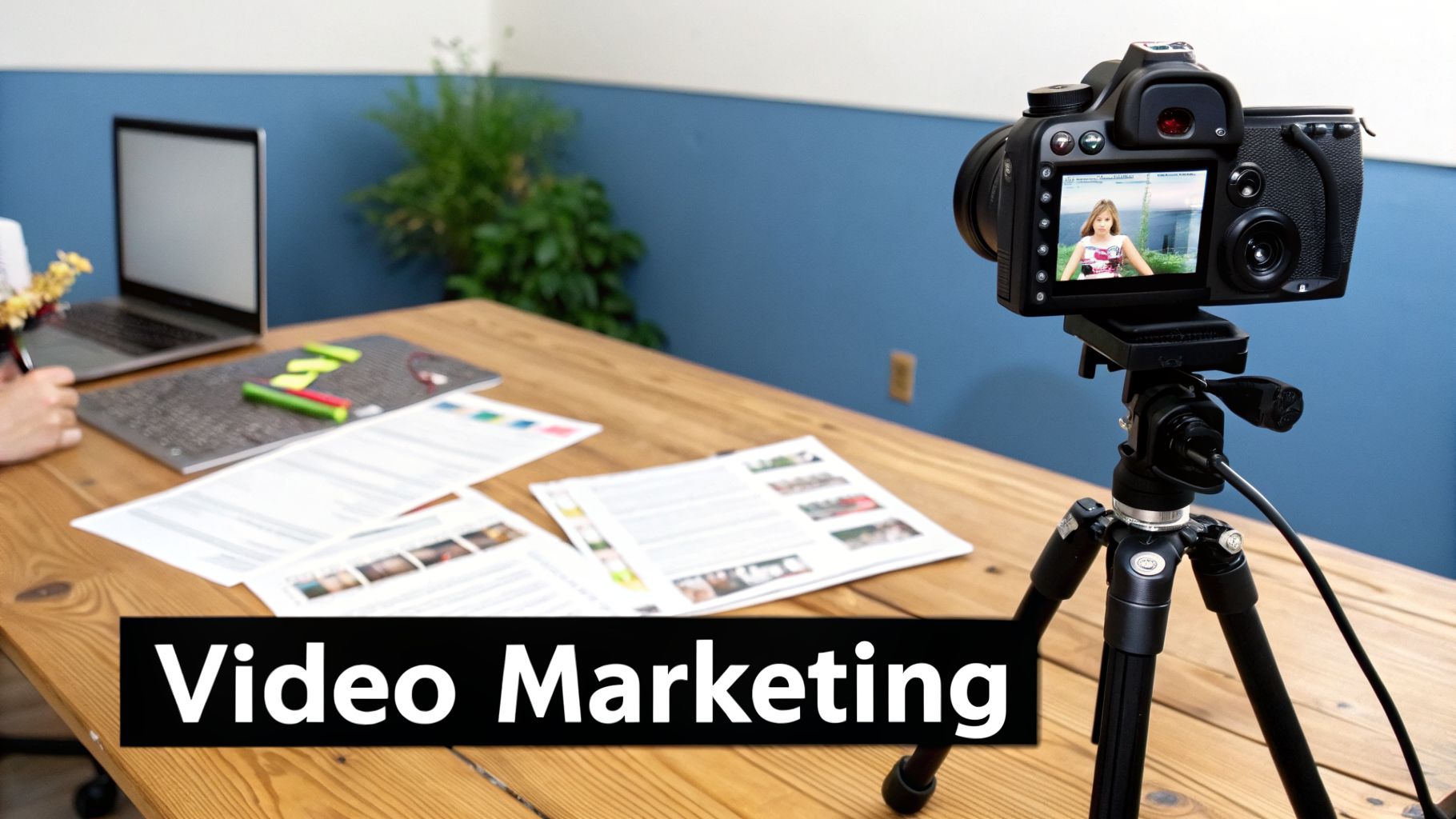
Video marketing involves creating and sharing video content to promote your brand, services, or products. It’s no longer a novelty; it's a core component of effective marketing strategies for small business, capable of engaging audiences on a deeper, more personal level than text or images alone. From quick social media stories and product demonstrations to in-depth testimonials and behind-the-scenes glimpses, video captures attention and builds a powerful connection with viewers.
For an Australian small business, this could mean a Perth-based cafe sharing a time-lapse of their barista creating latte art, a Sydney-based consultant explaining a complex topic in a simple 60-second clip, or a tradesperson in Melbourne showing a before-and-after of a recent job. Video content is versatile, highly shareable, and favoured by social media algorithms, giving it immense reach and impact.
Why It Works for Small Businesses
Video content humanises your brand and makes complex information easily digestible. It excels at storytelling, allowing you to showcase your passion, expertise, and the real people behind your business. This builds trust and authenticity far more effectively than a static advertisement. Furthermore, videos on landing pages can significantly increase conversion rates, and including video in emails has been shown to boost click-through rates. It’s a dynamic tool for building brand personality and driving customer action.
How to Implement Video Marketing
- Start with Your Smartphone: You don't need a professional film crew to begin. Modern smartphones shoot high-quality video. Invest in a simple tripod and an external microphone for clear audio, as sound quality is critical.
- Plan Your Content Pillars: Decide on a few key themes. These could be educational (how-to guides, tips), promotional (product demos, special offers), or cultural (meet the team, behind-the-scenes). Consistency helps your audience know what to expect.
- Choose the Right Platforms: Don't try to be everywhere at once. Short-form video (15-60 seconds) is perfect for Instagram Reels, TikTok, and YouTube Shorts. Longer-form content, like tutorials or customer testimonials, is better suited for your website, YouTube channel, or Facebook page.
- Optimise for Each Platform: Remember that most social media videos are watched with the sound off. Add captions to all your videos to ensure your message gets across. For YouTube, conduct basic keyword research for your video titles and descriptions to improve discoverability in search.
- Showcase, Don't Just Tell: Instead of just talking about your service, show it in action. A web designer could record a screen-capture video walking through the process of a website redesign, or a local baker could film the process of decorating a custom cake. This provides tangible value and demonstrates your expertise.
Small Business: 7 Marketing Strategies Compared
| Strategy | Implementation Complexity 🔄 | Resource Requirements ⚡ | Expected Outcomes 📊⭐ | Ideal Use Cases 💡 | Key Advantages ⭐ |
|---|---|---|---|---|---|
| SEO & Local SEO | Medium–High 🔄 (technical + ongoing) | Moderate — content, technical fixes, possible agency support ⚡ | Sustainable organic traffic; high‑intent local leads; long-term growth 📊 ⭐⭐⭐⭐ | Local service visibility and national keyword ranking (e.g., "web design Brisbane") 💡 | Cost‑effective long term; builds credibility; 24/7 traffic ⭐ |
| Pay‑Per‑Click (PPC) Advertising | Medium 🔄 (setup + continuous optimization) | High — ad budget + campaign management; landing page work ⚡ | Immediate visibility and measurable conversions; stops when budget ends 📊 ⭐⭐⭐⭐ | Time‑sensitive promos, competitive keywords, scaling lead volume fast 💡 | Fast results; precise targeting; clear ROI tracking ⭐ |
| Content Marketing | Medium 🔄 (strategy + consistent production) | Moderate — writers, producers, editorial planning ⚡ | Authority building, supports SEO and lead nurture; durable organic gains 📊 ⭐⭐⭐⭐ | Educating prospects, long sales cycles, SEO support (cornerstone content) 💡 | Builds trust; repurposable; supports other channels ⭐ |
| Social Media Marketing | Low–Medium 🔄 (regular content & engagement) | Low–Moderate — content creation, some paid promotion ⚡ | Brand awareness and engagement; variable direct lead ROI 📊 ⭐⭐⭐ | Visual portfolios, B2B outreach (LinkedIn), local community engagement 💡 | Direct engagement; brand amplification; low‑cost organic reach ⭐ |
| Email Marketing & Lead Nurturing | Low–Medium 🔄 (list building + automation) | Low–Moderate — platform fees, copywriting, segmentation ⚡ | High conversion and ROI when list is quality; highly measurable 📊 ⭐⭐⭐⭐ | Converting leads, onboarding, retention, upsells, cart recovery 💡 | Owned channel; personalisable and scalable; strong ROI ⭐ |
| Video Marketing | Medium–High 🔄 (production + distribution) | Moderate–High — filming/editing skills or vendor costs ⚡ | High engagement and improved conversions; boosts YouTube/SEO impact 📊 ⭐⭐⭐⭐ | Demos, testimonials, tutorials, case studies, conversion lift 💡 | Strong engagement; builds trust; repurposable across platforms ⭐ |
Integrating Your Strategies for Maximum Impact
You've now explored a comprehensive list of powerful marketing strategies for small business owners in Australia, from mastering local SEO to building communities on social media and engaging customers through targeted email campaigns. It’s easy to look at this list and feel overwhelmed, wondering where to begin. The most crucial takeaway is that you don't need to do everything at once. The real power lies not in adopting every strategy, but in choosing the right ones for your business and, most importantly, making them work together.
Effective marketing is rarely about a single, siloed channel. Think of it as a well-oiled machine where each part supports the others. Your content marketing efforts, for instance, are the fuel. The high-quality blog posts you create don’t just sit on your website; they become the cornerstone of your SEO, the valuable links you share in your email newsletters, and the engaging content you post on your social media channels. Each piece of content works multiple times, across multiple platforms, maximising your return on investment.
From Individual Tactics to a Cohesive System
The true path to sustainable growth is integration. Imagine this common scenario for an Australian small business:
- A potential customer searches on Google for a local service you provide. Your Local SEO efforts ensure your Google Business Profile appears prominently, complete with positive reviews and accurate information.
- They click through to your website, which is professionally designed and optimised for conversions. Here, they read an insightful blog post (your Content Marketing) that answers their exact questions and establishes your expertise.
- While they don't purchase immediately, they see a prompt to sign up for your newsletter to receive a helpful guide. This captures their details for your Email Marketing list.
- Later, they see one of your targeted PPC ads on a different website, reminding them of your brand. They also notice your active and helpful presence on social media, reinforcing your credibility.
- A week later, they receive a well-timed email from you, not with a hard sell, but with more valuable tips related to their initial interest. This final touchpoint converts them into a paying customer.
In this journey, every single one of our discussed marketing strategies played a part. SEO provided the initial discovery, content built trust, email marketing nurtured the lead, and PPC and social media created reinforcing brand touchpoints. No single strategy closed the deal on its own; it was their combined, synergistic effect that guided the customer from awareness to conversion.
Your Actionable Path Forward
The key is to start small, measure everything, and then scale what proves effective for your unique business and audience. Don't chase every shiny new trend. Instead, focus on building a solid foundation. Choose one or two of the strategies detailed in this article that best align with your current resources and goals. Dedicate your efforts to implementing them correctly, tracking your key performance indicators (KPIs), and understanding the results.
Is your primary goal immediate lead generation? Perhaps a combination of Local SEO and a targeted Google Ads campaign is the best place to start. Are you looking to build a long-term brand and a loyal customer base? Then a concerted effort in content and email marketing might be your ideal first step. The beauty of these marketing strategies for small business is their flexibility. As you master one area and see positive returns, you can reinvest that success into exploring another, gradually building a comprehensive and resilient marketing ecosystem.
The ultimate goal is to create a system that consistently attracts, engages, and converts customers, turning your marketing from an expense into your most powerful engine for growth.
At the heart of every successful digital marketing strategy is a professional, high-performing website that acts as your central hub. If you're ready to build that solid foundation, the team at Website Builder Australia specialises in creating custom websites that are not only beautiful but are also optimised for SEO, lead generation, and e-commerce success. Let us help you build the digital centrepiece your business deserves.


