

Finding the Best Domain Registrar Australia for Your Business
When it comes to picking the best domain registrar in Australia, you're often weighing up the benefits of local support against sharp international pricing. It's a classic balancing act. Providers like VentraIP are a go-to for many Aussies wanting dedicated local service, while the big global players like GoDaddy and Namecheap often catch the eye with their low prices. Ultimately, the right choice really hinges on what your business needs most—whether that’s rock-solid security, an easy-to-use dashboard, or a simple all-in-one hosting package.
What Makes a Great Australian Domain Registrar
Choosing a domain registrar is one of the first, most crucial steps you'll take to get online. But it’s so much more than a quick purchase. Before you can really pick the best fit, it helps to understand what domain name registration truly entails. You're not just buying a web address; you're securing a critical piece of your digital identity. For any Australian business, this means looking past the flashy introductory deals to find a genuine partner who gets the local landscape.
The best registrars offer a solid mix of reliable tech, transparent pricing, and support you can actually reach. Think of them as the gatekeeper to your online presence, managing that all-important link between your domain name and your website's server.
Key Factors for Australian Businesses
A few non-negotiables separate the average registrars from the great ones here in Australia. Top of the list is accreditation with the .au Domain Administration (auDA), the official authority for all .au domains. This is your guarantee that the registrar plays by Australian rules for domain management and knows how to handle things if a dispute pops up.
Here’s a quick rundown of what you should be looking for:
- auDA Accreditation: This is a must-have. It ensures the registrar is compliant with local rules for .com.au and .net.au domains, like verifying you have an ABN.
- Local Support: Nothing is more frustrating than a technical issue at 2 PM AEST and being stuck with support on the other side of the world. Time-zone-friendly help is a lifesaver.
- Transparent Pricing: We’ve all seen it – a cheap first-year price that skyrockets on renewal. A good registrar is upfront about costs, so you aren't shocked when the bill comes.
- Integrated Services: Juggling different providers for domains, hosting, and email can be a headache. Bundling them simplifies everything to one dashboard and one support contact.
There’s no denying the demand for local domains. By the end of 2023, Australia's .au namespace hit a record 4,294,913 registered domains, a climb of 1.5% year-on-year. It’s a clear signal that Aussie businesses are serious about cementing their local online identity.

If you want to get into the nitty-gritty, the auDA website is the official source for all policies covering .au domains. Getting familiar with these guidelines helps you understand your rights and responsibilities as a domain owner down under.
The Core Criteria for Evaluating Australian Domain Registrars

Before we jump into a head-to-head comparison, we need to set the ground rules. Choosing the best domain registrar in Australia isn’t just about nabbing the cheapest deal you can find; it’s about finding a reliable, long-term partner to look after a critical business asset. The best providers strike a fine balance between cost, solid features, local know-how, and straight-up honest practices.
We’ve broken our evaluation down into a few key pillars. These criteria are all about the real-world needs of Aussie businesses, whether you’re a sole trader in Perth or a booming e-commerce store in Melbourne.
Pricing Transparency and True Value
That initial registration fee is often just a marketing hook. A domain that costs $5 for the first year might renew at $35 the next, wiping out any savings you thought you made. Real value comes from figuring out the total cost of ownership over a few years.
This means you’ve got to look past the sticker price and scrutinise the renewal rates. Also, keep an eye out for sneaky hidden costs for things that should be standard, like domain transfers or basic privacy. A registrar worth your time is upfront about all this from day one.
DNS Management and Performance
Think of your Domain Name System (DNS) as the engine that connects your domain name to your website. If your DNS is slow or unreliable, your website will be too, and that hits your user experience and sales directly. A top-tier registrar will offer a high-performance, globally spread DNS network to make sure your site loads quickly for visitors and stays online.
Key Takeaway: DNS performance is absolutely non-negotiable. Even a few minutes of downtime can cost a business serious revenue and hurt its reputation. Always lean towards registrars that guarantee high uptime and give you an easy-to-use interface for managing your DNS records.
On top of that, look for features that make DNS management a breeze. Even if you’re not a tech whiz, having clear controls and rock-solid performance is crucial. It’s one of the most important website builder features to think about when you're bundling services together.
Local Support and auDA Expertise
When things go sideways, you need to talk to someone who gets the local scene. An Australian-based support team working on AEST can give you help when you actually need it. They’re also experts at navigating the rules set by auDA, the official regulator for all .au domains.
This local knowledge is gold when you're dealing with issues like:
- ABN/ACN eligibility for registering a .com.au domain.
- Domain transfer processes that are specific to the Australian market.
- Dispute resolution under local Aussie policies.
An international provider might have 24/7 support, but if they don’t understand auDA regulations, their help can only go so far.
Security and Privacy Protections
Your domain is a valuable asset, and it’s a target for threats like hijacking and phishing. A good registrar gives you the tools you need to protect it.
Start with WHOIS privacy, which hides your personal contact details from the public, cutting down on spam and unwanted calls. Another critical feature is DNSSEC (Domain Name System Security Extensions), which adds a layer of authentication to stop DNS spoofing and ensures visitors land on your actual site. And finally, always turn on two-factor authentication (2FA) for your account to block unauthorised access. These are the absolute basics for modern domain security.
A Detailed Comparison of Top Domain Registrars
Alright, let's move past the cookie-cutter lists and properly dig into the best domain registrars for Aussies. We're going to compare the big players—VentraIP, Crazy Domains, GoDaddy Australia, and Namecheap—against the criteria that actually matter for a local business.
We'll look at everything from the real cost over a few years to how helpful their support is when you're stuck. The idea is to give you a clear, honest picture of who fits your business best, without the marketing fluff.
Pricing Structure and True Cost
That super-cheap first-year price is almost always a trap. The real cost of a domain is what you pay over several years, once you factor in renewals and all the "essential" extras they try to tack on.
VentraIP is refreshing because their pricing is straightforward. Yes, their initial fee for a .com.au domain might look a little higher than others at first glance, but they include things like WHOIS privacy and DNS hosting for free. Their renewal rates are fair and predictable, which means you won't get a nasty bill shock a year down the track. It makes budgeting simple.
Crazy Domains is famous for its aggressive introductory deals, sometimes offering domains for just a couple of bucks. But be warned: the renewal fees can jump significantly. On top of that, basics like privacy protection are usually paid add-ons. Over five years, that "cheap" domain can easily end up costing more than one from an all-inclusive provider.
GoDaddy Australia plays a similar game to Crazy Domains, luring you in with low first-year prices. Their renewals are also much higher than the initial fee. They run a lot of promotions, but you absolutely have to read the fine print to understand what you’re signing up for long-term.
Then there's Namecheap. True to its name, it consistently has some of the lowest registration and renewal prices around, even for .com.au domains. They also throw in free lifetime WHOIS privacy, which is a huge value-add. For a business owner on a tight budget who doesn’t mind dealing with international support, Namecheap is a very strong contender on price alone.
Customer Support and Local Expertise
When something goes wrong, the quality of support you get is everything. This is where having a local team on your side really pays off.
VentraIP is the clear winner here. You get Australian-based phone and ticket support from a team that operates on local time. They know auDA regulations like the back of their hand and can give you proper advice for the Aussie market. This is a godsend when you're dealing with eligibility rules or a tricky domain transfer.
Crazy Domains also has Australian phone support, which is a big plus. The catch is that their support can sometimes feel a bit like a sales call, with upselling being a common theme. They can get the job done, but the experience can be a bit hit-or-miss.
Expert Insight: Never underestimate the value of localised support. When your website is down or you're facing a complex domain transfer, speaking to an expert in your own time zone who understands local regulations like auDA's ABN requirement is a massive advantage.
GoDaddy Australia offers 24/7 global support with a local phone number. Their team is generally good with common problems, but if you have a complex, Australia-specific issue, you might not get an auDA expert on your first call.
Namecheap runs on a 24/7 live chat and ticket system. Their support is quick and technically solid for general domain issues, but it lacks that specialised Aussie knowledge. If you prefer picking up the phone or need help with local compliance, this could be a deal-breaker.
Domain Management and User Experience
A clean, easy-to-use dashboard can save you a world of pain. Being able to quickly update DNS records, set up an email forward, or start a transfer shouldn't require a university degree.
VentraIP uses a modern, clean interface called VIPControl. It’s simple enough for beginners but still has all the advanced tools that tech-savvy users need. Everything is laid out logically, so you can find what you're looking for without clicking through endless menus.
The dashboard at Crazy Domains is functional, but it feels a bit dated and cluttered. It can be confusing for new users, and the constant upsells and promotional banners are distracting when you’re just trying to get a task done.
GoDaddy’s dashboard is packed with features, which can be overwhelming if you're new to it all. Because they sell so many different products, the interface is busy, and finding the one setting you need can sometimes feel like a treasure hunt.
Namecheap offers a simple, no-frills dashboard that’s a breeze to navigate. It’s focused purely on managing your domains and DNS without all the hosting upsells, making it a great choice if you just want to get in, get the job done, and get out.
Feature and Performance Comparison of Australian Domain Registrars
To make things even clearer, we’ve put together a side-by-side breakdown of our top contenders. This table focuses on the features that are most critical for Australian businesses.
| Feature | VentraIP | Crazy Domains | GoDaddy Australia | Namecheap |
|---|---|---|---|---|
| Primary Audience | Australian SMBs & Professionals | Budget-conscious beginners | Global audience with local presence | Tech-savvy, price-focused users |
| .com.au Pricing Model | All-inclusive, transparent renewals | Low intro, high renewals, many add-ons | Low intro, high renewals, some add-ons | Consistently low intro & renewal |
| Local Support | Excellent (AU phone & ticket) | Good (AU phone support) | Good (24/7 global with AU number) | Limited (24/7 chat & ticket only) |
| WHOIS Privacy | Included Free | Paid Add-on | Paid Add-on (varies by TLD) | Included Free (Lifetime) |
| User Interface | Modern, clean & user-friendly | Functional but cluttered | Feature-rich but can be overwhelming | Simple, clean & straightforward |
| auDA Accreditation | Yes | Yes | Yes | Yes |
| Best For | Reliability & premium local support | Lowest initial cost | Brand recognition & broad services | Best overall long-term value |
This table highlights a crucial point: the .com.au extension is king in the Australian market. It commands between 64% and 74% of all registrations, making it the default choice for any SMB trying to build a credible local brand. This dominance, along with .net.au at 6.53%, shows why picking a registrar with deep expertise in local extensions is so important. You can discover more about these Australian domain trends to get a better feel for the market.
Ultimately, the right choice for you comes down to what you value most. If you want top-tier local support and a seamless, all-in-one experience, VentraIP is an excellent pick. If your main goal is to lock in the lowest possible price over the long run and you're happy to manage things yourself, Namecheap delivers unbeatable value. Crazy Domains and GoDaddy fall somewhere in the middle, offering a mix of local presence and eye-catching intro prices, but you’ll need to watch those renewal costs and add-on fees like a hawk.
Navigating the Hidden Costs and Risks
Falling for the cheapest introductory price when choosing a domain registrar is an all-too-common mistake. It’s an easy trap to fall into, but one that can lead to some serious long-term costs and operational headaches down the line. That eye-catching $2 first-year deal often just masks the true cost of owning and managing your domain.
The real sting comes at renewal time. You’ll often find that a registrar will double, triple, or even quadruple the fee after that first year, wiping out any initial savings. All of a sudden, your "budget" domain becomes a surprisingly chunky recurring expense you didn't plan for.
On top of that, many of these budget registrars nickel-and-dime you for services that really should be standard. Essential features like WHOIS privacy, which stops your personal contact info from being publicly listed, are frequently sold as pricey add-ons. Without it, you’re basically opening your inbox and phone to a flood of spam.
The Real-World Consequences of a Bad Choice
The risks go well beyond surprise fees. Choosing poorly can have a very real, negative impact on your business operations, costing you both time and money.
Picture this: you're running an e-commerce store in the middle of a massive sale. A DNS outage, even for just an hour, could mean thousands of dollars in lost revenue and a serious dent in customer trust. A reliable registrar invests in a robust, high-performance DNS network to minimise this risk. A cheaper provider might cut corners, leaving your site vulnerable to downtime.
The Australian managed Domain Name System (DNS) market, which is the backbone for registrars, pulled in USD 349.7 million in revenue in 2024 and is forecast to hit USD 1,029.7 million by 2030. This massive growth shows just how vital quality DNS management is for any online business. You can discover more about the DNS market's rapid expansion and why it matters so much.
Security Vulnerabilities and Restrictive Policies
Poor security is another massive red flag. Features like DNSSEC (Domain Name System Security Extensions) and two-factor authentication (2FA) are non-negotiable for protecting your domain from being hijacked. If a hijacker gets control, they could redirect your website traffic to a malicious site, costing you customers and wrecking your reputation.
Crucial Takeaway: Your domain isn't just a name; it's a critical business asset. Choosing a registrar with weak security or rubbish support is like leaving the front door of your shop unlocked. The initial savings are never worth the potential chaos.
Finally, some registrars have incredibly restrictive transfer policies that can effectively hold your business hostage. They make the process of moving your domain so complicated and frustrating that they hope you’ll just give up and stay put. This lack of freedom becomes a huge problem if you're unhappy with their service and want to move to a better provider.
This decision tree can help you quickly figure out which path to take based on what matters most to you.
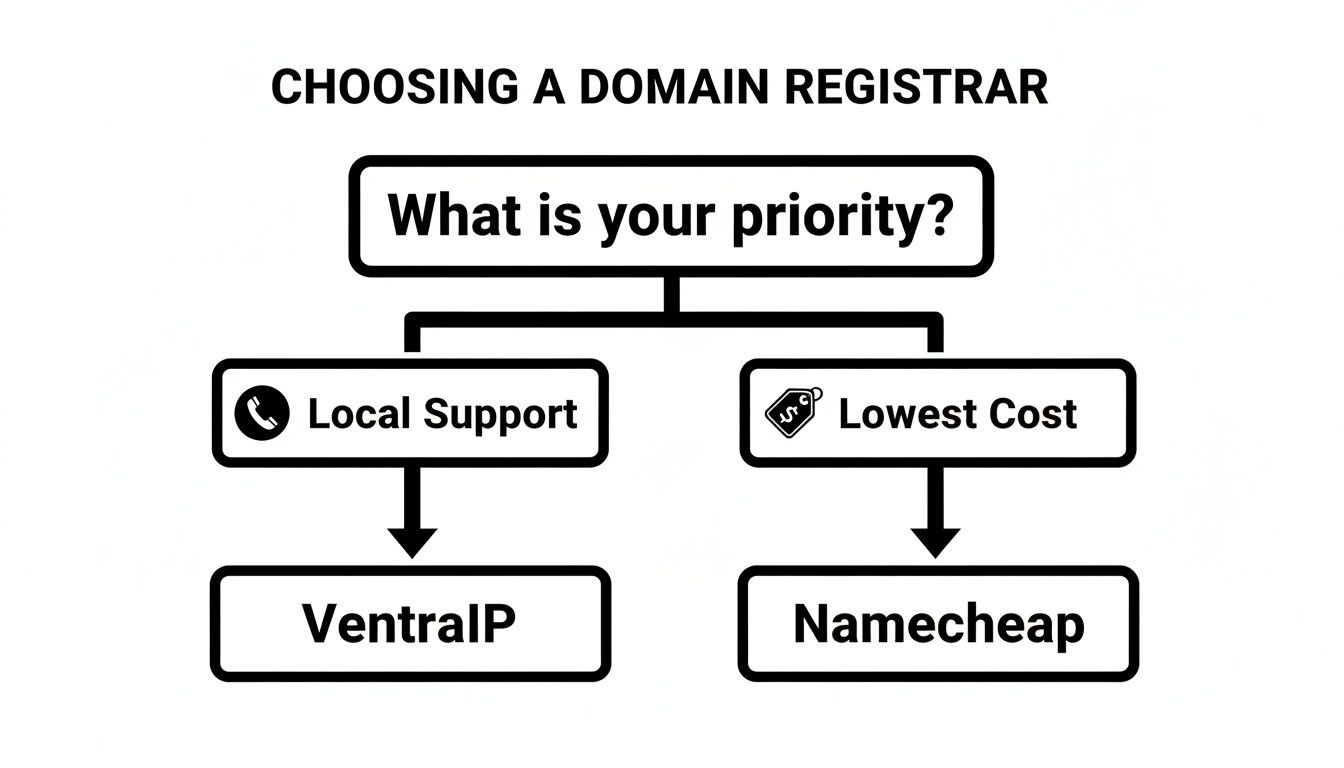
As the flowchart shows, if you value dedicated, knowledgeable local support above all else, a provider like VentraIP is the logical choice. But if getting the lowest possible long-term cost is your main goal, Namecheap is the better option. This just reinforces the idea that the best domain registrar Australia has to offer is simply the one that aligns with your specific business priorities—whether that's premium service or maximum savings. Investing in a reliable, transparent provider from day one is the smartest move for long-term stability and peace of mind.
The Advantage of an Integrated Digital Presence

For most business owners, sorting out the best domain registrar Australia has to offer is just one job on a very long to-do list. Your domain name is crucial, but it’s just the start. You still need hosting for your website to live on, the website itself, and professional email addresses to look the part. Trying to juggle different suppliers for each of these can quickly become a headache.
This scattered approach often ends in disaster. You run into compatibility problems, support teams from different companies start blaming each other when things go wrong, and you’re left with potential security holes. Troubleshooting turns into a nightmare when your domain company, hosting provider, and web developer are all separate entities, and none of them can see the full picture of your setup.
The Power of a Unified Platform
This is where having an all-in-one solution really shines. When you bundle your domain registration with high-quality hosting and expert web development under one roof, you simplify your entire online operation. It just makes sense.
A unified platform means every piece of the puzzle is designed to work together perfectly. You get one dashboard to manage everything, one bill to pay, and—most importantly—one local team to call for support.
Key Insight: Having a single, trusted partner manage your entire online presence gets rid of all the complexity. Instead of wasting hours trying to get multiple vendors on the same page, you can make one phone call to a local Aussie team that understands everything about your setup, from your domain settings right down to your website’s code.
This kind of cohesion saves a massive amount of time and stress. It lets you get back to what you do best—running your business—knowing that your online infrastructure is optimised and managed by a single, accountable team.
From Registration to Ranking
An integrated approach offers benefits that go well beyond simple management. When your web developer is also in charge of your hosting and domain, they can make sure everything is perfectly optimised for speed and security from day one. This solid technical foundation is absolutely vital for search engine optimisation (SEO).
Building a strong online presence is about more than just owning a domain name. After you’ve picked a registrar, understanding Domain Authority and other key SEO metrics is the next critical step. A unified provider can build a website with these factors baked in, giving you a serious head start.
For instance, our experience with ecommerce website design in Australia means we build online stores where the domain, hosting, and platform all work in harmony to maximise speed and sales. That's a holistic strategy you just can't get when your digital assets are spread across different providers.
Answering Your Questions About Australian Domain Registration
Getting a domain name sorted can bring up a lot of questions, especially with Australia’s unique rules. We get it. Below are some clear answers to the most common queries we hear from Aussie business owners, helping you cut through the technical talk.
We’ve pulled together the key questions that pop up once you start digging in, giving you the quick insights you need to get moving.
Do I Need an ABN for a .com.au Domain?
Yes, you absolutely do. This is a hard-and-fast rule set by auDA, the authority for all Australian domains. To register a .com.au or .net.au name, you must have a current Australian Business Number (ABN) or Australian Company Number (ACN).
This rule is there for a good reason: it keeps these domain extensions as a trusted sign of a legitimate Aussie business. On top of that, the domain name you pick has to be closely linked to your business name or what you do. For instance, a café called "Melbourne Coffee Roasters" could easily register melbournecoffeeroasters.com.au.
How Long Does Domain Registration Take?
The registration itself is lightning-fast, often sorted in just a few minutes. Once your details and payment are in, the domain is usually locked in for you almost instantly.
But there’s a second step called DNS propagation. This is where the internet’s servers all around the world get updated to know your new domain exists. This part can take anywhere from 24 to 48 hours, so don't stress if your new web address doesn't work everywhere straight away.
What Is the Difference Between .au and .com.au?
This is a really common point of confusion, particularly since the direct .au domain is still quite new. The main difference comes down to who can get one and what it's for.
- .com.au: This is the classic, most trusted extension for Australian businesses. It requires an ABN/ACN and tells everyone you’re a registered commercial operation.
- .au: This is a shorter, more general-purpose option. It’s available to any Australian resident or organisation with a proven local connection—not just businesses.
Our Advice: For almost any business,
.com.auis still the gold standard for building trust with local customers. That said, grabbing the matching.auversion at the same time is a smart, defensive play to protect your brand from anyone else trying to register it.
Can I Transfer My Domain to a New Registrar?
Of course. You have every right to move your domain to any registrar you choose. If a provider makes this difficult, that’s a big red flag. A smooth, easy transfer is the sign of a registrar that actually cares about its customers.
The process is pretty standard and follows a few key steps:
- Unlock Your Domain: First, log in to your current registrar's dashboard and turn off the "registrar lock."
- Get Your Auth Code: You'll need to request a transfer authorisation code, sometimes called an EPP code.
- Start the Transfer: Give this code to your new registrar, and they'll kick off the process.
This system ensures only the real owner can move a domain, protecting it from being hijacked. Thinking about the long game, especially for an online store, is crucial. If you're just starting, our guide on how to open an ecommerce business can help you plan these foundational steps. A good registrar will walk you through the transfer without any drama, making sure your digital asset is safe the entire time.
Choosing the right domain is just the first step. At Website Builder Australia, we provide an all-in-one solution that combines reliable domain registration with high-performance hosting and expert web design, all supported by a local Aussie team. Let us handle the technical details so you can focus on growing your business. Visit us today to build your complete online presence.


